
Explain Rhinitis for my medicine viva
Reading File
Now let me search the medical library for Rhinitis content in parallel:
Finding Sources
Finding Sources
Excellent sources found. Now let me read the most comprehensive sections in parallel:
Reading File
Reading File
Reading File
Great content gathered. Let me read more from Cummings Otolaryngology (comprehensive ENT source) for the full picture:
Reading File
Reading File
Let me now read the diagnosis and management sections:
Reading File
Reading File
Let me get the manifestations/clinical features and treatment sections:
Reading File
Reading File
Let me now fetch the pathophysiology diagram and get the immunotherapy/INCS sections:
Loading Image
Reading File
I now have excellent, comprehensive content from multiple authoritative textbooks. Let me compile the full viva answer:
Rhinitis - Medicine Viva Guide
Definition
Rhinitis is inflammation of the nasal mucosa characterized by one or more of the following: nasal congestion, rhinorrhea (anterior or posterior), sneezing, and nasal itching. It is broadly divided into allergic and non-allergic subtypes.
Classification
| Type | Key Features |
|---|---|
| Allergic Rhinitis (AR) | IgE-mediated, seasonal or perennial |
| Non-allergic (Vasomotor) | Profuse clear rhinorrhea, no allergen trigger |
| Non-allergic with Eosinophilia (NARES) | Eosinophils on nasal smear, negative allergy tests |
| Infectious | Viral (most common), bacterial, fungal |
| Drug-induced | OCP, reserpine, beta-blockers, rhinitis medicamentosa |
| Granulomatous | Sarcoidosis, Granulomatosis with Polyangiitis (Wegener's) |
| Hormonal | Pregnancy, hypothyroidism |
| Atrophic | Crusting, foul smell (ozena) |
| Mechanical/Obstructive | Septal deviation, adenoid hypertrophy, foreign body |
- Cummings Otolaryngology Head and Neck Surgery
Allergic Rhinitis (AR) - The Most Important Type
Epidemiology
AR ranks 5th among all chronic diseases in the US in terms of economic impact, with estimated annual direct costs of up to $5 billion. It accounts for ~3.5 million lost workdays per year. About 80% of patients with allergic asthma also suffer from AR, and AR is an independent risk factor for developing asthma.
Classification of AR
- Seasonal (Hay Fever): Triggered by outdoor allergens - tree pollens (spring), grass pollens (summer/early fall)
- Perennial: Year-round symptoms - triggered by indoor allergens: house dust mites, cat dander (most common animal allergen), cockroaches, indoor mold
- Dust mites peak from August to December
Pathophysiology
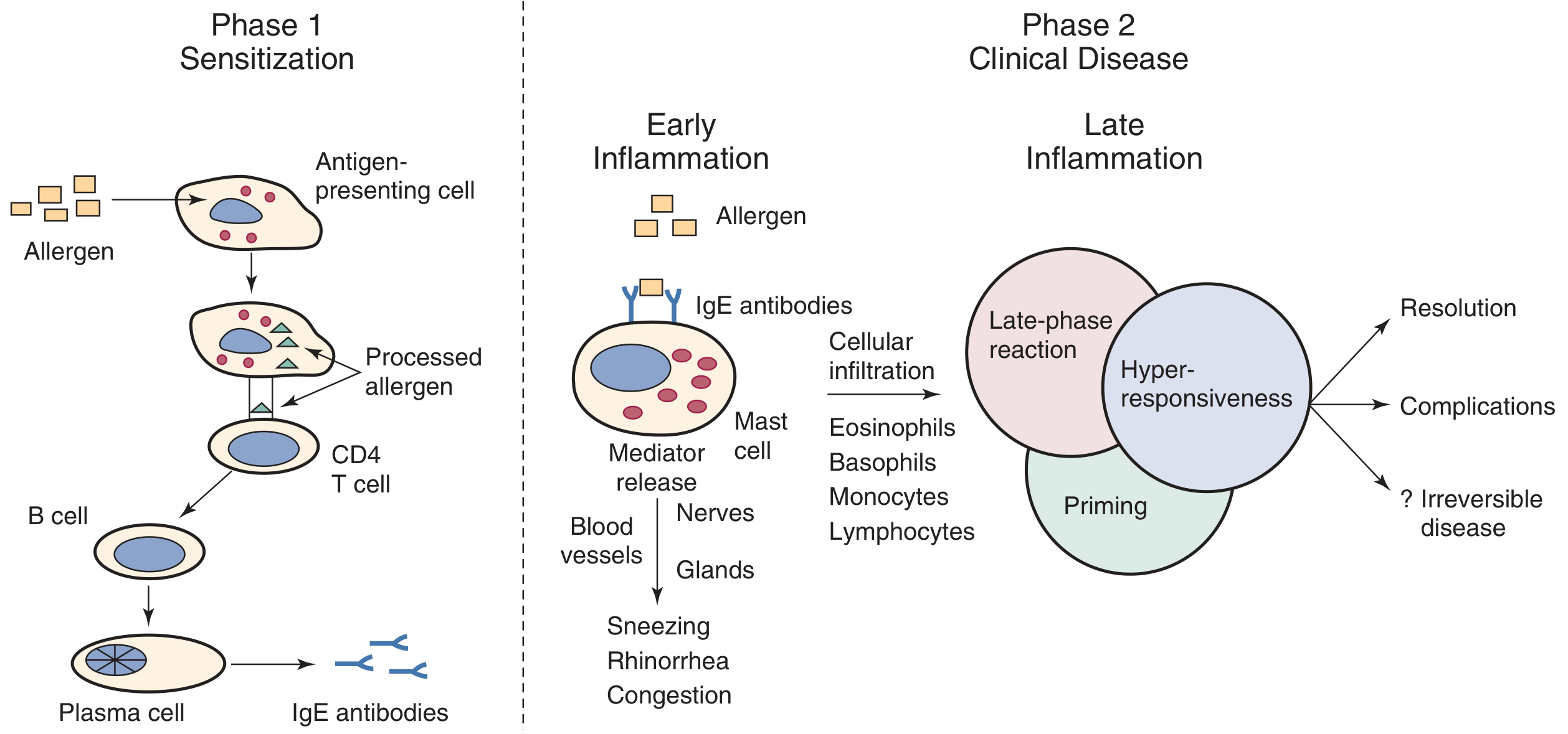
Phase 1 - Sensitization
- Allergen is deposited on nasal mucosa and taken up by antigen-presenting cells (APCs)
- Mucosal epithelial cells secrete TSLP, which matures dendritic cells into TH2-promoting subtypes
- TH2 cells drive B cells to produce allergen-specific IgE antibodies
- IgE binds to high-affinity receptors (FcεRI) on mast cells and basophils
Key cytokines:
- IL-4 and IL-13 → Enhanced IgE production
- IL-5 → Enhanced eosinophil activity and prolonged eosinophil survival
- IL-9 → Bronchial hyperreactivity
Phase 2 - Early Phase Reaction (within minutes)
On re-exposure, allergen cross-links IgE on mast cells → mast cell degranulation → release of:
- Preformed mediators: Histamine, tryptase, kinins
- Newly synthesized: Prostaglandins, leukotrienes, PAF
Results in: sneezing, watery rhinorrhea, nasal itching, congestion (within minutes)
Phase 2 - Late Phase Reaction (4-8 hours later)
Chemoattractants and adhesion molecules (ICAM-1, VCAM-1) recruit inflammatory cells:
-
Eosinophils, basophils, CD4+ lymphocytes, monocytes
-
These cells release a second wave of mediators
-
Nasal congestion dominates the late phase
-
Goldman-Cecil Medicine, p. 2355
Priming Phenomenon
A hallmark of AR - after repeated allergen exposure, the threshold dose to elicit symptoms decreases more than 5-fold by day 4 of consecutive challenges. This explains why patients worsen as the allergy season progresses even when pollen counts fall, and why they become hypersensitive to non-specific irritants (perfume, smoke, cold air).
Clinical Features
Classic Signs ("Allergic Stigmata")
| Sign | Description |
|---|---|
| Allergic salute | Upward palm thrust against nose to relieve itching; causes a supratip crease at the junction of upper/lower lateral cartilages |
| Allergic shiners | Dark circles under eyes due to venous stasis |
| Dennie-Morgan lines | Extra wrinkle folds under the lower eyelid |
| Adenoid facies | Open mouth, high arched palate, long face, retracted jaw - from chronic mouth breathing |
Symptoms
- Paroxysmal sneezing
- Watery (clear) rhinorrhea
- Nasal congestion and pruritus
- Conjunctival and pharyngeal itching
- Postnasal drip
- Loss of smell and taste
- Nasal speech quality
Complications
- Serous otitis media (1/3 to 1/2 of children with AR) - eustachian tube dysfunction
- Rhinosinusitis - edematous mucosa obstructs sinus ostia
- Nasal polyps (pearl-gray gelatinous masses - unusual in uncomplicated AR alone)
- Sleep disturbance, snoring, sleep apnea-like symptoms
- Asthma - 80% of asthmatic patients have AR
- Epistaxis in children (from nose picking due to irritation)
- Maxillomandibular alignment problems (overbite/underbite) from chronic mouth breathing
Nasal Examination Findings
- Pale, bluish, edematous inferior turbinates (NOT pathognomonic)
- Thin, clear secretions
- No appearance is pathognomonic for AR
Diagnosis
1. History
- Seasonal pattern, family history of atopy
- Late-evening or early-morning symptoms suggest dust mite allergy
- Improvement with change of environment
2. Nasal Smear (Hansel's Stain)
- Eosinophils support allergic diagnosis but are not diagnostic alone
- Elevated peripheral eosinophilia may support diagnosis (but can be absent)
3. Skin Prick Testing (SPT) - Gold Standard
- Allergen applied epicutaneously with a lancet (1 mm depth)
- Wheal ≥ 3 mm larger than negative control = positive
- Sensitivity: 80-100%, Specificity: 70-90%
- Stop antihistamines 2-7 days before testing
- Contraindications: Severe asthma, history of anaphylaxis, beta-blocker use, pregnancy
4. Serum-Specific IgE (RAST/ImmunoCAP)
- Less sensitive than SPT for inhalant allergens
- Useful when SPT is contraindicated
5. Local Allergic Rhinitis (LAR) - Important Concept
A subset of patients have typical AR symptoms but negative skin testing and serum IgE. These patients have a localized nasal IgE response without systemic atopy. Diagnosis by nasal allergen challenge. Prevalence may be 47-62% of patients with perennial symptoms who test negative systemically.
Treatment
Step 1: Environmental Control (Allergen Avoidance)
- Air conditioning with HEPA filters
- Impermeable encasings for pillows and mattresses
- Wash linens in hot water
- Remove carpets, avoid fans and cool-mist vaporizers
- Masks with microfoam filters for dust allergy
Step 2: Pharmacotherapy
| Drug Class | Examples | Key Notes |
|---|---|---|
| Intranasal Corticosteroids (INCS) | Fluticasone, mometasone, budesonide | Most effective single agent for AR; reduces all nasal symptoms |
| Oral 2nd-gen Antihistamines | Loratadine, cetirizine, fexofenadine, levocetirizine, desloratadine | Less sedating than 1st gen; good for sneezing and rhinorrhea |
| Intranasal Antihistamines | Azelastine, olopatadine | Onset within minutes; may cause bitter taste or mild somnolence |
| Leukotriene Receptor Antagonists (LTRA) | Montelukast | Useful especially in AR with concurrent asthma |
| Topical Decongestants | Oxymetazoline, xylometazoline | Max 3 days use only - prolonged use causes rhinitis medicamentosa (rebound swelling) |
| Oral Decongestants | Pseudoephedrine, phenylephrine | No rebound, but less effective; side effects: insomnia, HTN, arrhythmias |
| Intranasal Ipratropium | Ipratropium bromide spray | Targets rhinorrhea; little effect on congestion |
| Saline irrigation | - | Thins secretions, mechanically clears allergens |
Rhinitis Medicamentosa - Caused by prolonged use (>3 days) of topical decongestants; leads to rebound mucosal swelling and then chronic mucosal inflammation. Treatment = stop the topical decongestant.
Step 3: Allergen Immunotherapy (AIT) - Disease-Modifying
Two routes:
- Subcutaneous Immunotherapy (SCIT): Injections started at dilute dose, escalated weekly over months to maintenance, then monthly. Introduced since 1911. Evidence from multiple systematic reviews.
- Sublingual Immunotherapy (SLIT): Alternative route
Mechanism: Shifts immune response from TH2 to TH1/Treg dominance; IL-10 and Treg cells suppress total and allergen-specific IgE, increase IgG4 ("blocking antibody"), downregulate eosinophil function, decrease mast cell/basophil activation threshold.
Indications: Failed pharmacotherapy, desire for durable benefit, high risk for asthma or new sensitizations.
Contraindications to SCIT: Poorly controlled asthma, active autoimmune disease, malignancy, pregnancy (to initiate; maintenance can continue if pregnancy occurs during treatment).
Non-Allergic Rhinitis
Vasomotor (Idiopathic) Rhinitis
- Perennial, profuse clear rhinorrhea and congestion
- No allergen correlation, no eosinophilia
- Triggers: temperature changes, strong odors, smoke, alcohol, exercise
NARES (Non-Allergic Rhinitis with Eosinophilia Syndrome)
- Most common in adults
- Eosinophilia on nasal smear
- Negative allergy test results for specific allergens
- Responds to intranasal steroids
Drug-Induced Rhinitis
- Oral contraceptives, reserpine, hydralazine, beta-blockers (even eye drops), topical decongestants (rhinitis medicamentosa)
Key Viva Points to Remember
- Rhinitis medicamentosa = rebound congestion from topical decongestants used >3 days
- AR + asthma link: 80% of asthmatic patients have AR; AR is a risk factor for asthma - "one airway, one disease"
- Pale, edematous turbinates are characteristic but NOT pathognomonic for AR
- Nasal polyps are pearl-gray and gelatinous - unusual in uncomplicated AR alone; their presence should raise suspicion of complicating factors
- Skin prick test threshold: wheal ≥3 mm above negative control = positive
- Stop antihistamines before skin prick testing (2-7 days depending on half-life)
- Pregnancy = contraindication to initiating SCIT, but maintenance can be continued
- Local Allergic Rhinitis (LAR) = AR symptoms + negative systemic tests + positive nasal challenge
- INCS are the most effective single pharmacological class for AR
- 1% to 2% of viral URIs (common colds) progress to bacterial sinusitis
Sources: Cummings Otolaryngology Head and Neck Surgery; Goldman-Cecil Medicine; Textbook of Family Medicine 9e
This is a shared conversation. Sign in to Orris to start your own chat.