
Why posterior cricoarytenoid muscle is called safety muscle of larynx
The posterior cricoarytenoid (PCA) is the only muscle that abducts the vocal cords, keeping the airway open. Without it, both cords would fall into the midline (adducted position), causing life-threatening airway obstruction.
Searching sources...
Reading File
Finding Sources
Searching the Web
posterior cricoarytenoid muscle safety muscle larynx abductor
Now let me read the relevant textbook section for a thorough answer:
Reading File
Finding Sources
Reading File
I now have everything needed for a thorough answer. Let me also fetch the larynx anatomy diagram.
Loading Image
Here is the complete answer:
Posterior Cricoarytenoid (PCA) - The "Safety Muscle" of the Larynx
The Core Reason
The PCA is called the safety muscle because it is the only muscle in the entire body that abducts (opens) the vocal cords. Every other intrinsic laryngeal muscle either adducts (closes) or tenses/relaxes the cords. If the PCA fails bilaterally, nothing else can open the airway - the vocal cords fall into the midline and the patient asphyxiates.
As Scott-Brown's Otorhinolaryngology puts it directly:
"The posterior cricoarytenoid is the only abductor of the larynx - and is arguably, therefore, the most important muscle in the body."
- Scott-Brown's Otorhinolaryngology Head & Neck Surgery
Anatomy
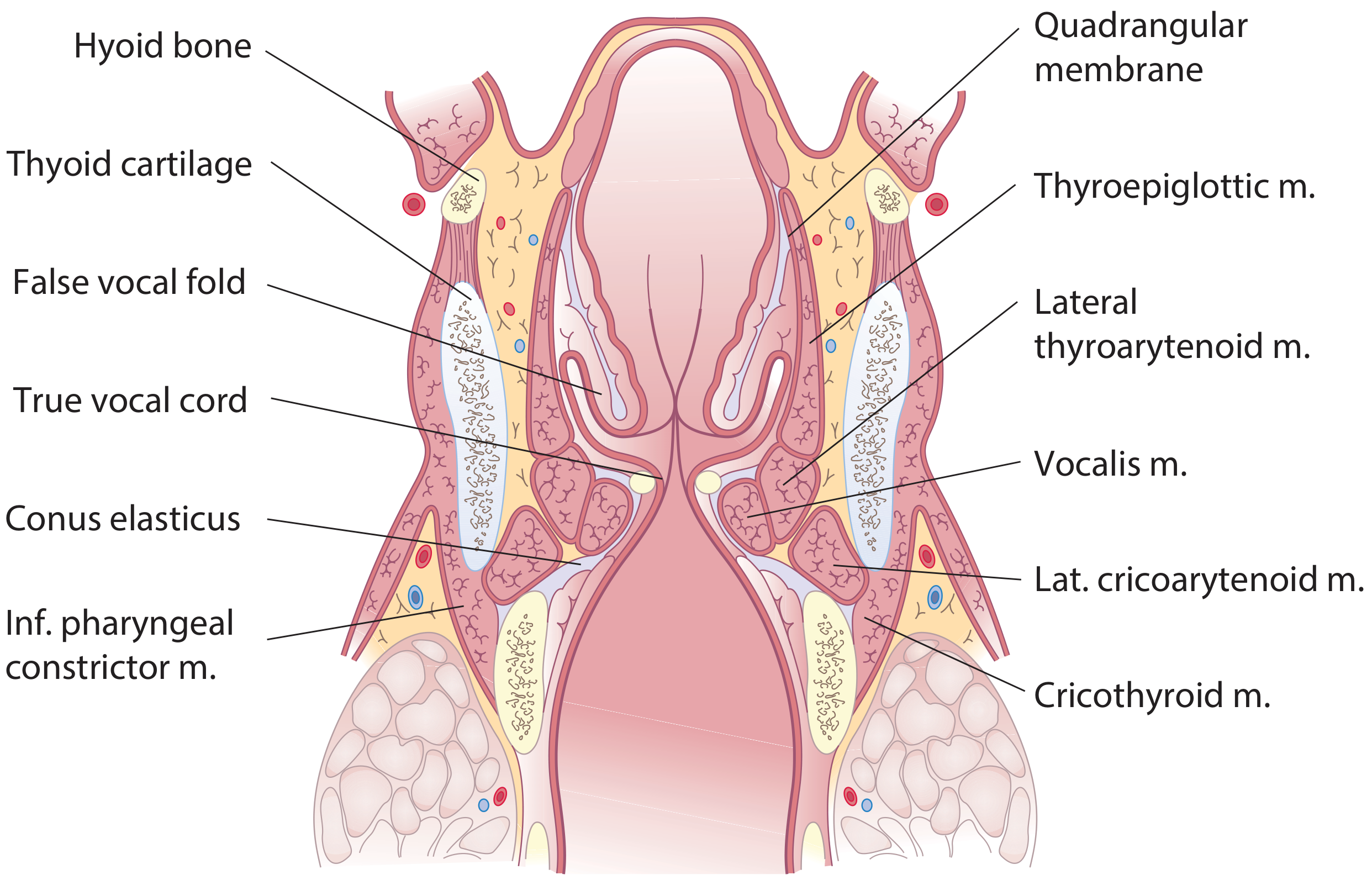
| Feature | Detail |
|---|---|
| Origin | Lower and medial surface of the posterior cricoid lamina |
| Insertion | Muscular process of the arytenoid cartilage (fans out) |
| Innervation | Recurrent laryngeal nerve (RLN) - anterior division |
| Action | Rotates arytenoids laterally → abducts vocal cords; also draws arytenoids downward, separating them further |
| Antagonist | Lateral cricoarytenoid muscle |
How It Works - Two Components
The PCA has two fiber groups, each contributing to glottic opening:
- Upper horizontal fibers - rotate the arytenoid cartilages outward, pulling the vocal processes apart (abduction of the cords)
- Lower vertical (lateral) fibers - draw the arytenoids down the sloping shoulders of the cricoid, physically separating the arytenoids from each other
Together these widen the rima glottidis into a triangular shape, maximizing the airway during inspiration.
Why "Safety" - The Clinical Consequence
The term "safety muscle" comes from what happens when it is paralyzed:
- Unilateral PCA paralysis: The ipsilateral cord lies in or near the midline (paramedian position). The contralateral cord can cross to compensate for phonation, but breathing is compromised.
- Bilateral PCA paralysis (e.g., bilateral RLN injury after thyroidectomy, neck trauma, or malignancy): Both cords fall to the midline. The glottis is virtually closed. The patient develops acute upper airway obstruction and may asphyxiate - hence requiring emergency tracheostomy or intubation.
This is the direct opposite scenario to all other laryngeal muscles: paralysis of adductors (lateral cricoarytenoid, transverse arytenoid, thyroarytenoid) leaves the cords open and causes hoarseness/aspiration - uncomfortable but not immediately life-threatening. Paralysis of the PCA, the sole abductor, closes the airway - immediately dangerous.
Summary Table: All Intrinsic Laryngeal Muscles
| Muscle | Action | Consequence if Paralyzed |
|---|---|---|
| Posterior cricoarytenoid | Abducts (opens) vocal cords | Airway obstruction - life-threatening |
| Lateral cricoarytenoid | Adducts vocal cords | Cords remain open; breathy voice |
| Transverse arytenoid | Adducts (closes posterior glottis) | Posterior glottic gap; breathy voice |
| Oblique arytenoid | Adducts aryepiglottic folds | Minimal effect on breathing |
| Thyroarytenoid (vocalis) | Tenses/shortens vocal cords | Voice change; no airway risk |
| Cricothyroid | Lengthens/tenses vocal cords | Pitch loss; no airway risk |
Key Points for Exam
- PCA is the sole abductor of the vocal cords - no other muscle can compensate.
- It is innervated by the RLN (recurrent laryngeal nerve) - any RLN injury (thyroid surgery, mediastinal pathology) can paralyze it.
- Bilateral paralysis = bilateral cord adduction = airway emergency (tracheostomy may be needed).
- The muscle is active primarily during inspiration, contracting just before the diaphragm to pre-open the glottis for airflow.
- "Safety muscle" = if it functions, it keeps the airway safe; if it fails, safety is lost.
This is a shared conversation. Sign in to Orris to start your own chat.