
HPV vaccine
The HPV vaccine protects against Human Papillomavirus strains that cause cervical cancer, other anogenital cancers, and genital warts. There are three main vaccines (Gardasil, Gardasil 9, Cervarix), with Gardasil 9 being the current standard covering 9 HPV types. It is recommended for preteens (ages 9-12) but can be given up to age 26 routinely, and in some cases up to age 45 after shared decision-making.
Searching sources...
Reading File
Searching the Web
HPV vaccine 2025 2026 recommendations guidelines update
Searching PubMed
"HPV vaccine"[MeSH Terms] AND "efficacy"[MeSH Terms]
Finding Sources
Searching Images
HPV vaccine types cervical cancer prevention diagram
Finding Sources
Finding Sources
Reading Article
PMID: 41276263
Reading File
Finding Sources
Finding Sources
Reading File
Reading File
Loading Image
Reading File
I now have comprehensive information from textbooks and the latest 2025-2026 guideline updates to provide a thorough answer.
HPV Vaccine - Comprehensive Overview
What is HPV and Why Vaccinate?
Human Papillomavirus (HPV) is the most common sexually transmitted infection worldwide. Persistent infection with high-risk HPV types is the key factor in cervical cancer development - the fourth most common cause of cancer-related death among females globally. HPV also causes cancers of the vulva, vagina, penis, anus, oropharynx, and genital warts.
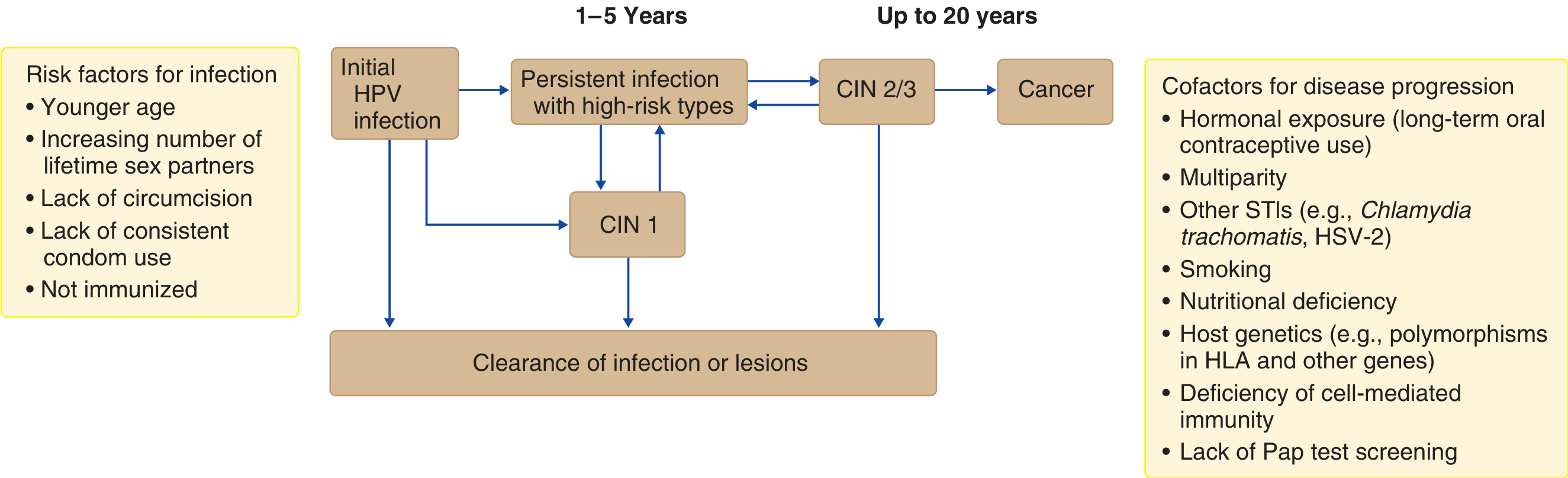
The disease pathway from initial infection to cancer can take up to 20 years, passing through cervical intraepithelial neoplasia (CIN) grades 1, 2, and 3 before invasive cancer develops - which is exactly why early vaccination before sexual debut is so important:
How the Vaccines Work
All HPV vaccines use virus-like particles (VLPs) made from the HPV L1 major capsid protein. The L1 protein self-assembles into VLPs when expressed in yeast or insect cells. These VLPs:
-
Carry the same surface epitopes as actual HPV virions
-
Contain no genetic material - cannot transmit infection
-
Stimulate production of conformational neutralizing antibodies against HPV capsid epitopes
-
Harrison's Principles of Internal Medicine 22E, p. 1571
The Three Approved Vaccines
| Vaccine | Brand | Types Covered | Key Uses |
|---|---|---|---|
| Bivalent | Cervarix (GSK) | HPV 16, 18 | Cervical cancer, CIN 2+, AIS |
| Quadrivalent | Gardasil (Merck) | HPV 6, 11, 16, 18 | Cervical cancer + genital warts + anal cancer |
| Nonavalent | Gardasil 9 (Merck) | HPV 6, 11, 16, 18, 31, 33, 45, 52, 58 | All of above + broader cancer coverage |
Gardasil 9 is now the only HPV vaccine available in the United States.
Why Gardasil 9 is the Standard
-
HPV 16 and 18 alone cause up to 80% of all cervical cancers worldwide
-
The five additional types in Gardasil 9 (31, 33, 45, 52, 58) are the next most commonly detected in invasive cervical cancers
-
Mathematical models estimate Gardasil 9 could protect against at least 90% of all HPV-associated squamous cell cancers globally
-
Goldman-Cecil Medicine, Harrison's 22E
Who Should Be Vaccinated
Routine vaccination: Ages 9-12 years (ideally before any sexual exposure)
Catch-up vaccination: Up to age 26 years for all who were not adequately vaccinated
Shared clinical decision-making: Ages 27-45 (some benefit, but most adults have already been exposed)
Not recommended: Under age 9, over age 45
Special note: Even individuals with existing genital warts, abnormal Pap tests, or positive HPV tests are unlikely to be infected with all vaccine types and should still be vaccinated per standard recommendations.
- Goldman-Cecil Medicine
Dosing Schedule
| Age at Series Start | Doses |
|---|---|
| 9-14 years | 2 doses at months 0 and 6 |
| 15+ years | 3 doses at months 0, 2, and 6 |
| Immunocompromised (any age) | 3 doses regardless |
Interruptions: If the schedule is interrupted, the series does not need to be restarted - complete it as soon as possible.
2026 U.S. Schedule Update - Single Dose
As of January 2026, the CDC updated the U.S. child and adolescent immunization schedule to recommend one dose of HPV vaccine (down from two) for standard-risk children, following evidence from the ESCUDDO trial (published December 2025 in NEJM) showing non-inferiority of one dose vs. two. This aligns the U.S. with several other nations that already adopted a single-dose strategy. However, the updated schedule did not specify age-based guidance clearly, and insurance coverage for additional doses remains in flux.
Efficacy Data
From the 2025 Cochrane Network Meta-Analysis (PMID: 41276263) - 60 trials, 157,414 participants:
- In 15-25 year-old females, vaccination reduced CIN 2+ from any HPV type by 30% (RR 0.70, 95% CI 0.56-0.88) and by 60% for vaccine-matched types (RR 0.40, 95% CI 0.30-0.54) - moderate certainty
- In females over 25, little to no difference vs. control for Cervarix and Gardasil
- For HPV type-specific disease in pre-exposed individuals, efficacy is lower - the greatest benefit is in those vaccinated before exposure
From Harrison's 22E:
- Bivalent vaccine: 94.9% efficacy against CIN 2+ caused by HPV 16/18 in HPV-naive women
- Quadrivalent vaccine: High safety confirmed in trials of ~22,000 women; no evidence of waning protection at 10-year follow-up
- Protection from a 3-dose series has been confirmed for at least 14 years
Safety Profile
HPV vaccines have an excellent safety record:
- Common: Injection-site reactions (pain, redness, swelling); systemic effects (fatigue, headache, myalgia) - mild to moderate
- Notable: Slightly higher rates of syncope and venous thrombotic events vs. other vaccines (post-Gardasil VAERS data)
- Serious adverse events: Occur at the same rate as in placebo/control groups
- No evidence of increased new-onset chronic disease
Contraindications:
- Severe allergic reaction (anaphylaxis) to a prior dose or vaccine component
- Hypersensitivity to yeast
- Pregnancy (not recommended due to lack of data; safe in lactating women)
Important Limitations
- No therapeutic benefit for existing infections or lesions (purely prophylactic)
- May lower disease recurrence rates after successful treatment
- Does not replace cervical cancer screening - vaccinated women still need Pap/HPV testing per guidelines
- Condoms reduce (but do not eliminate) HPV transmission and are not a substitute for vaccination
Recent Evidence Updates
| Study | Key Finding |
|---|---|
| Cochrane 2025 (PMID: 41276263) | Confirmed high efficacy in 15-25 year-olds; less benefit after age 25 |
| ESCUDDO Trial, NEJM Dec 2025 | One dose non-inferior to two in girls 12-16 years (>20,000 participants) |
| Meta-analysis, PMID: 41607770 (2025) | Comprehensive efficacy, safety, and immunogenicity confirmed in both males and females |
| Single-dose meta-analysis, PMID: 38180991 | One-dose effectiveness confirmed across 902,368 vaccinated women |
Bottom line: The HPV vaccine (Gardasil 9) is one of the most effective cancer-prevention tools available - ideally given at ages 9-12 before sexual debut. The 2026 U.S. guideline shift to a single-dose schedule for children represents a major practical change that could improve global coverage, especially in resource-limited settings.
This is a shared conversation. Sign in to Orris to start your own chat.