
Explain hypersensitivity in simplest as non medico
Imagine your body has a security guard - your immune system. Its job is to protect you from dangerous invaders like bacteria and viruses.
Hypersensitivity is when that security guard becomes overly suspicious and aggressive - it starts attacking harmless things (like pollen, dust, certain foods, or even your own body) as if they were deadly enemies.
The 4 Types - In Simple Language
Think of 4 different "overreaction styles":
Type 1 - The Instant Panic Attack
"Oh no, BEES!" → Immediate alarm
- Happens within minutes
- The guard sees pollen/peanuts/bee sting → hits the emergency alarm instantly
- Body releases chemicals (histamine) → sneezing, itching, swelling, or in severe cases - full shutdown (anaphylaxis)
- Examples: Hay fever, peanut allergy, asthma, bee sting allergy
Type 2 - Friendly Fire
"Wait, I'm shooting my own team!"
- The guard mistakes your own body cells as the enemy and attacks them
- Happens with blood, organs, or tissues
- Examples: Blood transfusion reactions (wrong blood type), some drug allergies that destroy blood cells
Type 3 - Garbage Pile Buildup
"Too much trash left lying around"
- When the guard kills enemies, it normally cleans up the mess. Here, the cleanup fails - dead enemy clumps pile up in tissues
- Those clumps then trigger inflammation and damage
- Takes hours to days to show up
- Examples: Certain autoimmune diseases, farmer's lung (breathing in mold)
Type 4 - The Slow Burn
"I'll hold a grudge... for days"
- No alarm chemicals this time - instead, the guard sends in soldiers (T-cells) who are slow but persistent
- Takes 2-3 days to react
- Examples: Poison ivy rash, skin reactions to nickel jewelry, TB skin test reaction
Quick Summary Table
| Type | Nickname | Speed | Common Example |
|---|---|---|---|
| 1 | Instant Panic | Minutes | Peanut allergy, hay fever |
| 2 | Friendly Fire | Hours | Wrong blood transfusion |
| 3 | Garbage Pile | Hours-Days | Some autoimmune diseases |
| 4 | Slow Burn | 2-3 Days | Poison ivy, nickel rash |
The bottom line: Your immune system is supposed to protect you - but in hypersensitivity, it's doing too much of a good thing, causing damage to your own body in the process. It's not weak - it's actually overworking.
Explain as medico
Reading File
Searching sources...
Finding Sources
Finding Sources
Good results. Let me pull from the richest sources - Roitt's Immunology, Goldman-Cecil, and the Jawetz Microbiology blocks for detailed mechanistic content.
Reading File
Reading File
Reading File
Good content from Roitt's and Jawetz. Let me get the detailed mechanistic content from Roitt's on each type, plus the Tietz table.
Reading File
Reading File
Excellent material from Roitt's. I now have detailed mechanistic content for all 4 types. Let me also fetch the key hypersensitivity diagram from Roitt's for visual clarity.
Loading Image
Reading File
I now have comprehensive content. Let me compile the full medical-level explanation.
Hypersensitivity - Medical Overview (Gell & Coombs Classification)
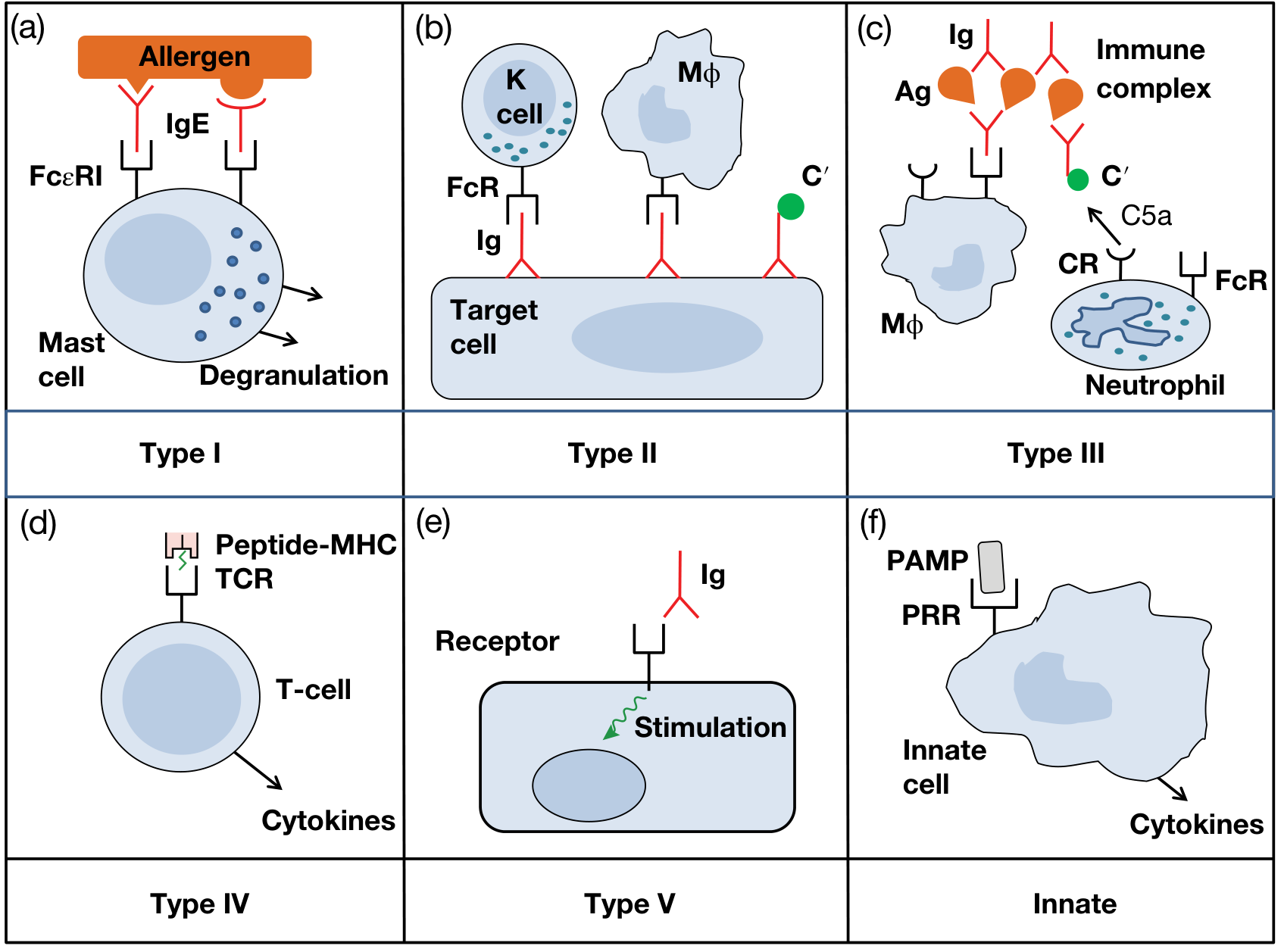
Definition
Hypersensitivity is an exaggerated or augmented immune response that is harmful to the host. It requires a presensitised state - classically manifesting on second (or subsequent) antigen exposure. The term encompasses reactivity to:
- Exogenous environmental antigens (allergens)
- Antigens from another species (xenoantigens)
- Self antigens (autoimmunity)
The underlying effector mechanisms are identical to those used in normal host defense - the pathology arises because they are too intense, misdirected, or occur at inappropriate anatomical sites.
"Hypersensitivity responses lead to tissue damage: immunopathology." - Roitt's Essential Immunology
Classification: Gell & Coombs (1963) - Types I to IV
Types I, II, III = Antibody-mediated | Type IV = T cell-mediated
Type I - Immediate (IgE-mediated) Hypersensitivity
Mechanism
Sensitisation phase:
- Allergen processed by APCs → drives Th2 polarisation → IL-4/IL-13 → class switching in B cells to produce IgE
- IgE binds via its Fc portion to high-affinity FcεRI receptors on mast cells and basophils (also low-affinity FcεRII/CD23 on B cells, eosinophils)
- Host is now sensitised - no symptoms yet
Effector/Elicitation phase (seconds-minutes):
- Second antigen exposure → allergen cross-links cell-surface IgE molecules
- FcεRI aggregation in lipid rafts → ITAM activation → Lyn, Syk, Fyn tyrosine kinase cascade
- PLCγ activation → DAG + IP3 → PKC activation + Ca²⁺ release from ER
- Mast cell degranulation - release of preformed and newly synthesised mediators
Mediators
| Category | Mediators | Effect |
|---|---|---|
| Preformed (granules) | Histamine, tryptase, heparin, chymase | Vasodilation, ↑ vascular permeability, bronchospasm |
| Newly synthesised (lipid) | PGD2, LTC4, LTD4, LTE4, TXA2 | Bronchoconstriction, vasodilation, chemotaxis |
| Cytokines | IL-4, IL-5, IL-13, TNF-α, GM-CSF, CCL11 (eotaxin) | Late-phase inflammation, eosinophil recruitment |
| Late-phase | LTB4 | Leukocyte chemotaxis |
Biphasic response:
- Early phase (0-30 min): Mast cell degranulation, histamine dominant
- Late phase (4-12 hrs): Eosinophil/neutrophil influx driven by lipid mediators and cytokines
Clinical Manifestations
- Systemic anaphylaxis (parenteral allergen exposure)
- Atopy: Hayfever (allergic rhinitis), asthma, atopic eczema, urticaria, food allergy
- Atopy has strong familial/genetic predisposition; associated with elevated serum IgE
Treatment
- Epinephrine (reverses bronchoconstriction, anaphylaxis)
- Antihistamines (H1-receptor antagonists)
- Corticosteroids (suppress late-phase)
- Omalizumab - humanised anti-IgE monoclonal Ab (targets Cε3 domain, blocks FcεRI binding)
- Desensitisation immunotherapy (shifts Th2 → Th1; induces IgG "blocking" antibodies; Treg induction)
Type II - Antibody-Dependent Cytotoxic Hypersensitivity
Mechanism
-
IgG (or IgM) antibodies directed against antigens on cell surfaces or extracellular matrix
-
Tissue damage via three effector pathways:
- Complement activation (classical pathway) → MAC-mediated cell lysis, opsonisation with C3b/C4b for phagocytosis
- ADCC (Antibody-Dependent Cellular Cytotoxicity) - K cells/NK cells bearing FcγRIII (CD16) bind IgG-coated targets and lyse them
- Opsonisation - IgG/C3b → Fc/complement receptors on macrophages/neutrophils → enhanced phagocytosis
-
In some Type II variants, antibody binding to surface receptors stimulates or blocks function without cytolysis (sometimes called "Type V" or stimulatory hypersensitivity - e.g., Graves' disease: anti-TSH receptor Ab → thyroid stimulation)
Clinical Examples
| Condition | Antibody Target |
|---|---|
| ABO transfusion reaction | RBC alloantigens (A/B blood group) |
| Rh hemolytic disease of newborn | D antigen on fetal RBCs |
| Autoimmune hemolytic anaemia | RBC surface antigens |
| Goodpasture syndrome | Type IV collagen (GBM + alveolar BM) |
| Drug-induced cytopenias (penicillin) | Drug-hapten on RBC/platelet surface |
| Myasthenia gravis* | AChR at NMJ (blocking) |
| Graves' disease* | TSH receptor (stimulatory) |
Often classified under stimulatory/Type V
Type III - Immune Complex-Mediated Hypersensitivity
Mechanism
- Soluble antigens combine with circulating antibody (IgG/IgM) → form immune complexes (ICs)
- Normally ICs are cleared by the mononuclear phagocyte system; in Type III, this clearance fails
- IC deposition in vessel walls, glomeruli, synovium, or skin
- Deposited ICs activate:
- Classical complement pathway → C3a, C5a (anaphylatoxins) → mast cell degranulation, vascular permeability
- C5a → neutrophil and monocyte chemotaxis
- Neutrophils attempt phagocytosis of ICs → frustrated phagocytosis → lysosomal enzyme release → tissue damage
- Platelet aggregation → microthrombi, ischaemia
Onset: Hours to days (Arthus reaction: local; serum sickness: systemic)
Arthus reaction - local IC deposition after intradermal Ag in presensitised host; intense neutrophilic inflammation, haemorrhagic necrosis
Serum sickness - systemic IC disease; fever, urticaria, arthralgia, glomerulonephritis; classically seen 7-10 days after heterologous serum administration
Clinical Examples
- Serum sickness, drug reactions (e.g., sulfonamides)
- Post-streptococcal glomerulonephritis
- SLE (anti-dsDNA ICs in kidneys)
- Rheumatoid arthritis (RF-IgG complexes in joints)
- Hypersensitivity pneumonitis/Farmer's lung (inhaled fungal/organic antigens)
- Cryoglobulinaemia
Type IV - Delayed-Type Hypersensitivity (DTH) / Cell-Mediated
Mechanism
- The only T cell-mediated type; no antibody involved
- Two subtypes:
TD (Delayed - CD4⁺ Th1 mediated):
- Sensitisation: APCs present peptide-MHC II to naive CD4⁺ T cells → Th1 priming
- Re-exposure → antigen-specific Th1 cells activated → release IFN-γ, TNF-β, IL-2, GM-CSF
- IFN-γ activates macrophages → oxidative burst, lysosomal enzymes, pro-inflammatory cytokines → tissue destruction
- Chronic activation → granuloma formation (collections of activated macrophages, epithelioid cells, giant cells, surrounded by lymphocytes)
- Onset: 48-72 hours (hence "delayed")
TC (Contact - CD8⁺ CTL mediated):
- Hapten-modified keratinocytes present peptide-MHC I → CD8⁺ CTL priming
- Re-exposure → CD8⁺ CTL directly kills hapten-bearing cells via perforin/granzymes
- Classic example: allergic contact dermatitis (nickel, urushiol in poison ivy)
Subtypes of Type IV (extended classification)
| Subtype | Primary Cell | Timeframe | Example |
|---|---|---|---|
| IVa | Th1 (IFN-γ, macrophage activation) | 48-72h | Tuberculin PPD reaction |
| IVb | Th2 (IL-4/IL-5, eosinophilia) | 48-72h | Some forms of eczema |
| IVc | CD8⁺ CTL (perforin/granzymes) | 48-72h | Contact dermatitis, SJS |
| IVd | Neutrophilic (IL-8/GM-CSF) | 24-48h | AGEP (pustular drug reaction) |
Clinical Examples
- Tuberculin test (Mantoux): Induration at 48-72h = Type IV (classic teaching example)
- Allergic contact dermatitis (nickel, rubber, urushiol)
- Granulomatous diseases: TB, sarcoidosis, leprosy (tuberculoid), Crohn's disease
- Graft rejection (chronic)
- Type 1 diabetes mellitus (CD8⁺ CTL destruction of β cells)
Type V - Stimulatory Hypersensitivity (Roitt's Addition)
- Antibodies bind to cell surface receptors and mimic the natural ligand → receptor stimulation or inhibition without cytolysis
- Not always listed in standard 4-type classification, but mechanistically distinct from Type II
- Examples:
- Graves' disease: TSI (thyroid-stimulating immunoglobulin) activates TSHR → hyperthyroidism
- Myasthenia gravis: anti-AChR Ab blocks receptor → flaccid paralysis
Comparative Summary Table
| Feature | Type I | Type II | Type III | Type IV |
|---|---|---|---|---|
| Mediator | IgE | IgG/IgM (cell-surface) | IgG/IgM (soluble Ag-Ab complexes) | T cells (Th1/CTL) |
| Antigen | Exogenous allergen | Cell surface / matrix | Soluble circulating Ag | Intracellular/contact |
| Effector mechanism | Mast cell degranulation | Complement, ADCC, opsonisation | IC deposition → complement, neutrophils | Cytokines, CTL, macrophage activation |
| Onset | Seconds-minutes | Minutes-hours | Hours-days | 48-72 hours |
| Complement involved? | No (sometimes via C3a/C5a) | Yes | Yes | No |
| Prototype disease | Anaphylaxis, asthma | ABO transfusion reaction | Serum sickness, SLE | Tuberculin test, contact dermatitis |
| Key cells | Mast cells, basophils, eosinophils | NK cells, phagocytes | Neutrophils, macrophages | CD4⁺ Th1, CD8⁺ CTL, macrophages |
Clinical Pearl - Multiple Types in One Disease
Many diseases involve overlapping types:
- Asthma: Type I (IgE/mast cell) + Type IVb (Th2 eosinophilic)
- SLE: Type II (anti-RBC, anti-platelet) + Type III (anti-dsDNA IC in kidneys) + Type IV (T cell-mediated tissue damage)
- Atopic dermatitis: Type I + Type IVb
"In a particular disease state more than one type of hypersensitivity may be operating." - Roitt's Essential Immunology, 13th Ed.
Sources: Roitt's Essential Immunology 13e | Jawetz, Melnick & Adelberg's Medical Microbiology 28e | Goldman-Cecil Medicine
This is a shared conversation. Sign in to Orris to start your own chat.