
May patient has hyperthyroidism which is recently reversed from hypothyroidism Causing graves disease and proptosis of left eye and today morning she is having swelling and mild redness and itching on the ocular area
Reading File
Now let me run parallel searches across the medical library and web for this clinical scenario.
Finding Sources
Finding Sources
Finding Sources
Searching the Web
Graves disease proptosis periorbital swelling redness itching acute management 2024
Now let me read the key textbook sections on Graves ophthalmopathy management and the Kanski ophthalmology section:
Reading File
Reading File
Searching PubMed
thyroid eye disease Graves ophthalmopathy active phase management
I now have sufficient information for a thorough, well-structured answer. Let me also grab the Kanski section on TED clinical features and management:
Reading File
Reading File
I now have excellent material. Let me fetch the eye image for visual clarity and provide the comprehensive answer.
Loading Image
Here is a thorough clinical assessment of your patient's presentation.
Clinical Assessment: Active Thyroid Eye Disease (TED) / Graves Ophthalmopathy
What is happening to this patient right now
Your patient has active-phase Thyroid Eye Disease (TED), also called Graves ophthalmopathy. The new-onset periorbital swelling, redness, and itching of the left eye this morning represent the congestive/inflammatory stage of TED, which is a recognized complication of Graves disease - and critically, it can emerge or worsen even when thyroid status is changing (hypothyroid to hyperthyroid transition is a known trigger).
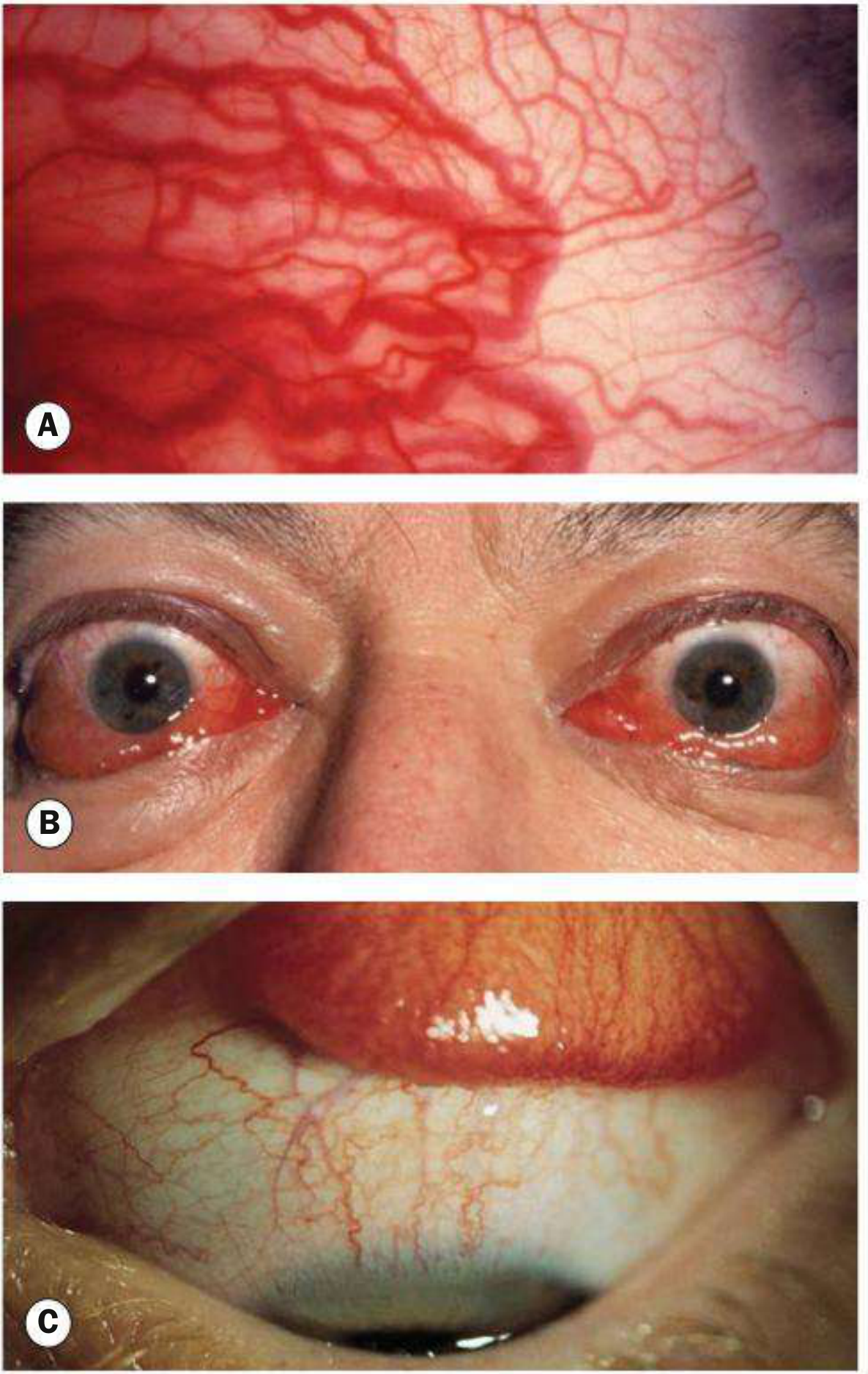
Pathophysiology of the new symptoms
Anti-TSH receptor antibodies (and IGF-1R antibodies) activate orbital fibroblasts and preadipocytes, which:
- Secrete excess hydrophilic glycosaminoglycans (GAGs) that trap water osmotically
- Cause lipogenesis expanding orbital fat volume
- Trigger inflammatory cytokine release
This leads to periorbital oedema, conjunctival hyperaemia (redness), chemosis, and the subjective itch/gritty sensation. The transition from hypothyroid to hyperthyroid state adds a surge in thyroid-stimulating immunoglobulins (TSI) that accelerates this process. - Kanski's Clinical Ophthalmology, p.133; Cummings Otolaryngology, p.2411
EUGOGO Activity Assessment (2021) - Is this the Active Inflammatory Phase?
The Clinical Activity Score (CAS) should be formally calculated. Score 1 point each for:
| Feature | Your Patient |
|---|---|
| Spontaneous retrobulbar pain | ? |
| Pain on eye movement | ? |
| Redness of eyelids | YES |
| Redness of conjunctiva | YES |
| Swelling of conjunctiva/plica (chemosis) | Likely YES |
| Swelling of eyelids (periorbital oedema) | YES |
| Inflammation of caruncle/plica | ? |
A CAS >= 3/7 = active disease requiring intervention. Based on the symptoms described alone, the score is already >= 3 and this patient is in active TED. - Kanski's Clinical Ophthalmology, p.133
Severity Classification
Per EUGOGO:
- Mild TED: Periorbital swelling only, minor lid retraction (<2mm), no diplopia, proptosis <3mm above normal
- Moderate-severe TED: Lid retraction >= 2mm, moderate/severe soft tissue involvement, proptosis >= 3mm, diplopia
- Sight-threatening TED: Optic neuropathy or corneal breakdown
Based on your description (periorbital swelling + redness + itching + pre-existing left proptosis), this is at minimum mild-to-moderate active TED. The pre-existing proptosis pushes towards moderate.
RED FLAGS to rule out immediately
Before attributing everything to TED, examine for:
- Corneal exposure keratopathy - the existing proptosis means incomplete lid closure; the itch/redness may indicate corneal epithelial breakdown. Check with fluorescein staining.
- Sight-threatening TED - assess visual acuity, colour vision, relative afferent pupillary defect (RAPD). Any change = optic nerve compression, urgent decompression needed.
- Orbital cellulitis - distinguish from TED: fever, pain on movement, restricted EOM, proptosis worsening acutely, CT showing orbital fat stranding. Needs IV antibiotics urgently.
- Allergic contact dermatitis - if she recently applied new eye drops or cosmetics.
Management Plan
Immediate Steps
-
Ophthalmology referral today / urgently - given active inflammation with pre-existing proptosis, she needs slit-lamp exam, tonometry (IOP elevation with downgaze is common in TED), and formal CAS scoring.
-
Thyroid status optimisation - check current TFTs (TSH, free T4, free T3) urgently. Achieving and maintaining euthyroidism is the single most important step in controlling TED activity. Fluctuations (especially the hypothyroid-to-hyperthyroid swing as in this patient) worsen orbital inflammation. Adjust antithyroid medication (carbimazole/methimazole) accordingly.
-
Stop smoking - if applicable. Smoking is the strongest modifiable risk factor for TED severity. - Kanski's Clinical Ophthalmology, p.133
For Mild TED (soft tissue symptoms only, CAS 3-4, no vision threat)
- Topical lubricants (preservative-free artificial tears, e.g., carboxymethylcellulose 0.5% 4-6x/day) - first-line for ocular surface symptoms, dryness, and grittiness
- Lubricating eye ointment at night + eyelid taping if lagophthalmos present
- Selenium 200 mcg/day orally x 6 months - shown in double-blind placebo-controlled trials to slow disease progression, improve quality of life, and reduce soft tissue involvement (monitor serum selenium levels; excess causes diabetes, neurotoxicity, and glaucoma) - Cummings Otolaryngology, p.2922
- Sunglasses for photophobia
- Cold compresses to the periorbital area for symptomatic relief of the acute swelling and itch
- If itching is prominent: topical antihistamine eye drops (e.g., olopatadine) for symptomatic relief, though address whether there is a contact allergic component too
For Moderate-Severe TED (CAS >= 4, significant soft tissue, diplopia, or proptosis progression)
- IV Methylprednisolone - first-line. Protocol: 500 mg IV weekly for 6 weeks, then 250 mg IV weekly for 6 weeks. This pulsed regimen is superior to daily oral dosing in both efficacy and safety. Response rate 33-63%. - Cummings Otolaryngology, p.2927
- Alternative: Oral prednisone 80-100 mg/day if IV not feasible
- Mycophenolate mofetil (MMF) as steroid-sparing agent - fewer reactivations and improved outcomes
- Rituximab (anti-CD20 monoclonal antibody) - for steroid-refractory or dependent cases
- Orbital radiotherapy - combined with azathioprine is effective; useful for extraocular muscle inflammation
For Sight-Threatening TED
- IV methylprednisolone 1g/day x 3 days immediately
- If no response in 2 weeks: urgent surgical orbital decompression
- Endoscopic or transantral orbital decompression for optic nerve compression
Note on Radioactive Iodine (RAI)
If RAI was used or is planned to treat her Graves hyperthyroidism - be cautious: RAI is known to worsen TED. Prophylactic oral prednisone should be co-administered with RAI in patients with active or moderate TED. - Kanski's Clinical Ophthalmology, p.133
Summary of Today's Acute Actions
| Priority | Action |
|---|---|
| Urgent | Visual acuity + colour vision check, corneal exam (fluorescein) |
| Urgent | Rule out orbital cellulitis (fever, TLC, CT orbit if needed) |
| Today | Ophthalmology referral |
| Today | TFTs - optimise to euthyroidism |
| Symptomatic | Preservative-free lubricant drops + cold compresses |
| Symptomatic | Topical antihistamine drops if itching prominent |
| Discuss | Selenium 200 mcg/day if mild-moderate active TED |
| Discuss | Systemic corticosteroids if moderate-severe confirmed |
Sources: Kanski's Clinical Ophthalmology 10th Ed., pp.132-134 | Cummings Otolaryngology, pp.2918-2937 | Harrison's Principles of Internal Medicine 22E (2025) | StatPearls - Graves Disease | Alves Junior JM et al., J Clin Endocrinol Metab 2024 (PMID 39076015) - systematic review confirming IV steroids as most effective in the active phase
The redness and swelling is not inside the eye It's on outer upper lid
Good clarification. The redness, swelling, and itching is isolated to the outer upper eyelid skin - this changes the differential significantly. In a Graves/proptosis patient, the upper lid skin is prone to specific problems.
Searching sources...
Finding Sources
Finding Sources
Searching the Web
upper eyelid skin swelling redness itching Graves disease proptosis differential diagnosis management
Reading Web Page
https://www.aafp.org/afp/2007/1215/p1815
Finding Sources
Finding Sources
Reading File
Finding Sources
Reading File
Reading File
Reading File
Excellent - I now have everything needed for a focused, well-structured answer.
Revised Assessment: Outer Upper Eyelid Skin - Swelling, Redness, Itching
This is an important distinction. The problem is in the eyelid skin itself (preseptal / anterior lamella), not the globe or conjunctiva. The key differential in a Graves patient with proptosis changes considerably.
The Most Likely Diagnoses (in order of probability)
1. Eyelid Erythema (Periocular/Periorbital Dermatitis) - Part of TED Itself
This is actually a recognized feature of active TED and is sometimes overlooked. Known as eyelid erythema or periorbital dermatitis in TED:
"Eyelid erythema presents with a scaly, erythematous eruption of the upper and lower eyelids, resulting in swollen eyelids that often itch, burn, sting, and look red." - TED Impact / EUGOGO classification
The skin over the upper lid in proptotic eyes is stretched and under constant tension, making it vulnerable to:
- Inflammatory infiltration from the underlying orbital tissue (same GAG/cytokine process)
- Dryness and breakdown due to incomplete lid closure over the proptotic eye
- Reactive skin inflammation from exposure
Itching is a key feature that fits this - it is a soft tissue sign of active TED inflammation.
2. Contact Dermatitis (Allergic or Irritant)
The most common non-TED cause of itchy, red, swollen upper eyelid skin. - AAFP - Differential Diagnosis of the Swollen Red Eyelid
Ask specifically:
- Any new eye drops started recently? (Including lubricants, antihistamine drops, antithyroid eye drops - preservatives like benzalkonium chloride are common sensitizers)
- New cosmetics, face creams, sunscreens?
- New laundry detergent on pillow case?
- Nickel contact (tweezers, glasses frames)?
Upper eyelid contact dermatitis is often caused by airborne allergens or nail polish (patients touch their lids with fingers coated in allergen). Itching is the predominant symptom.
3. Preseptal (Periorbital) Cellulitis - Must Rule Out
This is a vision-threatening diagnosis that must be excluded first.
Classic features (from Wills Eye Manual):
- Eyelid erythema, tense edema, warmth, and tenderness on palpation
- Often follows: skin abrasion, insect bite, hordeolum, trauma, sinusitis
- May have fever, malaise
Key distinguishing feature from orbital cellulitis: NO proptosis worsening, NO pain with eye movement, NO motility restriction, NO visual change.
However - this patient already has proptosis from Graves, which makes the exam trickier. If in doubt, CT orbit is required.
4. Atopic Dermatitis / Eczema
The upper eyelid is a classic location. Chronic course with history of atopy. Associated with dry, lichenified skin elsewhere. Itching is intense and prominent.
5. Herpes Zoster Ophthalmicus (HZO) - Must Rule Out
- Reactivation of VZV in V1 (ophthalmic division of trigeminal nerve)
- Vesicular rash on forehead/upper lid - look carefully for even tiny vesicles or crusts
- Unilateral, respects midline
- Very important to catch early - can cause corneal involvement, uveitis, optic neuritis
- Particularly relevant because immunosuppression / immune dysregulation in Graves/autoimmune disease can trigger reactivation
6. Angioedema
- Sudden onset, non-tender, non-pitting lid oedema with itch
- No fever, no warmth
- History of allergic triggers, ACE inhibitor use, or hereditary angioedema
- Resolves within 24-48 hours spontaneously
Diagnostic Examination - What to Check Right Now
| Step | What to Look For |
|---|---|
| Inspect the lid skin closely | Vesicles/crusts = HZO; scaling/weeping = contact/atopic dermatitis; smooth tense swelling = cellulitis or angioedema; erythema only = TED eyelid erythema |
| Palpate the lid | Tender + warm = cellulitis; non-tender = allergic/TED |
| Check for fever | Fever = cellulitis |
| Eye movements | Restricted + painful = orbital cellulitis (emergency) |
| Visual acuity | Any drop = urgent referral |
| Examine cornea | Proptotic eye - check for exposure keratopathy |
| Ask about new exposures | Eye drops, cosmetics, allergens |
| Check forehead/scalp same side | Herpetic lesions following dermatome |
Management by Likely Diagnosis
| Diagnosis | Immediate Management |
|---|---|
| TED eyelid erythema (active TED) | Ophthalmology referral; optimise thyroid control; cold compresses; topical lubricants; selenium 200mcg/day; oral steroids if moderate-severe |
| Contact/Atopic dermatitis | Remove the allergen/irritant; topical low-potency corticosteroid (e.g., hydrocortisone 1% cream to lid skin) - avoid fluorinated steroids near eye; oral antihistamine (cetirizine 10mg) for itch |
| Preseptal cellulitis (mild, afebrile) | Oral amoxicillin-clavulanate 875/125 mg q12h x 10-14 days; review in 24-48h; if worsening - admit for IV vancomycin + ampicillin-sulbactam |
| Preseptal cellulitis (moderate/severe, fever) | Admit; IV antibiotics immediately; CT orbit + sinuses |
| HZO | Oral acyclovir 800mg 5x/day x 7-10 days (or valacyclovir 1g TDS); urgent ophthalmology - corneal involvement common |
| Angioedema | Antihistamine (cetirizine/fexofenadine); if severe - oral prednisolone; identify and avoid trigger |
Bottom Line for This Patient
Given Graves disease with proptosis + new morning onset upper lid skin swelling + redness + itching (itching is the key - cellulitis is typically tender, not itchy):
Most likely: Either active TED eyelid erythema OR contact/allergic dermatitis (check for new eye drops or cosmetics).
Must exclude urgently: Preseptal cellulitis (palpate for tenderness, check temperature) and HZO (inspect for vesicles).
The itch pattern points away from infection and towards an inflammatory/allergic process. Check for any new topical agent - if she was recently started on new lubricant drops or topical antithyroid medication, the preservative is the culprit until proven otherwise.
- Wills Eye Manual, pp.403-409 | Kanski's Clinical Ophthalmology 10th Ed., p.133 | AAFP Swollen Red Eyelid
This is a shared conversation. Sign in to Orris to start your own chat.