
Pnd and orthopnea mechanism
Reading File
Finding Sources
Finding Sources
Finding Sources
Finding Sources
Reading File
I can see the section on orthopnea/PND starts around line 2310. Let me read that directly.
Reading File
I have all the key content. Let me also fetch the diagram image referenced in the text.
Loading Image
Here is a comprehensive explanation of both mechanisms:
Orthopnea & Paroxysmal Nocturnal Dyspnea (PND) — Mechanisms
Both symptoms arise from the same underlying problem: elevated pulmonary venous/capillary hydrostatic pressure in the setting of left heart failure. The key difference is timing and severity.
The Shared Pathophysiologic Cascade
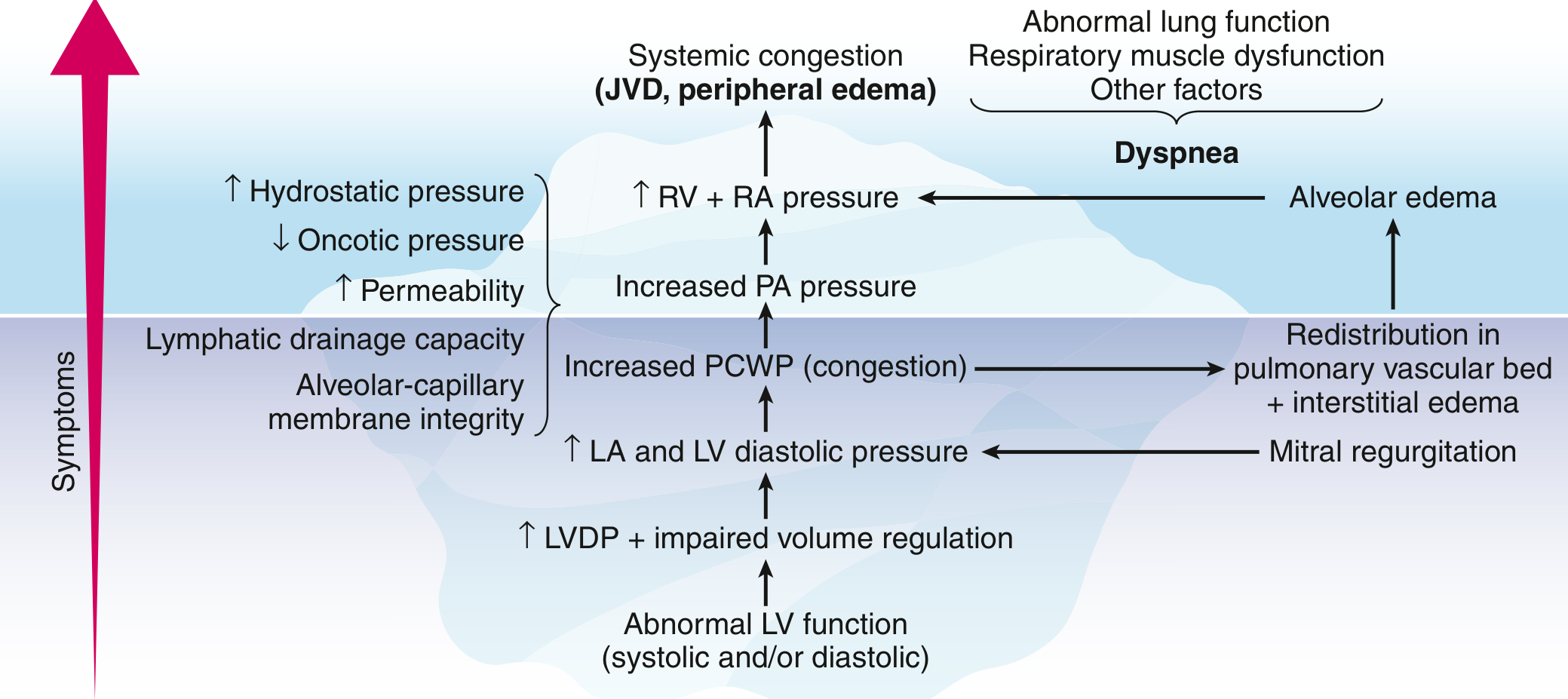
Abnormal LV function → ↑ LV diastolic pressure → ↑ LA pressure → ↑ pulmonary capillary wedge pressure (PCWP) → interstitial/alveolar edema → ↓ lung compliance → ↑ work of breathing → dyspnea
Orthopnea
Definition: Dyspnea that occurs specifically in the recumbent (lying flat) position.
Mechanism:
- When the patient lies flat, gravity no longer pools blood in the lower extremities and splanchnic bed.
- Venous return increases from the extremities and splanchnic circulation to the central (thoracic) circulation.
- This raises ventricular preload, which a failing left ventricle cannot handle.
- Pulmonary venous and pulmonary capillary hydrostatic pressures rise acutely.
- Fluid shifts into the interstitium → reduced lung compliance → increased work of breathing.
Clinical correlate: Graded by "number of pillows" the patient needs to sleep comfortably. Severe orthopnea forces the patient to sleep sitting upright. It correlates well with the severity of pulmonary congestion and is a specific symptom of heart failure.
Paroxysmal Nocturnal Dyspnea (PND)
Definition: Acute, severe shortness of breath that awakens the patient from sleep, typically 1–2 hours after lying down. Relieved by sitting upright or standing.
Mechanism — same trigger as orthopnea, but additional factors make it more dramatic and delayed:
| Factor | Explanation |
|---|---|
| Postural fluid redistribution | Same as orthopnea — recumbency increases venous return and preload |
| Delayed mobilization | Interstitial fluid from the splanchnic bed and lower extremities is gradually absorbed over 1–2 hours after lying down, so the central volume overload builds progressively |
| Alveolar edema | By the time PND strikes, fluid has moved from the interstitium into alveoli — more severe than the interstitial edema of orthopnea |
| Reduced sympathetic tone during sleep | Catecholamine support to the heart falls during sleep, unmasking cardiac decompensation |
| Reduced respiratory drive | Blunted ventilatory response during sleep means more hypoxia accumulates before the patient wakes |
Clinical significance: PND is relatively uncommon compared to orthopnea, but when present it almost always signals severe heart failure and is associated with increased mortality.
Key Differences at a Glance
| Feature | Orthopnea | PND |
|---|---|---|
| Onset | Immediate on lying flat | Delayed ~1–2 hours after sleep |
| Severity | Interstitial edema | Alveolar edema |
| Relief | Sitting up immediately | Sitting/standing; may take 15–30 min |
| Specificity for HF | High | Very high |
| Prognostic weight | Moderate | Higher (associated with ↑ mortality) |
Why PND is Worse Than Orthopnea
The extra severity of PND comes from the time course of fluid mobilization: during sleep, the gradual reabsorption of peripheral edema into the circulation overwhelms the pulmonary lymphatics and Starling forces, tipping the balance from interstitial edema (orthopnea) into frank alveolar flooding (PND). Alveolar edema causes a sudden, dramatic drop in diffusion capacity and triggers the hypoxic/hypercapnic arousal from sleep.
— Goldman-Cecil Medicine International Edition, pp. 467–468
I have a case presentation on rhd with severe ms with severe pah. Enumerate the possible questions and answer that the professors can ask
Checking Date & Time
Finding Sources
Finding Sources
Finding Sources
Reading File
Finding Sources
Finding Sources
Reading File
Reading File
Reading File
Finding Sources
Reading File
Reading File
I now have comprehensive, authoritative content. Let me compile the full Q&A.Here is a comprehensive list of professor questions with model answers, organized by topic category:
Case Presentation: RHD with Severe MS + Severe PAH
Anticipated Professor Q&A
🔬 CATEGORY 1 — Etiology & Pathogenesis of RHD
Q1. How does rheumatic fever cause mitral stenosis?
The mechanism of valve damage in RHD is thought to be an autoimmune response to Group A Streptococcus (GAS) moieties that molecularly mimic valve antigens, involving both humoral and cellular immune mechanisms. Repeated untreated GAS pharyngeal infections accelerate progression. Carditis typically occurs in the second decade; significant MS develops 2 decades later. The mitral valve is the most commonly involved valve in RHD.
Q2. Why is MS more common in women?
Classic RHD/MS has a female preponderance even though ARF affects both sexes equally — the reason is not fully understood but may relate to hormonal and immune differences affecting the autoimmune response.
Q3. What are the pathologic changes seen in the mitral valve in RMS?
- Leaflet thickening and fibrosis
- Commissural fusion — the dominant mechanism reducing valve area
- Chordal fusion and shortening (subvalvular disease)
- Calcification in advanced disease
- "Fish-mouth" or "buttonhole" valve appearance
❤️ CATEGORY 2 — Pathophysiology of MS
Q4. What is the normal mitral valve area? How does it correlate with severity?
| MVA | Severity | Gradient |
|---|---|---|
| ≥ 4.0 cm² | Normal | None |
| 1.5–2.0 cm² | Mild | Minimal, on exertion only |
| 1.0–1.5 cm² | Severe | 5–10 mmHg, symptoms |
| < 1.0 cm² | Very severe | >10 mmHg, resting symptoms |
Guidelines define severe MS as MVA ≤ 1.5 cm².
Q5. How does tachycardia worsen MS hemodynamics?
An increase in heart rate shortens diastole disproportionately more than systole, reducing the time available for blood to flow across the stenotic mitral orifice. At any given cardiac output, tachycardia (including AF with rapid ventricular response) augments the transvalvular pressure gradient and further elevates LA pressure. This is why events that cause tachycardia (fever, exercise, pregnancy, AF) precipitate acute decompensation in MS.
Q6. What is the effect of MS on LV function?
In isolated MS, LV diastolic pressure and EF are normal — the problem is upstream (LA, pulmonary circulation). However, in some patients with advanced RHD, the LV can be involved by the rheumatic process itself or compressed by the enlarged LA, leading to LV dysfunction.
Q7. What happens to cardiac output in severe MS?
In severe MS (MVA 1–1.5 cm²), CO is normal or near-normal at rest but rises subnormally during exertion. In very severe MS (MVA <1 cm²) with markedly elevated PVR, CO is subnormal at rest and may fail to rise — or even decline — during activity.
🫁 CATEGORY 3 — Pulmonary Hypertension in MS
Q8. What are the mechanisms of PAH in MS? (High-yield — professors love this)
There are four mechanisms (Harrison's):
- Passive — backward transmission of elevated LA pressure (pulmonary venous HTN)
- Reactive ("second stenosis") — pulmonary arteriolar vasoconstriction triggered by LA/pulmonary venous hypertension; initially reversible
- Interstitial edema — in walls of small pulmonary vessels
- Organic/obliterative — end-stage irreversible structural changes in the pulmonary vascular bed (intimal fibrosis, medial hypertrophy)
Q9. What is "reactive PAH" and why is it called "second stenosis"?
Reactive PAH is the vasoconstriction/remodeling of pulmonary arterioles in response to chronically elevated pulmonary venous pressure. It is called the "second stenosis" because it creates an additional fixed resistance in series with the mitral valve obstruction. It is initially reversible with relief of the mitral obstruction (BMV/surgery), but becomes irreversible at end stage when organic obliterative changes predominate.
Q10. How does severe PAH lead to right heart failure?
Severe PAH → RV pressure overload → RV enlargement and hypertrophy → RV failure → secondary tricuspid regurgitation (TR) and pulmonary regurgitation (PR) → right-sided heart failure with JVD, hepatomegaly, ascites, peripheral edema.
Q11. How do you define severe PAH?
Pulmonary artery systolic pressure (PASP) > 70 mmHg on echo (or mean PAP > 40 mmHg on catheterization). The European definition of PAH: mean PAP ≥ 25 mmHg at rest (updated 2022 definition: mean PAP > 20 mmHg).
🩺 CATEGORY 4 — Clinical Features & Auscultation
Q12. What are the classic symptoms of severe MS?
- Dyspnea on exertion → orthopnea → PND (as MS worsens)
- Hemoptysis — from rupture of pulmonary-bronchial venous connections due to pulmonary venous HTN
- Palpitations (AF)
- Systemic embolism (stroke)
- Features of right heart failure in severe PAH: edema, ascites, RHC pain
Q13. What are the classic auscultatory findings in MS?
- Loud S1 (due to delayed, forceful mitral valve closure — mitral leaflets still open at end diastole)
- Opening snap (OS) — due to sudden tensing of mitral leaflets after valve "snaps" open
- A2-OS interval — shorter interval = more severe MS (elevated LA pressure causes earlier valve opening)
- Low-pitched mid-diastolic rumble with pre-systolic accentuation (if in sinus rhythm) at the apex, best heard in left lateral decubitus
- Loud P2 in PAH
- Graham-Steell murmur — early diastolic murmur at left sternal edge due to pulmonary regurgitation from PAH
Q14. When does the loud S1 disappear?
S1 becomes soft when the mitral valve is heavily calcified (restricted mobility) or when the gradient is very low (very advanced MS with low flow).
Q15. What is malar flush (mitral facies)?
Bilateral bluish-red discoloration of the cheeks due to low cardiac output and peripheral vasodilation from chronic MS. A classic but uncommon physical finding.
📊 CATEGORY 5 — Investigations
Q16. What does the ECG show in severe MS with PAH?
- P-mitrale — broad, notched P wave in lead II (>0.12 sec); biphasic P in V1 → LA enlargement
- RVH — right axis deviation, tall R in V1, deep S in V5-V6
- AF — absent P waves, irregularly irregular rhythm (very common in MS)
Q17. What are the chest X-ray findings?
- Enlarged LA — double-density sign, elevation of left main bronchus, splaying of the carina
- Pulmonary venous HTN — upper lobe blood diversion, Kerley B lines
- Interstitial edema → alveolar edema (in decompensation)
- Hemosiderosis — fine nodular pattern (longstanding severe MS)
- RV enlargement — filling of retrosternal space on lateral view
- Enlarged MPA — convex left heart border at level of pulmonary artery segment
Q18. What are the echocardiographic features of severe MS?
- Diastolic doming of the anterior mitral leaflet ("hockey stick" appearance)
- Commissural fusion
- MVA by planimetry < 1.5 cm²
- Pressure half-time (PHT) ≥ 220 ms → MVA = 220/PHT
- Mean transmitral gradient > 10 mmHg (severe)
- Elevated PASP
- LA enlargement, LA thrombus assessment
Q19. What is the Wilkins Score and what does it measure?
The Wilkins (echocardiographic) score assesses 4 parameters, each scored 0–4:
- Leaflet mobility (restricted = higher score)
- Leaflet thickening
- Calcification
- Subvalvular apparatus deformity
Total score 0–16.
- Score ≤ 8 → favorable morphology → PTMC/BMV likely successful (>90%)
- Score 9–11 → intermediate; consider BMV at experienced centers
- Score > 11 → suboptimal morphology → surgery preferred
💊 CATEGORY 6 — Management
Q20. What are the indications for intervention (PTMC/Surgery) in MS?
| Class | Indication |
|---|---|
| I (Class A) | Symptomatic (NYHA II–IV), severe MS (MVA ≤1.5 cm²), favorable morphology, MR <2+, no LA thrombus → PTMC |
| I (B-NR) | NYHA III–IV, severe MS, not PTMC candidate (failed PTMC, requires other cardiac surgery, no access) → Mitral valve surgery |
| IIa | Asymptomatic, severe MS + PASP > 50 mmHg → PTMC reasonable |
| IIb | Asymptomatic, severe MS + new-onset AF → PTMC may be considered |
Q21. What are the contraindications to PTMC?
- LA thrombus (absolute — must anticoagulate for 2–3 months, recheck TEE)
- MR ≥ 2+ (PTMC may worsen it)
- Wilkins score > 11 (relative)
- Severe bicommissural calcification
- Severe subvalvular disease
Q22. How does severe PAH affect management decisions?
- Severe PAH is actually an indication for PTMC (even in asymptomatic patients, if PASP > 50 mmHg)
- After successful PTMC, reactive PAH often reverses over months
- Fixed/obliterative PAH does not reverse — presence of very high PVR (>10 Wood units) increases surgical risk significantly
- Severe PAH with RV failure makes the patient a higher surgical risk
Q23. What anticoagulation is used in MS with AF?
- Warfarin (vitamin K antagonist) — target INR 2.5–3.5
- NOT direct oral anticoagulants (DOACs) — DOACs are contraindicated in rheumatic MS with AF (this distinction is critical — the RE-ALIGN trial showed dabigatran was inferior in mechanical valves; ESC/ACC guidelines explicitly state warfarin only for rheumatic MS)
- Anticoagulation is indicated regardless of CHADS₂-VASc score in MS + AF
- Consider anticoagulation in sinus rhythm if: dense spontaneous echo contrast in LA or LA dilation (European guidelines)
Q24. What is the role of beta-blockers/rate control in MS?
Rate control is a cornerstone of medical management:
- Beta-blockers (metoprolol, bisoprolol) or ivabradine — slow heart rate, prolong diastolic filling time, reduce transmitral gradient
- Digoxin — useful for rate control in AF
- Diuretics for pulmonary congestion There is no drug that treats the mechanical obstruction; medical therapy is symptomatic only.
⚡ CATEGORY 7 — Complications
Q25. Why are MS patients at high risk for stroke?
MS + AF is a particularly high-risk combination:
- Reduced LA appendage emptying velocity
- LA stasis → thrombus formation (especially in the LA appendage)
- Risk of embolism is 17–18× higher in MS+AF vs controls
- Even transient AF episodes increase risk significantly
- MS patients can have LA thrombus even in sinus rhythm
Q26. What causes hemoptysis in MS?
Rupture of pulmonary-bronchial venous connections secondary to acute rise in pulmonary venous pressure. Most common in patients with elevated LA pressure without markedly elevated PVR (because if PVR is high, it acts as a "buffer" reducing pulmonary venous pressure swings). Rarely fatal but recurrent.
Q27. What is the prognosis of untreated severe symptomatic MS?
Dismal:
- Mortality 8–13% per year in the first 5 years
- Only 15% of NYHA Class IV patients survive 5 years without intervention
- 60% of NYHA Class III survive 5 years without intervention
🤰 BONUS CATEGORY 8 — Special Situations
Q28. Why is MS dangerous in pregnancy?
- Pregnancy increases blood volume and heart rate → elevated LA pressure → acute pulmonary edema
- Severe PAH is an absolute contraindication to pregnancy (maternal mortality up to 50%)
- Severe MS (MVA ≤1.5 cm²) with symptoms or PAH should be treated before conception, preferably with PTMC
- Warfarin is teratogenic (especially 6–12 weeks) — requires careful anticoagulation strategy
Q29. What Jones Criteria findings confirm the diagnosis of ARF?
Major criteria (JONES): Joints (migratory polyarthritis), O (rheumatic carditis), Nodules (subcutaneous), Erythema marginatum, Sydenham's chorea Minor criteria: Fever, elevated ESR/CRP, prolonged PR interval Plus evidence of prior GAS infection (elevated ASO titer, positive throat culture)
*Sources: Braunwald's Heart Disease (9780323722193), Harrison's Principles of Internal Medicine 22E (9781265977061), Fuster & Hurst's The Heart 15E (9781264257560)*That covers 29 questions across 8 categories from basic science to clinical management. Here's a quick study priority guide:
🎯 Top 5 "Must-Know" Questions Professors Always Ask
- Mechanisms of PAH in MS (Q8) — the 4 mechanisms, especially reactive/"second stenosis"
- Wilkins Score (Q19) — all 4 parameters, cutoffs for PTMC vs surgery
- Auscultatory signs (Q13) — why S1 is loud, A2-OS interval correlating with severity
- Indications for PTMC vs surgery (Q20) — Class I and IIa indications especially
- Warfarin NOT DOACs in MS+AF (Q23) — professors specifically test this distinction
🔑 High-Yield Facts for PAH in Your Case
- Severe PAH (PASP >50 mmHg) is itself an indication for PTMC even in asymptomatic patients
- Reactive PAH reverses after successful PTMC; obliterative PAH does not
- RV failure from PAH significantly increases surgical risk
- The 4-mechanism cascade (passive → reactive → interstitial edema → obliterative) is the signature pathophysiology question for Group 2 PAH due to MS
This is a shared conversation. Sign in to Orris to start your own chat.