
Lung volume
Reading File
Finding Sources
Searching Images
lung volumes and capacities spirometry diagram
Reading File
Reading File
Loading Image
Here is a comprehensive overview of lung volumes and capacities:
Lung Volumes & Capacities
Spirogram
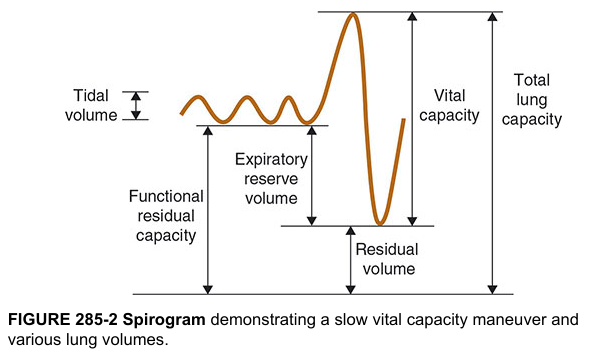
Spirogram demonstrating a slow vital capacity maneuver and the various lung volumes — Harrison's Principles of Internal Medicine
The Four Basic Lung Volumes
These are non-overlapping compartments that together make up the total lung capacity:
| Volume | Abbreviation | Normal Value | Description |
|---|---|---|---|
| Tidal Volume | Vt | ~500 mL | Volume inspired/expired during normal quiet breathing |
| Inspiratory Reserve Volume | IRV | ~3,000 mL | Additional volume that can be inspired above tidal volume |
| Expiratory Reserve Volume | ERV | ~1,200 mL | Additional volume that can be expired below tidal volume |
| Residual Volume | RV | ~1,200 mL | Volume remaining after maximal forced expiration; cannot be measured by spirometry |
The Four Lung Capacities
Each capacity includes two or more lung volumes:
| Capacity | Abbreviation | Formula | Normal Value | Notes |
|---|---|---|---|---|
| Inspiratory Capacity | IC | Vt + IRV | ~3,500 mL | — |
| Functional Residual Capacity | FRC | ERV + RV | ~2,400 mL | Resting/equilibrium volume of the lungs; cannot be measured by spirometry |
| Vital Capacity | VC | IC + ERV | ~4,700 mL | Volume expired after maximal inspiration; increases with body size, male sex, fitness; decreases with age |
| Total Lung Capacity | TLC | VC + RV | ~5,900 mL | All lung volumes combined; cannot be measured by spirometry |
Key Concept: What Spirometry Can and Cannot Measure
- Measurable by spirometry: Vt, IRV, ERV, VC, IC
- Not measurable by spirometry (because they include RV): RV, FRC, TLC
To measure FRC (and thereby calculate RV and TLC), two methods are used:
- Helium dilution — subject breathes a known concentration of insoluble helium; its equilibration concentration back-calculates lung volume
- Body plethysmography — uses Boyle's Law (P × V = constant) in an airtight box to measure airway pressure changes during attempted breathing against a closed mouthpiece
Factors Affecting Lung Volumes
- Body size: larger body → larger volumes
- Sex: males have higher values than females
- Age: VC and FVC decline progressively (~21–33 mL/year in men, ~18–29 mL/year in women); RV and RV/TLC ratio increase with age due to loss of elastic recoil and air trapping
- Posture: volumes are measured with the subject seated; values are slightly lower supine
- Physical conditioning: increases VC
Clinical Significance
| Pattern | TLC | FVC | FEV₁/FVC | Likely Cause |
|---|---|---|---|---|
| Obstructive | Normal or ↑ | ↓ | ↓ | Asthma, COPD, emphysema |
| Restrictive | ↓ | ↓ | Normal or ↑ | Pulmonary fibrosis, chest wall disease |
| Mixed | ↓ | ↓ | ↓ | Combined pathology |
The FRC is the equilibrium point where outward chest wall recoil balances inward lung recoil. Conditions that alter either (e.g., emphysema destroying lung elastic recoil, or obesity restricting chest wall outward recoil) shift FRC accordingly.
Sources: Costanzo Physiology 7th Edition; Fishman's Pulmonary Diseases and Disorders; Harrison's Principles of Internal Medicine
This is a shared conversation. Sign in to Orris to start your own chat.