
IBS and it's neurological connection
Reading File
Reading File
Finding Sources
Finding Sources
Searching PubMed
"irritable bowel syndrome"[MeSH Terms] AND "brain-gut axis"
Let me read the Harrison's pathophysiology section and the Cecil section.
Reading File
Reading File
Searching Images
pathophysiology of irritable bowel syndrome brain-gut axis
Reading File
Reading File
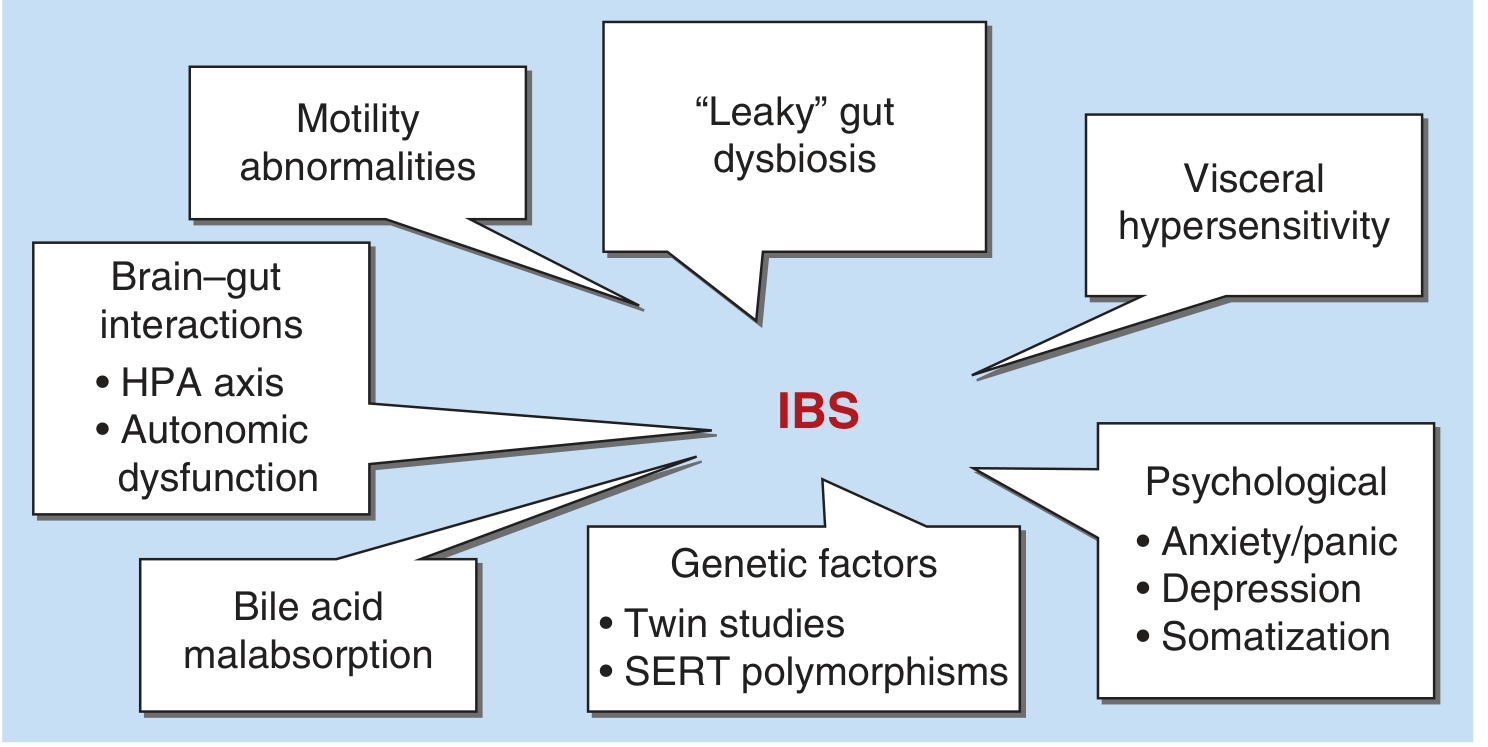
IBS is a disorder of gut-brain interaction. The nervous system is involved at every level: the enteric nerves in the gut wall, the afferent and autonomic pathways, and the brain's processing of gut signals. Cecil describes it as "a dysregulation of gut-brain interactions" that alters motility, visceral perception, autonomic function, stress responsiveness, mucosal immune function, microbiota, and CNS modulation of viscerosensory input - Goldman-Cecil Medicine, p. 1412.
Key neurological links
1. Visceral hypersensitivity (peripheral and spinal afferents)
- IBS patients feel pain and urgency at lower rectal balloon volumes than controls, without any change in rectal tension. This points to a problem with visceral afferents.
- The hypersensitivity is selective for the gut. Somatic pain sensitivity elsewhere in the body is spared.
- Dietary lipids lower the thresholds for first sensation, discomfort, and pain, which helps explain postprandial symptoms.
- Source: Harrison's Principles of Internal Medicine 22E, p. 2615.
2. Central processing (brain)
- Functional MRI shows greater activation of the mid-cingulate cortex (attention and response selection) in response to colonic stimulation. Modulating this region changes how unpleasant the pain feels.
- The prefrontal vigilance network is preferentially activated. This is read as hypervigilance toward visceral pain.
- In patients with a history of sexual abuse, the posterior and middle dorsal cingulate cortex (affect processing) is more active.
- Source: Harrison's 22E, p. 2615.
3. Stress axis and psychological factors
- Stress and emotional disorders trigger or worsen symptoms. Psychiatric features are recorded in up to 80% of patients in referral centers, but no single diagnosis predominates.
- Early-life adversity and genetic or epigenetic interactions may shape brain networks for emotional arousal, central autonomic control, salience, and somatosensory integration.
- The HPA axis is part of the proposed model.
- Source: Harrison's 22E, p. 2615.
4. Enteric nervous system and serotonin
- A few patients may have genetic abnormalities of the serotonin reuptake transporter (SERT) in enteric nerves.
- Serotonin acts on both motility and sensation.
- Source: Harrison's 22E, Fig. 338-1.
5. Motor and autonomic dysfunction
- Colonic motor abnormalities are most obvious under stimulation, such as eating or balloon distension. In IBS-D, high-amplitude propagating contractions are increased and are linked to rapid transit and pain.
- Source: Harrison's 22E, p. 2615.
6. Microbiota-gut-brain axis and post-infectious IBS
- More than 10% of people with infectious enteritis later develop IBS, a fourfold higher risk than in those without enteritis.
- Germ-free animals given microbiota from IBS patients develop visceral hypersensitivity and altered gut-brain signaling. This supports a microbiota-gut-brain axis.
- Sources: Harrison's 22E; Yamada's Textbook of Gastroenterology, 7th ed.
Clinical implications of the neural link
- Gut-brain neuromodulators treat IBS pain and bowel symptoms, not just coexisting anxiety or depression. The main examples are tricyclic antidepressants and SNRIs. They act in both the brain and the gut. See Goldman-Cecil Medicine, p. 1413, and Yamada's Textbook of Gastroenterology, 7th ed.
- Psychological therapies such as gut-directed hypnotherapy and CBT are part of the treatment algorithms. See Goldman-Cecil Medicine, Fig. on IBS-D and IBS-C treatment.
- Overlapping conditions include functional dyspepsia, noncardiac chest pain, and esophageal hypersensitivity. This fits a shared sensory-processing mechanism.
- Alarm features such as weight loss, nocturnal symptoms, and bleeding point away from IBS and need workup. Source: Harrison's 22E.
Recent evidence check
Recent systematic reviews support the library account and do not contradict it:
- Functional connectivity, mood, and cognition in IBS (PMID 41945210, 2026).
- Attention and brain-gut axis interactions (PMID 40048890, 2025).
- White matter changes on diffusion tensor imaging (meta-analysis, PMID 39687489, 2024).
I only read titles and metadata for these, not the full texts. Harrison's notes that the mechanisms behind visceral hypersensitivity are still under investigation.
I can go deeper on any one of these if you want: the brain imaging findings, serotonin and enteric neurobiology, the microbiome axis, or neuromodulator treatment.
This is a shared conversation. Sign in to Orris to start your own chat.