
Estrogen receptor modulator
Reading File
Estrogen receptor modulators (ERMs) are drugs that interact with estrogen receptors (ERs) and can act as agonists, antagonists, or mixed agonist/antagonists depending on the tissue. Let me pull comprehensive textbook content on this.
Searching sources...
Finding Sources
Finding Sources
Searching PubMed
"selective estrogen receptor modulator"[MeSH Terms]
Good hits. Now let me read the core textbook sections in parallel.
Reading File
Reading File
Finding Sources
Excellent content. Let me now pull more detail on other SERMs (raloxifene, clomiphene, bazedoxifene), SERDs (fulvestrant, oral SERDs), aromatase inhibitors for context, and the Goodman & Gilman section for a broader mechanistic view.
Reading File
Reading File
Finding Sources
Searching Images
selective estrogen receptor modulator SERM mechanism of action breast bone
Let me fetch the diagram from Lippincott and also get the clomiphene and Goodman & Gilman content on ER mechanism.
Loading Image
Finding Sources
Finding Sources
Finding Sources
Finding Sources
Reading File
I now have comprehensive content. Let me compile the full answer.
Estrogen Receptor Modulators (ERMs)
Estrogen receptor modulators are agents that interact with estrogen receptors (ERs) and either activate or block them - sometimes doing both depending on the tissue. They are classified into three major groups: SERMs (Selective Estrogen Receptor Modulators), SERDs (Selective Estrogen Receptor Downregulators/Degraders), and Pure Antagonists.
Estrogen Receptor - Background
There are two ER subtypes: ERα and ERβ, both nuclear receptors (ligand-activated transcription factors). When estradiol binds, the receptor undergoes a conformational change, forms homodimers or heterodimers, and recruits coactivator proteins to the activation function-2 (AF-2) domain, which drives gene transcription. The key insight for SERMs is that different ligands induce different conformational states of the ER, recruiting different coactivators or corepressors in a tissue-specific manner.
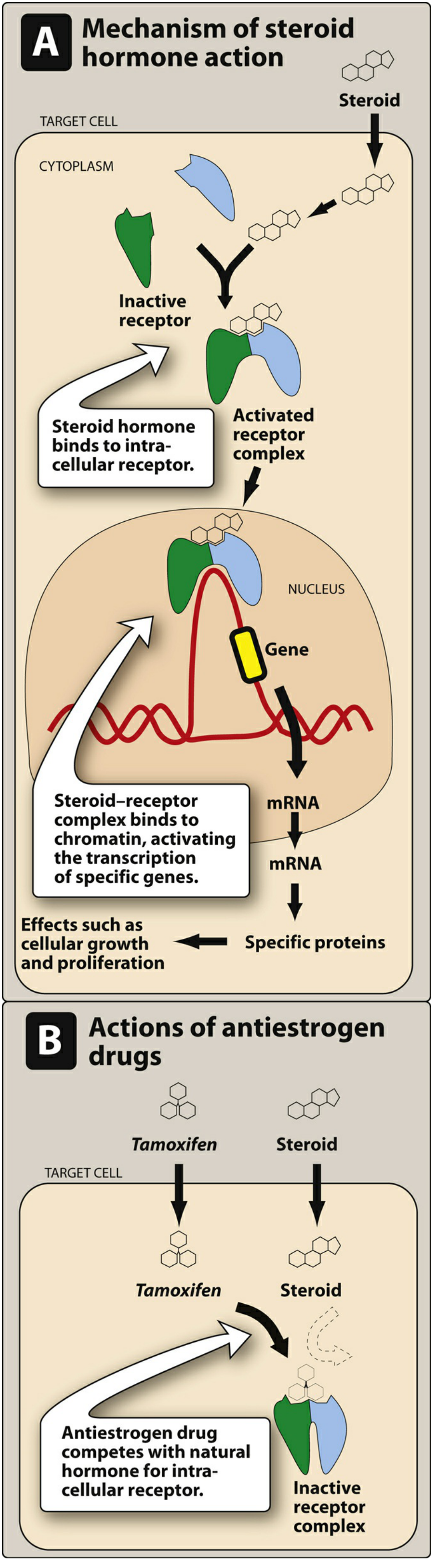
Figure: (A) Normal steroid hormone action - steroid binds to intracellular receptor, receptor complex binds chromatin, activates gene transcription. (B) Antiestrogen drugs (e.g., tamoxifen) compete with estrogen for binding to the receptor, producing an inactive complex. - Lippincott Illustrated Reviews: Pharmacology
1. Selective Estrogen Receptor Modulators (SERMs)
SERMs bind to both ERα and ERβ and competitively block estradiol. Their tissue-specific agonist/antagonist profile arises from:
- Differential conformational changes in the ER-ligand complex
- Differential recruitment of coactivators vs. corepressors depending on tissue context
- ERα vs. ERβ expression ratios and AF-1 vs. AF-2 domain activity
Tamoxifen
The first SERM introduced. A nonsteroidal triphenylethylene derivative.
| Tissue | Effect |
|---|---|
| Breast | Antagonist - inhibits proliferation |
| Endometrium | Partial agonist - stimulates growth |
| Bone | Agonist - antiresorptive |
| Lipids | Reduces LDL, total cholesterol (agonist-like) |
Mechanism: Tamoxifen induces an ER conformation that recruits corepressors to both ERα and ERβ (blocking them). However, in endometrium, tamoxifen activates the ligand-independent AF-1 domain of ERα (which ERβ lacks), producing partial agonism there. The active metabolite endoxifen (4-hydroxytamoxifen via CYP2D6) is actually more potent than tamoxifen itself - hence CYP2D6 inhibitors (e.g., certain antidepressants) should be avoided.
Pharmacokinetics:
- Well absorbed orally; initial t½ of 7-14 hours
- Metabolized by CYP2D6 to endoxifen (active)
- Inhibitor of CYP3A4 and P-glycoprotein
- Excreted predominantly via bile/feces
- Dose: 10-20 mg twice daily
Clinical uses:
- First-line therapy in ER-positive breast cancer (pre- and postmenopausal)
- Chemoprevention of breast cancer in high-risk women
- Adjuvant therapy: 35% reduction in contralateral breast cancer; continued beyond 5 years shows no further benefit and may allow resistant cells to treat tamoxifen as an agonist
Adverse effects:
- Hot flashes, nausea, vomiting (very common, ~25%)
- Vaginal bleeding and discharge (endometrial agonism)
- Endometrial cancer risk (2-fold increase)
- Thromboembolism (DVT/PE risk 2-3 fold)
- Cataracts
- Tumor flare at initiation
Toremifene is a structurally similar analog with near-identical properties, indications, and adverse effects.
Raloxifene
A benzothiophene SERM, second-generation.
| Tissue | Effect |
|---|---|
| Breast | Antagonist - reduces invasive breast cancer risk |
| Endometrium | Antagonist - no stimulation |
| Bone | Agonist - antiresorptive, increases bone density |
| Vasomotor | No benefit for hot flashes |
| Lipids | Reduces LDL, total cholesterol; does NOT increase HDL |
Key advantage over tamoxifen: No estrogenic activity in the endometrium, so no increased risk of endometrial cancer. Also associated with less vaginal discharge.
Clinical uses:
- Prevention and treatment of postmenopausal osteoporosis (alternative to bisphosphonates/denosumab if intolerant)
- Reduction of invasive ER-positive breast cancer risk in postmenopausal women
- Note: Has not been shown to reduce hip or non-vertebral fractures
Adverse effects:
-
Hot flashes, leg cramps
-
Venous thromboembolism (3-fold increase in DVT/PE) - contraindicated with prior thromboembolic history
-
Lippincott Illustrated Reviews: Pharmacology; Goodman & Gilman's The Pharmacological Basis of Therapeutics
Clomiphene
A triphenylethylene (like tamoxifen). Has two isomers:
- Zuclomiphene (cis): weak estrogen agonist
- Enclomiphene (trans): potent estrogen antagonist
Mechanism: Blocks ER at the hypothalamus, reducing the negative feedback of endogenous estrogen. This increases amplitude of LH and FSH pulses (without changing frequency), triggering ovulation.
Clinical use: Induction of ovulation in anovulatory women (infertility treatment). - Goodman & Gilman's
Bazedoxifene
A third-generation SERM. Used in Europe for postmenopausal osteoporosis. In the US, available only as a combination product (conjugated equine estrogen + bazedoxifene, trade name Duavee) for treating menopausal hot flashes - the SERM protects the endometrium so that a progestin is not needed. - Swanson's Family Medicine Review
2. Selective Estrogen Receptor Downregulators (SERDs) / Pure Antagonists
Fulvestrant
A 7α-alkylamide derivative of estradiol - structurally steroidal. Binds ERα and ERβ.
Mechanism: Unlike SERMs, fulvestrant has no agonist activity. It binds to the ER and causes receptor downregulation (destabilizes the receptor, promotes its degradation) and also prevents receptor dimerization. The result is a marked reduction in ER levels on tumor cells and other targets.
Pharmacokinetics: Given as an intramuscular injection (cannot be given orally due to extensive first-pass metabolism); monthly dosing.
Clinical use: Hormone receptor-positive, HER2-negative metastatic breast cancer in postmenopausal women (or in combination with CDK4/6 inhibitors).
Adverse effects: Hot flashes, injection site reactions, elevated liver enzymes.
A 2024 systematic review (PMID 38166684) confirmed the value of oral SERDs (next-generation degraders like elacestrant) in HR-positive, HER2-negative advanced breast cancer after progression on endocrine therapy.
3. Summary Comparison Table
| Drug | Class | Breast | Endometrium | Bone | Clinical Use |
|---|---|---|---|---|---|
| Tamoxifen | SERM | Antagonist | Partial agonist | Agonist | Breast cancer Tx/prevention |
| Raloxifene | SERM | Antagonist | Antagonist | Agonist | Osteoporosis, breast cancer prevention |
| Clomiphene | SERM | Antagonist (hypothalamus) | - | - | Ovulation induction |
| Bazedoxifene | SERM | Antagonist | Antagonist | Agonist | Osteoporosis (+ estrogen combo) |
| Fulvestrant | SERD | Pure antagonist | Pure antagonist | - | Metastatic breast cancer |
4. Related Drug Classes (Estrogen-Suppressing)
Aromatase Inhibitors (not direct ER modulators, but suppress estrogen synthesis):
- Anastrozole, Letrozole - nonsteroidal, reversible; first-line for postmenopausal breast cancer
- Exemestane - steroidal, irreversible; used after tamoxifen failure
- These do NOT increase endometrial cancer risk
GnRH Agonists (leuprolide, goserelin, triptorelin) - suppress pituitary LH/FSH via receptor desensitization, thereby reducing ovarian estrogen; used in premenopausal breast cancer.
Key Clinical Pearls
- CYP2D6 interactions with tamoxifen are clinically important - fluoxetine, paroxetine (CYP2D6 inhibitors) reduce conversion to endoxifen and may blunt tamoxifen efficacy.
- Tamoxifen increases endometrial cancer risk; raloxifene does not - this makes raloxifene preferred for osteoporosis in postmenopausal women.
- Both tamoxifen and raloxifene carry a DVT/PE risk - avoid in patients with thromboembolic history.
- SERMs work by differential coregulator recruitment - the same drug can be an agonist in one tissue and an antagonist in another based on local coactivator/corepressor expression.
- Fulvestrant (SERD) is purely antagonistic with no agonist effects in any tissue, distinguishing it from all SERMs.
Sources: Lippincott Illustrated Reviews: Pharmacology; Katzung's Basic and Clinical Pharmacology, 16th Ed.; Goodman & Gilman's The Pharmacological Basis of Therapeutics; Rheumatology, 2-Volume Set (2022, Elsevier)
This is a shared conversation. Sign in to Orris to start your own chat.