
Junctional epithelium bds final year
Reading File
Finding Sources
Searching the Web
junctional epithelium BDS final year exam topic dentistry
Finding Sources
Finding Sources
I found relevant content in the Histology textbook and Color Atlas. Let me read those sections in detail.
Reading File
Reading File
Reading File
Reading File
Searching Images
junctional epithelium gingival sulcus attachment epithelium tooth
Loading Image
Finding Sources
I now have comprehensive information to compile a thorough BDS final year answer on junctional epithelium. Let me also fetch the diagram image from the Color Atlas.
Loading Image
Now I have all the content needed to write a comprehensive BDS Final Year answer on Junctional Epithelium.
Junctional Epithelium — BDS Final Year
Definition
The junctional epithelium (JE), also called the attachment epithelium or epithelial attachment, is the specialized non-keratinized stratified squamous epithelium that forms a collar around the tooth at the base of the gingival sulcus and attaches the gingiva firmly to the tooth surface.
Location & Anatomy
The JE is situated at the base of the gingival sulcus (the shallow crevice between the free gingival margin and the tooth). It forms the apical-most component of the gingival unit and is continuous with the sulcular (crevicular) epithelium coronally.
- The gingival sulcus is the shallow groove lined on one side by the tooth surface and on the other by the JE/sulcular epithelium
- A periodontal probe inserted into the sulcus meets resistance at the coronal face of the JE
- Normal sulcus depth: 1–3 mm (the base of the sulcus = coronal border of JE)
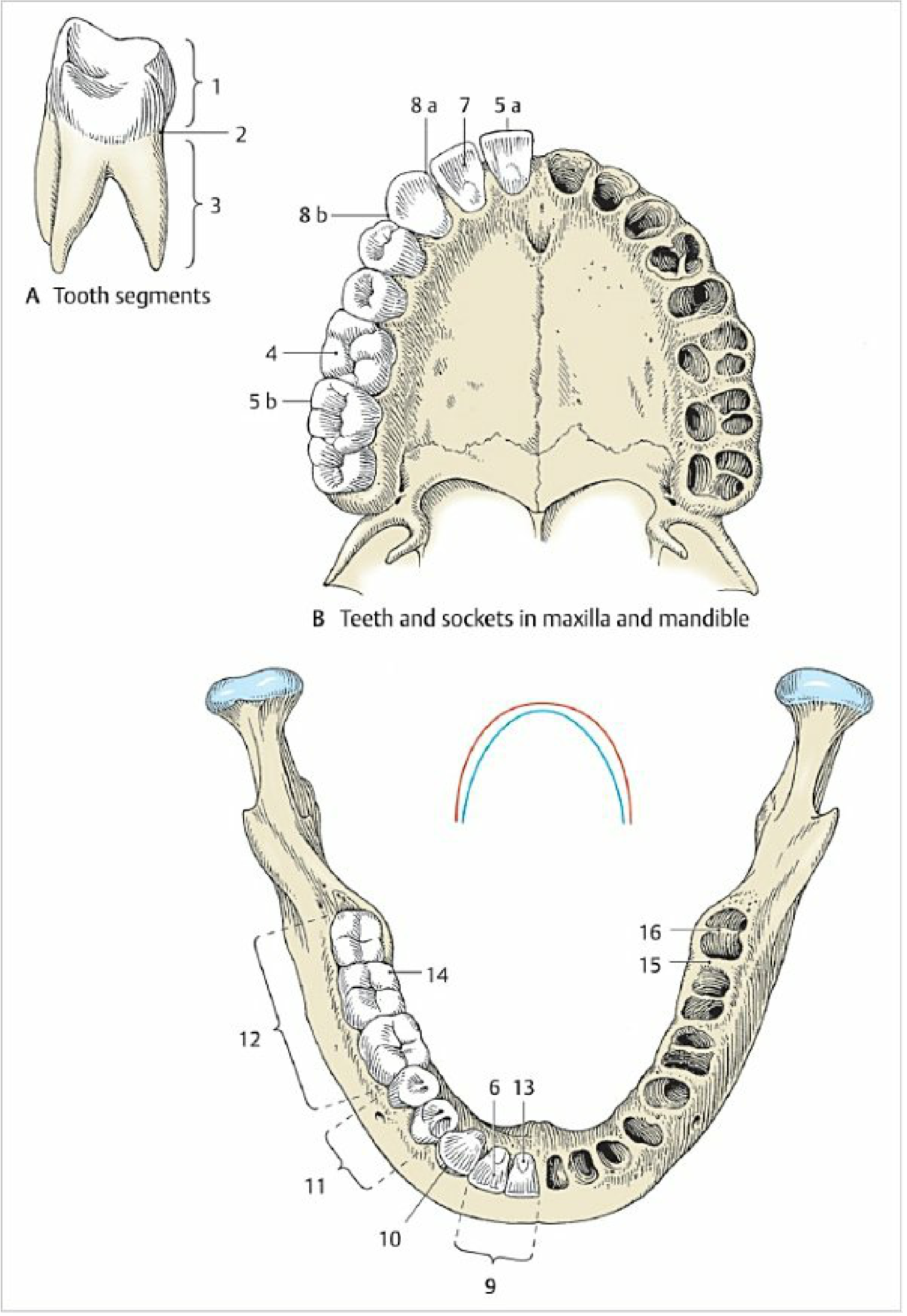
Origin / Development (Embryology)
During tooth eruption, the reduced enamel epithelium (a remnant of the dental organ after crown formation) degenerates. The remaining epithelial cells of the reduced enamel epithelium fuse with the oral epithelium and differentiate into the junctional epithelium. This is why the JE is sometimes described as being of enamel-organ origin.
"Before eruption, the dental organ degenerates, and the remaining cells are later involved in formation of the junctional epithelium." — Color Atlas of Human Anatomy, Vol. 2
Structure / Histology
| Feature | Detail |
|---|---|
| Type | Non-keratinized stratified squamous epithelium |
| Thickness | 3–30 cells thick (thinner apically, thicker coronally) |
| Length | ~2 mm (apico-coronal) |
| Cells | Flattened cells oriented parallel to the tooth surface |
| Connective tissue junction | Smooth (no rete ridges / papillae — unlike oral epithelium) |
| Mitotic activity | Very high — rapid turnover (~4–6 days vs. 10–14 days for oral mucosa) |
Key Structural Feature: The Epithelial Attachment
The JE does not attach to the tooth via desmosomes in the conventional sense. Instead, attachment occurs via a two-component mechanism:
- Internal basal lamina — a basal lamina-like material secreted by JE cells themselves onto the tooth surface (rather than the underlying connective tissue), composed of laminin, fibronectin, and type IV collagen
- Hemidesmosomes — the JE cells attach to this internal basal lamina via hemidesmosomes on their tooth-facing surface
"A basal lamina-like material is secreted by the junctional epithelium and adheres firmly to the tooth surface. The cells then attach to this material via hemidesmosomes. The basal lamina and hemidesmosomes are together referred to as the epithelial attachment." — Histology: A Text and Atlas, Pawlina
This is unique because epithelial cells normally have hemidesmosomes only on their basal (connective tissue-facing) surface; in the JE, they are present on the lateral (tooth-facing) surface as well.
Relationship to the Tooth Surface (Age Changes)
| Age | Location of Attachment |
|---|---|
| Young individual | To enamel, at or above the cementoenamel junction (CEJ) |
| Older individual (passive eruption / gingival recession) | Migrates apically — attaches to cementum |
This apical migration is called passive eruption and is physiologic.
Biological Width (Critical Clinical Concept)
The biological width = Junctional epithelium + supracrestal connective tissue attachment
- JE height: ~1 mm
- Connective tissue attachment (above alveolar crest): ~1 mm
- Total biological width ≈ 2 mm
Violation of the biological width (e.g., by subgingival margins of restorations placed too close to the alveolar crest) leads to chronic inflammation, bone loss, and gingival recession.
Functions
- Seals the periodontium from the oral environment — acts as a barrier between the sulcus and the deeper attachment apparatus
- Immunological gateway — highly permeable; allows passage of gingival crevicular fluid (GCF), PMNs, immunoglobulins, and other immune cells to defend against plaque bacteria
- Rapid self-renewal — high mitotic rate (~4–6 days) allows quick repair after injury
- Mediates attachment to the tooth via the epithelial attachment (internal basal lamina + hemidesmosomes)
Gingival Crevicular Fluid (GCF)
The JE is highly permeable. GCF seeps through the intercellular spaces of the JE into the sulcus. In health, it is minimal; in inflammation (gingivitis/periodontitis), GCF flow increases substantially. GCF contains:
- PMNs (neutrophils)
- Immunoglobulins (IgG, IgA, IgM)
- Complement components
- Enzymes (e.g., alkaline phosphatase, collagenase)
The JE in Periodontal Disease
In gingivitis/periodontitis, plaque-associated inflammation causes the JE to:
- Proliferate apically — migrating down the root surface
- Transform into pocket epithelium — the base of the sulcus deepens, forming a periodontal pocket
- Lose its tight attachment → loss of clinical attachment (CAL)
The JE is the first line of defense breached in periodontitis. Its destruction leads to the formation of a pathological pocket and eventually alveolar bone loss.
Comparison: JE vs Oral Epithelium vs Sulcular Epithelium
| Feature | Junctional Epithelium | Sulcular Epithelium | Oral Gingival Epithelium |
|---|---|---|---|
| Keratinization | None | None | Keratinized / parakeratinized |
| Rete ridges | Absent | Absent | Present |
| Turnover rate | Very fast (~4–6 days) | Moderate | Slowest (~10–14 days) |
| Hemidesmosomes | Yes (tooth-facing surface) | No | No |
| Permeability | Highest | Intermediate | Low |
| Function | Attachment | Lines sulcus | Masticatory surface |
Summary Points for Exam
- JE = non-keratinized stratified squamous epithelium; no rete ridges
- Origin: reduced enamel epithelium (dental organ remnant)
- Attachment = internal basal lamina + hemidesmosomes (epithelial attachment)
- In youth: attaches to enamel; in old age: attaches to cementum
- High mitotic rate; highly permeable
- Biological width = JE (~1 mm) + CT attachment (~1 mm) = ~2 mm
- Violation of biological width → bone loss and recession
- In periodontitis: JE migrates apically → pocket epithelium → attachment loss
Sources: Histology: A Text and Atlas with Correlated Cell and Molecular Biology (Pawlina), p. 1462–1463; Color Atlas of Human Anatomy Vol. 2 (Thieme), p. 268–270
This is a shared conversation. Sign in to Orris to start your own chat.