
Enzymology biochemistry
Reading File
The topic "enzymology biochemistry" is broad. Let me clarify what you need before diving deep.
Asking for Preferences
Which aspect of enzymology are you interested in? · What level / purpose?
Searching sources...
Finding Sources
Finding Sources
Finding Sources
Finding Sources
Good - found key sources in Basic Medical Biochemistry (6e) and Lippincott's Biochemistry. Let me read those sections.
Reading File
Finding Sources
Reading File
Reading File
Reading File
Finding Sources
Reading File
Finding Sources
Finding Sources
Finding Sources
I have enough textbook content now. Let me also fetch the key diagram images to include visually.
Loading Image
I now have comprehensive content from the textbooks. Here is the complete USMLE-focused guide:
Enzymology: Coenzymes, Cofactors & Enzyme Classification
1. Core Terminology (High-Yield)
| Term | Definition |
|---|---|
| Apoenzyme | Protein portion of an enzyme - inactive without its nonprotein component |
| Cofactor | Nonprotein component needed for enzyme activity |
| Holoenzyme | Apoenzyme + cofactor = the active, complete enzyme |
| Coenzyme | Small organic molecule cofactor (usually derived from a vitamin) |
| Prosthetic group | Coenzyme permanently (covalently) bound to the enzyme; does not dissociate |
USMLE pearl: Apoenzyme (inactive) + cofactor = Holoenzyme (active). A vitamin deficiency reduces the coenzyme pool, leaving inactive apoenzyme in cells.
- Biochemistry, 8th ed - Lippincott Illustrated Reviews, p.172
2. Cofactors vs. Coenzymes
Cofactor
├── Metal ion (Zn²⁺, Fe²⁺, Mg²⁺, Cu²⁺, Mn²⁺)  ← "cofactor" strictly
└── Small organic molecule  ← "coenzyme"
    ├── Cosubstrate: transiently binds, leaves altered (e.g., NAD⁺ → NADH)
    └── Prosthetic group: permanently bound, regenerated in place (e.g., FAD, heme)
- Lippincott's Biochemistry, p.172; Basic Medical Biochemistry - A Clinical Approach 6e, p.241
3. The Two Classes of Coenzymes
A. Activation-Transfer Coenzymes
Form a covalent bond with part of the substrate, activating it for transfer.
| Coenzyme | Vitamin Source | Functional Group | What is Transferred | Key Enzymes |
|---|---|---|---|---|
| Thiamin pyrophosphate (TPP) | B1 (Thiamin) | Reactive carbanion carbon | Acyl groups (after decarboxylation) | Pyruvate dehydrogenase, alpha-ketoglutarate dehydrogenase, transketolase |
| Coenzyme A (CoASH) | B5 (Pantothenate) | Sulfhydryl (-SH) group | Acyl groups (forms thioesters) | Acetyl-CoA carboxylase, citrate synthase, fatty acid synthase |
| Biotin | Biotin (B7) | CO₂ carrier via N atom | CO₂ (carboxylation reactions) | Pyruvate carboxylase, acetyl-CoA carboxylase, propionyl-CoA carboxylase |
| Pyridoxal phosphate (PLP) | B6 (Pyridoxine) | Schiff base with amino acid | Amino groups (transamination) | Aminotransferases (AST, ALT), decarboxylases, synthases |
USMLE pearl - Biotin: Biotin is covalently attached to a lysine residue on its enzyme (biotin-lysine = biocytin), making it a prosthetic group. Avidin in raw egg whites binds biotin and causes deficiency.
USMLE pearl - PLP: PLP is the coenzyme for ALL transamination reactions and amino acid decarboxylases. Isoniazid (INH) depletes PLP, causing peripheral neuropathy - prevented with B6 supplementation.
B. Oxidation-Reduction Coenzymes
Do NOT form covalent bonds with substrate. They accept and donate electrons via their unique functional groups.
| Coenzyme | Vitamin Source | Electrons Transferred | Type | Key Enzymes/Pathways |
|---|---|---|---|---|
| NAD⁺ / NADH | B3 (Niacin) | Hydride ion (H⁻) = 2e⁻ | Cosubstrate (dissociates) | Glycolysis, TCA, beta-oxidation, LDH |
| NADP⁺ / NADPH | B3 (Niacin) | Hydride ion (H⁻) = 2e⁻ | Cosubstrate (dissociates) | Pentose phosphate pathway, fatty acid synthesis, steroid synthesis |
| FAD / FADH₂ | B2 (Riboflavin) | 2H atoms (2e⁻ + 2H⁺) | Prosthetic group (stays bound) | Succinate dehydrogenase, fatty acyl-CoA dehydrogenase, complex II |
| FMN / FMNH₂ | B2 (Riboflavin) | 2H atoms | Prosthetic group | Complex I (NADH dehydrogenase) |
| Coenzyme Q (Ubiquinone) | Not a vitamin | Single electrons | Lipid-soluble carrier | Electron transport chain (complex I, II → III) |
| Lipoic acid | Not a vitamin | Acyl groups + electrons | Prosthetic group | Pyruvate dehydrogenase complex, alpha-KG dehydrogenase |
| Vitamin C (Ascorbate) | C | Single electrons | Antioxidant/cosubstrate | Procollagen hydroxylase, dopamine beta-hydroxylase |
| Vitamin E (Tocopherol) | E | Single electrons | Antioxidant (membrane) | Protects polyunsaturated fatty acids from lipid peroxidation |
The diagram below shows NAD⁺ accepting a hydride ion from lactate (oxidation-reduction coenzyme in action):
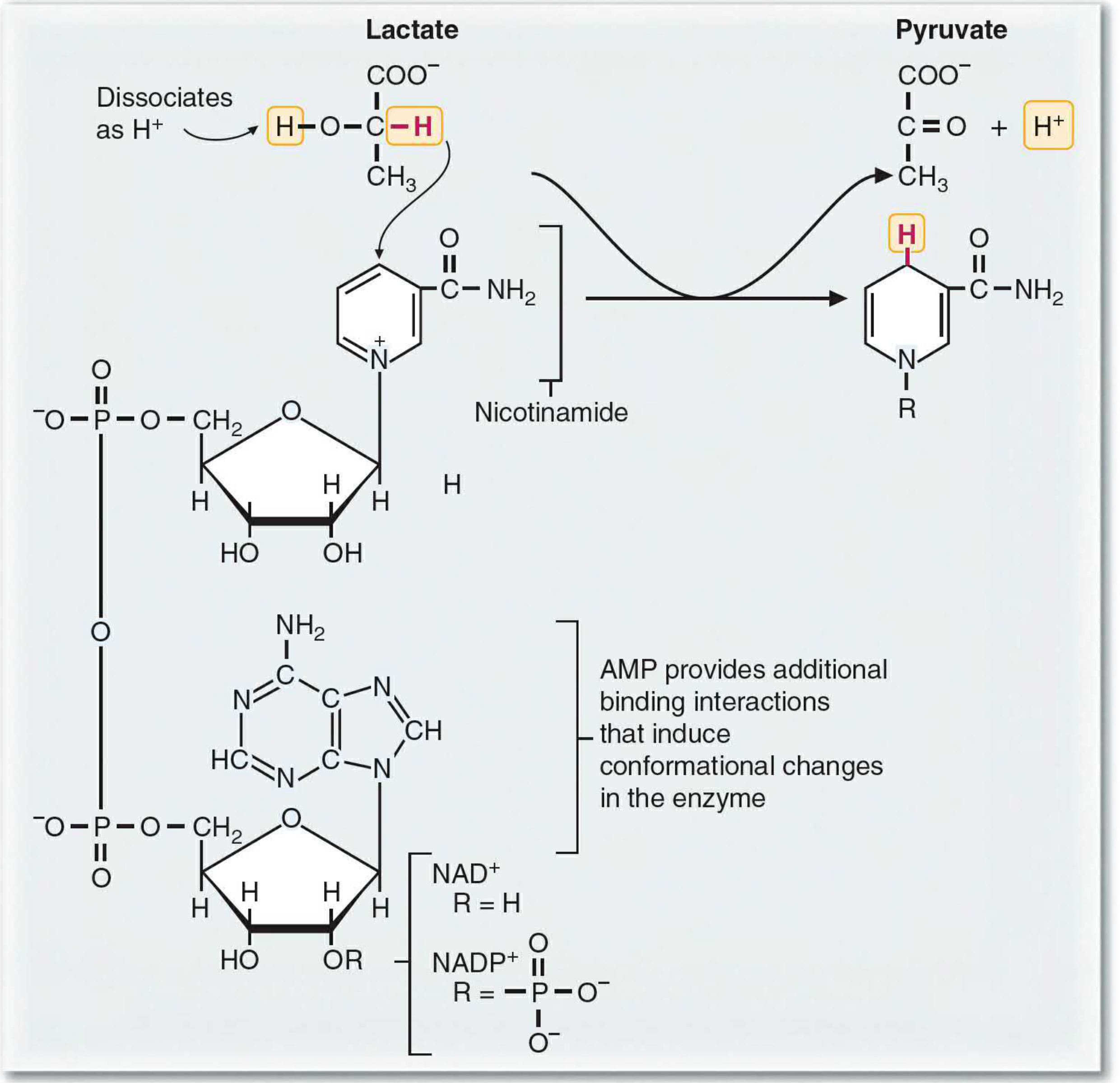
Figure: NAD⁺ accepts a hydride ion (shown in red) from lactate, producing NADH + pyruvate. NADP⁺ has the same mechanism but adds a phosphate group at the 2' position of adenosine ribose. - Basic Medical Biochemistry 6e, p.246
USMLE pearl - NAD vs NADP: NAD⁺ is used in catabolism (fuel oxidation = energy generation). NADPH is used in anabolism (biosynthesis) and antioxidant defense (glutathione reductase in RBCs). G6PD deficiency impairs NADPH production, leaving RBCs vulnerable to oxidative hemolysis.
USMLE pearl - FAD vs NAD: FAD is a prosthetic group (stays on the enzyme); NAD⁺ is a cosubstrate (dissociates). This is why succinate dehydrogenase cannot be inhibited competitively like NAD-dependent enzymes.
4. Vitamin-to-Coenzyme Quick Reference (High-Yield Table)
| Vitamin | Active Coenzyme Form | Key Reaction Type | Deficiency Disease |
|---|---|---|---|
| B1 - Thiamin | TPP (thiamin pyrophosphate) | Oxidative decarboxylation of alpha-keto acids | Beriberi, Wernicke-Korsakoff |
| B2 - Riboflavin | FAD, FMN | Oxidation-reduction | Cheilosis, corneal vascularization |
| B3 - Niacin | NAD⁺, NADP⁺ | Oxidation-reduction | Pellagra (dermatitis, diarrhea, dementia) |
| B5 - Pantothenate | CoASH (Coenzyme A) | Acyl group transfer | Rare (burning feet syndrome) |
| B6 - Pyridoxine | PLP (pyridoxal phosphate) | Transamination, decarboxylation | Peripheral neuropathy, sideroblastic anemia |
| B7 - Biotin | Biocytin (biotin-lysine) | CO₂ fixation (carboxylation) | Dermatitis, alopecia (raw egg whites, antibiotic use) |
| B9 - Folate | THF, 5,10-methylene THF | One-carbon transfers | Megaloblastic anemia, neural tube defects |
| B12 - Cobalamin | Adenosylcobalamin, Methylcobalamin | Isomerization (MMA mutase), methylation (methionine synthase) | Megaloblastic anemia + subacute combined degeneration |
| C - Ascorbate | Ascorbate (active itself) | Hydroxylation of proline/lysine | Scurvy |
- Harper's Illustrated Biochemistry 32e, p.147-152; Basic Medical Biochemistry 6e, p.242-244
5. Enzyme Classification (IUB System)
The International Union of Biochemistry classifies all enzymes into 6 main classes based on the reaction they catalyze:
| Class | Name | Reaction Catalyzed | Coenzyme Often Used | Examples |
|---|---|---|---|---|
| 1 | Oxidoreductases | Oxidation-reduction (transfer e⁻) | NAD⁺, FAD, NADP⁺ | LDH, succinate dehydrogenase, alcohol dehydrogenase |
| 2 | Transferases | Transfer functional groups (-CH₃, -NH₂, -phosphate) | PLP, TPP, CoA | Aminotransferases (AST, ALT), kinases, methyltransferases |
| 3 | Hydrolases | Hydrolysis (bond cleavage by adding H₂O) | None typically | Proteases (pepsin, trypsin), lipases, phosphatases |
| 4 | Lyases | Breaking bonds without hydrolysis or oxidation; adds/removes groups | PLP, TPP | Aldolase, pyruvate decarboxylase, citrate synthase |
| 5 | Isomerases | Rearranging atoms within the same molecule | None typically | Phosphoglucose isomerase, mutases, epimerases |
| 6 | Ligases | Joining two molecules using ATP (C-C, C-O, C-N, C-S bonds) | Biotin (for CO₂ ligations) | Pyruvate carboxylase, acetyl-CoA carboxylase, DNA ligase |
Mnemonic: O T H L I L - "Oh The Hell Let It Live" (Oxidoreductases, Transferases, Hydrolases, Lyases, Isomerases, Ligases)
6. Metal Ion Cofactors (USMLE High-Yield)
| Metal Ion | Key Enzymes | Clinical Relevance |
|---|---|---|
| Zinc (Zn²⁺) | Carbonic anhydrase, alcohol dehydrogenase, carboxypeptidase, DNA polymerase | Zinc deficiency: poor wound healing, ageusia, alopecia |
| Iron (Fe²⁺/Fe³⁺) | Cytochromes, catalase, peroxidase, ribonucleotide reductase | Iron deficiency anemia; iron overload (hemochromatosis) |
| Copper (Cu²⁺) | Cytochrome c oxidase, superoxide dismutase, lysyl oxidase, dopamine beta-hydroxylase, tyrosinase | Menkes disease (Cu²⁺ transport defect); Wilson disease (Cu accumulation) |
| Magnesium (Mg²⁺) | Kinases (activates ATP-Mg complex), enolase, DNA/RNA polymerases | Required for nearly all phosphoryl transfer reactions |
| Selenium (Se) | Glutathione peroxidase | Protects against oxidative damage; Keshan disease (deficiency) |
| Molybdenum (Mo) | Xanthine oxidase | Allopurinol inhibits xanthine oxidase (gout treatment) |
7. Key USMLE High-Yield Points Summary
- Apoenzyme + cofactor = Holoenzyme. Vitamin deficiency leaves inactive apoenzyme.
- Cosubstrate (e.g., NAD⁺) dissociates from enzyme in altered form. Prosthetic group (e.g., FAD) stays bound and is regenerated.
- TPP is the coenzyme for ALL alpha-keto acid dehydrogenases - deficit causes pyruvate/lactate buildup (Wernicke encephalopathy).
- PLP is the coenzyme for ALL transamination reactions. Isoniazid blocks PLP - always co-prescribe B6.
- Biotin is covalently attached and is the CO₂ carrier for all carboxylases. Inhibited by avidin (raw eggs).
- NAD⁺ = catabolism; NADPH = anabolism + antioxidant (critical in G6PD deficiency).
- FAD is tightly bound (prosthetic group); yields less ATP per pair of electrons than NADH (1.5 vs 2.5 ATP).
- Ligases use ATP to form bonds (they "ligate" molecules). Hydrolases use water to cleave bonds (no energy required).
Sources: Lippincott Illustrated Reviews: Biochemistry 8e, p.172; Basic Medical Biochemistry: A Clinical Approach 6e, p.241-246; Harper's Illustrated Biochemistry 32e, p.147-152
This is a shared conversation. Sign in to Orris to start your own chat.