
Acne vulgaris
Reading File
Now I'll run parallel searches across the library and PubMed for a comprehensive overview of acne vulgaris.
Finding Sources
Searching PubMed
"acne vulgaris"[MeSH Terms] AND treatment
Excellent results. Now let me read the most comprehensive sources in parallel - Harrison's 22E, Andrews' Dermatology, and Robbins Pathology.
Reading File
Reading File
Reading File
Now let me read the Harrison's treatment section and Andrews' treatment section in parallel.
Reading File
Reading File
Now let me read the Andrews' treatment section and fetch key clinical images in parallel.
Reading File
Loading Image
Loading Image
Now I have comprehensive data from multiple authoritative sources. Let me also fetch the Andrews' treatment table and the acne scarring image.
Reading File
Loading Image
I now have comprehensive, authoritative content from multiple textbooks. Here is the full, well-organized overview:
Acne Vulgaris
Definition and Epidemiology
Acne vulgaris is a chronic inflammatory disease of the pilosebaceous follicles. It is virtually universal in adolescence, affecting approximately 85% of teenagers to some degree, with peak frequency between ages 15-18 in both sexes. Males tend to have more severe, widespread disease due to higher androgen levels, while about 12% of women and 3% of men continue to have clinical acne until age 44. It remains primarily a disease of younger individuals, though 10-20% of adults experience persistent disease.
- Harrison's Principles of Internal Medicine 22E, p.434 | Andrews' Diseases of the Skin, p.278
Pathogenesis
Four interacting factors drive acne development:
- Follicular hyperkeratinization - Abnormal keratinization of the lower follicular infundibulum creates a keratin plug that blocks outflow of sebum to the skin surface.
- Sebaceous gland hypertrophy - Androgen-driven sebaceous gland enlargement at puberty increases sebum production (castrated males generally did not develop acne, establishing the androgen link).
- Cutibacterium acnes (formerly Propionibacterium acnes) colonization - These lipase-synthesizing bacteria colonize the follicle and convert lipid components of sebum into free proinflammatory fatty acids.
- Secondary inflammation - Follicular rupture releases oily/keratinous debris into the dermis, triggering an inflammatory foreign-body reaction with lymphocytes, neutrophils, and macrophages.
Once the follicular wall ruptures, keratin, sebum, and bacterial products spill into the dermis, resulting in the formation of inflammatory papules, pustules, and nodules.
- Robbins, Cotran & Kumar Pathologic Basis of Disease | Harrison's 22E
Clinical Features
Primary Lesion: The Comedone
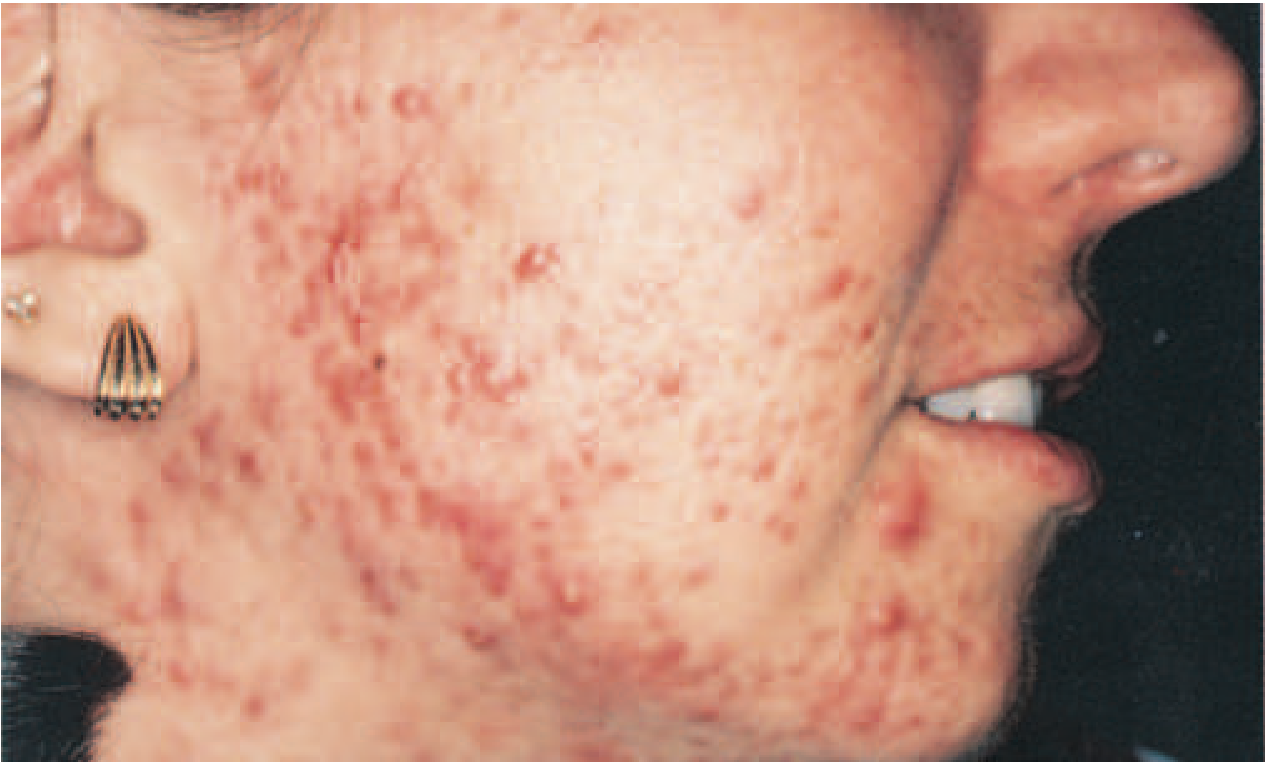
The comedone is the hallmark lesion and comes in two forms:
| Type | Appearance | Key Feature |
|---|---|---|
| Open (blackhead) | Dilated follicular orifice with darkened plug | Black color from melanin oxidation (not dirt); rarely causes inflammation |
| Closed (whitehead) | 1-2 mm pebbly white papule; requires skin stretching to see | Contents not easily expressed; precursor to inflammatory lesions |
Inflammatory Lesions
- Papules - 1-5 mm erythematous, edematous
- Pustules - Visible pus within the lesion
- Nodules/cysts - Deeper, larger; potential for scarring
- Acne conglobata - Severe variant with sinus tract formation and significant dermal scarring
Distribution
- Face is the most common site - cheeks, nose, forehead, chin
- Chest and back are commonly involved (upper trunk)
- Ears (comedones in the concha), neck (large cystic lesions in the nuchal area)
Scarring
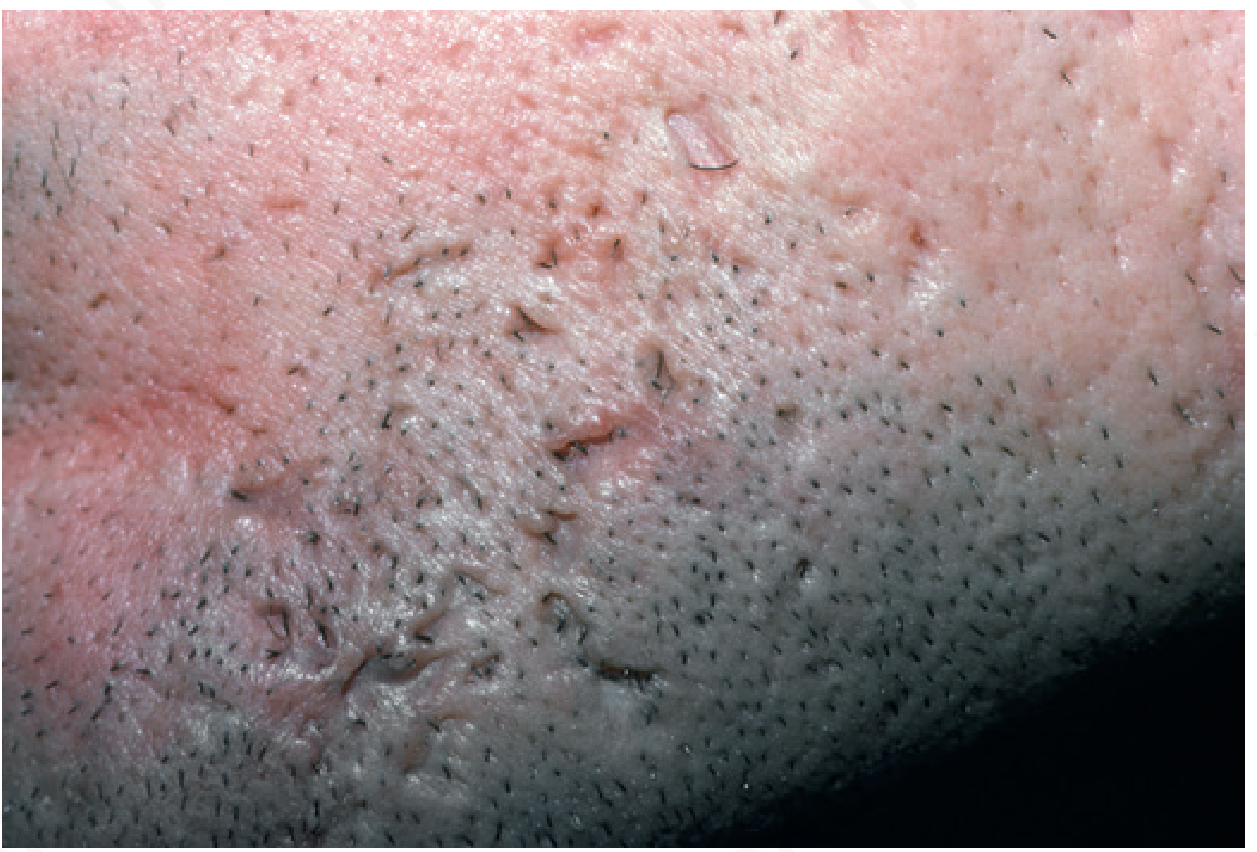
Scar morphologies include:
- Deep, narrow ice-pick scars (temples, cheeks)
- Canyon-type atrophic lesions (face)
- Hypertrophic/keloidal scars (neck, trunk)
- Post-inflammatory hyperpigmentation - especially prominent and prolonged in darker skin types
Age-related Patterns
| Age Group | Pattern |
|---|---|
| Neonatal (first days-weeks) | Transient facial papules/pustules; male predominance; usually self-limited |
| Early adolescence (8-12 yrs) | Predominantly comedonal on forehead/cheeks |
| Mid-adolescence | Inflammatory pustules and nodules appear; spread to other sites |
| Adult women (20-35 yrs) | Papules, pustules, deep nodules on jawline, chin, neck; often cyclical |
Histopathology
- Comedones show a thinned epithelium with a dilated follicular canal filled with lamellar, lipid-impregnated keratinous material.
- Pustular cases show folliculocentric abscesses surrounded by lymphocytes and polymorphonuclear leukocytes.
- Nodular lesions additionally show plasma cells, foreign body giant cells, and fibroblast proliferation.
- Epithelial-lined sinus tracts may form in severe disease.
- Andrews' Diseases of the Skin, p.279
Exacerbating Factors
- Mechanical/frictional - Headbands, chin straps, helmets, tight collars, surgical tape, orthopedic casts
- Topical comedogenics - Hair pomades, oil-based cosmetics, certain industrial compounds
- Drugs - Glucocorticoids (topical/systemic), anabolic steroids, testosterone, ACTH, lithium, cyclosporine, epidermal growth factor inhibitors, iodides, bromides
- Diet - High-glycemic diet, skim milk, and whey protein may worsen acne
- Hormonal - In women: PCOS, menstrual irregularities; premenstrual flares (about 1 week before menses)
- Vigorous scrubbing - Worsens acne by mechanical comedone rupture
Differential Diagnosis
Consider these when evaluating an acne-like presentation:
- Rosacea - Central facial erythema, telangiectasia, no comedones; older patients
- Folliculitis - Bacterial, fungal (Malassezia)
- Perioral dermatitis
- Drug-induced acneiform eruptions - Monomorphic papules/pustules (vs. pleomorphic acne)
- Hyperandrogenism / PCOS - Irregular menses, hirsutism, acanthosis nigricans
Workup for hyperandrogenism when clinically indicated: serum DHEAS, total and free testosterone, LH, FSH, androstenedione.
Treatment
Treatment targets all four pathogenic factors: normalize follicular keratinization, reduce sebum, suppress C. acnes, and decrease inflammation.
Topical Therapy (for mild-to-moderate disease)
| Agent | Mechanism | Notes |
|---|---|---|
| Topical retinoids (tretinoin, adapalene, tazarotene) | Normalize follicular desquamation; comedolytic | 8-12 weeks to judge efficacy; apply to entire affected area |
| Benzoyl peroxide | Antibacterial; oxidizing agent | Reduces antibiotic resistance; first-line |
| Topical antibiotics (clindamycin, erythromycin) | Anti-C. acnes | Must be combined with benzoyl peroxide to prevent resistance |
| Azelaic acid | Antibacterial, anti-inflammatory, comedolytic | Also addresses post-inflammatory hyperpigmentation |
| Salicylic acid | Promotes desquamation | Useful for comedonal acne |
| Dapsone | Anti-inflammatory | Especially useful in adult women |
| Clascoterone cream | Topical androgen receptor antagonist | FDA-approved; newer agent |
Key principle: Topical agents are preventive - apply to all acne-prone areas, not just individual lesions. Long-term use is standard.
Systemic Therapy (for moderate-to-severe inflammatory acne)
Oral antibiotics:
- Doxycycline or minocycline 100 mg twice daily (or extended-release lower-dose preparations)
- Adequate response expected at 3 months
- Have anti-inflammatory effects independent of their antibacterial action
- Always combine with topical benzoyl peroxide to limit resistance
Hormonal therapy (women):
- Several oral contraceptives are FDA-approved for acne treatment
- Spironolactone - Safe, effective, and durable antiandrogen; well-supported for women with hormonal acne
Isotretinoin (13-cis-retinoic acid):
- Reserved for severe nodulocystic acne unresponsive to other therapies
- Dosing is weight-based and cumulative
- Strong antisebaceous action produces lasting remission
- Strict regulatory requirements (iPLEDGE program in the US):
- Female patients require two negative pregnancy tests before initiation and one before each refill
- Patients counseled on risks of teratogenicity
- Common side effects: dry skin, cheilitis
- Severe extracutaneous adverse effects are rare
- Harrison's Principles of Internal Medicine 22E | Andrews' Diseases of the Skin
General/Non-pharmacologic Measures
- Gentle cleansing - avoid vigorous scrubbing
- Avoid comedogenic cosmetics (use non-comedogenic products)
- Consider reducing skim milk intake
- A low-glycemic diet may be beneficial for some patients
- Patient education on lesion formation, treatment timelines, and adherence is essential
Acne Scarring - Management
A 2024 network meta-analysis (PMID 39110247) found microneedling and its combinations with other treatments to be effective for acne scars. A 2025 meta-analysis (PMID 39509291) found isotretinoin combined with laser/light-based treatments superior to isotretinoin alone. Procedural options include:
- Microneedling (with or without PRP or radiofrequency)
- Chemical peels
- Laser resurfacing (ablative and non-ablative)
- Subcision (for tethered atrophic scars)
- Dermal fillers
Recent Evidence (2024-2025)
| Study | Finding |
|---|---|
| Podwojniak et al., J Eur Acad Dermatol Venereol 2025 (PMID 39269130) | Systematic review - cutaneous microbiome dysbiosis plays a mechanistic role in acne; microbiome-directed therapies are emerging |
| Kakpovbia et al., J Eur Acad Dermatol Venereol 2025 (PMID 38943431) | Network meta-analysis - combination topical therapies (retinoid + benzoyl peroxide + antibiotic) most effective for mild-to-moderate acne |
| Li et al., Arch Dermatol Res 2024 (PMID 39110247) | Microneedling combinations superior to microneedling alone for acne scars |
Summary: Severity-Based Approach
| Severity | First-Line Treatment |
|---|---|
| Mild comedonal | Topical retinoid ± salicylic acid |
| Mild-moderate inflammatory | Topical retinoid + benzoyl peroxide ± topical antibiotic |
| Moderate-severe inflammatory | Add oral doxycycline/minocycline; hormonal therapy in women |
| Severe nodulocystic / scarring | Oral isotretinoin |
Early intervention in severe or rapidly progressing acne is essential to prevent permanent scarring and the profound impact on quality of life.
Sources: Harrison's Principles of Internal Medicine 22E (2025) | Andrews' Diseases of the Skin 5e | Robbins, Cotran & Kumar Pathologic Basis of Disease | Goldman-Cecil Medicine
This is a shared conversation. Sign in to Orris to start your own chat.