
Dcld with hrs
Reading File
The query "Dcld with hrs" is quite brief. Let me clarify what you mean before diving in.
Asking for Preferences
What does 'Dcld with hrs' mean? Please pick the closest match:
Quick answer: Decompensated Chronic Liver Disease (DCLD) with Hepatorenal Syndrome (HRS) is a serious complication where advanced liver disease causes renal vasoconstriction and functional kidney failure. HRS-1 (acute) carries very high short-term mortality; HRS-2 (chronic) is linked to refractory ascites. Key management includes terlipressin + albumin as first-line, treating precipitants (infections, GI bleed), and bridging to liver transplant when possible.
Searching sources...
Finding Sources
Finding Sources
Searching PubMed
"hepatorenal syndrome" AND "liver disease" AND terlipressin
Good results. Now I'll read the most comprehensive sources in parallel - Harrison's, Sleisenger's, and Goldman-Cecil.
Reading File
Reading File
Reading File
I have rich content. Let me also grab the Sleisenger pathophysiology/treatment section and the HRS diagnostic criteria in detail.
Reading File
Searching PubMed
"hepatorenal syndrome" AND terlipressin
I now have comprehensive information. Let me also fetch the pathophysiology diagram from Sleisenger.
Loading Image
I have everything needed for a thorough answer. Here is the full synthesis:
Decompensated Chronic Liver Disease (DCLD) with Hepatorenal Syndrome (HRS)
Definition
HRS is a form of functional renal failure without intrinsic renal pathology that occurs in approximately 10-30% of hospitalized patients with cirrhosis and ascites. The kidneys are histologically normal - the failure is hemodynamic. It is essentially the extreme end of the splanchnic vasodilation - renal vasoconstriction cascade that underlies all fluid complications of advanced cirrhosis. - Harrison's Principles of Internal Medicine 22E
Pathophysiology
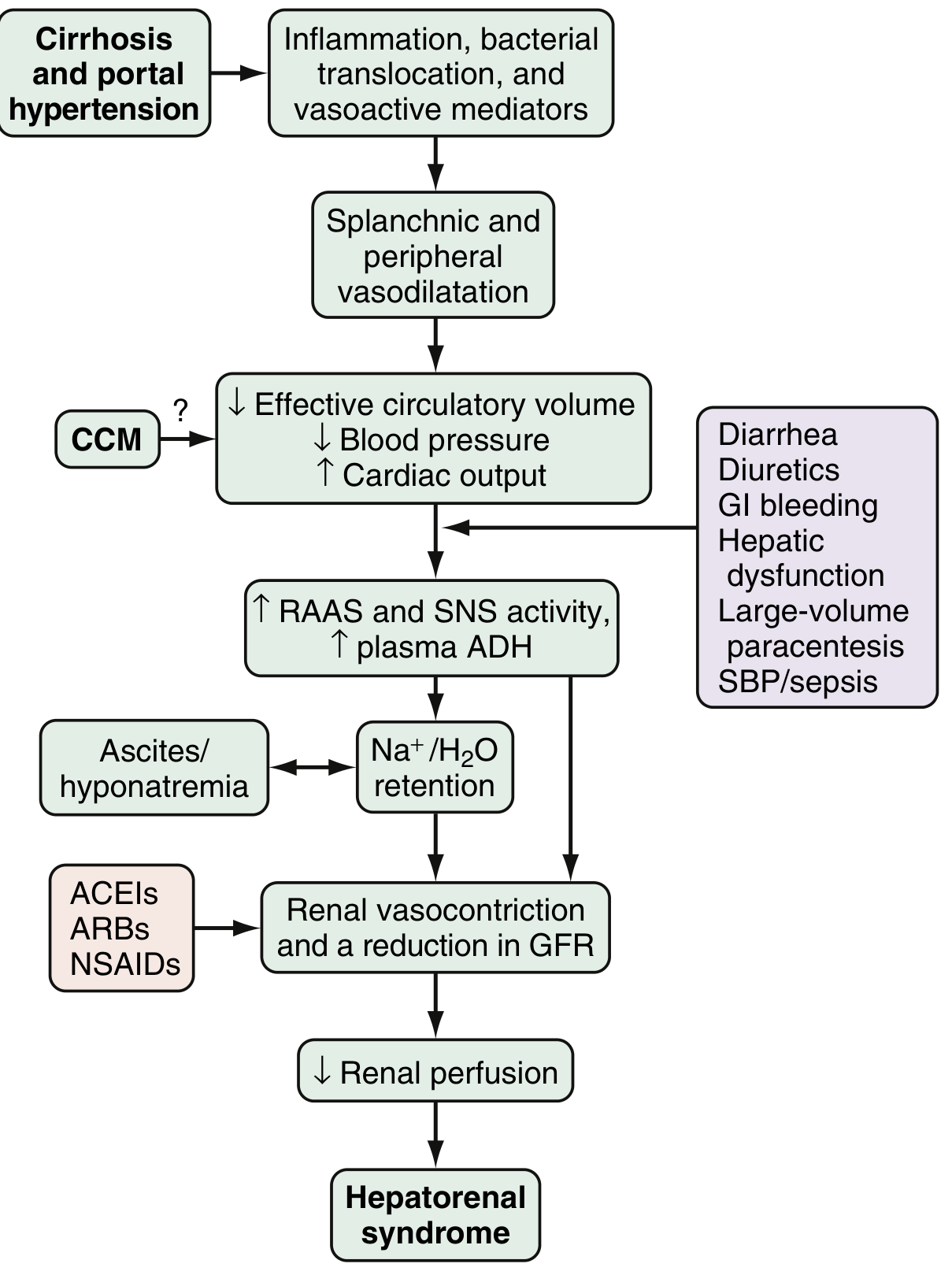
The mechanism is driven by 3 interconnected processes - Sleisenger & Fordtran's Gastrointestinal and Liver Disease:
-
Splanchnic + systemic vasodilation - Portal hypertension triggers release of vasoactive mediators (nitric oxide, CO, glucagon, prostacyclin) causing progressive splanchnic arterial dilation. This reduces effective circulating blood volume.
-
Compensatory renal vasoconstriction - Activation of RAAS, SNS, and increased ADH secretion compensate initially but eventually cause intense renal arterial vasoconstriction and a marked fall in GFR. Drugs like ACEIs, ARBs, and NSAIDs can worsen this directly.
-
Cirrhotic cardiomyopathy (CCM) - Impaired cardiac function further worsens renal hypoperfusion and is increasingly recognized as a contributor.
Precipitants include: SBP/sepsis (~30% of SBP episodes), GI bleeding, large-volume paracentesis without albumin, diarrhea, hepatic decompensation, and overdiuresis.
Classification (Updated ICA/ADQI Terminology)
| Old term | New term | Features |
|---|---|---|
| Type 1 HRS | HRS-AKI | Rapid progressive renal failure; creatinine doubles to >2.5 mg/dL in <2 weeks; high short-term mortality |
| Type 2 HRS | HRS-CKD | Slower, stable reduction in GFR; mainly in refractory ascites; better short-term prognosis but poor long-term |
AKI staging (ICA criteria) - Sleisenger & Fordtran's:
- Stage 1: Creatinine rise ≥0.3 mg/dL or ≥1.5-2x baseline
- Stage 2: Creatinine rise >2-3x baseline
- Stage 3: Creatinine rise >3x baseline OR ≥4 mg/dL with acute rise ≥0.3 mg/dL OR need for renal replacement therapy
Diagnosis
HRS is a diagnosis of exclusion - Goldman-Cecil Medicine. Steps required before diagnosing HRS-AKI:
- Stop diuretics
- Albumin volume expansion - 1 g/kg/day for 48 hours (max 100 g/day) - no significant improvement in creatinine
- Exclude other causes of AKI:
- Pre-renal: GI bleed, over-diuresis, diarrhea
- Intrinsic: acute tubular necrosis, acute interstitial nephritis, glomerulonephritis (check urine sediment, protein, casts)
- Obstructive: renal US
- Sepsis / SBP (diagnostic paracentesis in all admitted cirrhotics)
- Nephrotoxins: NSAIDs, aminoglycosides, contrast
- No sustained improvement after plasma expansion
Typical picture: tense ascites (often diuretic-refractory), hyponatremia, low urine sodium (<10 mEq/L), oliguria, rising creatinine - no proteinuria, no casts.
Treatment
Pharmacological (First-line)
| Agent | Details |
|---|---|
| Terlipressin (1st line) | Vasopressin analogue - splanchnic vasoconstrictor. 0.5-1 mg IV q4-6h, titrate up. FDA-approved (2022) in US. Most evidence. |
| Albumin (always with vasoconstrictors) | 20-40 g/day IV; volume expansion + anti-inflammatory effects |
| Norepinephrine (if no terlipressin) | ICU monitoring required; equivalent efficacy in several RCTs |
| Midodrine + Octreotide + Albumin | Third-line (US-based fallback when terlipressin unavailable); oral midodrine 7.5-12.5 mg TID + octreotide 100-200 mcg TID SC |
Terlipressin reverses HRS in ~40-50% of patients. - Harrison's 22E
Supportive
- Stop all nephrotoxins (NSAIDs, aminoglycosides, ACEIs/ARBs, contrast)
- Treat precipitants aggressively (antibiotics for SBP/sepsis; blood transfusion for GI bleed)
- Restrict fluid only if severe hyponatremia; avoid excessive free water
- Renal replacement therapy (dialysis/CRRT) - as a bridge to transplant, not standalone therapy
Definitive
- Liver transplantation (LT) is the only curative option - renal function typically recovers post-LT
- For HRS-CKD: simultaneous liver-kidney transplant (SLKT) may be needed if renal dysfunction persists >12 weeks
Prevention
- IV albumin 1.5 g/kg at SBP diagnosis + 1 g/kg on day 3 - reduces HRS development from ~30% to ~10% in SBP
- Norfloxacin prophylaxis in patients with low-protein ascites (<1.5 g/dL) + advanced cirrhosis reduces HRS risk
- Albumin post large-volume paracentesis (6-8 g per liter removed) prevents circulatory dysfunction
Prognosis
- HRS-AKI untreated: median survival 2-4 weeks
- HRS-AKI with terlipressin: 30-day survival improves significantly if reversal achieved
- HRS-CKD: median survival ~6 months without transplant
- Post-LT: renal recovery occurs in most HRS patients who had functional (not organic) failure
Recent evidence - A 2024 consensus statement from the ICA/ADQI (PMID 38527522) updated AKI staging and management in cirrhosis. A 2025 Annual Review (PMID 39869432) provides updated guidance from pathophysiology to treatment, including evolving roles for terlipressin and SLKT criteria.
Dcld
Reading File
Quick answer: Decompensated Chronic Liver Disease (DCLD) refers to advanced cirrhosis complicated by one or more major clinical events - ascites, variceal bleeding, hepatic encephalopathy, jaundice, or spontaneous bacterial peritonitis. It marks a critical shift from compensated cirrhosis (where the liver maintains function despite architectural damage) to a state of overt organ failure with high mortality.
Searching sources...
Finding Sources
Finding Sources
Searching PubMed
"decompensated cirrhosis" AND management
Excellent - Harrison's has a dedicated DCLD section with 5 sub-paragraphs. Let me read that along with Goldman-Cecil and Sleisenger in parallel.
Reading File
Reading File
Reading File
Good data. Now let me get the specific sections on each complication - management of ascites, variceal hemorrhage, encephalopathy, and SBP from Goldman-Cecil, and the scoring systems.
Reading File
Finding Sources
I have excellent content from Goldman-Cecil covering all major complications and scoring systems. Let me now compile a comprehensive answer.
Decompensated Chronic Liver Disease (DCLD)
Definition
At the stage of decompensation, cirrhosis is complicated by overt clinical events: ascites, variceal hemorrhage, jaundice, hepatic encephalopathy, or spontaneous bacterial peritonitis (SBP) - any combination of these. Ascites is the most frequent sign of decompensation, present in 80% of patients. - Goldman-Cecil Medicine
This contrasts with compensated cirrhosis, where architectural distortion exists but portal hypertension and synthetic dysfunction are subclinical.
Pathophysiology Overview
The central event is portal hypertension leading to:
- Splanchnic vasodilation (NO-mediated) → reduced effective circulating blood volume
- RAAS + SNS activation → sodium and water retention → ascites
- Progressive rise in portal pressure → varices → bleeding
- Reduced hepatic clearance of gut-derived toxins → encephalopathy
- Immune dysfunction + translocation of gut bacteria → SBP
Severity Scoring
Child-Turcotte-Pugh (CTP) Score (Range 5-15) - Goldman-Cecil Medicine
| Parameter | 1 pt | 2 pts | 3 pts |
|---|---|---|---|
| Ascites | None | Grade 1-2 (easy to treat) | Grade 3-4 (refractory) |
| Hepatic encephalopathy | None | Grade 1-2 | Grade 3-4 (spontaneous) |
| Bilirubin (mg/dL) | <2 | 2-3 | >3 |
| Albumin (g/dL) | >3.5 | 2.8-3.5 | <2.8 |
| PT (sec > control) / INR | <4 / <1.7 | 4-6 / 1.7-2.3 | >6 / >2.3 |
- Child A (5-6): Compensated
- Child B (7-9): Significant functional compromise
- Child C (10-15): Decompensated - high mortality
MELD-Na Score (Range 6-40)
MELD = [0.957 × ln(creatinine) + 0.378 × ln(bilirubin) + 1.12 × ln(INR) + 0.643] × 10
MELD-Na adjusts for serum sodium when MELD ≥12:
- MELD(Na) = MELD + 1.32 × (137 - Na) - [0.033 × MELD × (137 - Na)]
Used for transplant listing priority. MELD >15 generally favors listing for transplant.
Major Complications of DCLD
1. Ascites
- Most common decompensating event (7-10% per year in compensated cirrhosis)
- Develops from portal hypertension + RAAS activation + hypoalbuminaemia
Management:
- Sodium restriction (88 mEq/day = ~2 g/day)
- Diuretics: Spironolactone (100 mg/day, up to 400 mg) ± furosemide (40 mg/day, up to 160 mg) in 100:40 ratio
- Large-volume paracentesis (LVP) for tense/refractory ascites + albumin 6-8 g/L removed (prevents post-paracentesis circulatory dysfunction)
- TIPS (transjugular intrahepatic portosystemic shunt) for refractory ascites
- Refractory ascites: LVP every 2-4 weeks; TIPS if eligible; consider transplant listing
Hyponatremia (Na <130 mEq/L) is present in ~25% of cirrhosis with ascites; a marker of disease severity.
2. Variceal Hemorrhage
- Gastroesophageal varices present in ~50% of newly diagnosed cirrhosis; prevalence 40% (Child A) to 85% (Child C)
- Varices grow at 7-8%/year; large varices bleed at ~15%/year - Goldman-Cecil Medicine
- Predictors of bleeding: large varices, severe liver disease, red wale markings on endoscopy
Primary prophylaxis (before first bleed):
- Non-selective beta-blockers (NSBB): propranolol, nadolol, or carvedilol
- Endoscopic variceal ligation (EVL) for medium/large varices or if NSBB contraindicated/not tolerated
Acute variceal bleed (AVB) management:
- ABC stabilization - avoid over-transfusion (target Hb 7-8 g/dL; restrictive strategy reduces rebleeding)
- Vasoactive drugs (start immediately, before endoscopy): terlipressin, somatostatin, or octreotide for 3-5 days
- Prophylactic antibiotics: IV ceftriaxone 1 g/day for 7 days (reduces SBP and improves survival)
- Urgent endoscopy within 12 hours: EVL (preferred) or sclerotherapy
- TIPS if endoscopic treatment fails (salvage TIPS)
- Balloon tamponade (Sengstaken-Blakemore tube) as bridge only if bleeding uncontrolled
Secondary prophylaxis (after first bleed): NSBB + EVL (combination most effective)
3. Spontaneous Bacterial Peritonitis (SBP)
- ~1/3 of admitted cirrhotics have bacterial infection; SBP is most common
- Most frequent organisms: gram-negative enterics (E. coli, Klebsiella); increasingly multidrug-resistant organisms due to antibiotic prophylaxis
- Diagnosis: ascitic fluid PMN count >250 cells/µL (even without positive culture)
- Positive culture in only 40-50% cases
- Diagnostic paracentesis should be done at ANY admission of a cirrhotic patient, regardless of reason - Goldman-Cecil Medicine
Management:
- IV ceftriaxone or cefotaxime 5-7 days
- IV albumin 1.5 g/kg at diagnosis + 1 g/kg on day 3 → reduces HRS and mortality
- Long-term antibiotic prophylaxis after SBP: norfloxacin 400 mg/day (or ciprofloxacin/trimethoprim-sulfamethoxazole as alternatives)
4. Hepatic Encephalopathy (HE)
- Neuropsychiatric syndrome from gut-derived toxins (esp. ammonia) bypassing the liver
- Ranges from minimal HE (detectable only on psychometric tests) to overt HE (confusion, asterixis, coma)
- Ammonia levels correlate poorly with grade; not reliable for diagnosis or monitoring (levels >150 µmol/L are however suggestive) - Goldman-Cecil Medicine
- Precipitants: GI bleed, infection, hyponatremia, constipation, over-diuresis, sedatives, renal failure
Management:
- Identify and treat precipitant
- Lactulose (titrate to 2-3 soft stools/day) - first-line; reduces intestinal ammonia
- Rifaximin 550 mg BD - adds to lactulose for prevention of recurrence; minimal systemic absorption
- Dietary protein: do NOT restrict protein (worsens sarcopenia); prefer BCAA-enriched or vegetable protein
- Zinc supplementation (often deficient in cirrhotics)
5. Hepatorenal Syndrome (HRS)
- Functional renal failure in ~10-30% of hospitalized cirrhotics (see detailed HRS discussion above)
- HRS-AKI (old Type 1): rapid progressive, median survival 2-4 weeks untreated
- HRS-CKD (old Type 2): slower, associated with refractory ascites
6. Hepatopulmonary Syndrome (HPS) & Portopulmonary Hypertension (PPH)
- HPS: Intrapulmonary vascular dilation → shunting → hypoxemia (PaO2 <80 mmHg or A-a gradient >15 mmHg + contrast echocardiography showing shunt); treated by LT
- PPH: Pulmonary arterial hypertension in portal hypertension context; mPAP >25 mmHg; managed with pulmonary vasodilators; severe PPH (mPAP >50) is a contraindication to LT
General Management Principles
| Domain | Actions |
|---|---|
| Cause treatment | Treat underlying cause (antivirals for HBV/HCV, alcohol abstinence, weight loss for NASH) |
| Nutrition | High-calorie, high-protein (1.2-1.5 g/kg/day); BCAA supplements; late-evening snack |
| Sarcopenia | Exercise; high-protein diet; address zinc/vitamin deficiencies |
| Vaccinations | HAV, HBV, pneumococcus, influenza |
| Drugs to AVOID | NSAIDs (worsen renal function/ascites), sedatives, aminoglycosides, nephrotoxic contrast |
| Transplant listing | All Child C and MELD >15 should be evaluated; absolute priority in DCLD |
Prognosis
| Stage | 1-year survival |
|---|---|
| Compensated cirrhosis | ~95% |
| First decompensation | ~60% |
| Multiple decompensations / ACLF | <50% (grade-dependent) |
| ACLF Grade 3 (≥3 organ failures) | <20% |
Acute-on-chronic liver failure (ACLF) is a distinct, severe phenotype of rapid decompensation with multi-organ failure, high short-term mortality, and systemic inflammation as a key driver.
Recent update - A 2025 Lancet Gastroenterology & Hepatology review (PMID 40780235) covers the emerging concept of recompensation in DCLD - where targeted treatment of the underlying cause (e.g., antiviral therapy, alcohol abstinence) can reverse decompensation in a subset of patients, an important shift in prognosis thinking.
This is a shared conversation. Sign in to Orris to start your own chat.