
Grades of atelectasis and its management
Reading File
Now let me search the medical library for atelectasis content in parallel.
Finding Sources
Finding Sources
Searching PubMed
atelectasis classification management
Good - I have several textbook sources. Let me now read the most relevant ones in parallel - Goldman-Cecil Medicine and Fishman's Pulmonary are best for this topic.
Reading File
Reading File
Reading File
Now let me get more content from Goldman-Cecil on management and also search for grading/staging specifically.
Reading File
Finding Sources
Finding Sources
Let me search for grading systems (radiological/postoperative grading) and also fetch the Tintinalli's content for emergency management.
Reading File
Finding Sources
Searching the Web
grades of atelectasis radiological classification postoperative management
I have good content now. Let me also fetch the Sabiston content and search for the radiological grading scale specifically.
Reading File
Reading Web Page
https://publishingimages.s3.amazonaws.com/eZineImages/Practi…
Let me now fetch the chest X-ray image of atelectasis from Goldman-Cecil to include in the answer.
Loading Image
Loading Image
I now have comprehensive information from multiple authoritative textbooks. Let me compile the full answer.
Atelectasis: Grades (Types) and Management
Atelectasis (from Greek: ateles = incomplete + ektasis = expansion) is the loss of lung volume due to collapse of lung tissue. It is the most common respiratory complication in postoperative patients and can affect an entire lung, a lobe, a segment, or a subsegment.
Classification / "Grades" of Atelectasis
Atelectasis is classified in three overlapping ways: by pathophysiologic mechanism, by anatomical extent (which reflects clinical severity), and by radiographic pattern.
A. By Pathophysiologic Mechanism
| Type | Mechanism | Common Causes |
|---|---|---|
| Obstructive (Resorptive) | Airway blockage - gas distal to the obstruction is resorbed | Mucus plugs, foreign bodies, endobronchial tumors, external lymph node compression |
| Compressive (Passive / Relaxation) | Lung recoils inward due to adjacent pleural space process | Pleural effusion, pneumothorax, elevated hemidiaphragm |
| Adhesive | Alveolar instability from surfactant deficiency | ARDS, RDS of newborn, post-anesthesia |
| Cicatrization | Fibrotic contraction of lung parenchyma | Granulomatous disease (TB, sarcoid), radiation fibrosis |
| Replacement | Alveolar filling by cells or fluid | Tumor, infection, hemorrhage |
| Rounded (Folded Lung / Blesovsky's syndrome) | Pleural thickening invaginates and traps adjacent lung | Asbestos-related pleural disease, any chronic pleural disease |
- Goldman-Cecil Medicine, p. 918
B. By Anatomical Extent (Severity Grades)
This is the most clinically used grading system - ranked from least to most severe:
| Grade | Extent | Radiographic Finding | Clinical Significance |
|---|---|---|---|
| 1 - Subsegmental (Plate-like / Discoid / Linear) | Sub-segment only | Horizontal or curvilinear lines on CXR, often fleeting | Usually asymptomatic; very common postoperatively |
| 2 - Segmental | One bronchopulmonary segment | Triangular density, mild volume loss | May cause mild hypoxemia |
| 3 - Lobar | Entire lobe | Lobar consolidation, fissure displacement, mediastinal shift | Significant hypoxemia; often requires active treatment |
| 4 - Whole Lung | Entire lung | Complete opacification of hemithorax, massive mediastinal shift toward collapsed side | Severe respiratory failure; emergency management required |
- Tintinalli's Emergency Medicine, p. 1756; Goldman-Cecil Medicine, p. 918
C. By Radiographic Pattern
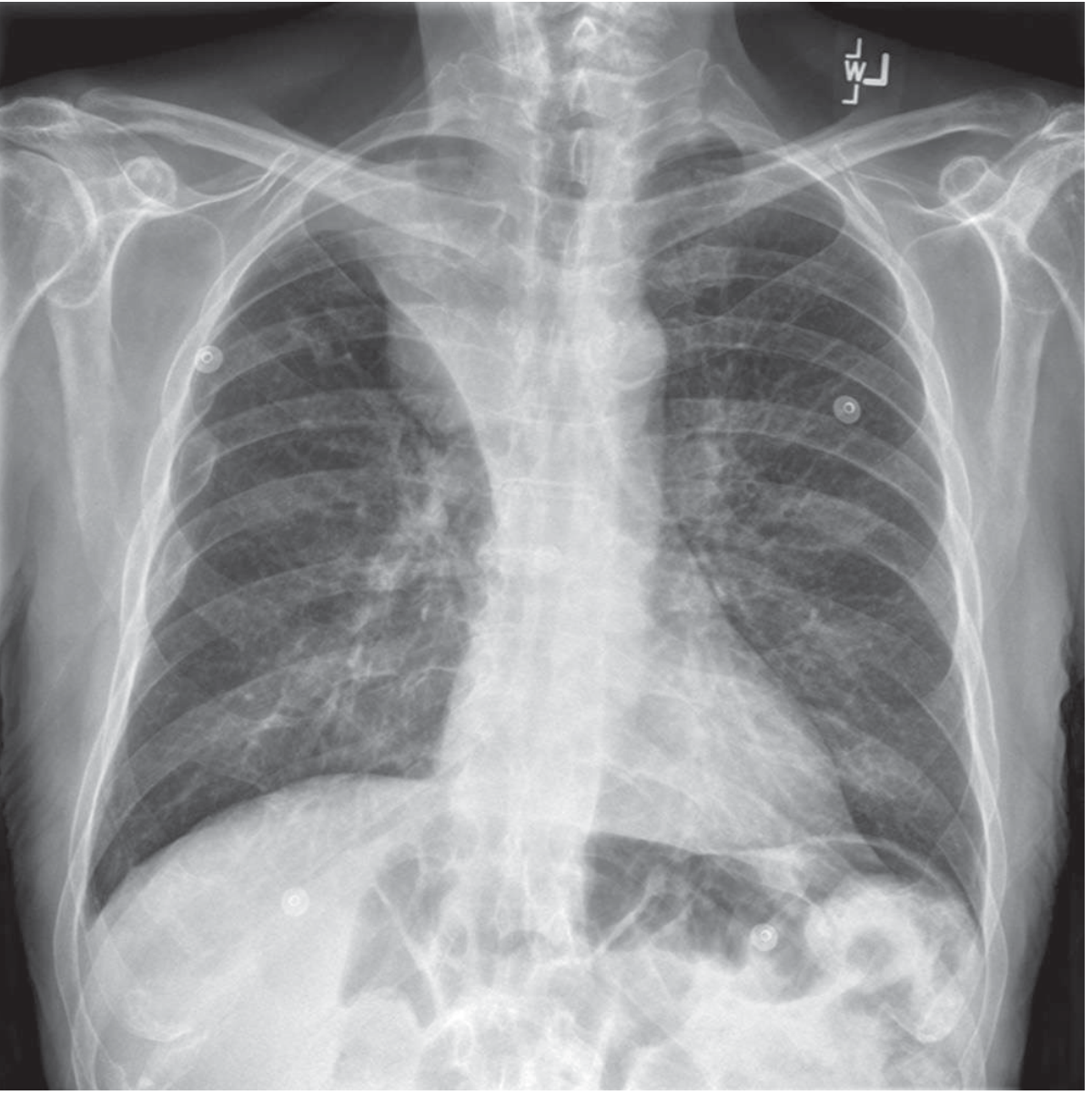
- Plate-like (linear/discoid): Horizontal lines, usually in lower zones; most common postoperative type
- Triangular density: Segmental involvement; base toward pleura
- Lobar consolidation: Dense opacification with fissure or mediastinal shift
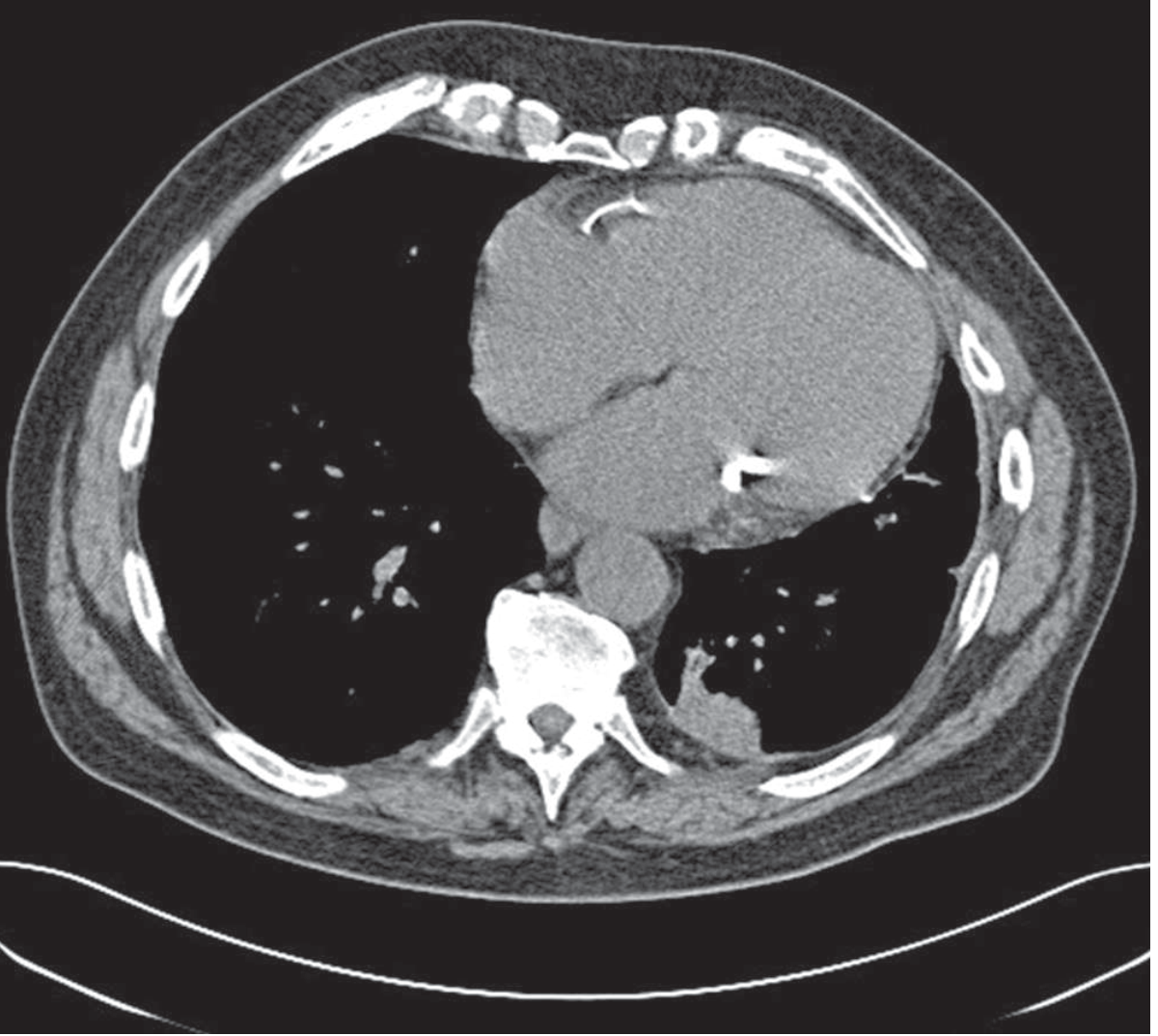
- Rounded atelectasis: Ovoid masslike density abutting the pleura - can mimic a tumor (important to distinguish via CT)
CXR - Right upper lobe atelectasis (endobronchial tumor):
CT - Rounded atelectasis:
Pathophysiology (Key Points)
-
Lung bases and posterior segments are most vulnerable due to dependent positioning
-
Anesthesia reduces FRC, impairs mucociliary clearance, and causes V/Q mismatch
-
Rapid, shallow breathing produces small airway closure with inspissated secretions, leading to alveolar air resorption
-
The result is hypoxemia (V/Q mismatch and shunt) proportional to the extent of atelectasis
-
Fever in the first 24-48 hours postoperatively is often attributed to atelectasis, though evidence for this association is debated
-
Barash Clinical Anesthesia, p. 3267; Sabiston Surgery, p. 446
Management
Management is tailored to the type and severity.
1. Prevention (Perioperative)
| Measure | Mechanism |
|---|---|
| Incentive spirometry | Increases tidal volume and FRC |
| Deep breathing exercises (5 sequential breaths, held 5-6 s) | Re-expands collapsed alveoli |
| Early ambulation and mobilization | Reduces dependent atelectasis |
| Adequate analgesia (multimodal - paracetamol + NSAIDs + regional blocks) | Reduces splinting and promotes deep breathing |
| Epidural analgesia (thoracic) | Shown to reduce atelectasis and pneumonia after thoracotomy |
| Chest physiotherapy | Clears secretions |
| Preoperative inspiratory muscle training | Reduces post-cardiac/upper abdominal surgery atelectasis |
| Oral care (ICOUGH protocol) | Reduces colonization, lowers pneumonia risk |
| Head-of-bed elevation | Prevents compression from abdominal contents |
2. Treatment by Grade
Subsegmental / Plate-like Atelectasis (Grade 1)
- Usually resolves spontaneously
- Deep breathing exercises, incentive spirometry, coughing
- Adequate pain control
- Mild hypoxemia: supplemental O2 via nasal cannula
- May manage as outpatient if no hypoxemia and no underlying disease
- Tintinalli's Emergency Medicine
Segmental / Lobar Atelectasis (Grades 2-3)
- Hospital admission if debilitated, underlying lung disease, or hypoxemia present
- Chest physiotherapy + bronchodilators
- CPAP / bilevel positive airway pressure (BiPAP) - increases transpulmonary pressure, expands alveoli
- Positioning: lateral decubitus with the healthy lung dependent (improves matching, facilitates mucus clearance from the obstructed lung)
- Exception: Do NOT place operative side down after pneumonectomy (risk of cardiac herniation)
- Bronchoscopy for mucus plugging not responding to physiotherapy
- Mechanical ventilation (increases airway pressure and transpulmonary pressure) if respiratory failure
- Goldman-Cecil Medicine, p. 918; Barash Clinical Anesthesia, p. 3267
Whole-Lung / Massive Atelectasis (Grade 4)
- Urgent bronchoscopy - both diagnostic (intrinsic vs. extrinsic obstruction) and therapeutic (mucus plug removal)
- Mechanical ventilation with PEEP
- Treat the underlying cause (tumor, foreign body, effusion drainage)
- Multiple bronchoscopies may be required for retained secretions, though mucus often reaccumulates until overall status improves
3. Treatment by Type
| Type | Specific Treatment |
|---|---|
| Obstructive / Resorptive | Bronchoscopy to remove obstruction (mucus plug, foreign body); treat endobronchial tumor |
| Compressive | Drain the pleural space (thoracocentesis for effusion, chest tube for pneumothorax) |
| Patchy / Adhesive | Treat underlying lung parenchymal disease (e.g., ARDS management, surfactant in neonates) |
| Rounded | No treatment required; CT to distinguish from malignancy |
| Cicatrization | Treat underlying fibrotic disease; surgical resection only if persistently symptomatic with good remaining lung function |
4. In Cystic Fibrosis
- Vigorous chest physiotherapy + antibiotics - often successfully re-expands the affected lung
- Bronchoscopy if physiotherapy fails (though not more effective than physiotherapy overall)
- Surgical resection of a persistently atelectatic/bronchiectatic lobe only if: remaining lung is in good condition, overall pulmonary function is adequate, and the affected segment is causing intolerable symptoms
- Fishman's Pulmonary Diseases, p. 1313
Key Diagnostic Points
| Modality | Findings |
|---|---|
| CXR | Loss of lung volume, fissure/mediastinal/diaphragm displacement toward involved lung; plate-like linear densities; air bronchograms |
| CT | More sensitive; shows cause (tumor, effusion, mucus plug); distinguishes rounded atelectasis from neoplasm |
| Bedside ultrasound | Confirms diagnosis; especially useful ICU/bedside |
| Pulse oximetry / ABG | SpO2 ≤96% on Venturi mask O2 after 30 min is moderately sensitive/specific for postoperative atelectasis |
| Bronchoscopy | Confirms intrinsic vs. extrinsic obstruction; defines exact pathology |
Sources: Goldman-Cecil Medicine 25e, p. 918 | Sabiston Textbook of Surgery 21e, p. 446 | Barash Clinical Anesthesia 9e, p. 3267 | Tintinalli's Emergency Medicine, p. 1756 | Fishman's Pulmonary Diseases and Disorders, p. 1313
Grades of atelectasis of ear and its management
Your credits are exhausted. You can purchase a top-up or subscribe to a plan to continue using Orris. If you're already subscribed, your daily credits will reset tomorrow.
This is a shared conversation. Sign in to Orris to start your own chat.