
PTA
Asking for Preferences
What does PTA refer to in your question?
The user is asking about PTA in the context of Salakya Tantra - the Ayurvedic branch dealing with diseases of the head and neck (eyes, ears, nose, throat). PTA in this context refers to Pratishyaya (nasal catarrh/rhinitis) or possibly another Salakya condition. Let me check the medical library first.
Searching sources...
Reading File
PTA in Salakya Tantra likely refers to Pratishyaya (nasal catarrh/rhinitis) - a major topic in Ayurvedic ENT. Let me search the library.
Finding Sources
Finding Sources
Searching the Web
PTA Pratishyaya Salakya Tantra Ayurveda nasal disease types treatment
Finding Sources
Reading Web Page
https://unisciencepub.com/wp-content/uploads/2020/11/Ayurved…
Reading Web Page
https://www.researchgate.net/publication/338995731_STANDARD_…
Here is a comprehensive overview of Pratishyaya (PTA) as described in Shalakya Tantra (the Ayurvedic branch of head and neck diseases):
Pratishyaya (Rhinitis/Nasal Catarrh) - Shalakya Tantra
Definition & Importance
Pratishyaya is one of the most important Nasa Rogas (nasal diseases) described in Shalakya Tantra. The term refers to nasal catarrh/rhinitis - a condition where vitiated Doshas accumulate in the nasal cavity causing discharge, obstruction, and related symptoms.
It holds a unique position: Pratishyaya is the only disease in Shalakya Tantra that can develop complications even before its signs and symptoms fully manifest. Therefore early treatment at the Purvaroopa (prodromal) stage is essential.
Nidana (Etiology/Causative Factors)
Aharaja Nidana (Dietary causes):
- Ajirna (indigestion)
- Sheeta Ambu (cold water)
- Ati Ambupana (excessive water intake)
- Mandagni (low digestive fire)
- Excessive intake of Guru (heavy), Madhura (sweet), Sheeta (cold) substances
Viharaja Nidana (Lifestyle causes):
- Vega Sandharana - suppression of natural urges (mentioned by all major Acharyas - Charaka, Sushruta, Vagbhat, Kashyapa)
- Rajah Sevan - exposure to dust
- Dhooma Sevana - exposure to smoke
- Ati Bhasana - excessive talking
- Ritu Vaishamya - seasonal changes
- Shirobhitapa - heat exposure to head
- Ratri Jagarana - night waking
- Avasyaya - exposure to fog/mist/dew
Purvaroopa (Prodromal Features)
- Shirogurutvam - heaviness in the head
- Kshvathu Pravartanam - repeated sneezing
- Angamarda - body ache
- Parihristaromata - generalised horripilation (goosebumps)
Classification (Types of Pratishyaya)
Most Acharyas (Sushruta, Vagbhata, Madhavakar, Bhava Mishra, Sharangadhara) describe 5 types. Charaka and Kashyapa accept only 4 (they do not include Raktaja). Rasa Ratna Samuchchaya describes 6 types.
1. Vataja Pratishyaya
Charaka (C.Ch.26/105):
- Ghranarti Toda - pricking pain in nose
- Kshavathu - sneezing
- Jalabhasrava - watery nasal discharge
- Swarabheda - hoarseness of voice
- Shirashoola - headache
Sushruta (Su.Ut.24/6-7):
- Anadhapihita Nasa - nasal obstruction and stiffness
- Tanusrava pravartini - watery nasal discharge
- Galtalvoshath shosha - dryness of throat, palate, lips
- Shankh Nistoda - pricking sensation in temporal region
- Swaropa ghata - hoarseness of voice
Vagbhata (A.H.Ut.19/3-4):
- Mukhshosha - dryness of mouth
- Bhranshma Shava - sneezing
- Ghranoprodha - nasal blockage
- Nistoda Danta Shankh - pricking in temporal region and teeth
- Shirovaytha - headache
- Kitika eva Sarpanti - ant-like crawling sensation around eyebrows
- Swarsaad - hoarseness
- Chiratpaka - late, viscous secretion
- Shishira Kaphashruti - watery nasal secretion
2. Pittaja Pratishyaya
Charaka (C.Chi.26/106):
- Nasagrapaka - inflammation of tip of nose
- Jwara - fever
- Vaktrashosha - dryness of mouth
- Trishna - thirst
- Ushnapittasrava - hot and yellow nasal discharge
Sushruta (S.S.Ut.24/8):
- Ushnapittaksrava - hot and yellow nasal discharge
- Krishata - weakness
- Panduta - pallor
- Trishna - thirst
- Dhumravahini Vamana - vomiting
Vagbhata (A.H.Ut.19/5):
- Trishna - thirst
- Jwara - fever
- Ghranapitika - furuncles in nose
- Bhrama - giddiness
- Nasagrapaka - inflammation of tip of nose
- Ushnatamrapittasrava - hot yellowish nasal discharge
3. Kaphaja Pratishyaya
Charaka (C.Chi.26/106):
- Kasa - cough
- Aruchi - anorexia
- Ghanasrava - thick nasal discharge
- Kandu - itching
Sushruta:
- Shukla-sheeta srava - whitish nasal discharge
- Shuklaavabhasa - whitish appearance
- Shoonakshi - swelling around eyes
4. Raktaja Pratishyaya
(Described by Sushruta and Vagbhata; not accepted by Charaka and Kashyapa)
- Features similar to Pittaja with bloody nasal discharge
5. Sannipataja Pratishyaya
- Mixed features of all three Doshas
- More severe and complex clinical picture
6. Dushta Pratishyaya (Complication)
If any type of Pratishyaya is neglected or improperly treated, it progresses to Dushta Pratishyaya - the most severe form with tissue destruction and further complications (can progress to ozena, nasal polyp, etc.).
Samprapti (Pathogenesis)
Due to exposure to causative factors, Vata gets aggravated first. This aggravated Vata then involves other Doshas and they accumulate in the nasal cavity (Nasa), producing the various types of Pratishyaya. If untreated, it causes tissue depletion (Dhatu Kshaya) and further complications.
Chikitsa (Treatment)
General Principle - all types:
- Nidana Parivarjana - removal of causative factors (first step)
- Sneha - oleation
- Sweda - sudation/fomentation
- Vamana - therapeutic emesis
- Avapeedana Nasya - nasal drops (instillation therapy)
- Ghritapana - oral intake of medicated ghee (except in Navin/fresh Pratishyaya)
- Dhumapana - medicated fumigation/smoking
Per Sushruta: Langhana + Deepana/Pachana Dravyas + Swedana + Vamana + Avapeedana Nasya are the core treatments.
Specific Treatments by Dosha:
| Type | Key Treatment |
|---|---|
| Vataja | Snehana, Nasya with Sneha, Gritapana, Dhumapana, Swedana |
| Pittaja | Sheeta (cooling) treatment, Virechana |
| Kaphaja | Vamana, Ruksha Nasya (dry/stimulant nasya), Dhumapana |
| Sannipataja | Tridoshic approach |
| Dushta | Shodhana Panchakarma, stronger formulations |
Key Therapeutic Modalities:
- Nasya (Nasal drops): Shadbindu Taila, Hingvadi Taila for oleation nasya
- Dhumapana (Medicated fumigation): Gandha Dravyadi Dhuma (cinnamon, cardamom, Mesua ferrea, Cinnamomum tamala)
- Gandusha - medicated gargles/mouth holding
- Shiro Abhyanga - head massage with herbal oils
- Nasa Prakshalana - nasal wash/rinsing
External/Lifestyle Measures:
- Avoid cold breeze, mist, dust, smoke
- Stay in wind-free rooms
- Wear warm/protective clothing
- Cover the head with a turban (protecting ears)
- Regular exercise
- Avoid excessive speaking, night waking, daytime sleeping
Sadhyasadhyata (Prognosis)
| Type | Prognosis |
|---|---|
| Vataja (fresh/Navin) | Sadhya (curable) |
| Pittaja (fresh) | Sadhya |
| Kaphaja (fresh) | Sadhya |
| Sannipataja | Kashtasadhya (difficult to cure) |
| Dushta Pratishyaya | Yapya or Asadhya (palliable/incurable) |
Key references: Charaka Chikitsa Sthana 26, Sushruta Uttaratantra 24, Ashtanga Hridayam Uttaratantra 19, Madhava Nidana, Bhava Prakasha.
PTA
I'll assume you want to continue with Pratishyaya in Shalakya Tantra - let me know if you mean something else.
Are you looking for more detail on a specific aspect?
Asking for Preferences
Which aspect of Pratishyaya do you want to focus on?
The full Pratishyaya overview was already covered in my previous response. Here is a quick-reference summary for revision:
Pratishyaya (PTA) - Quick Revision Card
Types (5 per Sushruta; 4 per Charaka - no Raktaja)
| Type | Key Feature |
|---|---|
| Vataja | Watery discharge, sneezing, hoarseness, headache |
| Pittaja | Hot yellow discharge, fever, thirst, tip of nose inflamed |
| Kaphaja | Thick white discharge, cough, itching, eye swelling |
| Raktaja | Bloody discharge (Sushruta & Vagbhata only) |
| Sannipataja | Mixed features of all Doshas |
| Dushta | Complication of neglected/undertreated Pratishyaya |
Purvaroopa (4 prodromal signs)
- Shirogurutvam - head heaviness
- Kshavathu Pravartanam - sneezing
- Angamarda - body ache
- Parihristaromata - horripilation
Treatment (common to all types)
Sneha → Sweda → Vamana → Nasya → Dhumapana → Gandush
- Nasya: Shadbindu Taila, Hingvadi Taila
- Dhumapana: Gandha Dravyadi Dhuma
- Ghritapana: oral medicated ghee (not in fresh/Navin)
- Nidana Parivarjana is always the first step
Prognosis
- Vataja/Pittaja/Kaphaja (fresh) = Sadhya (curable)
- Sannipataja = Kashtasadhya
- Dushta = Yapya/Asadhya
Key References
- Sushruta Uttaratantra 24
- Charaka Chikitsa Sthana 26
- Ashtanga Hridayam Uttaratantra 19
If you want deeper detail on any specific type, Dushta Pratishyaya, or specific formulations, just ask.
No
My apologies! What does PTA refer to in your context?
Asking for Preferences
What does PTA stand for in your question?
Pure Tone Audiometry (PTA) is a key topic in Shalakya Tantra (ENT). Let me pull comprehensive information from the medical library.
Searching sources...
Finding Sources
Searching the Web
Pure Tone Audiometry PTA procedure interpretation audiogram hearing loss ENT
Excellent - found dedicated sections in Scott-Brown's, KJ Lee's, and Shambaugh. Let me read the most comprehensive ones simultaneously.
Reading File
Reading File
Reading File
Reading File
Reading File
Reading File
Reading File
Now I have comprehensive textbook content. Let me also fetch the audiogram images to include visuals.
Loading Image
Loading Image
Loading Image
Excellent - I now have comprehensive textbook content and audiogram images. Here is the full overview:
Pure Tone Audiometry (PTA)
Definition
PTA is a behavioral hearing test that measures hearing sensitivity thresholds at discrete frequencies across the range important for human communication. The threshold is defined as the softest sound audible to an individual at least 50% of the time. Thresholds are plotted on an audiogram - a graph of intensity (dB HL) vs frequency (Hz).
- Shambaugh Surgery of the Ear, p. 221; KJ Lee's Essential Otolaryngology, p. 296
Audiometric Zero
- 0 dB HL = average normal hearing threshold (defined statistically from normal-hearing individuals)
- Standard deviation is ~5 dB, so 99% of normals fall between -15 to +15 dB HL
Prerequisites / Requirements for Valid Testing
- Quiet test environment - a sound-treated booth (to measure 0 dB HL thresholds)
- Calibrated audiometer - annual calibration + routine clinical verification
- Trained personnel - preferably a licensed audiologist
- Proper earphone placement - supra-aural or insert earphones; bone oscillator on mastoid/forehead
- Otoscopic inspection before testing
- Clear, age-appropriate instructions to the patient
- Patient comfort
- KJ Lee's Essential Otolaryngology, p. 296
Frequencies Tested
- Standard octave frequencies: 250, 500, 1000, 2000, 4000, 8000 Hz
- Inter-octave frequencies (750, 1500, 3000, 6000 Hz): tested if there is a ≥25 dB difference between adjacent octave thresholds
- 3000 and 6000 Hz are also acquired for baseline audiograms in noise-exposed individuals or those receiving ototoxic drugs
Components of PTA
1. Air Conduction (AC)
- Tests the entire auditory pathway: ear canal → middle ear → cochlea → auditory nerve → brainstem
- Delivered via supra-aural headphones or insert earphones
2. Bone Conduction (BC)
- Bypasses the outer and middle ear; tests cochlea → auditory nerve → brainstem only
- Delivered via bone oscillator placed on the mastoid or forehead
- BC is indicated whenever AC thresholds are ≥15 dB HL
Air-Bone Gap (ABG)
- Difference between AC and BC thresholds
- ABG > 10 dB = conductive component present
- Reflects the contribution of outer and middle ear pathology to hearing loss
Audiogram Symbols (ASHA Standard)
| Symbol | Ear | Type |
|---|---|---|
| O | Right | Unmasked AC |
| X | Left | Unmasked AC |
| Δ | Right | Masked AC |
| □ | Left | Masked AC |
| < | Right | Unmasked BC |
| > | Left | Unmasked BC |
| [ | Right | Masked BC |
| ] | Left | Masked BC |
Types of Hearing Loss on PTA
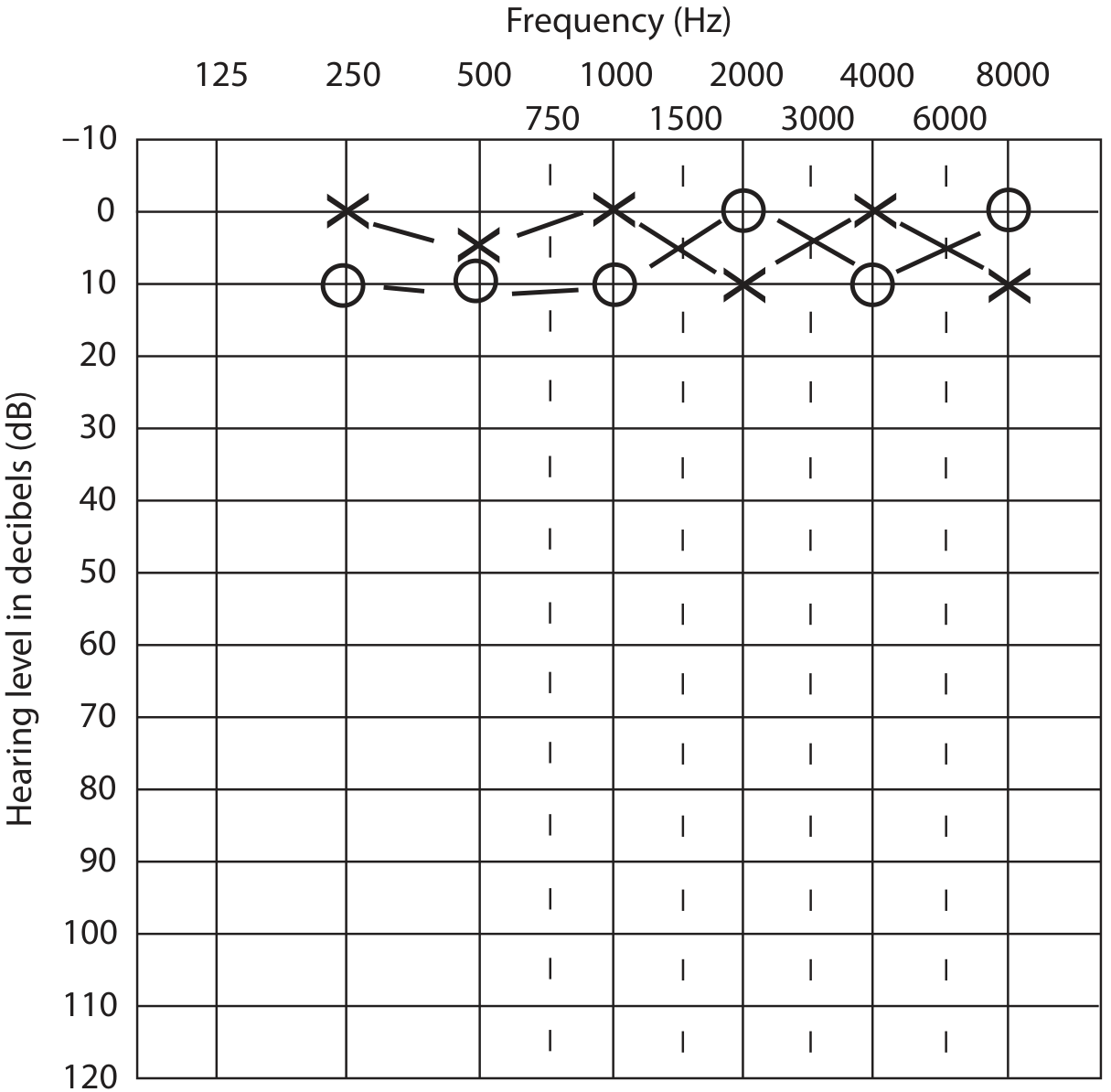
Normal Hearing Audiogram
All AC thresholds ≤ 25 dB HL (adults); ≤ 15 dB HL (children). No ABG.
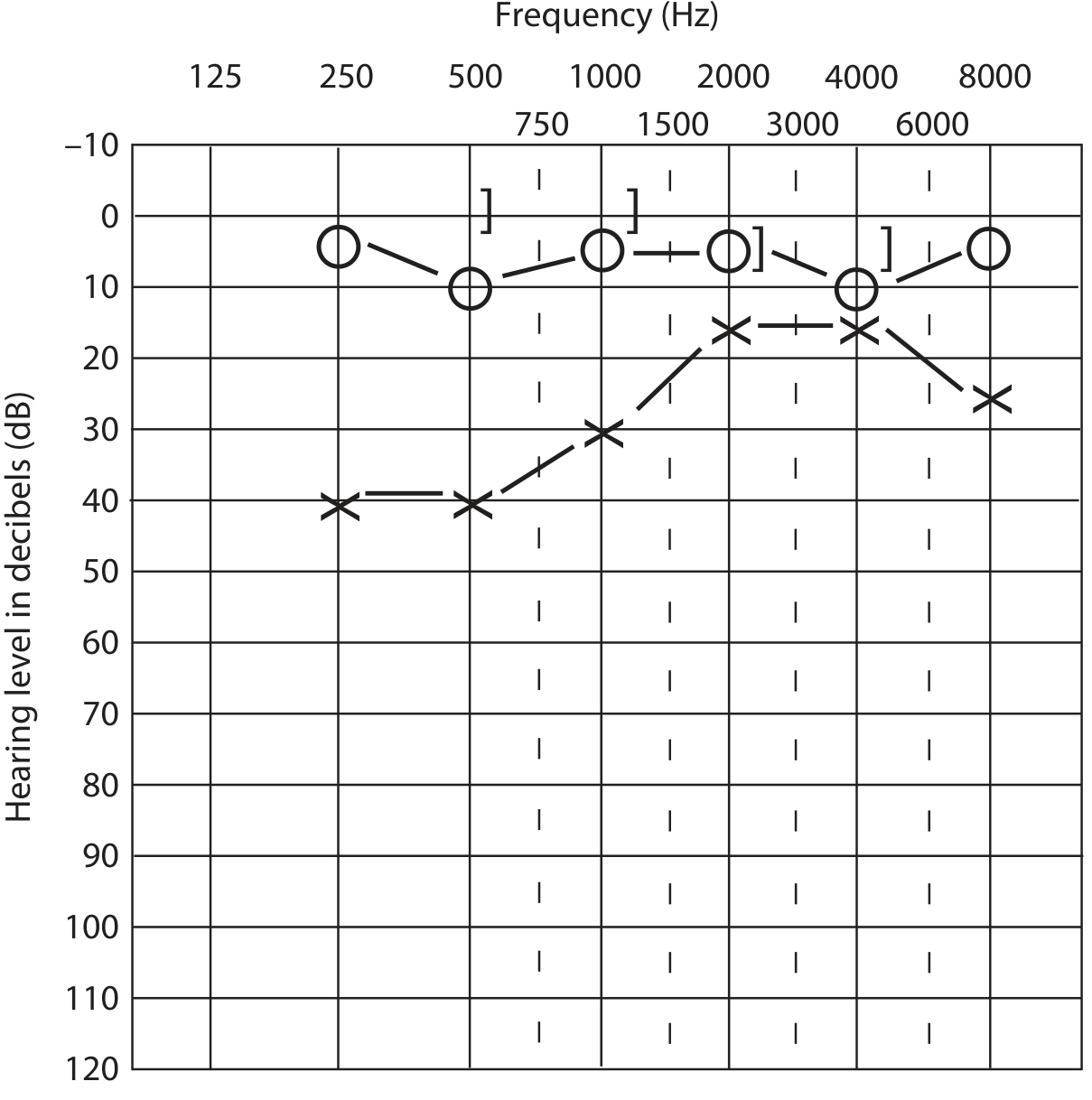
Conductive Hearing Loss (CHL)
- AC thresholds elevated (>25 dB HL), BC thresholds normal
- ABG present (>10 dB)
- Pathology in outer ear or middle ear
- Examples: otitis media with effusion, otosclerosis, perforated TM, ossicular discontinuity
Sensorineural Hearing Loss (SNHL)
- Both AC and BC thresholds elevated, no significant ABG (<10 dB gap)
- Pathology in cochlea (sensory), auditory nerve (neural), or central auditory nervous system
- Examples: noise-induced HL, presbycusis, Meniere's disease, acoustic neuroma
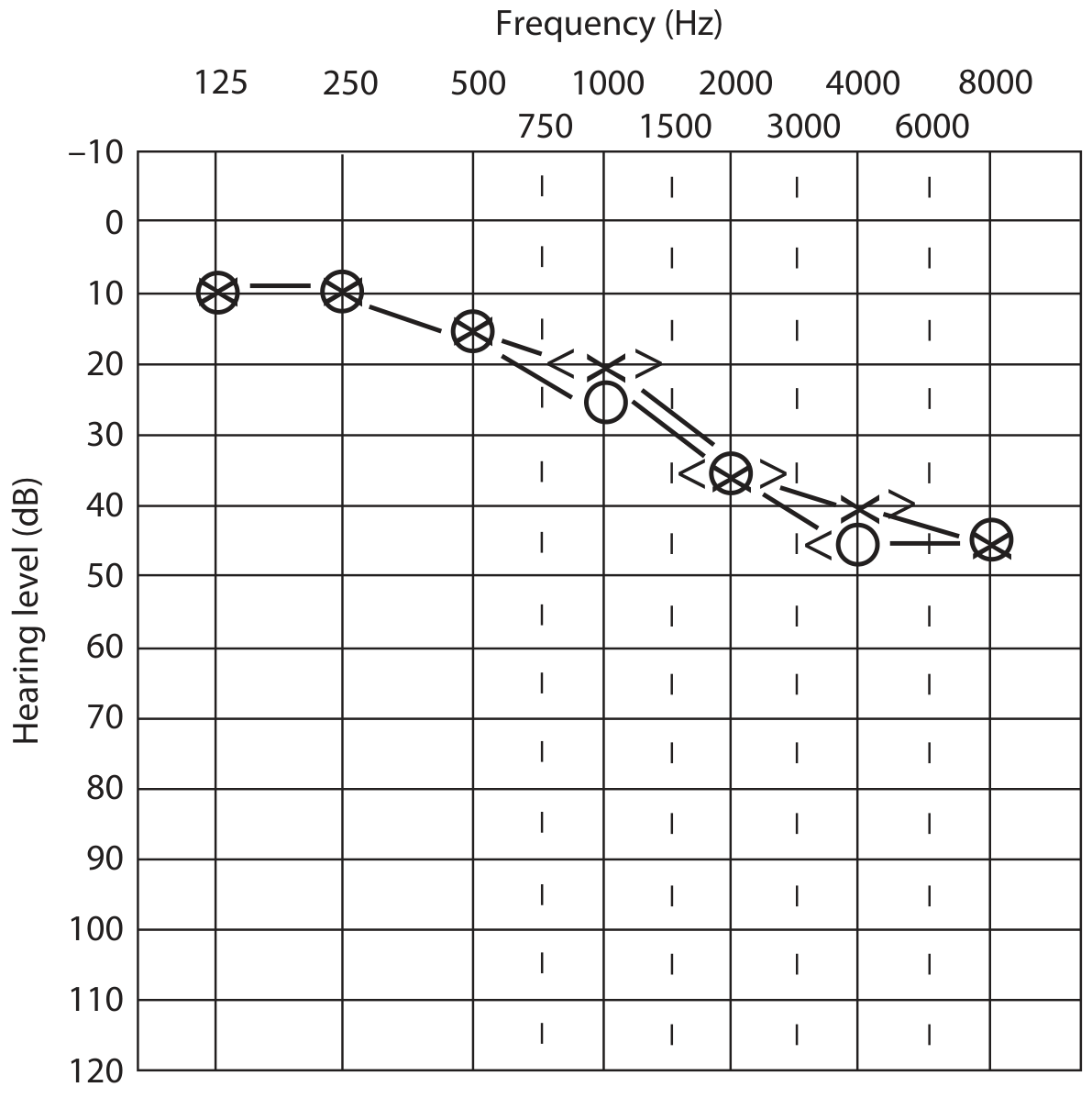
Mixed Hearing Loss
- Both AC and BC thresholds elevated, with ABG present
- Indicates conductive pathology overlaid on sensorineural pathology
- Examples: chronic suppurative otitis media (CSOM) with cochlear damage
Degree of Hearing Loss (Classification)
| Threshold (dB HL) | Degree |
|---|---|
| -10 to 15 | Normal |
| 15-25 | Minimal |
| 25-40 | Mild |
| 40-55 | Moderate |
| 55-70 | Moderately Severe |
| 70-90 | Severe |
| >90 | Profound |
- Shambaugh Surgery of the Ear, p. 221
Configuration (Shape) of Audiogram
| Configuration | Description | Common Etiology |
|---|---|---|
| Flat | Similar thresholds across all frequencies | Mixed HL, CSOM |
| Rising | Better at high frequencies | Conductive HL |
| Sloping/Falling | Better at low frequencies, worse at high | SNHL, presbycusis |
| Notched | Dip at 4000 Hz | Noise-induced HL (classic 4 kHz notch) |
| Saucer-shaped | Better at low and high, worse in mid | Meniere's disease (early), certain SNHL |
| Falling | Progressive drop toward high frequencies | Age-related HL |
Masking
Masking is introducing noise into the non-test ear to prevent it from detecting signals meant for the test ear (via bone conduction vibration through the skull = crossover).
When to Mask
Rule A - Air Conduction: Mask the non-test ear when:
AC stimulus to the test ear exceeds BC threshold of the non-test ear by ≥40 dB (supra-aural earphones) or ≥70 dB (insert earphones)
Rule B - Bone Conduction: Mask the non-test ear when:
There is an ABG >10 dB in the test ear
Interaural Attenuation (IA)
- AC with supra-aural headphones: 40-65 dB (varies by frequency)
- AC with insert earphones: >70 dB (often eliminates need for masking)
- BC: 0-10 dB (crossover can occur at 0 dB HL - masking almost always required for BC)
Masker Used
-
Pure tones: narrow-band noise centered at the frequency being tested
-
Speech: speech-spectrum noise
-
KJ Lee's Essential Otolaryngology, p. 297
Pure Tone Average (PTA)
The PTA is the average of AC thresholds at 500, 1000, and 2000 Hz - the speech frequencies. It:
- Predicts speech reception threshold (SRT) - should be within ±6 dB of SRT
- Used to classify degree of hearing loss
- Used in medicolegal assessment of disability
Behavioral Audiometry in Children
| Age Group | Method |
|---|---|
| 0-6 months | Behavioral Observation Audiometry (BOA) |
| 6 months - 2 years | Visual Reinforcement Audiometry (VRA) |
| 2-5 years | Conditioned Play Audiometry (CPA) |
| >5 years | Standard PTA |
Clinical Significance of PTA Findings
| Finding | Significance |
|---|---|
| Asymmetric SNHL (unexplained) | Suspect retrocochlear disorder (acoustic neuroma) |
| 4 kHz notch (BC and AC) | Noise-induced hearing loss |
| Low-frequency SNHL | Meniere's disease (early) |
| ABG with normal BC | Middle ear disorder |
| Poor word recognition disproportionate to PTA | Retrocochlear (CN VIII) pathology |
- Shambaugh Surgery of the Ear, p. 227; Scott-Brown's Otorhinolaryngology Vol.2
Sources: Shambaugh - Surgery of the Ear; KJ Lee's Essential Otolaryngology, 11th ed.; Scott-Brown's Otorhinolaryngology Head & Neck Surgery Vol.2
This is a shared conversation. Sign in to Orris to start your own chat.