
How hypokalemia develops in conns syndrome
Reading File
In Conn's syndrome (primary hyperaldosteronism), hypokalemia results from excess aldosterone driving urinary potassium wasting. Aldosterone acts on the principal cells of the cortical collecting duct to increase Na⁺ reabsorption, which creates an electronegativity that pulls K⁺ (and H⁺) into the tubular lumen for excretion.
Searching sources...
Finding Sources
Finding Sources
Good results. Now let me read the most relevant detailed sections.
Reading File
Reading File
Reading File
Now let me get the detailed mechanism from Harrison's (the most authoritative source) and also search for aldosterone mechanism on ENaC/principal cells:
Reading File
Finding Sources
Reading File
Reading File
I now have comprehensive information to give a detailed, well-cited answer. Let me also fetch the key diagram showing the principal cell mechanism.
Loading Image
I have everything needed for a thorough answer. Here is a detailed explanation:
How Hypokalemia Develops in Conn's Syndrome (Primary Hyperaldosteronism)
Conn's syndrome is caused by autonomous (non-renin-mediated) secretion of aldosterone by the adrenal cortex - most commonly from an aldosterone-producing adenoma (60-70% of cases) or bilateral adrenal hyperplasia. The excess aldosterone directly drives renal potassium wasting through a well-defined tubular mechanism.
Step 1: Aldosterone Acts on the Principal Cell of the Cortical Collecting Duct
Aldosterone is a mineralocorticoid that binds to the mineralocorticoid receptor (MR) in the principal cells of the cortical collecting duct (CCD) and connecting tubule (CNT). This is the primary site of regulated K⁺ excretion in the kidney.
Upon binding MR, aldosterone upregulates the expression and activity of three key proteins simultaneously:
| Protein | Location | Effect |
|---|---|---|
| ENaC (epithelial Na⁺ channel) | Apical membrane | More Na⁺ enters the cell from lumen |
| Na⁺/K⁺-ATPase | Basolateral membrane | Pumps Na⁺ out to blood, pulls K⁺ into cell |
| Apical K⁺ channels (ROMK) | Apical membrane | K⁺ secreted from cell into lumen |
- Comprehensive Clinical Nephrology, 7th Ed - "In the cortical collecting duct principal cell, K⁺ secretion involves integrated functions of the basolateral Na⁺, K⁺-ATPase, apical Na⁺ channel (ENaC), and apical K⁺ channel. Aldosterone stimulates this process through interaction with the mineralocorticoid receptor (MR), resulting in increased expression and activity of each of these processes."
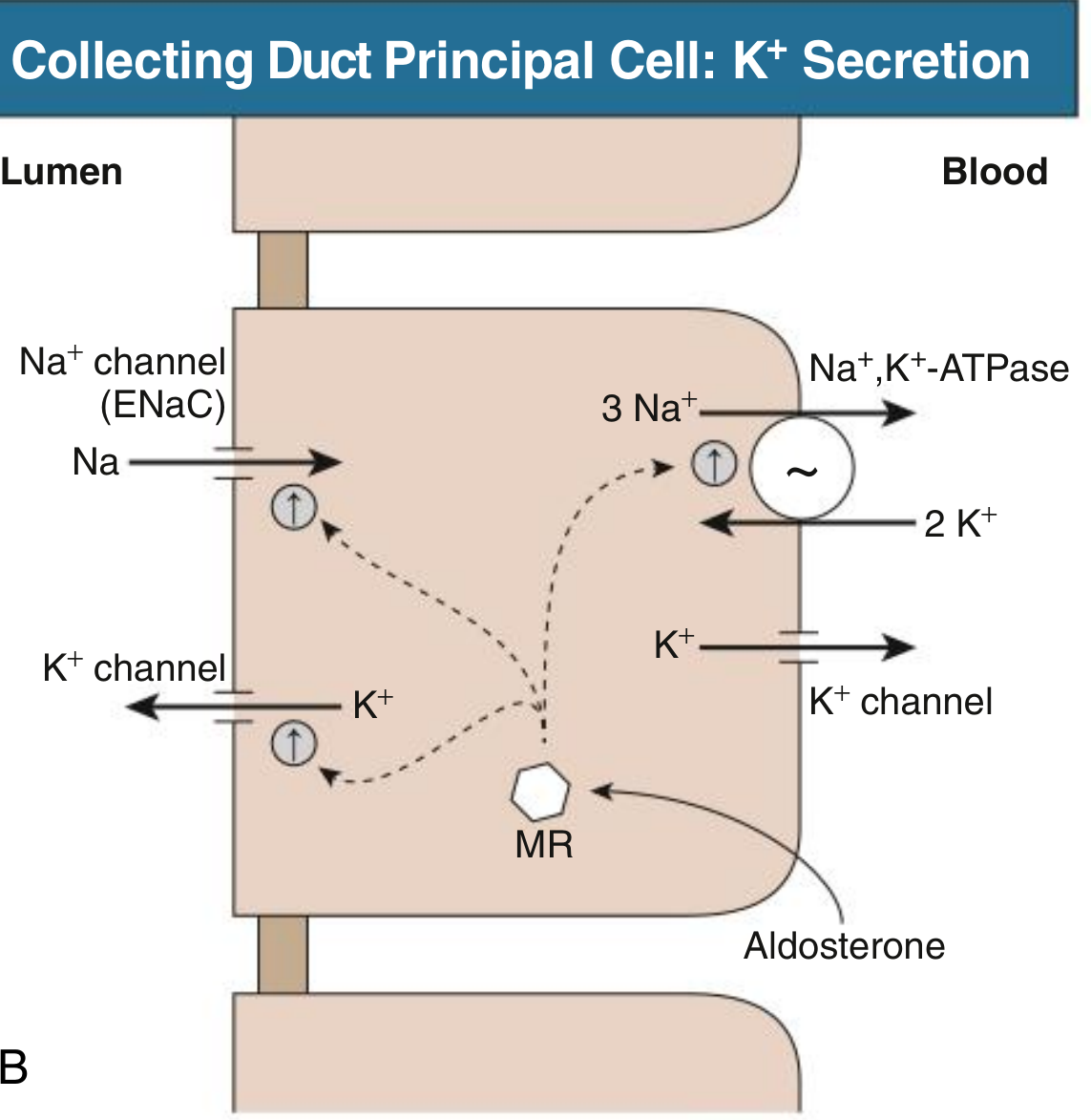
Step 2: The Electrochemical Driving Force for K⁺ Secretion
The key mechanism is electrogenic:
- Excess aldosterone causes massive Na⁺ reabsorption via ENaC from the tubular lumen into the principal cell
- This makes the tubular lumen electronegative relative to the cell interior (lumen-negative transepithelial potential difference)
- This electrical gradient acts as a powerful driving force pulling K⁺ (positively charged) out of the cell and into the lumen through apical K⁺ channels (ROMK)
- The basolateral Na⁺/K⁺-ATPase continuously replenishes intracellular K⁺ from the blood, keeping the cycle going
- K⁺ that accumulates in the lumen is then excreted in urine
In parallel, H⁺ is also secreted by alpha-intercalated cells (driven by the same lumen-negative potential), which explains the accompanying metabolic alkalosis.
- Harrison's Principles of Internal Medicine 22E - "Aldosterone activates the ENaC channel in principal cells via multiple synergistic mechanisms, thus increasing the driving force for K⁺ excretion."
Step 3: Volume Expansion Suppresses Renin - But K⁺ Loss Continues
Na⁺ retention causes mild volume expansion and raises blood pressure. This suppresses renin (and angiotensin II). However, the adenoma (or hyperplastic gland) continues secreting aldosterone autonomously, independent of renin - so the potassium-wasting drive is unrelenting.
- NKF Primer on Kidney Diseases, 8e - "Primary hyperaldosteronism is due to autonomous (non-renin-mediated) secretion of aldosterone by the adrenal cortex. This results in avid sodium retention and potassium secretion by the distal nephron. Patients present with volume-dependent hypertension, hypokalemia, and metabolic alkalosis."
Why Hypokalemia Occurs Despite Normal Dietary Intake
Normally, aldosterone secretion is feedback-inhibited by volume expansion and hyperkalemia would suppress it. In Conn's syndrome:
- The gland secretes aldosterone constitutively
- The kidney cannot compensate - it keeps losing K⁺ regardless of serum K⁺ levels
- Total body K⁺ depletion ensues
Clinical Note on Frequency
Importantly, frank hypokalemia (K⁺ < 3.5 mEq/L) is not universal - it occurs in fewer than 40% of patients with primary hyperaldosteronism, and is even less common with adrenal hyperplasia than with adenomas.
- Mulholland & Greenfield's Surgery, 7e - "Significant hypokalemia occurs in less than 40% of patients with primary hyperaldosteronism and is even less frequent in cases caused by adrenal hyperplasia, therefore hypokalemia is neither a sensitive nor specific marker of primary hyperaldosteronism."
Consequences of Hypokalemia in Conn's
| Effect | Mechanism |
|---|---|
| Muscle weakness and fatigue | K⁺ required for normal resting membrane potential |
| Polyuria / polydipsia | Hypokalemia impairs renal concentrating ability (nephrogenic DI) |
| Fasting hyperglycemia | K⁺ depletion impairs insulin secretion from beta cells |
| Metabolic alkalosis | Concurrent H⁺ loss from alpha-intercalated cells |
| ECG changes | Prolonged QT, U waves, ventricular arrhythmias |
Summary in One Sentence
Excess autonomous aldosterone in Conn's syndrome over-activates ENaC and Na⁺/K⁺-ATPase in collecting duct principal cells, creating a lumen-negative electrochemical gradient that continuously drives K⁺ into the urine, depleting total body potassium and producing hypokalemia.
This is a shared conversation. Sign in to Orris to start your own chat.