
Write note on apostasis
apoptosis
apoptosis NCBI Bookshelf mechanisms intrinsic extrinsic pathway
https://www.ncbi.nlm.nih.gov/sites/books/NBK499821
Apoptosis
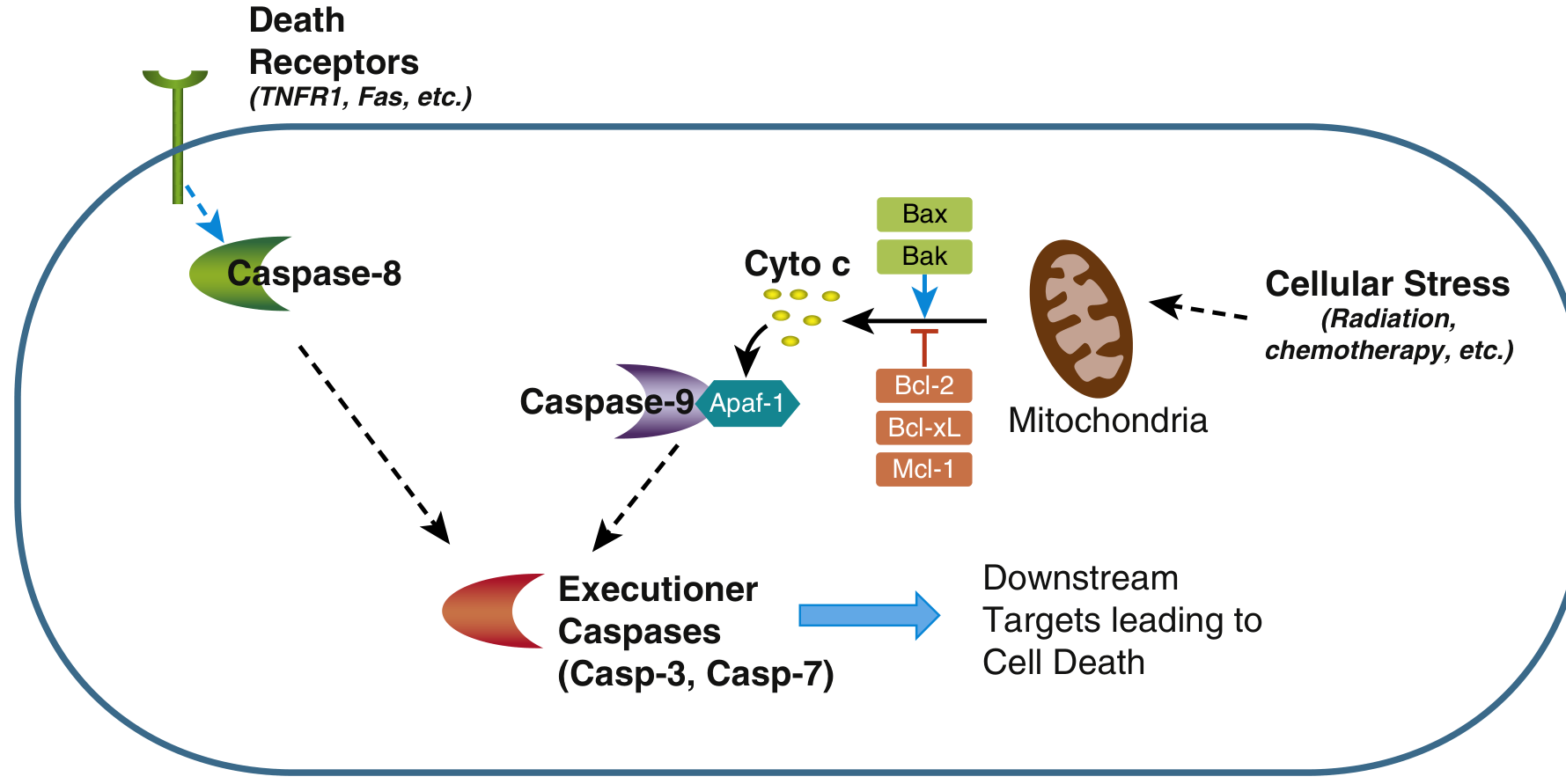
Morphological features
- Cell shrinkage and cytoplasmic condensation
- Chromatin condensation (pyknosis)
- Nuclear fragmentation (karyorrhexis)
- Membrane blebbing
- Formation of membrane-bound apoptotic bodies
- Rapid phagocytosis by macrophages or adjacent cells
- Minimal leakage of cell contents, hence little or no inflammatory reaction
Biochemical basis
- Initiator caspases: caspase-8, caspase-9
- Executioner caspases: caspase-3, caspase-6, caspase-7
Pathways of apoptosis
1. Intrinsic or mitochondrial pathway
- DNA damage
- Hypoxia
- Nutrient deprivation
- Radiation, toxins, or chemotherapy
- Misfolded proteins and severe cellular stress
- Stress activates pro-apoptotic Bcl-2 family members, particularly Bax and Bak.
- They increase mitochondrial outer-membrane permeability.
- Cytochrome c is released into the cytoplasm.
- Cytochrome c combines with Apaf-1 and procaspase-9 to form the apoptosome.
- Caspase-9 activates executioner caspases, especially caspase-3 and caspase-7.
2. Extrinsic or death-receptor pathway
- Fas (CD95)
- TNF receptor 1 (TNFR1)
3. Cytotoxic T-cell pathway
- Fas-Fas ligand interaction
- Perforin, which creates membrane pores
- Granzyme B, which enters the target cell and activates caspases
Physiological roles
- Embryogenesis and tissue sculpting, for example separation of fingers and toes
- Hormone-dependent involution, such as endometrial shedding and post-lactational breast involution
- Elimination of self-reactive lymphocytes
- Termination of immune responses
- Removal of senescent, damaged, infected, or mutated cells
Clinical significance
- Reduced apoptosis allows abnormal cells to survive and contributes to cancer and autoimmune disease. For example, excess Bcl-2 activity may promote tumour-cell survival.
- Excess apoptosis contributes to neurodegenerative disease, ischemic injury, and some viral infections.
- Defects in apoptosis can permit survival of cells with DNA damage, facilitating malignant transformation.
Apoptosis versus necrosis
| Feature | Apoptosis | Necrosis |
|---|---|---|
| Nature | Programmed, regulated | Uncontrolled cell injury/death |
| Cell size | Shrinkage | Swelling |
| Plasma membrane | Intact until apoptotic bodies form | Disrupted |
| Cell contents | Contained and phagocytosed | Leak into surrounding tissue |
| Inflammation | Usually absent | Marked |
| DNA breakdown | Internucleosomal, orderly fragmentation | Random degradation |
Create a one-page PDF revision note on apoptosis
~/
apoptosis
apoptosis intrinsic extrinsic pathway NCBI Bookshelf
mkdir -p "/tmp/workspace/apoptosis-revision-note/src" "/tmp/workspace/apoptosis-revision-note/output" && python - <<'PY' from reportlab.lib.pagesizes import A4 from reportlab.pdfgen import canvas from reportlab.lib import colors from reportlab.lib.units import mm from reportlab.pdfbase.pdfmetrics import stringWidth from pypdf import PdfReader out='/tmp/workspace/apoptosis-revision-note/output/Apoptosis_One_Page_Revision_Note.pdf' W,H=A4 c=canvas.Canvas(out,pagesize=A4) c.setTitle('Apoptosis - One-Page Revision Note') c.setAuthor('Orris') # Palette NAVY=colors.HexColor('#10324A'); TEAL=colors.HexColor('#167A7A'); BLUE=colors.HexColor('#EAF5F6') INK=colors.HexColor('#1E2933'); MUTED=colors.HexColor('#52616B'); PALE=colors.HexColor('#F5F8FA') RED=colors.HexColor('#9D3145'); GREEN=colors.HexColor('#286B4D'); GOLD=colors.HexColor('#C58728') # Helpers def text(x,y,s,font='Helvetica',size=8,color=INK): c.setFont(font,size); c.setFillColor(color); c.drawString(x,y,s) def wrap(s,font,size,width): words=s.split(); lines=[]; line='' for w in words: trial=(line+' '+w).strip() if stringWidth(trial,font,size)<=width: line=trial else: lines.append(line); line=w if line: lines.append(line) return lines def para(x,y,s,width,font='Helvetica',size=7.3,leading=9,color=INK,bullet=None): c.setFillColor(color); c.setFont(font,size) indent=0 if bullet: c.drawString(x,y,bullet); indent=8 for i,line in enumerate(wrap(s,font,size,width-indent)): c.drawString(x+indent,y-i*leading,line) return y-len(wrap(s,font,size,width-indent))*leading def box(x,y,w,h,title,accent=TEAL): c.setFillColor(colors.white); c.setStrokeColor(colors.HexColor('#D8E1E6')); c.setLineWidth(.7) c.roundRect(x,y-h,w,h,4,fill=1,stroke=1) c.setFillColor(accent); c.roundRect(x,y-20,w,20,4,fill=1,stroke=0) c.rect(x,y-20,w,5,fill=1,stroke=0) text(x+8,y-13,title,'Helvetica-Bold',9,colors.white) # header c.setFillColor(NAVY); c.rect(0,H-43*mm,W,43*mm,fill=1,stroke=0) c.setFillColor(colors.white); c.setFont('Helvetica-Bold',24); c.drawString(16*mm,H-21*mm,'APOPTOSIS') c.setFont('Helvetica',9); c.drawString(16*mm,H-29*mm,'Programmed cell death | High-yield pathology revision') c.setFillColor(colors.HexColor('#64D3CC')); c.roundRect(W-58*mm,H-28*mm,40*mm,12*mm,6,fill=1,stroke=0) c.setFillColor(NAVY); c.setFont('Helvetica-Bold',8.5); c.drawCentredString(W-38*mm,H-23.7*mm,'CASPASE-MEDIATED') m=12*mm; gap=5*mm; col=(W-2*m-gap)/2; top=H-48*mm # left: definition + morphology box(m,top,col,56*mm,'CORE CONCEPT',TEAL) y=top-29 para(m+8,y,'A regulated, energy-dependent form of cell death that removes unwanted, damaged or potentially harmful cells without provoking significant inflammation.',col-16,'Helvetica',8,10) y-=31 text(m+8,y,'KEY IDEA', 'Helvetica-Bold',7.5,TEAL); y-=11 para(m+8,y,'Balances cell proliferation and preserves tissue homeostasis.',col-16,'Helvetica-Oblique',7.6,9,MUTED,bullet='•') box(m,top-61*mm,col,69*mm,'MORPHOLOGY & BIOCHEMISTRY',RED) y=top-61*mm-29 items=[ ('Cell shrinkage','dense cytoplasm; membrane blebs'), ('Nucleus','chromatin condensation → fragmentation'), ('DNA','orderly internucleosomal fragmentation'), ('Membrane','apoptotic bodies form; membrane remains intact'), ('Clearance','phagocytosis by macrophages/adjacent cells; little inflammation')] for a,b in items: text(m+8,y,'• '+a+': ','Helvetica-Bold',7.2,INK) x=m+8+stringWidth('• '+a+': ','Helvetica-Bold',7.2) text(x,y,b,'Helvetica',7.2,MUTED) y-=9.2 text(m+8,y-1,'Initiators: caspase-8, -9 | Effectors: caspase-3, -6, -7','Helvetica-Bold',7.1,RED) # right pathways x=m+col+gap box(x,top,col,73*mm,'TWO MAJOR PATHWAYS',GOLD) y=top-29 text(x+8,y,'1. INTRINSIC (MITOCHONDRIAL)', 'Helvetica-Bold',8,RED); y-=10 para(x+8,y,'Triggers: DNA damage, hypoxia, nutrient deprivation, toxins, misfolded proteins.',col-16,'Helvetica',7.2,8.5,MUTED) y-=28 text(x+8,y,'Bax / Bak ↑ → mitochondrial permeabilization → cytochrome c release → Apaf-1 apoptosome → caspase-9 → caspase-3/7','Helvetica-Bold',7.15,INK) y-=21 text(x+8,y,'Anti-apoptotic brakes: Bcl-2 and Bcl-xL', 'Helvetica-Oblique',7.3,GREEN); y-=15 text(x+8,y,'2. EXTRINSIC (DEATH RECEPTOR)', 'Helvetica-Bold',8,RED); y-=10 para(x+8,y,'Fas (CD95) or TNFR1 stimulation by their ligands → adaptor signalling → caspase-8 → caspase-3/7.',col-16,'Helvetica',7.2,8.5,MUTED) box(x,top-78*mm,col,48*mm,'PHYSIOLOGY & CLINICAL LINKS',GREEN) y=top-78*mm-29 for line in ['Embryogenesis: tissue sculpting, e.g. separation of digits.','Hormone-dependent involution and immune-cell selection.','Too little apoptosis: cancer, autoimmunity.','Too much apoptosis: neurodegeneration, ischemic injury.']: y=para(x+8,y,line,col-16,'Helvetica',7.25,8.7,INK,bullet='•')-1.3 # lower full panel comparison lower=top-135*mm box(m,lower,W-2*m,45*mm,'APOPTOSIS VS NECROSIS',NAVY) # table headings left=m+8; mid=m+(W-2*m)/2 text(left,lower-31,'APOPTOSIS','Helvetica-Bold',8,TEAL) text(mid,lower-31,'NECROSIS','Helvetica-Bold',8,RED) rows=[('Cell shrinks','Cell swells'),('Membrane largely intact','Membrane ruptures'),('Cell contents contained','Cell contents leak'),('No / minimal inflammation','Prominent inflammation'),('Orderly, caspase-dependent','Unregulated injury-related death')] y=lower-42 for a,b in rows: text(left,y,'• '+a,'Helvetica',7.45,INK); text(mid,y,'• '+b,'Helvetica',7.45,INK); y-=7.8 # footer c.setStrokeColor(colors.HexColor('#D8E1E6')); c.line(m,13*mm,W-m,13*mm) text(m,8.5*mm,'Memory hook: “8 = outside (death receptor); 9 = inside (mitochondria); 3 = execution.”','Helvetica-Oblique',7.4,MUTED) text(W-m-53*mm,8.5*mm,'Source: Sleisenger & Fordtran, p. 23','Helvetica',6.7,MUTED) c.showPage(); c.save() reader=PdfReader(out) assert len(reader.pages)==1, len(reader.pages) print(out, len(reader.pages), 'pages', 'size', __import__('os').path.getsize(out)) PY
Apoptosis One Page Revision Note
PDF Document · PDF