Here is a thorough breakdown of the uronic acid pathway based on Harper's Illustrated Biochemistry (32nd Ed.) and Lippincott's Biochemistry (8th Ed.).
Uronic Acid Pathway
Overview
The uronic acid pathway is an alternative oxidative route for glucose metabolism, primarily occurring in the liver. It does not generate ATP. Its major roles are:
- Synthesis of glucuronic acid for conjugation/detoxification (glucuronidation) and proteoglycan synthesis
- Synthesis of ascorbic acid (vitamin C) in most mammals - but not in humans or other primates
- Providing a route for dietary D-xylulose to enter central metabolic pathways (pentose phosphate pathway)
Step-by-Step Reactions
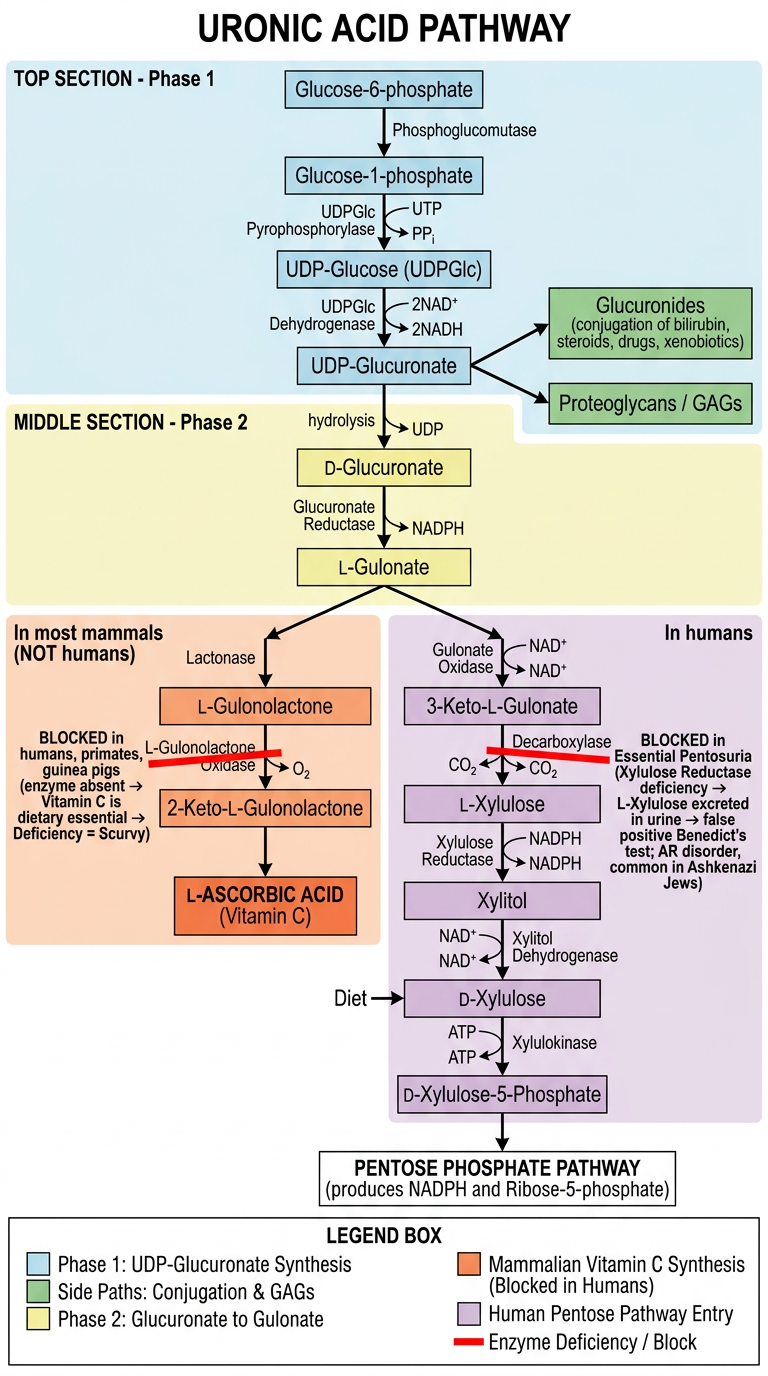
Phase 1: Glucose → UDP-Glucuronate
| Step | Substrate | Enzyme | Product | Cofactor |
|---|
| 1 | Glucose-6-phosphate | Phosphoglucomutase | Glucose-1-phosphate | - |
| 2 | Glucose-1-phosphate + UTP | UDPGlc pyrophosphorylase | UDP-glucose (UDPGlc) + PPi | UTP |
| 3 | UDP-glucose | UDPGlc dehydrogenase (two-step) | UDP-glucuronate | 2 NAD+ (→ 2 NADH) |
UDP-glucuronate is the activated donor form. It branches off here for two major uses: (a) incorporation into proteoglycans (GAGs), and (b) glucuronide conjugation of bilirubin, steroids, and xenobiotics for urinary/biliary excretion.
Phase 2: UDP-Glucuronate → Glucuronate → L-Gulonate
| Step | Substrate | Enzyme | Product | Cofactor |
|---|
| 4 | UDP-glucuronate | Hydrolysis | D-Glucuronate + UDP | - |
| 5 | D-Glucuronate | Glucuronate reductase | L-Gulonate | NADPH |
Phase 3: L-Gulonate → Ascorbic Acid (animals only) OR → L-Xylulose (humans)
In most mammals (not humans/primates):
| Step | Substrate | Enzyme | Product | Cofactor |
|---|
| 6a | L-Gulonate | Lactonase | L-Gulonolactone | - |
| 7a | L-Gulonolactone | L-Gulonolactone oxidase | 2-Keto-L-gulonolactone → L-Ascorbate | O2 |
Block in humans/primates/guinea pigs: L-gulonolactone oxidase is absent. Therefore, ascorbic acid (vitamin C) cannot be synthesized and must come from the diet.
In humans (alternative route):
| Step | Substrate | Enzyme | Product | Cofactor |
|---|
| 6b | L-Gulonate | Gulonate oxidase | 3-Keto-L-gulonate | NAD+ |
| 7b | 3-Keto-L-gulonate | Decarboxylase | L-Xylulose + CO2 | - |
| 8b | L-Xylulose | Xylulose reductase (NADPH-dependent) | Xylitol | NADPH |
| 9b | Xylitol | Xylitol dehydrogenase | D-Xylulose | NAD+ |
| 10b | D-Xylulose | Xylulokinase | D-Xylulose-5-phosphate | ATP |
| 11b | D-Xylulose-5-phosphate | - | Enters pentose phosphate pathway | - |
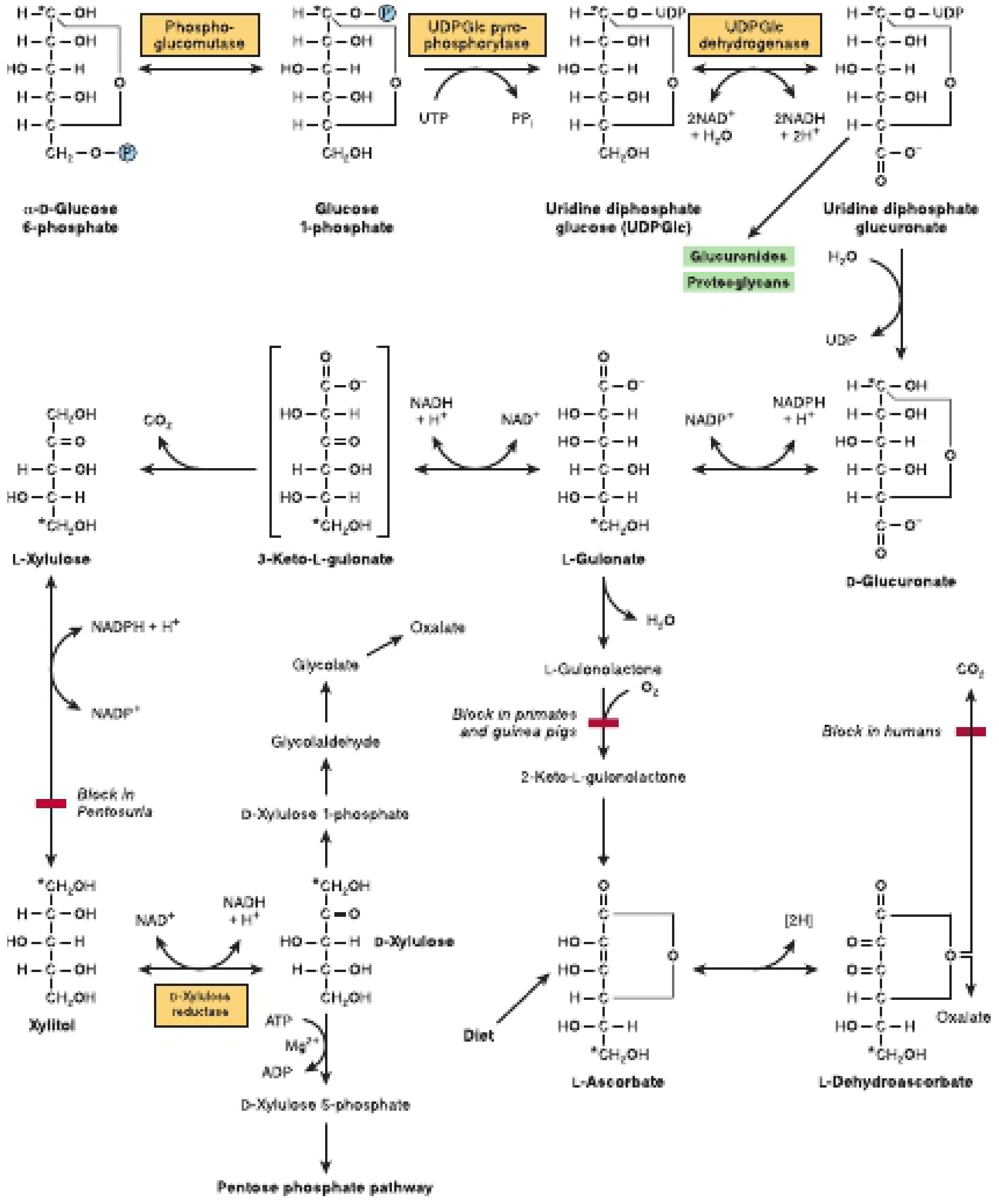
Pathway Diagram (Harper's Figure 20-4)
FIGURE 20-4 - Uronic acid pathway (Harper's Illustrated Biochemistry, 32nd Ed.)
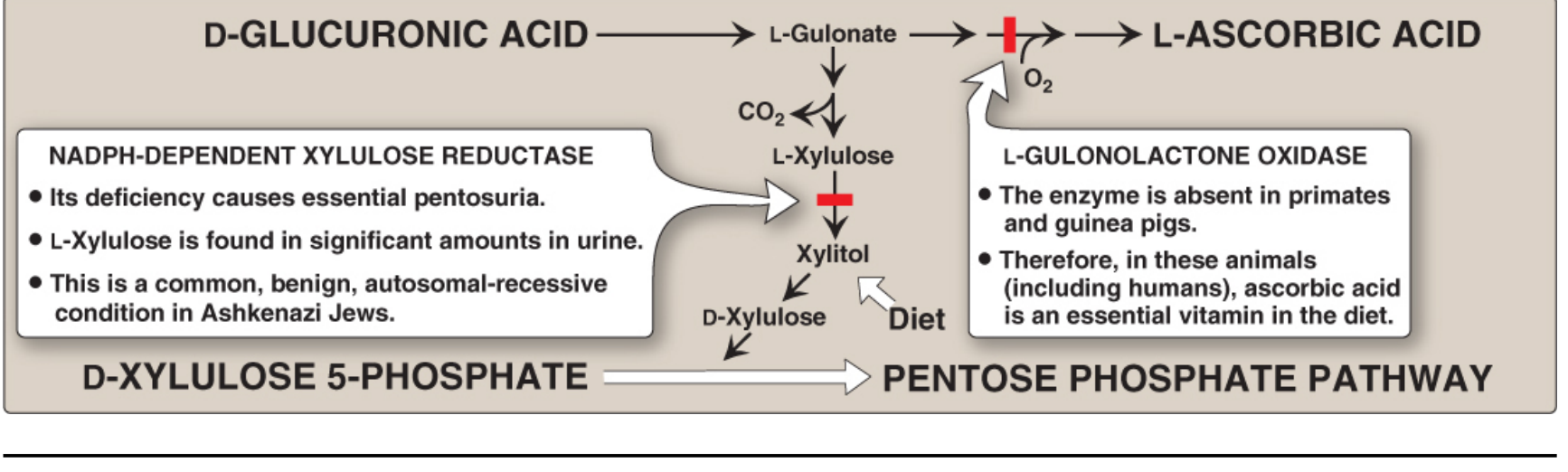
Summary Diagram (Lippincott's)
Figure 14.9 - Metabolism of glucuronic acid (Lippincott's Illustrated Reviews, 8th Ed.)
Physiological Importance
1. Glucuronidation (Conjugation/Detoxification)
UDP-glucuronate conjugates (adds glucuronate to) lipophilic, water-insoluble compounds to make them water-soluble for excretion:
- Bilirubin (conjugated bilirubin for bile secretion)
- Steroid hormones
- Many drugs (morphine, paracetamol, statins, NSAIDs)
- Xenobiotics (foreign chemicals)
2. Proteoglycan Synthesis
UDP-glucuronate provides glucuronate units incorporated into glycosaminoglycans (GAGs) such as heparan sulfate, chondroitin sulfate, dermatan sulfate, and hyaluronan.
3. Ascorbic Acid Synthesis
In most vertebrates (not primates, guinea pigs, some bats and birds), L-gulonate is the direct precursor of vitamin C. Humans lack L-gulonolactone oxidase, so vitamin C is a dietary essential.
4. Feeds the Pentose Phosphate Pathway
Dietary D-xylulose (a pentose sugar found in some foods) enters the pathway and is converted to D-xylulose-5-phosphate, feeding into the pentose phosphate pathway to generate NADPH and ribose-5-phosphate.
Clinical Significance: Disruption of the Pathway
Essential Pentosuria
- Enzyme deficient: Xylulose reductase (NADPH-dependent; also called L-xylulose reductase)
- Consequence: L-Xylulose accumulates and is excreted in the urine (xylosuria)
- Clinical features: Benign - no clinical consequences, but L-xylulose is a reducing sugar and can give false-positive results for urinary glucose when tested with alkaline copper reagents (e.g., Benedict's test, Fehling's solution)
- Genetics: Autosomal recessive; common in Ashkenazi Jews
Why Humans Cannot Synthesize Vitamin C
- Enzyme absent: L-gulonolactone oxidase is not expressed in primates, guinea pigs, some bats, and some birds/fish
- Result: Ascorbic acid is an essential vitamin in these species
- Deficiency causes scurvy (defective collagen synthesis)
Drug Effects on the Pathway
- Barbiturates (barbital), chlorobutanol, aminopyrine, and antipyrine increase flux through the uronic acid pathway, increasing conversion of glucose to glucuronate, L-gulonate, and (in animals) ascorbate
- In pentosuric patients, these drugs increase xylulose excretion
Key Points Summary
| Feature | Detail |
|---|
| Location | Primarily liver |
| Starting substrate | Glucose-6-phosphate |
| Key intermediate | UDP-glucuronate |
| ATP generated? | No |
| Major roles | Detoxification (glucuronidation), GAG synthesis, ascorbate synthesis (in animals), feeds pentose phosphate pathway |
| Enzyme absent in humans | L-Gulonolactone oxidase (no vitamin C synthesis) |
| Enzyme deficient in pentosuria | Xylulose reductase (NADPH-dependent) |
| End product in humans | D-Xylulose-5-phosphate → pentose phosphate pathway |
| Genetic disorder | Essential pentosuria (benign, AR, Ashkenazi Jews) |
- Harper's Illustrated Biochemistry, 32nd Ed., Chapter 20 (p. 203-210)
- Lippincott's Illustrated Reviews: Biochemistry, 8th Ed., Chapter 14 (p. 467-468)