
Enzyme inhibition
Reading File
Enzyme inhibition is a process where a molecule reduces or abolishes enzyme activity. There are four classical types: competitive (inhibitor binds the active site), non-competitive (binds allosteric site, reduces Vmax), uncompetitive (binds only the enzyme-substrate complex), and mixed inhibition. Irreversible inhibitors form covalent bonds. Km and Vmax changes on Lineweaver-Burk plots are the classic way to distinguish them.
Searching sources...
Finding Sources
Finding Sources
Reading File
Reading File
Reading File
Reading File
Reading File
Finding Sources
Reading File
Loading Image
Reading File
Loading Image
Loading Image
Finding Sources
Reading File
Reading File
Now I have rich material from multiple authoritative textbooks. Let me compose the comprehensive answer.
Enzyme Inhibition
Any substance that decreases the velocity of an enzyme-catalyzed reaction is considered an inhibitor. Inhibitors may be reversible or irreversible, and reversible inhibitors are further classified by their kinetic mechanism.
1. Reversible vs. Irreversible Inhibition
Reversible inhibitors bind through noncovalent forces (hydrogen bonds, ionic interactions, van der Waals). Dilution of the enzyme-inhibitor complex causes dissociation and recovery of activity. There are three classical types: competitive, noncompetitive, and uncompetitive.
Irreversible inhibitors form stable covalent bonds with the enzyme; activity cannot be restored by simple dissociation. Examples:
- Organophosphorus compounds (sarin, DFP, malathion, parathion) - covalently phosphorylate the active-site serine of acetylcholinesterase, preventing acetylcholine breakdown
- Aspirin - covalently acetylates an active-site serine of cyclooxygenase (prostaglandin endoperoxide synthase), irreversibly blocking prostaglandin/thromboxane synthesis
- Lead - forms covalent bonds with sulfhydryl groups of cysteine residues; irreversibly inhibits ferrochelatase (involved in heme synthesis)
"In irreversible inhibition, a covalent bond is formed between the inhibitor and the enzyme, and enzyme activity cannot be restored by dissociation of the inhibitor." - Henry's Clinical Diagnosis and Management by Laboratory Methods
2. Types of Reversible Inhibition
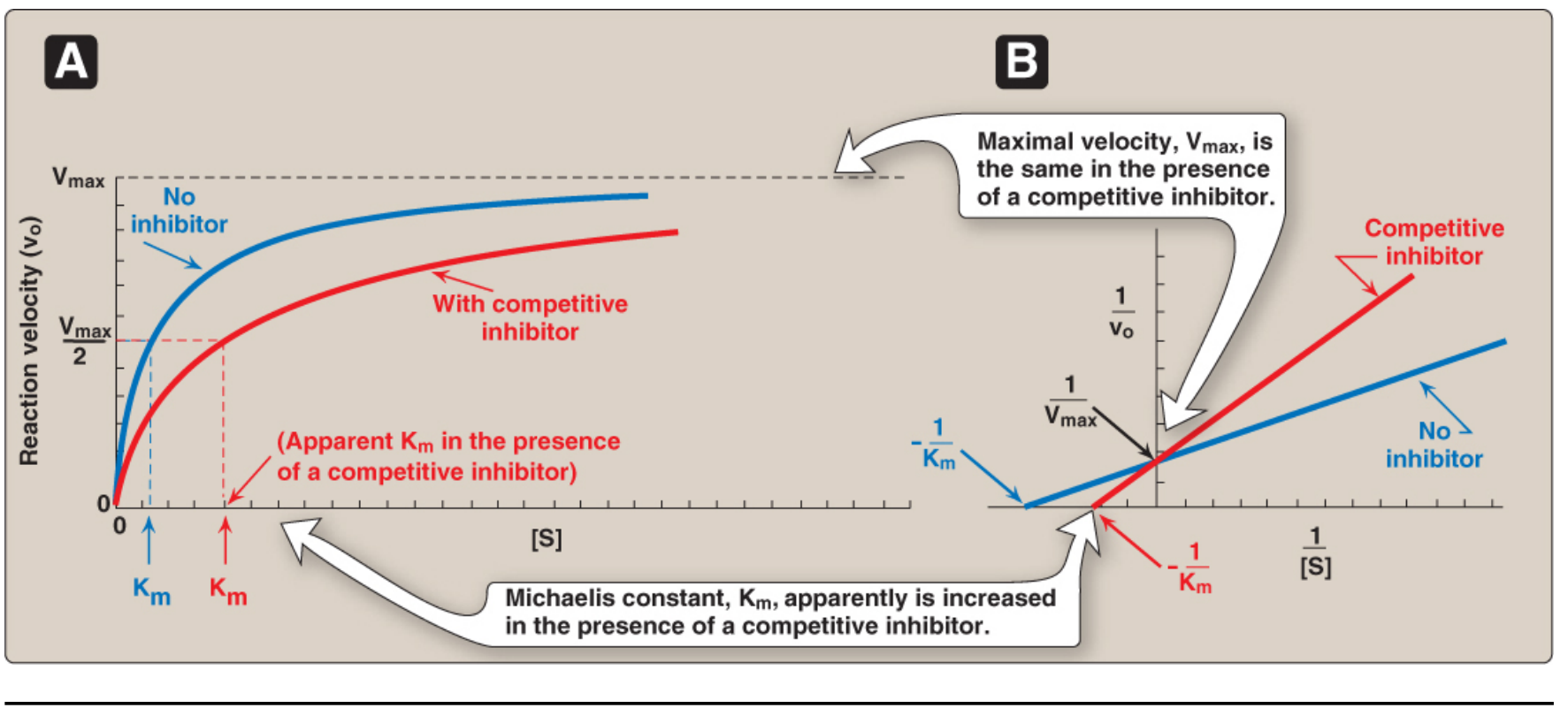
A. Competitive Inhibition
The inhibitor binds reversibly to the same active site as the substrate, directly competing with it.
Kinetic effects:
- Vmax - UNCHANGED - At sufficiently high [S], the inhibitor can be outcompeted and Vmax is reached
- Km - INCREASED (apparent Km rises) - More substrate is needed to achieve half-Vmax
- Lineweaver-Burk plot: Lines intersect on the y-axis (same 1/Vmax intercept, different x-intercepts/slopes)
Clinical examples of competitive inhibitors:
- Statins (atorvastatin, pravastatin) - structural analogs of HMG-CoA; competitively inhibit HMG-CoA reductase, the rate-limiting step in cholesterol synthesis
- Methotrexate - competitively inhibits dihydrofolate reductase
- ACE inhibitors (captopril, enalapril, lisinopril) - block angiotensin-converting enzyme to lower blood pressure
- Malonate - competitively inhibits succinate dehydrogenase (structurally similar to succinate)
- Fluoride ion - competitively inhibits enolase in glycolysis
- Alpha-1-antitrypsin - competitive inhibitor of trypsin
"Competitive inhibition occurs when the inhibitor binds at the same site as the substrate. The enzyme is 'deceived' into recognizing and binding the inhibitor." - Henry's Clinical Diagnosis and Management by Laboratory Methods
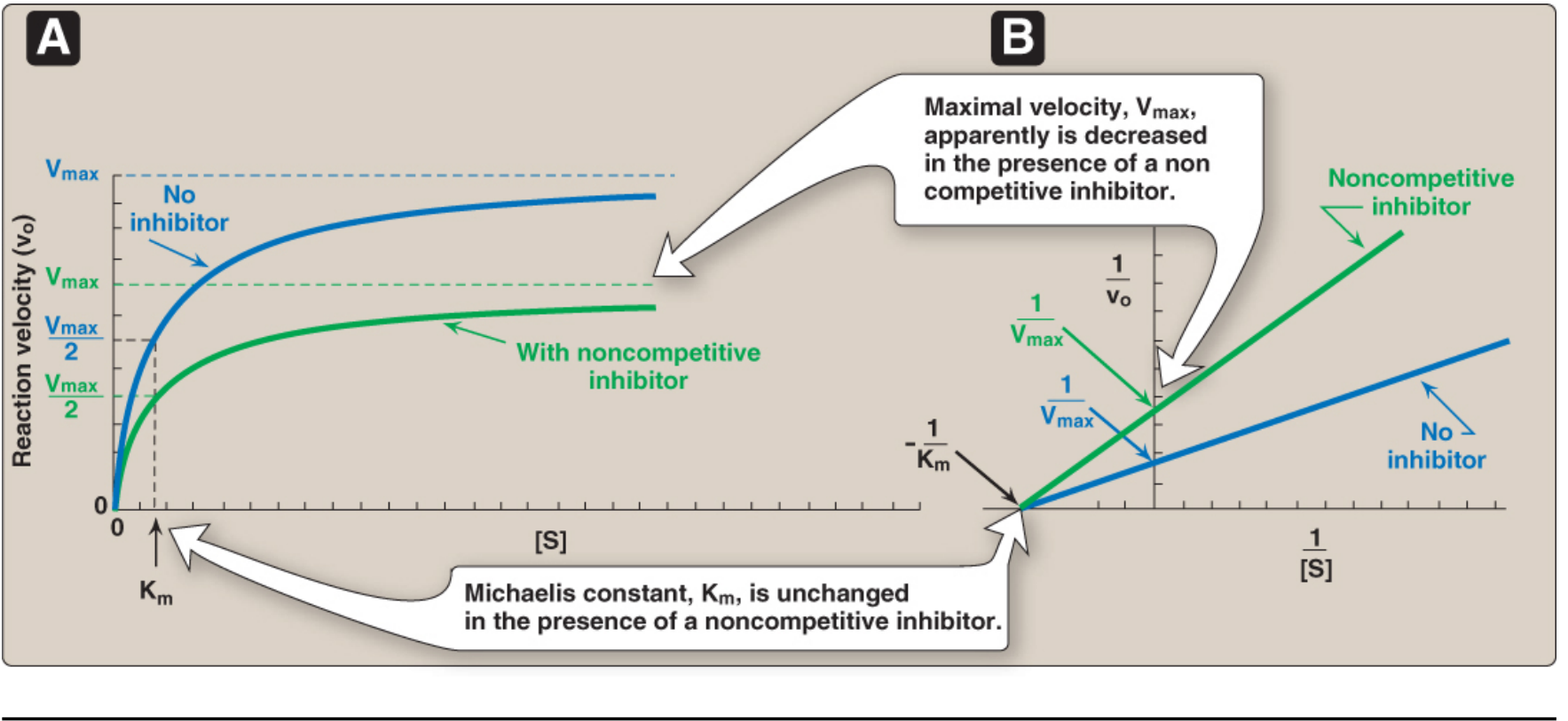
B. Noncompetitive Inhibition
The inhibitor binds at an allosteric site distinct from the active site, and can bind either the free enzyme (E) or the enzyme-substrate complex (ES).
Kinetic effects:
- Vmax - DECREASED - Cannot be overcome by increasing [S]
- Km - UNCHANGED - Substrate binding is not affected
- Lineweaver-Burk plot: Lines intersect on the x-axis (same Km, different y-intercepts/slopes)
There are two subtypes:
- Simple noncompetitive: Inhibitor has equal affinity for E and ES (Ki = Ki')
- Mixed noncompetitive: Inhibitor has different affinities for E vs ES (Ki ≠ Ki'), so both Km and Vmax are affected
Example: Noncompetitive inhibition of pyruvate kinase by alanine.
C. Uncompetitive Inhibition
The inhibitor binds only to the enzyme-substrate complex (ES), not to free enzyme.
Kinetic effects:
- Vmax - DECREASED (apparent)
- Km - DECREASED (apparent) - Both Vmax and Km are reduced by the same factor
- Lineweaver-Burk plot: Lines are parallel (same slope, different intercepts) - a hallmark feature
"In uncompetitive inhibition, parallel lines are [seen on Lineweaver-Burk]. It is more common in two-substrate reactions, in which a ternary ESI complex forms after the first substrate has combined with the enzyme." - Tietz Textbook of Laboratory Medicine
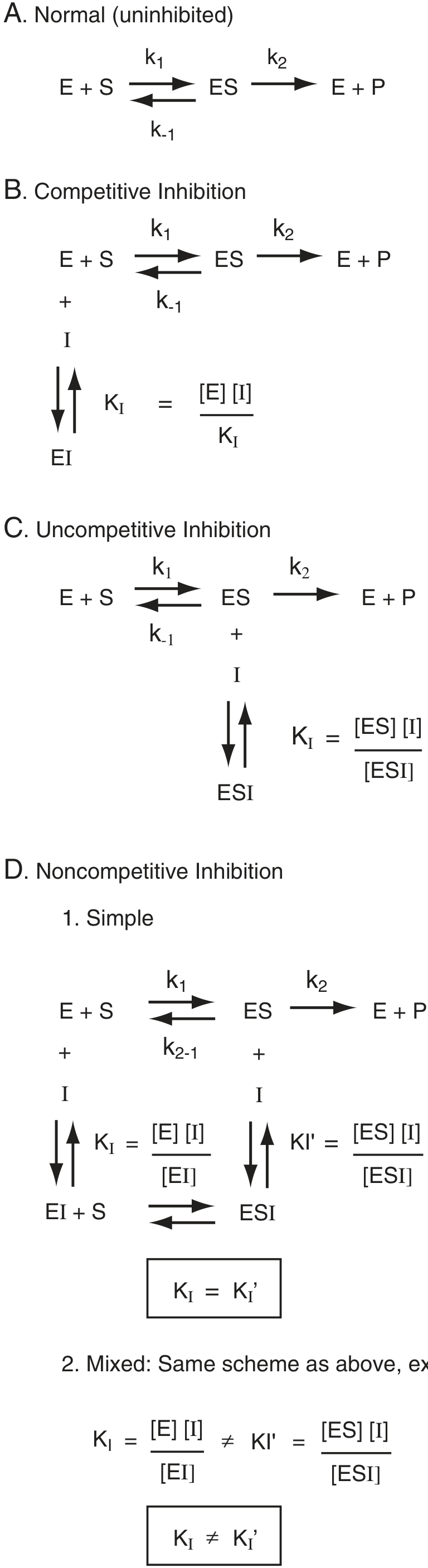
3. Reaction Scheme Summary
The figure below shows the binding schemes for all four types:
4. Comparison Table
| Feature | Competitive | Noncompetitive | Uncompetitive |
|---|---|---|---|
| Inhibitor binds | Free enzyme (E) | E and ES | ES only |
| Binding site | Active site | Allosteric site | Allosteric (ES only) |
| Vmax | Unchanged | Decreased | Decreased |
| Km | Increased | Unchanged | Decreased |
| Lineweaver-Burk | Intersect on y-axis | Intersect on x-axis | Parallel lines |
| Overcome by excess substrate? | Yes | No | No |
5. Special Categories
Transition-State Analogs
Stable molecules that mimic the structure of the transition state of the reaction. They bind the enzyme more tightly than the actual substrate, acting as potent competitive inhibitors. Many modern drugs exploit this principle.
Mechanism-Based (Suicide) Inhibitors
Mimic or participate in an intermediate step of the catalytic reaction. They enter the active site like a normal substrate, but then form a covalent bond, permanently inactivating the enzyme. They are effectively irreversible despite initial reversible binding.
Allosteric Inhibition
Distinct from classical inhibition. Negative allosteric effectors bind a regulatory site on a separate subunit of a multi-subunit enzyme, causing conformational changes that reduce activity (lower Vmax, raise K0.5, or both). These enzymes show sigmoidal kinetics, not hyperbolic, and do not follow Michaelis-Menten kinetics. They are typically rate-limiting enzymes at committed steps in metabolic pathways.
Examples of allosteric inhibition in metabolic regulation:
- ATP inhibits phosphofructokinase-1 (glycolysis)
- Glucose-6-phosphate inhibits hexokinase
- End-product inhibition of biosynthetic pathways
6. Clinically Relevant Drug Examples
| Drug | Enzyme Inhibited | Type | Clinical Use |
|---|---|---|---|
| Statins (atorvastatin) | HMG-CoA reductase | Competitive | Hypercholesterolemia |
| Methotrexate | Dihydrofolate reductase | Competitive | Cancer, autoimmune disease |
| ACE inhibitors (captopril) | Angiotensin-converting enzyme | Competitive | Hypertension, heart failure |
| Aspirin | Cyclooxygenase (COX) | Irreversible (covalent) | Anti-platelet, anti-inflammatory |
| Organophosphates (sarin) | Acetylcholinesterase | Irreversible (covalent) | (Toxin/nerve agent) |
| Beta-lactam antibiotics | Transpeptidase (cell wall synthesis) | Irreversible | Bacterial infections |
Sources: Biochemistry, 8th ed. - Lippincott Illustrated Reviews; Basic Medical Biochemistry - A Clinical Approach, 6e; Henry's Clinical Diagnosis and Management by Laboratory Methods; Tietz Textbook of Laboratory Medicine, 7th Edition; Goodman & Gilman's The Pharmacological Basis of Therapeutics
This is a shared conversation. Sign in to Orris to start your own chat.