
Semaglutide mechanism of action and side effects
semaglutide GLP-1 receptor agonist mechanism of action diagram
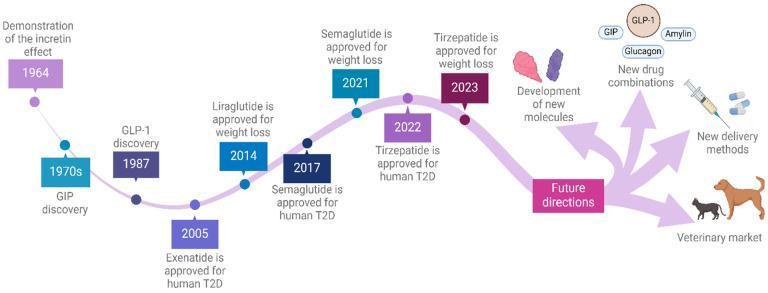
A timeline/progression infographic detailing critical milestones in the development of Glucagon-Like Peptide-1 (GLP-1) receptor agonists for Type 2 Diabetes (T2D) and obesity. The timeline follows a sinusoidal path from left to right, starting with basic science discoveries: the demonstration of the incretin effect (1964), the discovery of Gastric Inhibitory Polypeptide (GIP) (1970s), and the identification of GLP-1 (1987). It then transitions to clinical pharmacology and regulatory approvals, starting with exenatide for T2D (2005), followed by liraglutide for weight loss (2014), semaglutide for T2D (2017) and weight loss (2021), and tirzepatide (a dual GIP/GLP-1 agonist) for T2D (2022) and weight loss (2023). The rightmost section, titled 'Future directions,' branches into four pathways illustrated with icons: development of new molecules (molecular structures), new drug combinations (GLP-1, GIP, Glucagon, Amylin clusters), new delivery methods (syringe and capsule icons), and expansion into the veterinary market (canine and feline silhouettes). This visual represents the evolution from metabolic endocrinology research to modern pharmacotherapy and next-generation obesity management.
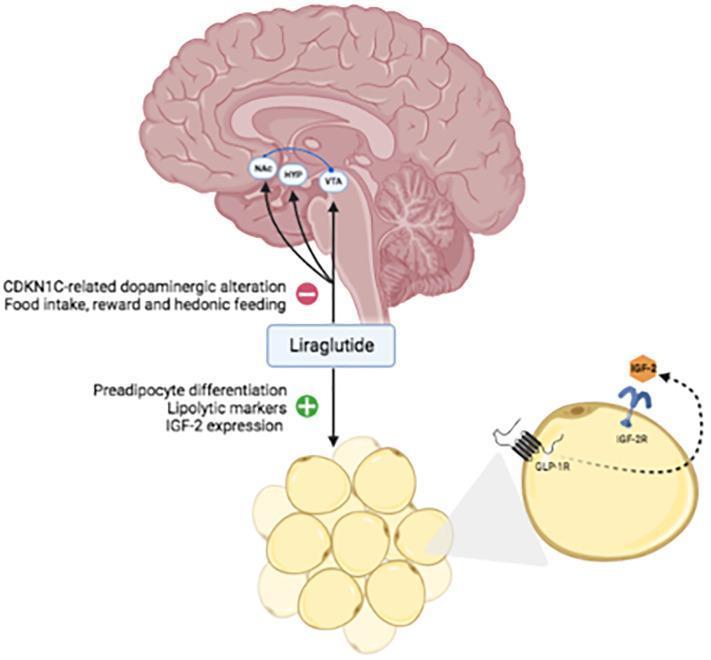
This pathophysiology diagram illustrates the hypothetical central and peripheral mechanisms of Liraglutide, a GLP-1 receptor agonist, in the context of Beckwith-Wiedemann Syndrome (BWS). The upper section shows a sagittal anatomical diagram of the human brain, highlighting the mesolimbic and homeostatic pathways involving the Nucleus Accumbens (NAc), Hypothalamus (HYP), and Ventral Tegmental Area (VTA), interconnected by blue neural pathways. Arrows from Liraglutide point to these regions, indicating a regulatory effect on food intake, reward, and hedonic feeding, potentially counteracting CDKN1C-related dopaminergic alterations. The lower section depicts the peripheral effect on adipose tissue. Liraglutide is shown stimulating a cluster of adipocytes, with positive signs (+) associated with preadipocyte differentiation, lipolytic markers, and IGF-2 expression. A detailed inset shows a single adipocyte expressing GLP-1R and IGF-2R receptors on its membrane, with IGF-2 acting as an extracellular ligand. This educational graphic demonstrates the drug's multi-organ approach to managing obesity by modulating central appetite signaling and peripheral lipid metabolism.
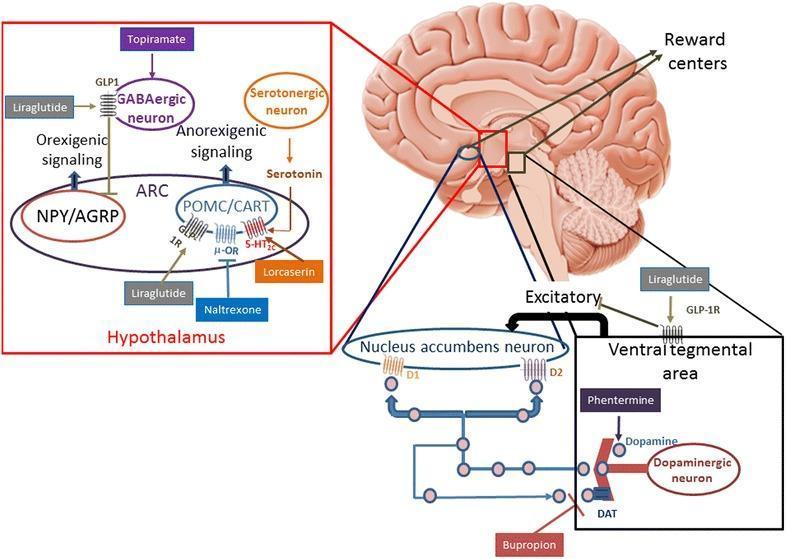
This medical illustration depicts the sagittal view of the human brain, focusing on the neurocircuitry of appetite and reward in the hypothalamus and ventral tegmental area (VTA). The diagram illustrates the mechanism of action for various antiobesity medications. In the magnified hypothalamus section (arcuate nucleus, ARC), orexigenic NPY/AgRP neurons and anorexigenic POMC/CART neurons are shown. Liraglutide is depicted acting on GLP-1 receptors (GLP-1R) on both GABAergic and POMC/CART neurons. Lorcaserin targets the 5-HT2C receptor, while Naltrexone blocks the μ-opioid receptor (μ-OR) to prevent feedback inhibition. Topiramate is shown interacting with GABAergic neurons. The lower magnified section highlights the reward system, where Phentermine and Bupropion influence dopaminergic signaling in the VTA and nucleus accumbens. Key neurotransmitters involved include dopamine (acting on D1/D2 receptors), serotonin, and GABA. Arrows indicate excitatory and inhibitory pathways leading toward cortical reward centers, demonstrating the integration of homeostatic appetite control and hedonic reward processing.
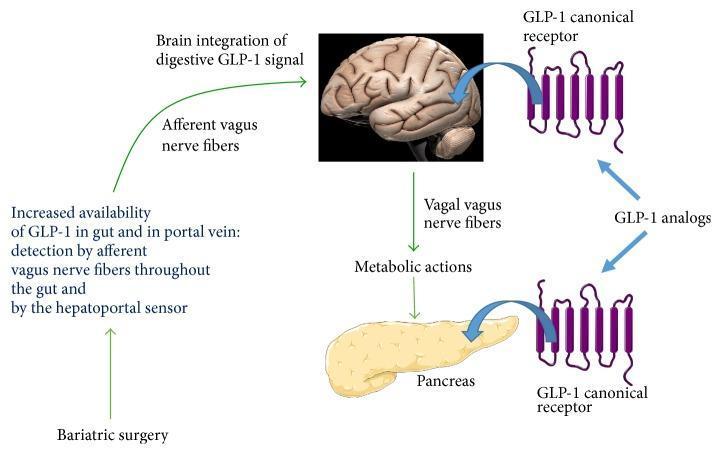
This pathophysiology diagram illustrates the comparative mechanisms of GLP-1 (glucagon-like peptide-1) action following bariatric surgery versus the administration of GLP-1 analogs. The bariatric surgery pathway is depicted as a gut-brain-periphery axis: surgery increases GLP-1 availability in the gut and portal vein, which is detected by hepatoportal sensors and afferent vagus nerve fibers. This signal travels to the brain for integration, which then sends efferent signals via vagal nerve fibers to trigger metabolic actions in peripheral organs like the pancreas. In contrast, the diagram shows GLP-1 analogs bypassing the gut-brain circuit to act directly on GLP-1 canonical receptors (represented by 7-transmembrane G protein-coupled receptor icons) located in tissues such as the brain and pancreas. Key anatomical landmarks included are the brain and the pancreas. This visual serves as an educational tool for endocrinology and metabolic surgery, highlighting the neuro-hormonal integration involved in endogenous GLP-1 signaling compared to direct pharmacological receptor activation.
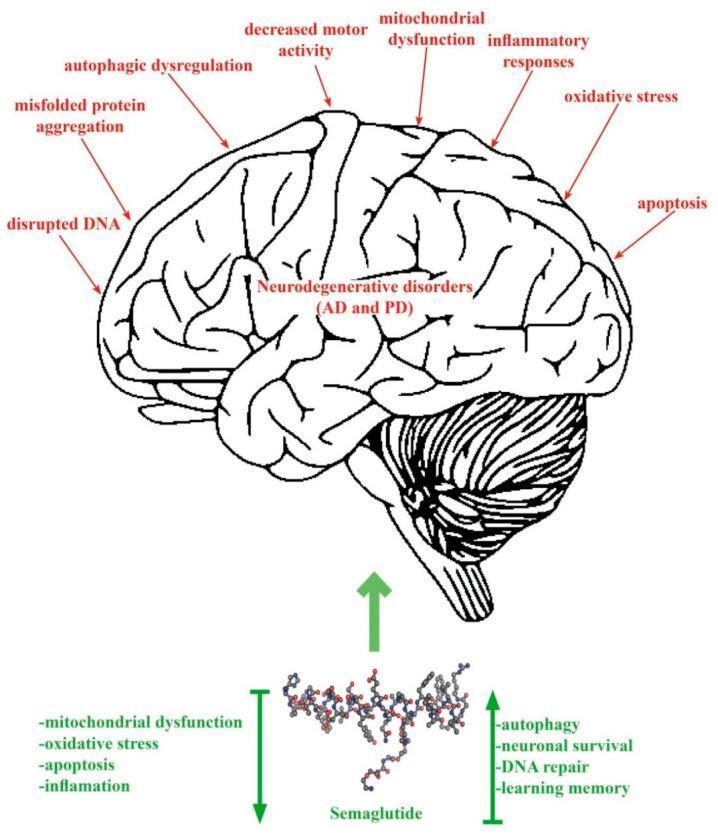
This pathophysiology diagram illustrates the therapeutic mechanisms of Semaglutide (SEM) in the context of neurodegenerative disorders, specifically Alzheimer's Disease (AD) and Parkinson's Disease (PD). The central focus is a lateral view of the human brain highlighting pathological markers associated with neurodegeneration, including disrupted DNA, misfolded protein aggregation, autophagic dysregulation, decreased motor activity, mitochondrial dysfunction, inflammatory responses, oxidative stress, and apoptosis. Below the brain, a molecular model of Semaglutide is shown with directional arrows indicating its pharmacological effects. Downward arrows (reduction) are associated with pathological factors: mitochondrial dysfunction, oxidative stress, apoptosis, and inflammation. Upward arrows (enhancement) are associated with neuroprotective and restorative factors: autophagy, neuronal survival, DNA repair, and learning memory. This educational visual summarizes how GLP-1 receptor agonists may modulate cellular pathways to improve neuronal health and cognitive/motor function in chronic neurodegenerative conditions.
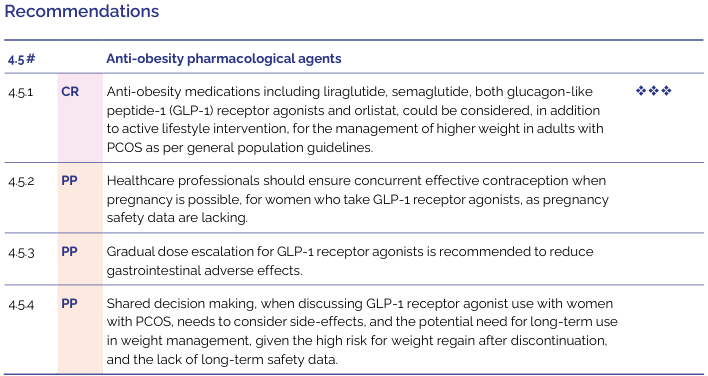
Recommendations <table><thead><tr><th>4.5#</th><th colspan="2">Anti-obesity pharmacological agents</th></tr></thead><tbody><tr><td>4.5.1</td><td>CR</td><td>Anti-obesity medications including liraglutide, semaglutide, both glucagon-like peptide-1 (GLP-1) receptor agonists and orlistat, could be considered, in addition to active lifestyle intervention, for the management of higher weight in adults with PCOS as per general population guidelines.</td><td>♦♦♦</td></tr><tr><td>4.5.2</td><td>PP</td><td>Healthcare professionals should ensure concurrent effective contraception when pregnancy is possible, for women who take GLP-1 receptor agonists, as pregnancy safety data are lacking.</td></tr><tr><td>4.5.3</td><td>PP</td><td>Gradual dose escalation for GLP-1 receptor agonists is recommended to reduce gastrointestinal adverse effects.</td></tr><tr><td>4.5.4</td><td>PP</td><td>Shared decision making, when discussing GLP-1 receptor agonist use with women with PCOS, needs to consider side-effects, and the potential need for long-term use in weight management, given the high risk for weight regain after discontinuation, and the lack of long-term safety data.</td></tr></tbody></table>
semaglutide mechanism GLP-1 receptor agonist
Semaglutide - Mechanism of Action and Side Effects
Background and Drug Class
Mechanism of Action
1. The Incretin Effect (Foundation)
- Robbins Pathologic Basis of Disease notes that GLP-1 and GIP are "both secreted by cells in the intestines following oral food intake... the incretin effect is significantly blunted in patients with T2D, and efforts to restore incretin function can improve glycemic control and promote weight loss."
2. Molecular Structure and Resistance to Degradation
- Alpha-aminoisobutyric acid substitution at position 8 - renders the molecule resistant to DPP-4 degradation
- C-18 fatty diacid chain attached to lysine at position 26 - binds to albumin, dramatically extending the half-life to approximately 1 week, enabling once-weekly subcutaneous injection
3. Receptor Binding and Signaling
- cAMP-PKA pathway (primary) - drives insulin exocytosis
- PKC and PI3K signaling
- β-arrestin pathway
- Ion channel modulation (especially calcium channels)
4. Pharmacological Actions
| Site | Effect |
|---|---|
| Pancreatic β cells | Stimulates insulin biosynthesis and exocytosis - glucose-dependent (minimal effect at fasting glucose, so low hypoglycemia risk) |
| Pancreatic α cells | Suppresses glucagon secretion, especially postprandially |
| GI tract | Delays gastric emptying - reduces postprandial glucose excursions and promotes satiety |
| Hypothalamus/CNS | Reduces food intake, decreases appetite, increases satiety signals via GLP-1R in arcuate nucleus |
| β cells (trophic) | Reduces apoptosis, promotes β-cell proliferation (shown in culture models) |
| Heart/vasculature | Cardioprotective effects - reduces MACE (cardiovascular death, MI, stroke) in high-risk patients |
5. Weight Loss Mechanism
- Central appetite suppression via hypothalamic GLP-1 receptors
- Delayed gastric emptying increasing meal-time fullness
- Increased energy expenditure
- Reduction in caloric intake
Clinical Efficacy
- HbA1c reduction: 1.5-1.8% (monotherapy and combination therapy)
- Weight loss: 3-5 kg in diabetic patients; up to 13 kg in obesity trials (SUSTAIN/STEP trials)
- Cardiovascular: Both oral and injectable semaglutide demonstrated cardiovascular safety and protection in the SUSTAIN-6 and PIONEER-6 trials
Side Effects
Common (Dose-Dependent, Mostly GI)
| Side Effect | Incidence |
|---|---|
| Nausea | 11-40% |
| Diarrhea | 9-17% |
| Vomiting | 4-13% |
| Constipation | Common |
| Abdominal pain | Variable |
| Decreased appetite | Very common |
Serious Side Effects
- All GLP-1RAs may increase the risk of acute pancreatitis. The drug should be stopped immediately if unexplained persistent severe abdominal pain develops. Evidence is "questionable" as noted in Tintinalli, but the risk is included in all prescribing information. Contraindicated in patients with a history of pancreatitis.
- Semaglutide stimulates thyroid parafollicular (C-cell) tumors in rodents at clinically relevant exposures. Human thyroid C cells express very few GLP-1 receptors, so the relevance to humans is uncertain, but the FDA requires a black box warning.
- Contraindicated in patients with personal or family history of medullary thyroid carcinoma (MTC) or Multiple Endocrine Neoplasia type 2 (MEN 2).
- An increase in diabetic retinopathy was observed in the semaglutide-treated group in a clinical trial. Thought to be due to rapid glucose lowering rather than a direct drug effect, but requires monitoring in patients with pre-existing retinopathy.
- Cases of acute renal injury reported, likely secondary to volume depletion from nausea, vomiting, and diarrhea rather than a direct nephrotoxic effect.
- Cholelithiasis and acute cholecystitis reported with increased frequency in clinical trials - likely related to altered gallbladder motility and weight loss.
- Low risk as monotherapy due to glucose-dependent mechanism. Risk increases when combined with sulfonylureas or insulin (dose reduction of those agents may be needed).
- Subcutaneous formulations may cause local redness, swelling, or discomfort.
Contraindications and Cautions
- Medullary thyroid carcinoma (personal or family history)
- MEN 2
- History of pancreatitis (relative contraindication)
- Pregnancy (GLP-1RAs should be stopped before conception; no long-term safety data)
- Severe GI disease (gastroparesis worsened by delayed emptying)
Pharmacokinetics Summary
| Parameter | Value |
|---|---|
| Half-life (SC) | ~7 days |
| Route | Subcutaneous (Ozempic/Wegovy) or Oral (Rybelsus) |
| Starting dose (T2DM) | 0.25 mg/week SC x 4 weeks |
| Maintenance dose | 0.5-2 mg/week SC |
| Obesity dose | 2.4 mg/week SC |
| Oral bioavailability | 0.4-1% |
| Clearance | Metabolic degradation (not predominantly renal) |
- Goodman & Gilman's The Pharmacological Basis of Therapeutics, Chapter 51 (GLP-1 Receptor Agonists section)
- Katzung's Basic and Clinical Pharmacology, 16th Ed., Chapter on diabetes drugs
- Robbins, Cotran & Kumar Pathologic Basis of Disease, Chapter 24 (Endocrine pancreas)
- Tintinalli's Emergency Medicine, 9th Ed. (GLP-1 receptor agonists section)
Recent evidence note (PubMed, 2024-2026): A 2025 systematic review (PMID 39952695) confirms semaglutide's place as first-line in emerging obesity pharmacotherapy. A 2026 systematic review in Annals of Internal Medicine (PMID 41996180) on incretin-based weight loss and body composition found favorable effects on lean and fat mass that are consistent with current textbook descriptions - no contradictory evidence found.