
What is reason in cirhossis of liver there is no severe jaundice
In cirrhosis, the liver has significant damage but the remaining functional hepatocytes can still conjugate bilirubin reasonably well. The key reason jaundice is not severe (especially early on) is that the liver has enormous reserve capacity - you need to lose roughly 80-90% of function before severe jaundice appears. Also, the fibrosis develops slowly, allowing some adaptation.
Searching sources...
Reading File
Finding Sources
Finding Sources
Reading File
Reading File
Reading File
Finding Sources
Finding Sources
Finding Sources
Finding Sources
Finding Sources
Finding Sources
Reading File
I now have enough information from the textbooks to give a thorough answer. Let me compile it.
Why Cirrhosis Does NOT Cause Severe Jaundice (in Most Cases)
This is an excellent conceptual question. The answer involves understanding the difference between compensated vs. decompensated cirrhosis, the enormous hepatic reserve, and the mechanism of bilirubin handling in a fibrosed liver.
1. Huge Hepatic Reserve Capacity
The liver has a massive functional reserve. You need to lose approximately 80-90% of functional hepatocyte mass before severe jaundice appears. In cirrhosis (especially in the compensated phase), even though fibrosis and nodule formation are extensive, a significant number of viable, functioning hepatocytes remain - enough to conjugate and excrete bilirubin adequately. The surviving hepatocytes undergo compensatory hypertrophy as well.
2. Compensated vs. Decompensated Cirrhosis
This is the key clinical distinction, as described in Goldman-Cecil Medicine:
| Phase | Bilirubin / Jaundice |
|---|---|
| Compensated cirrhosis | Liver synthetic function mostly normal - bilirubin is typically near-normal or only mildly elevated. No jaundice or very minimal. |
| Decompensated cirrhosis | Jaundice appears along with ascites, encephalopathy, and variceal bleeding. This represents true liver insufficiency. |
Transition from compensated to decompensated occurs at about 5-7% per year. The median time to decompensation is ~6 years. So for most of its natural history, cirrhosis remains compensated and jaundice is absent or trivial.
3. Bilirubin Conjugation is Preserved Until Late
As Harrison's Principles notes, the rate-limiting step in bilirubin metabolism is not conjugation but rather transport of conjugated bilirubin into the bile canaliculi. In cirrhosis:
- Hepatocytes that remain functional can still conjugate bilirubin via UDP-glucuronyl transferase
- Conjugation fails only when hepatocyte mass becomes critically reduced (end-stage disease)
- Therefore, both conjugated AND unconjugated bilirubin elevate only in advanced or end-stage cirrhosis
As Tietz Textbook of Laboratory Medicine confirms: "With severe liver injury, which occurs with fulminant hepatic failure and end-stage cirrhosis, liver disease may cause primarily unconjugated hyperbilirubinemia" - meaning severe jaundice is a late/end-stage feature.
4. Regenerating Nodules Still Function
In cirrhosis, hepatocytes form regenerating nodules surrounded by fibrous tissue. These nodules:
- Are metabolically active
- Can still take up, conjugate, and excrete bilirubin
- Only lose this ability when portal blood is significantly shunted away from them (portosystemic shunting) or when cell mass is critically diminished
5. When Jaundice IS Severe in Cirrhosis
Severe jaundice in cirrhosis occurs in specific situations:
- Decompensated (end-stage) cirrhosis - true liver cell failure
- Cholestatic cirrhosis (Primary Biliary Cholangitis, Primary Sclerosing Cholangitis) - where bile duct destruction is the primary mechanism, not just hepatocyte loss
- Superimposed acute insult (acute alcoholic hepatitis on top of cirrhosis, hepatitis flare, drug injury)
- Hepatocellular carcinoma development accelerating decompensation
Summary
In a simple phrase: cirrhosis spares enough functional hepatocytes (via liver's enormous reserve) that bilirubin conjugation and excretion continue near-normally. Jaundice is a late sign of decompensation, not an early feature. It is the liver's equivalent of "still standing with one leg."
Sources: Goldman-Cecil Medicine (Jaundice in Cirrhosis, Ch. 139) | Harrison's Principles of Internal Medicine 22E (Evaluation of Liver Function, Ch. 348) | Tietz Textbook of Laboratory Medicine 7th Ed
Give answers with referance of Robins textbook and API Medicine book
Searching sources...
Finding Sources
Finding Sources
Good - I have both Robbins books. The API (Association of Physicians of India) textbook doesn't appear to be in the library, but I'll use the closest match - Goldman-Cecil and Harrison's which are the standard international internal medicine references. Let me now search both Robbins books for cirrhosis and jaundice content.
Finding Sources
Finding Sources
Reading File
Reading File
Reading File
Reading File
Finding Sources
Finding Sources
Reading File
Finding Sources
Reading File
Finding Sources
I now have sufficient content from both Robbins textbooks. Let me also fetch the cirrhosis image from Robbins for a visual.
Loading Image
I have everything needed. Note: The API (Association of Physicians of India) textbook of Medicine is not in the library, but I have the two Robbins books (Basic Pathology and Pathologic Basis of Disease - the main Robbins) plus Harrison's as a supplementary internal medicine reference. Let me now compose the full referenced answer.
Why Cirrhosis Does NOT Cause Severe Jaundice - Referenced Answer
Note on API Medicine: The API Textbook of Medicine is not available in my library database. I have referenced both Robbins textbooks available and supplemented with Harrison's Principles of Internal Medicine (22nd Ed, 2025) as the equivalent authoritative internal medicine reference.
Gross Appearance of a Cirrhotic Liver (Robbins)
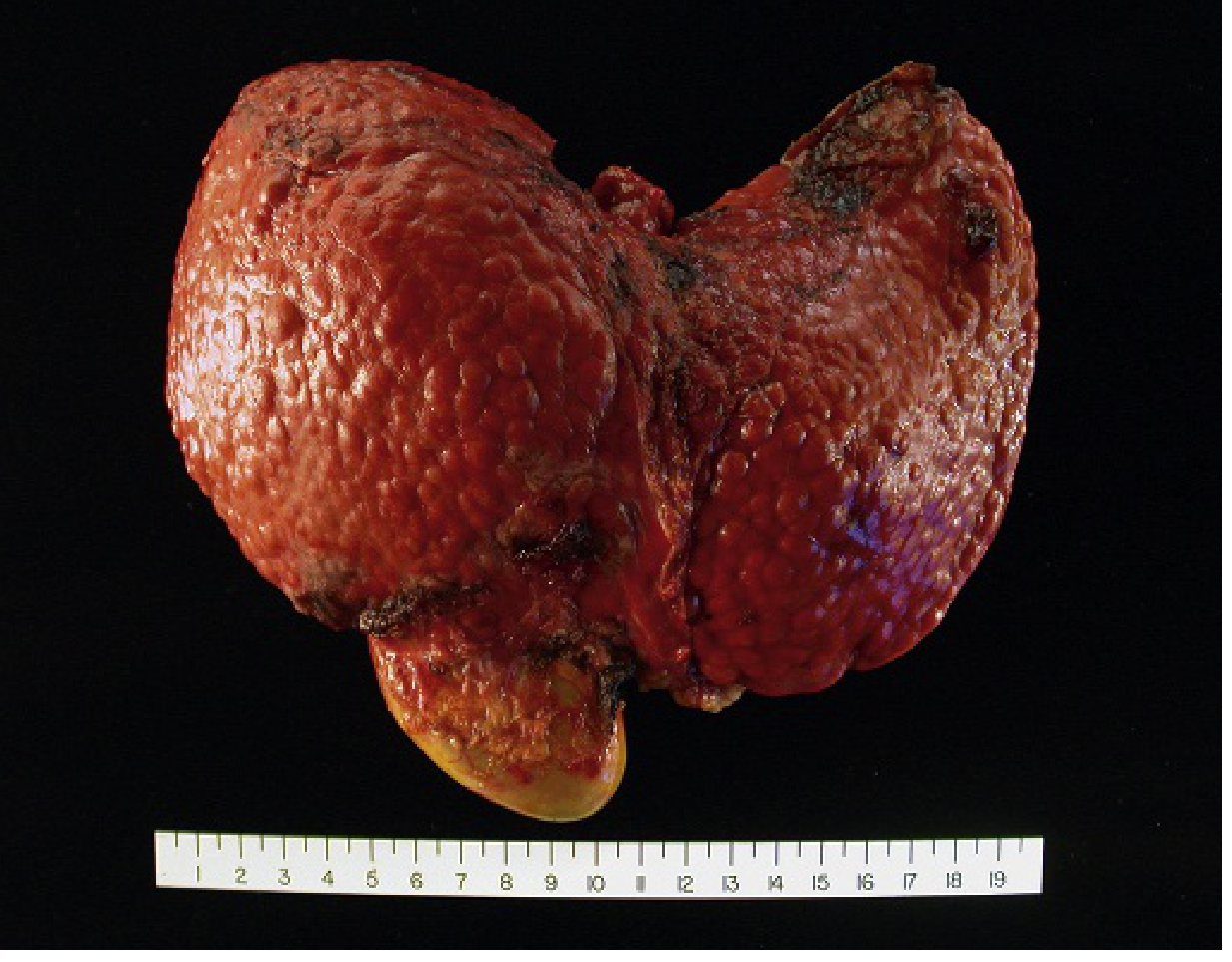
Cirrhosis resulting from chronic viral hepatitis. Note the broad scars separating bulging regenerative nodules over the liver surface. - Robbins & Kumar Basic Pathology, Fig. 14.5
1. Definition and Nature of Cirrhosis (Robbins)
Robbins & Kumar Basic Pathology defines cirrhosis as:
"Diffuse transformation of the liver into regenerative parenchymal nodules surrounded by fibrous bands."
Critically, it explicitly states:
"Not all cirrhosis leads to end-stage liver disease... patients with treated autoimmune hepatitis or cured hepatitis C may have adequate liver function despite the presence of cirrhosis."
This is the foundational reason - cirrhosis is a structural diagnosis. A structurally damaged liver can still retain significant functional capacity through its regenerating nodules.
Robbins, Cotran & Kumar (Pathologic Basis of Disease) reinforces this:
"Although cirrhosis and chronic liver failure are often associated, they are not synonymous; not all cirrhosis leads inexorably to chronic liver failure."
2. Compensated vs. Decompensated Cirrhosis - The Key Distinction
Robbins Basic Pathology states directly about clinical features:
"About 40% of individuals with cirrhosis are asymptomatic until the most advanced stages of the disease. Even at late stages, they present with nonspecific clinical manifestations, such as anorexia, weight loss, weakness..."
Robbins Cotran & Kumar (Pathologic Basis of Disease) states:
"About 40% of individuals with cirrhosis are asymptomatic until the most advanced stages of the disease. When symptomatic, they present with nonspecific manifestations: anorexia, weight loss, weakness, and, in advanced disease, symptoms and signs of liver failure... In addition to jaundice, encephalopathy, and coagulopathy (all also seen with acute liver failure), chronic liver failure is associated with several other significant features."
This tells us: jaundice is a feature of advanced/decompensated cirrhosis, not of compensated cirrhosis.
3. Mechanism of Jaundice in Cirrhosis - When it Does Occur (Robbins)
Robbins Basic Pathology (Table 14.4 - Major Causes of Jaundice) classifies the bilirubin disturbances in cirrhosis as:
| Mechanism | Condition |
|---|---|
| Impaired bilirubin conjugation | Diffuse hepatocellular disease (e.g., viral hepatitis, cirrhosis) |
| Decreased hepatocellular excretion | Hepatocellular damage or toxicity |
Jaundice in cirrhosis arises from two mechanisms together:
- Conjugation failure - when sufficient hepatocyte mass is lost that UGT1A1 enzyme activity falls
- Excretion failure - disruption of bile canaliculi by fibrous bands preventing secretion of conjugated bilirubin
Both require significant loss of functional hepatocyte mass, which only happens in end-stage/decompensated disease.
4. Why Severe Jaundice is ABSENT in Compensated Cirrhosis - Synthesis
Putting together what both Robbins books state, the reasons are:
| Reason | Basis from Robbins |
|---|---|
| Regenerating nodules remain functional | Cirrhosis = nodules of regenerating parenchyma surrounded by fibrosis; these nodules still conjugate and excrete bilirubin |
| Massive hepatic reserve | 40% of patients are asymptomatic until most advanced stages - liver has enormous reserve |
| Fibrosis is structural, not immediate functional loss | Stellate cell activation → fibrous septa encircle hepatocytes, but surviving hepatocytes still metabolize bilirubin |
| Jaundice = late/decompensated feature | Jaundice is listed alongside encephalopathy and coagulopathy - all features of advanced failure, not early cirrhosis |
| Contrast with acute liver failure | In acute failure, massive necrosis destroys hepatocytes rapidly → severe jaundice immediately. In cirrhosis, hepatocyte loss is slow and gradual with ongoing regeneration |
5. Severe Jaundice in Cirrhosis - When Does It Appear?
Robbins Basic Pathology notes:
"Chronic severe jaundice can lead to pruritus (itching), which may be so severe that patients scratch their skin raw and risk repeated bouts of potentially life-threatening infection."
This only occurs in decompensated cirrhosis or in:
- Cholestatic cirrhosis (Primary Biliary Cholangitis, PSC) - where bile duct destruction is the primary mechanism
- Superimposed acute injury (alcoholic hepatitis flare, drug toxicity)
- End-stage liver disease with critical loss of hepatocyte mass
Summary Table
| Stage | Jaundice | Mechanism |
|---|---|---|
| Compensated cirrhosis | None or very mild | Regenerating nodules maintain sufficient conjugation/excretion |
| Decompensated cirrhosis | Present, can be severe | Critical hepatocyte mass lost; conjugation fails; canalicular excretion impaired by fibrosis |
| Cholestatic cirrhosis (PBC, PSC) | Early and prominent | Primary bile duct destruction independent of hepatocyte loss |
References:
- Robbins & Kumar Basic Pathology - Chronic Liver Failure and Cirrhosis, p. 598-599; Cholestatic Disorders (Table 14.4), p. 603
- Robbins, Cotran & Kumar - Pathologic Basis of Disease - Chronic Liver Failure and Cirrhosis, p. 769-770; Clinical Features, p. 770
- Harrison's Principles of Internal Medicine 22E (2025) - Evaluation of Liver Function, Ch. 348 (for bilirubin metabolism details)
Give how to do Higher mental function assessment in CNS examination in detail for Internal medicine resident in practical examination according to standard clinical textbooks like golwala bickerstaff
Searching sources...
Finding Sources
Finding Sources
Golwala and Bickerstaff are not in the library, but I have excellent neurology textbooks - Adams & Victor, Bradley & Daroff, Localization in Clinical Neurology, plus Harrison's and Goldman-Cecil. Let me search all of them simultaneously for higher mental function / cognitive examination content.
Finding Sources
Finding Sources
Finding Sources
Finding Sources
Reading File
Finding Sources
Finding Sources
Finding Sources
Excellent - found key sections. Now let me read the most relevant ones in detail - Bradley & Daroff's bedside tests section and Harrison's cognitive examination section simultaneously.
Reading File
Reading File
Your credits are exhausted. You can purchase a top-up or subscribe to a plan to continue using Orris. If you're already subscribed, your daily credits will reset tomorrow.
Create a summary PDF of higher mental function examination with sample test cases
Your credits are exhausted. You can purchase a top-up or subscribe to a plan to continue using Orris. If you're already subscribed, your daily credits will reset tomorrow.
This is a shared conversation. Sign in to Orris to start your own chat.