
So, as we know that the body contain the 60 to 65% of the body water, from which 40% is the intracellular and 20% is the extracellular. In the intracellular, there-- extracellular, there is the 75% interstitial fluid and 20%-- 5% of the plasma. So, how can I make the difference between the interstitial fluid and the plasma, and how are they measured?
Reading File
Now let me search the medical library for content on body fluid compartments, interstitial fluid, plasma differences, and measurement methods.
Finding Sources
Finding Sources
Excellent. Let me read the most relevant sections - Costanzo's section on measuring fluid compartments and Guyton's section on body fluid compartments, in parallel.
Reading File
Reading File
Reading File
I now have excellent content. Let me also read the full measurement section from Costanzo and get the composition differences between interstitial fluid and plasma.
Reading File
Finding Sources
Reading File
Reading File
I now have everything I need for a thorough, well-cited answer. Let me also fetch the body fluid compartment diagram from Guyton.
Loading Image
Loading Image
I now have everything needed for a complete, well-sourced answer. Here it is:
Body Fluid Compartments: Interstitial Fluid vs. Plasma
First, a quick note on the numbers: ECF is split roughly 75% interstitial fluid and 25% plasma (not 20% plasma as you mentioned). In a 70-kg man, ECF = ~14 L total, of which plasma = ~3 L (~5% of body weight) and interstitial fluid = ~11 L (~15–16% of body weight).
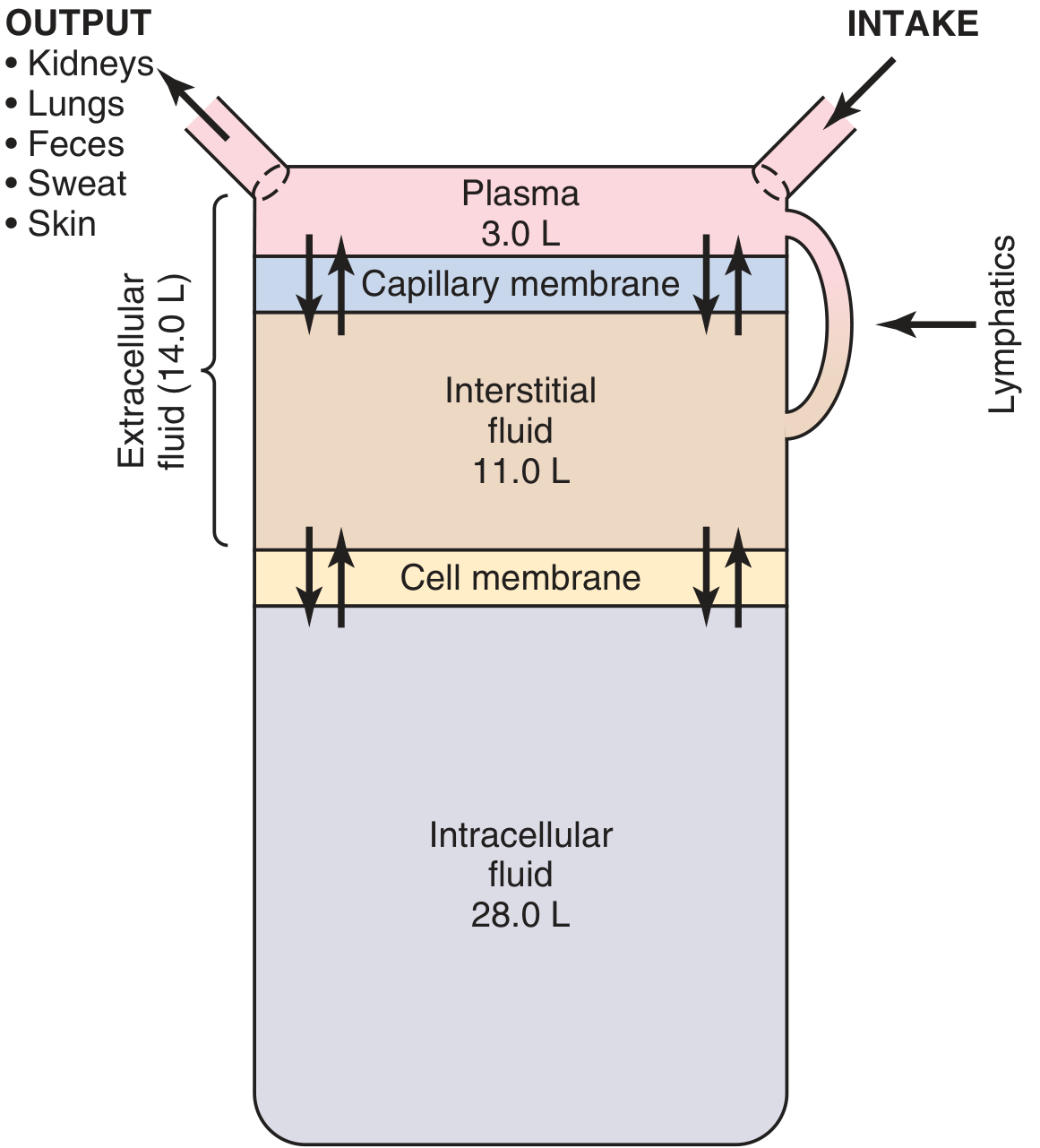
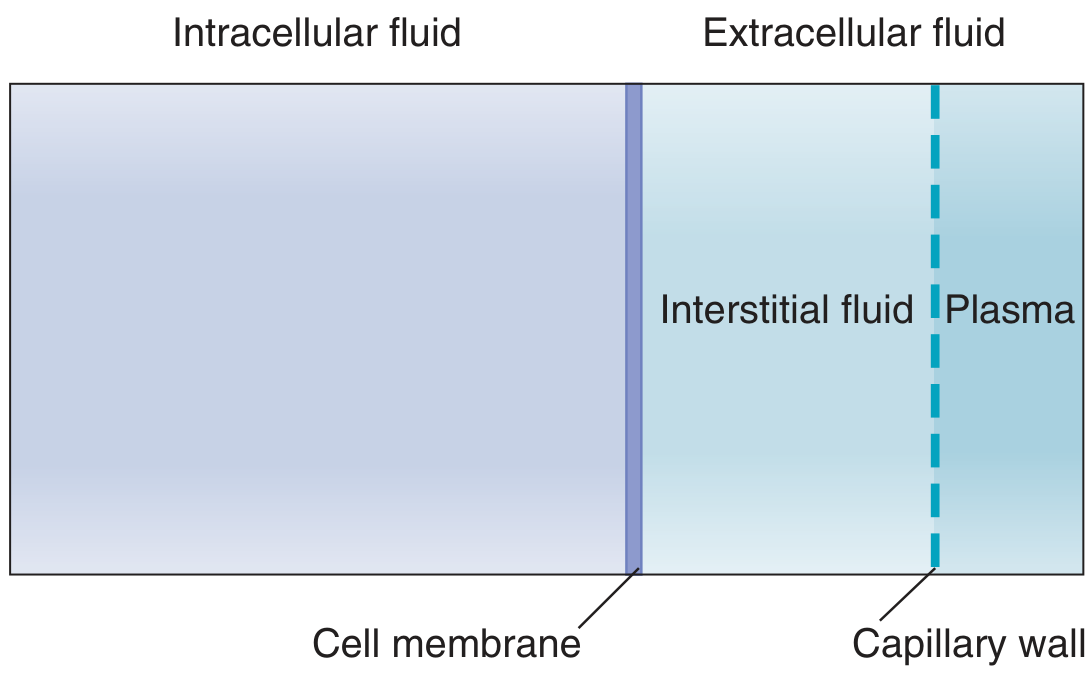
1. The Key Structural Difference: Location and Barrier
The single most important anatomical distinction between the two compartments is the capillary wall:
- Plasma is the fluid inside the blood vessels (the aqueous component of blood, ~55% of blood volume by weight).
- Interstitial fluid is the fluid that bathes the cells outside the blood vessels - it sits in the tissue spaces between capillaries and cells.
The capillary wall is the physical barrier that separates them. - Costanzo Physiology 7th Edition, p. 9
2. Compositional Differences
Interstitial fluid is essentially an ultrafiltrate of plasma. The capillary wall freely allows water and small solutes to pass, but is virtually impermeable to large molecules (proteins, blood cells). This creates two key differences:
| Feature | Plasma | Interstitial Fluid |
|---|---|---|
| Proteins | ~7% by volume (albumin, globulins, fibrinogen) | Virtually none (negligible) |
| Blood cells | Present (RBCs, WBCs, platelets) | Absent |
| Small cations (e.g., Na+) | Slightly higher | Slightly lower |
| Small anions (e.g., Cl-) | Slightly lower | Slightly higher |
| Oncotic pressure | High (due to proteins) | Very low |
The small ionic differences between the two are explained by the Gibbs-Donnan effect: the negatively charged plasma proteins attract small cations into plasma and repel small anions, so plasma has a slightly higher Na+ and slightly lower Cl- than interstitial fluid. - Costanzo Physiology 7th Edition, p. 255; Schwartz's Principles of Surgery 11th Edition, p. 111
The clinical consequence of this protein difference is enormous: plasma proteins generate colloid osmotic pressure (oncotic pressure) (~25 mmHg), which acts as a force pulling water back into the capillary and preventing edema (Starling forces).
3. How They Are Measured - The Dilution Principle
The fundamental method is the indicator dilution (tracer dilution) method:
Volume = Amount of marker injected (minus amount excreted) / Concentration of marker in plasma
The key is choosing the right marker based on its distribution characteristics:
Plasma Volume - directly measurable
Markers that are too large to cross capillary walls, so they stay inside vessels:
- Evans blue dye (binds to albumin and cannot exit the capillary)
- Radioiodinated serum albumin (RISA) / radioactive albumin
Inject a known amount → allow equilibration → measure plasma concentration → calculate volume.
Interstitial Fluid Volume - indirectly calculated
There is no unique marker for interstitial fluid - it cannot be measured directly. It is calculated as:
Interstitial fluid volume = ECF volume - Plasma volume
To get ECF volume, use markers that distribute throughout the entire extracellular space but cannot cross cell membranes (too large):
- Mannitol, inulin (large sugars)
- Sulfate (large anion)
Total Body Water (for completeness)
Markers that go everywhere water goes:
- Deuterium oxide (D₂O), tritiated water (THO)
- Antipyrine (lipid-soluble, same distribution as water)
ICF volume is also indirect:
ICF volume = Total body water - ECF volume
- Costanzo Physiology 7th Edition, p. 254-256; Guyton and Hall Medical Physiology
Summary Table
| Compartment | % Body Weight | Marker | Directly Measured? |
|---|---|---|---|
| Total body water | 60% | D₂O, THO, antipyrine | Yes |
| ECF | 20% | Mannitol, inulin, sulfate | Yes |
| ICF | 40% | TBW - ECF | No (indirect) |
| Plasma | ~4-5% | Evans blue, RISA | Yes |
| Interstitial fluid | ~15-16% | ECF - Plasma | No (indirect) |
The bottom line: plasma can be measured directly (its proteins keep markers inside capillaries), but interstitial fluid must always be derived by subtraction because no marker is confined exclusively to the interstitial space.
This is a shared conversation. Sign in to Orris to start your own chat.