
Lung surfectant
Lung surfactant is a complex mixture of lipids and proteins that lines the alveolar surface, reducing surface tension to prevent alveolar collapse at end-expiration. It is produced by type II pneumocytes and is essential for normal breathing mechanics.
Searching sources...
Reading File
Finding Sources
Finding Sources
Good results. Now let me read the core sections from Costanzo Physiology (surfactant), Murray & Nadel (surfactant composition), and Fishman's (pulmonary surfactant) in parallel.
Reading File
Reading File
Reading File
Excellent content. Let me now read the surfactant proteins section from Murray & Nadel and the Ganong physiology section, and also fetch the alveolar size/surfactant diagram.
Reading File
Reading File
Loading Image
I now have comprehensive content from multiple authoritative textbooks. Let me compile a complete, well-structured answer.
Pulmonary Surfactant
What Is It?
Pulmonary surfactant is a complex mixture of lipids (~90%) and proteins (~10%) secreted into the alveolar space by Type II alveolar (AT2) pneumocytes. Its primary role is to reduce surface tension at the air-liquid interface of alveoli, preventing alveolar collapse at end-expiration.
Composition
Lipids (85% phospholipids + 5% neutral lipids)
The most important constituent is dipalmitoylphosphatidylcholine (DPPC), which accounts for ~47% of all phospholipids. Full breakdown:
| Component | % of Phospholipids |
|---|---|
| Phosphatidylcholine (total) | 76.3% |
| - DPPC (saturated) | 47.0% |
| - Unsaturated PC | 29.3% |
| Phosphatidylglycerol | 11.6% |
| Phosphatidylinositol | 3.9% |
| Phosphatidylethanolamine | 3.3% |
| Sphingomyelin | 1.5% |
| Neutral lipids (cholesterol, free fatty acids) | 5% of total |
DPPC molecules are amphipathic - hydrophobic tails repel water and align at the air-liquid interface, while hydrophilic heads face the aqueous phase. This disrupts the intermolecular forces between water molecules that would otherwise generate high surface tension.
- Murray & Nadel's Textbook of Respiratory Medicine, Table 3.2
Proteins (~10%)
There are four surfactant-associated proteins:
| Protein | Abundance | Main Role |
|---|---|---|
| SP-A | Most abundant (++++) | Host defense; collagenous glycoprotein (18-mer); binds carbohydrates/pathogens via C-type lectin domain |
| SP-B | Low (+) | Biophysical function; regulates surfactant lipid spreading; required for lamellar body formation |
| SP-C | Low (+) | Biophysical function; stabilizes lipid film during compression |
| SP-D | Moderate (++) | Host defense; collectin; opsonization, pathogen binding |
SP-A and SP-D belong to the collectin family and are secreted via a distinct pathway (not lamellar bodies). SP-B and SP-C are packaged in lamellar bodies and secreted together with lipids.
- Murray & Nadel's Textbook of Respiratory Medicine
Mechanism of Action - The Law of Laplace
By the law of Laplace, the collapsing pressure of a sphere is:
P = 2T / r
where T = surface tension and r = radius.
This means small alveoli face greater collapsing pressure than large ones. Surfactant solves this by reducing T proportionally as radius decreases - as alveoli shrink at end-expiration, surfactant molecules pack more densely, lowering surface tension further and stabilizing the alveolus.
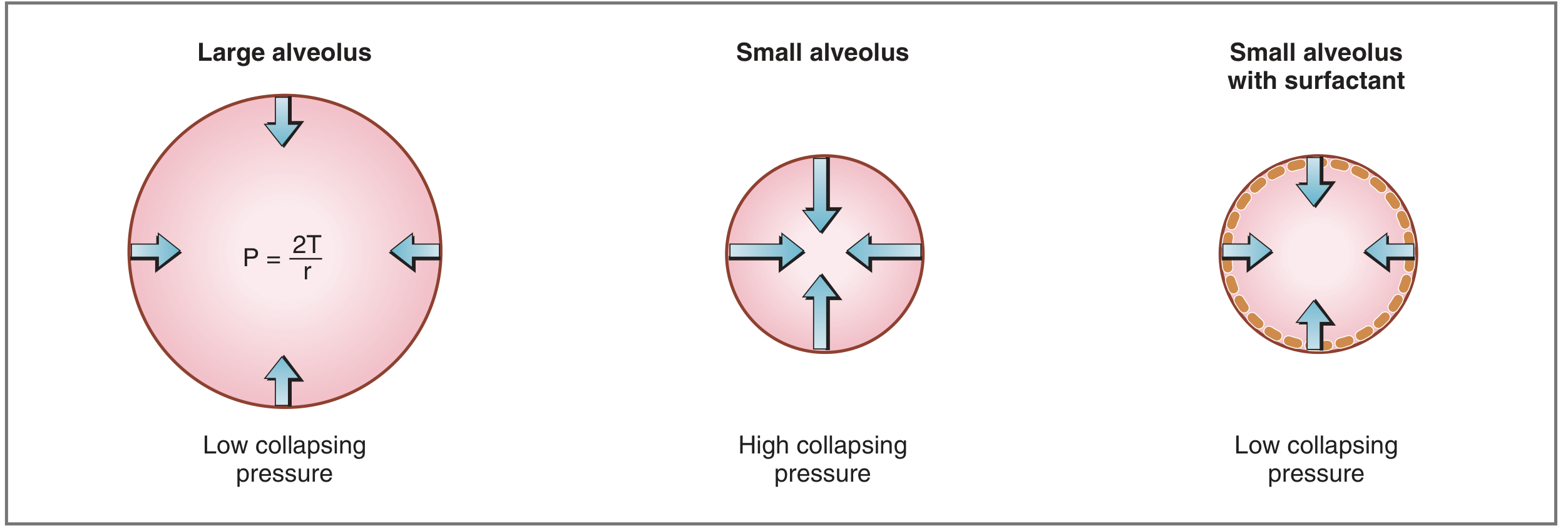
Fig. 5.12 - Costanzo Physiology: A large alveolus has low collapsing pressure (large r). A small alveolus without surfactant has high collapsing pressure (small r, high T). A small alveolus WITH surfactant has low collapsing pressure because surfactant reduces T.
Physiological Effects
- Prevents atelectasis - keeps small alveoli from collapsing at end-expiration
- Increases lung compliance - reduces the work of breathing during inspiration
- Stabilizes alveoli of different sizes - prevents larger alveoli from absorbing smaller ones (without surfactant, high pressure in small alveoli would push air into large ones per Laplace's law)
- Host defense - SP-A and SP-D opsonize pathogens, regulate alveolar macrophage function, and modulate inflammatory responses
- Costanzo Physiology 7th Edition
Synthesis, Secretion & Regulation
- Cell of origin: Type II alveolar epithelial (AT2) cells; SP-A and SP-D are also expressed in club cells of bronchioles
- Storage: Lipids, SP-B, and SP-C are stored in lamellar bodies before secretion
- Secretion trigger: β-adrenergic receptor activation, P2X7R purinergic receptors; mediated by intracellular cAMP and Ca²⁺
- Onset in fetal lung: Synthesis begins around gestational week 24, nearly complete by week 35
- Regulation:
- Stimulated by: Glucocorticoids (via lung fibroblasts), EGF, cAMP, thyroxine
- Inhibited by: TNF-α, TGF-β, insulin
- Transcription factors: TTF-1, FOXA2, CREBPA, GATA proteins, RARs, SREBP
Antenatal glucocorticoids (betamethasone/dexamethasone) are administered to mothers at risk of preterm delivery to accelerate fetal surfactant synthesis and reduce the risk of infant respiratory distress syndrome (IRDS).
- Fishman's Pulmonary Diseases and Disorders
Clearance
- Surfactant is primarily recycled by AT2 cells (uptake and repackaging into lamellar bodies)
- A smaller fraction is cleared by alveolar macrophages via a GM-CSF-dependent pathway
- GM-CSF signaling is essential for macrophage-mediated surfactant catabolism - deficiency leads to pulmonary alveolar proteinosis (PAP), where surfactant accumulates in alveoli
Clinical Relevance
| Condition | Mechanism | Notes |
|---|---|---|
| Neonatal RDS (IRDS) | Surfactant deficiency in premature infants | Hyaline membranes, atelectasis, hypoxemia; treated with exogenous surfactant replacement therapy (e.g., beractant, poractant alfa) |
| ARDS | Surfactant inactivation/dysfunction | Inflammatory mediators (TNF-α, phospholipases) inactivate surfactant; surfactant replacement has NOT proven effective in adult ARDS trials |
| Pulmonary Alveolar Proteinosis (PAP) | Impaired surfactant clearance | GM-CSF autoantibodies (autoimmune PAP) or receptor mutations; "crazy paving" on CT; PAS-positive alveolar material |
| SP-B deficiency | Inherited; absent SP-B | Fatal neonatal respiratory failure; dysfunctional surfactant; PAS-positive alveolar material |
| ABCA3 mutations | Absent lamellar bodies | Impaired surfactant packaging and secretion; neonatal/childhood respiratory failure |
| Hyperoxic lung injury / N-mustard | AT2/AT1 cell death | Surfactant inactivation + inflammatory recruitment |
- Murray & Nadel's Textbook of Respiratory Medicine, Table 3.1
Lamellar Body to Tubular Myelin
After secretion, surfactant lipids and proteins organize into tubular myelin - a lattice-like structure that serves as the reservoir for rapid surface film formation at the air-liquid interface. This conversion requires SP-A, SP-B, and calcium.
Key takeaway: Surfactant is not just a "soap" for the lungs - it is a dynamically regulated bioactive system with biophysical and immunological roles, whose dysfunction underlies some of the most serious respiratory diseases across all age groups.
This is a shared conversation. Sign in to Orris to start your own chat.