
Create an image. On. Distinguishing between chop and lacerated wound. Also add a separate note on stab wound. It is a ten mark question. From... Standard. FMD textbook. और नारायण रेड्डी textbook.
A detailed forensic medicine study chart/poster for a 10-mark exam question on distinguishing between Chop Wound and Lacerated Wound, with a separate note on Stab Wound. Based on Narayan Reddy's Essentials of Forensic Medicine and Toxicology. Layout: Clean white background, medical textbook style. Three main sections. SECTION 1 - TITLE BAR (dark navy blue background, white bold text): "CHOP WOUND vs LACERATED WOUND — 10 Mark Answer (Narayan Reddy / FMT)" SECTION 2 - COMPARISON TABLE (two columns side by side): Header row (dark teal): "CHOP WOUND | LACERATED WOUND" Row 1 - Definition: Chop: Deep gaping wound caused by a blow with sharp cutting edge of a heavy weapon Lacerated: Wound caused by blunt force — crushing, stretching or tearing of tissues Row 2 - Causative Weapon: Chop: Axe, hatchet, sword, chopper, meat cleaver, saber, heavy knife Lacerated: Blunt objects, falls on hard surfaces, machinery, traffic accidents Row 3 - Margins: Chop: Sharp margins; slight abrasion and bruising; ragged if edge is blunt Lacerated: Irregular, ragged, uneven, undermined; with minute tears; abraded edges Row 4 - Depth: Chop: Deep, involving soft tissue and bone; bone may be split or notched Lacerated: Variable; unevenly divided deeper tissues with tissue bridges Row 5 - Tissue Bridges: Chop: Absent (cutting action severs bridges) Lacerated: Present — nerves, vessels, connective tissue bridge across wound floor Row 6 - Bruising around wound: Chop: Present but less than laceration Lacerated: Prominent bruising in skin and subcutaneous tissue Row 7 - Bone involvement: Chop: Bone split; notched/smooth edge on one side, rough on other; may amputate Lacerated: Rarely cuts bone; may fracture or comminute Row 8 - Undermining: Chop: Occurs in direction of chop; heel end deeper than toe end Lacerated: Present at edges over bony prominences; indicates direction of force Row 9 - Hair bulbs: Chop: Cut cleanly Lacerated: Crushed Row 10 - Hemorrhage: Chop: Profuse due to sharp cutting of vessels Lacerated: Less — arteries crushed, torn irregularly, retract and clot readily Row 11 - Common sites: Chop: Head, neck, extremities Lacerated: Over bony prominences (scalp, parietal, shin, iliac crest) Row 12 - Medicolegal importance: Chop: Usually homicidal; weapon identifiable from wound dimensions Lacerated: Can be suicidal (exposed parts), homicidal (head), or accidental SECTION 3 - SEPARATE NOTE BOX (light orange/amber border, heading in bold red): "SEPARATE NOTE: STAB WOUND (Punctured Wound)" Content in two columns: Left column: • Definition: Force delivered along long axis of a narrow/pointed object — wound is DEEPER than wide • Weapon: Knife, dagger, scissors, nail, chisel, needle, spear, screwdriver • Types: (1) Puncture — superficial; (2) Penetrating — enters body cavity; (3) Perforating — through-and-through Right column: • Margins: Clean-cut, inverted; hilt mark if full penetration; abraded if blunt • Length: Slightly less than blade width due to skin elasticity • Depth: Greater than surface dimensions — key distinguishing feature • Shape: Depends on weapon edge (single-edged = one acute + one blunt end); affected by Langer's lines • Medicolegal importance: Usually homicidal; site = chest/abdomen; rarely suicidal (precordial) • Tentative wounds: May be present in suicidal stabs around the fatal wound FOOTER (gray): "Source: The Essentials of Forensic Medicine and Toxicology, 36th Ed. — Dr. K.S. Narayan Reddy | Standard FMT Textbook" Use a clean academic poster style with color-coded rows (alternating light gray and white), bold headings, easy-to-read font, well-organized layout suitable for medical students.
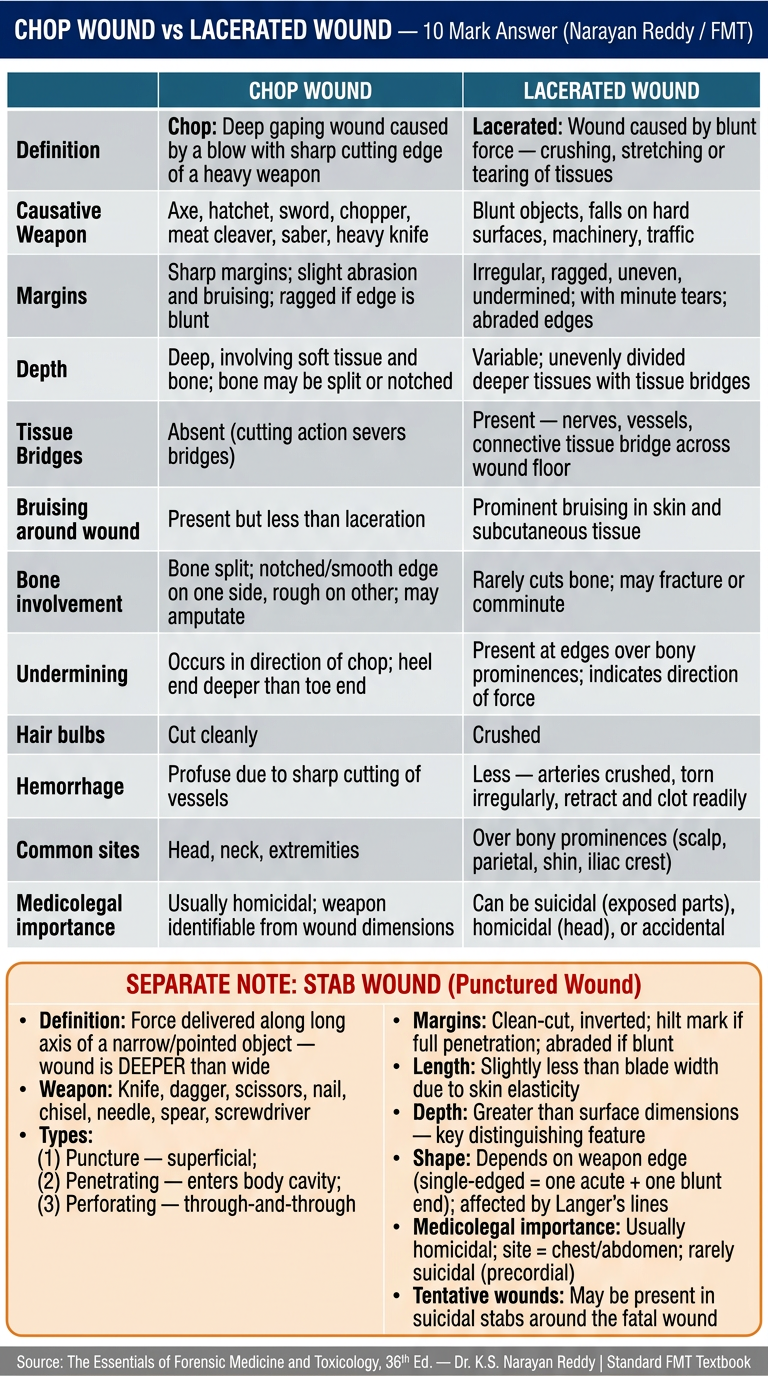
Chop Wound vs. Lacerated Wound — 10 Mark Answer
CHOP WOUND (Slash Wound)
- Margins — Sharp; slight abrasion and bruising. If edge is blunt, margins become ragged and bruised.
- Dimensions — Wound dimensions correspond to the cross-section of the penetrating portion of the blade.
- Undermining — Occurs in the direction of the chop. The heel (lower end) of the axe strikes first and is deeper than the toe (upper end); the deeper end indicates the assailant's position.
- Bone — Bone is split or notched. One edge is smooth, one is rough (cracked-off fragment on the opposite side from the force). May cause complete/incomplete amputation of fingers or extremities.
- Hemorrhage — Profuse due to clean cutting of blood vessels.
- Suicidal chop — Very rare; almost always homicidal.
LACERATED WOUND
- Margins — Irregular, ragged, uneven; ends are pointed or blunt; minute tears at margins; undermined.
- Tissue bridges — Present at the wound floor (nerves, blood vessels, connective tissue bridge across) — this is a KEY differentiating feature from incised/chop wounds.
- Bruising — Prominent bruising in skin and subcutaneous tissue around the wound.
- Hair bulbs — Crushed (not cut).
- Hemorrhage — Less than incised/chop wounds because arteries are crushed, torn irregularly, retract well, and clot readily.
- Common sites — Over bony prominences (scalp, parietal, shin, iliac crest, cheekbones).
- Medicolegal — Suicidal (exposed parts, same side), homicidal (usually on head), or accidental.
KEY COMPARISON TABLE (TABLE 8.9, Narayan Reddy)
| Feature | Chop Wound | Lacerated Wound |
|---|---|---|
| Weapon | Heavy sharp-edged (axe, sword) | Blunt objects |
| Margins | Sharp, slightly abraded | Irregular, ragged, undermined |
| Tissue bridges | Absent | Present |
| Hair bulbs | Cut cleanly | Crushed |
| Bone | Split/notched | Rarely cut; may fracture |
| Hemorrhage | Profuse | Less |
| Bruising | Mild-moderate | Prominent |
| Depth | Deep, uniform to heel end | Variable |
SEPARATE NOTE: STAB WOUND
- Definition: Wound produced when force is delivered along the long axis of a narrow or pointed object — the wound is deeper than it is wide (key feature).
- Weapons: Knife, dagger, scissors, nail, needle, chisel, screwdriver, spear.
- Types: (1) Puncture (superficial); (2) Penetrating (enters body cavity); (3) Perforating/through-and-through.
- Margins: Clean-cut, inverted edges; hilt mark with full penetration; ragged if weapon is blunt.
- Length: Slightly less than blade width due to skin elasticity; re-approximate edges to measure accurately.
- Shape: Affected by Langer's cleavage lines — parallel = slit-like; across lines = gapes open. Single-edged weapon produces one acute, one blunt/wedge-shaped end.
- Depth: Cannot be assessed from surface alone; should never probe with instruments before thorough examination.
- Medicolegal:
- Usually homicidal (chest, abdomen; multiple wounds; defense wounds on victim present)
- Suicidal — single wound, precordial/upper abdomen, tentative wounds around it, clothing removed from site
- Accidental — usually single, no defense wounds
- Distinguish from firearm wound: Stab causes a slit-like wound; firearm causes an actual hole.
Create an image on, write about various type of torture methods from Narayan Reddy Essentials of Foreign Sikh Medicine and Toxicology 36th edition. In detail. 10marks
A detailed, professional forensic medicine study poster titled "TORTURE — Types and Methods" for a 10-mark medical exam answer. Academic style, clean white background, color-coded sections, suitable for MBBS/forensic medicine students. Based on Narayan Reddy's Essentials of Forensic Medicine & Toxicology 36th Edition. TITLE BAR (dark crimson/maroon background, white bold text, large font): TORTURE — Types & Methods (10 Mark Answer) Source: Narayan Reddy's Essentials of FMT, 36th Ed. (2026) SECTION A — DEFINITION BOX (dark navy blue border): "The deliberate, systematic or wanton infliction of physical or mental suffering by one or more persons acting alone or on the orders of any authority, to force another person to yield information, to make a confession or for any other reason." — World Medical Association, Declaration of Tokyo, 1975 SECTION B — LEGAL PROVISIONS (small gray box): • S.120 BNS (S.330 IPC): Voluntarily causing hurt to extort confession — up to 7 years imprisonment • S.121 BNS (S.331 IPC): Voluntarily causing grievous hurt to extort confession — up to 10 years SECTION C — METHODS OF TORTURE (main body, 4 colored sub-boxes arranged in a 2x2 grid): BOX 1 — PHYSICAL ABUSE (red background, white heading): 1. Beating (commonest): Fist, foot, lathi, metal/wooden bars, whips, belts, cycle chains — usually targeting the back; causes abrasions, contusions, lacerations, fractures, organ rupture 2. Falanga / Bastinado: Beating soles of feet (or palms/hips) with canes/rods — very painful; causes deep tissue contusions, hyperpigmentation, aseptic necrosis 3. Telefono: Repeated open-palm slapping over both ears simultaneously — rupture of eardrums, inner ear injury 4. Abdominal beating while lying on table (upper body unsupported): Bruises and rupture of viscera 5. Head beating: Contusions, lacerations of brain, intracranial hemorrhage, skull fracture, cerebral cortical atrophy 6. Finger torture: Twisting fingers, pencils squeezed between fingers, pulling out fingernails with pliers, introducing pins under nails 7. Dental torture: Making victim chew metal/stones; pulling teeth with forceps; drilling to expose pulp cavity 8. Mutilation: Chopping of ears, nose, fingers 9. Disfiguration: Throwing corrosives (acid) on face/body 10. Continuous high-pitched sound 11. Wet Submarino (Latina): Forced immersion of head in dirty water (contaminated with urine/feces) to point of suffocation — foreign material found in upper respiratory and GI tract 12. Dry Submarino: Tying plastic bag over head to point of suffocation 13. Suspension: Hanging by arms tied behind back (Strappado); suspension by wrists (Palestinian hanging); suspension by the arms with forward bend; suspension in inverted position — all causing joint dislocations, brachial plexus injuries, vascular damage 14. Crucifixion: Tying to cross-like structures 15. Stretching: Extending limbs beyond normal range — causes joint injuries 16. Positional torture: Forced maintenance of painful postures for long periods 17. Burning/Heat: Cigarette burns, contact with hot objects, molten substances poured on body; injuries = typical burns with inflammation 18. Cold: Immersion in ice-cold water; exposure to extreme cold 19. Electrical torture: Electric shock applied to wet skin, genitals, ears, mouth — causes burns at contact points, cardiac arrhythmias, muscle necrosis 20. Cutting/Piercing: Blades, broken glass, needles 21. Sleep deprivation with bright light and continuous noise 22. Near-drowning: Using bath tubs 23. Isolation/Sensory deprivation: Confinement in dark rooms or with constant unbearable noise BOX 2 — PSYCHOLOGICAL TORTURE (blue background, white heading): 1. Solitary confinement 2. Threats to kill or harm the victim or family members 3. Witnessing torture of others (including children or family) 4. Threats of death or mock execution; simulated drowning; Russian roulette 5. Humiliation and degradation 6. Verbal abuse and constant interrogation 7. Forced nakedness before others 8. Complete isolation with no contact 9. Deprivation of sleep, food, water 10. Denial of toilet facilities Note: Psychological torture may leave NO physical marks — symptoms include anxiety, depression, PTSD, phobias, sleep disturbances BOX 3 — SEXUAL TORTURE (purple background, white heading): 1. Electric shock / burning to private parts; introducing foreign bodies into rectum or vagina 2. Rape or sexual assault; undressing before others 3. Sexual torture by trained animals 4. Suspension of weights on the penis and scrotum 5. Forced sex with other convicts 6. Application of chili powder or other irritants to genitalia 7. Mutilation of breasts or genitals BOX 4 — PHARMACOLOGICAL TORTURE (orange background, white heading): 1. Drugs to induce self-disclosure (truth serums) 2. Muscle relaxants (causing paralysis while consciousness is preserved) 3. Pain-inducing drugs 4. Psycho-pharmacological drugs (causing hallucinations, disorientation) SECTION D — SEQUELAE / CONSEQUENCES (green box, two columns): Physical: Infection, disfiguration, hearing/vision impairment, fractures, nerve damage, sexual dysfunction Psychological: Anxiety, depression, PTSD, phobias, sleep disturbances, suicidal tendencies, social stigma, personality destruction Death: Rare but possible SECTION E — EXAMINATION (Istanbul Protocol, 1999) (teal box): • First international guidelines for documenting torture • Complete history of torture methods obtained • Acute and chronic symptoms recorded • Injuries documented with body diagrams + photographs (with scale) • Complete systemic examination • X-rays and CT scan for minute fractures and soft tissue injuries FOOTER (gray bar): Source: The Essentials of Forensic Medicine and Toxicology, 36th Ed. (2026) — Dr. K.S. Narayan Reddy | Chapter on Torture, Human Rights Use academic poster formatting, clear fonts, organized layout, no graphic violence, suitable for exam preparation.
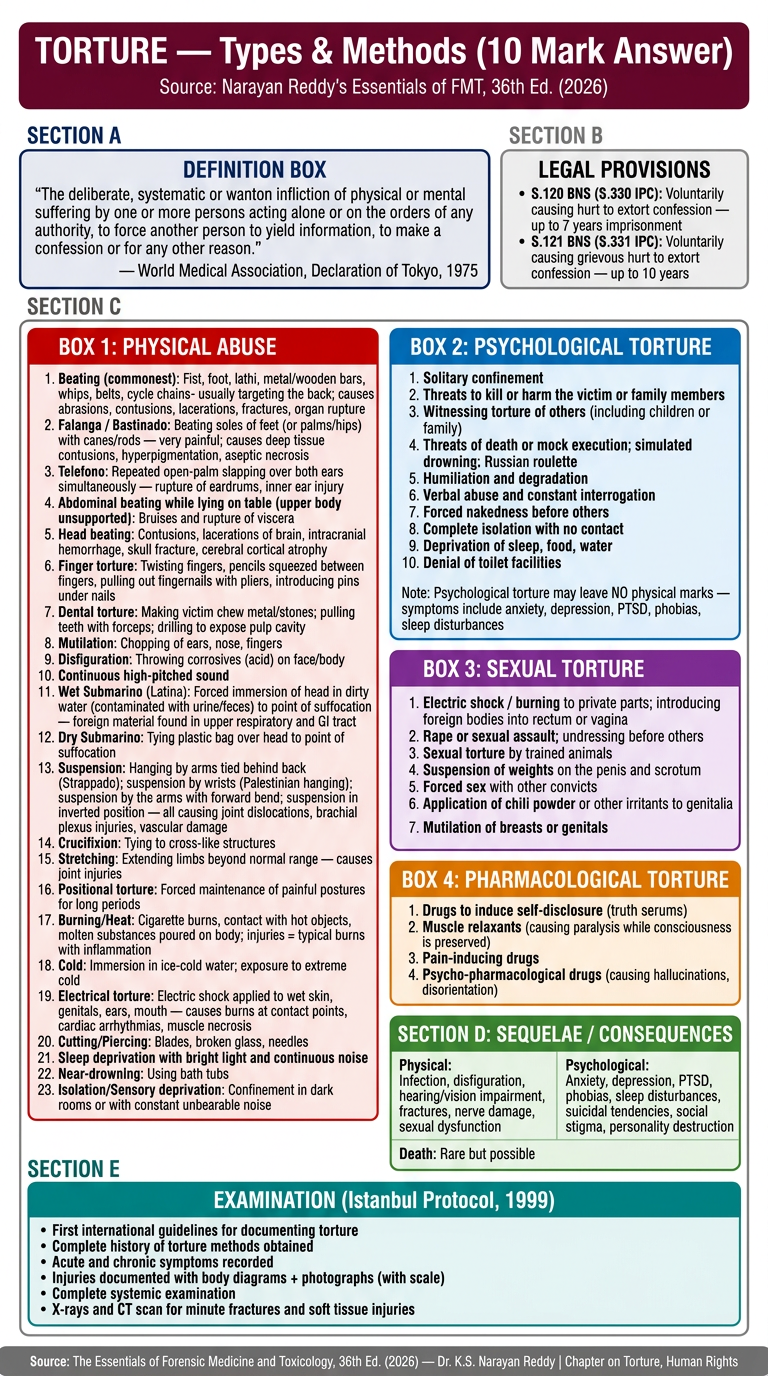
TORTURE — Methods and Types (10 Marks)
Definition
Legal Provisions
- S.120 BNS (S.330 IPC): Voluntarily causing hurt to extort confession — imprisonment up to 7 years
- S.121 BNS (S.331 IPC): Voluntarily causing grievous hurt to extort confession — up to 10 years
METHODS OF TORTURE
(1) PHYSICAL ABUSE
-
Beating (commonest form): Fist, foot, lathi, metal/wooden bars, whips, belts, cycle chains. Target is usually the back. Causes abrasions, contusions, lacerations, fractures, bruises of abdominal wall, rupture of internal organs.
-
Falanga / Bastinado: Canes or rods used to beat the soles of the feet (rarely palms or hips). Very painful and debilitating. Deep tissue contusions, hyperpigmentation along lines of injury, aseptic necrosis.
-
Telefono: Repeated simultaneous open-palm slapping over both ears - causes rupture of ear drums and inner ear injury.
-
Abdominal beating while lying on a table with upper body unsupported - causes visceral bruising and rupture.
-
Head beating: Brain contusions/lacerations, intracranial hemorrhages, skull fractures, cerebral cortical atrophy.
-
Finger torture: Twisting, pencil squeezed between fingers, pulling out fingernails with pliers, introducing pins under finger/toe nails.
-
Dental torture: Forcing victim to chew metal/stones, pulling teeth with forceps/pliers, drilling teeth to expose the pulp cavity.
-
Mutilation: Chopping off ears, nose, fingers.
-
Disfiguration: Throwing corrosives (acid) on face or body.
-
Continuous high-pitched sound.
-
Wet Submarino (Latina): Forced immersion of head in water contaminated with urine/feces until suffocation — foreign material found in upper respiratory and GI tract at autopsy.
-
Dry Submarino: Tying a plastic bag over the head to the point of suffocation.
-
Suspension:
- Strappado — arms tied behind back, suspended
- Palestinian hanging — wrists suspended
- Suspended in inverted position
- Causes joint dislocations, brachial plexus injuries, vascular damage
-
Crucifixion: Tying to cross-like structures.
-
Stretching: Extending limbs beyond normal range — causes joint injuries.
-
Positional torture: Forced maintenance of painful postures for long periods.
-
Burning / Heat: Cigarette burns, contact with hot objects, pouring molten substances on body.
-
Cold: Immersion in ice-cold water, exposure to extreme cold.
-
Electrical torture: Electric shocks applied to wet skin, genitals, ears, mouth — contact burns, cardiac arrhythmias, muscle necrosis.
-
Sleep deprivation with continuous bright light and noise.
(2) PSYCHOLOGICAL TORTURE
- Solitary confinement
- Threats of death to self or family members
- Witnessing torture of others (including children)
- Mock executions, simulated drowning, Russian roulette
- Humiliation, degradation, verbal abuse
- Forced nakedness before others
- Denial of food, water, toilet facilities
Note: May leave NO physical marks. Symptoms include anxiety, depression, PTSD, phobias, sleep disturbances, suicidal tendencies.
(3) SEXUAL TORTURE
- Electric shock/burning of genitals; introduction of foreign bodies into rectum/vagina
- Rape; forced sexual acts
- Suspension of weights on penis and scrotum
- Application of chili powder or irritants to genitalia
- Mutilation of breasts or genitals
(4) PHARMACOLOGICAL TORTURE
- Truth serums (drugs to induce self-disclosure)
- Muscle relaxants (paralysis while consciousness preserved)
- Pain-inducing drugs
- Psycho-pharmacological drugs (hallucinations, disorientation)
SEQUELAE
- Physical: Infection, disfigurement, impaired hearing/vision, fractures, nerve damage
- Psychological: Anxiety, depression, PTSD, phobias, sleep disturbances, suicidal tendencies, social stigma
- Death: Rare but may occur
EXAMINATION — Istanbul Protocol (UN, 1999)
- First international guidelines for documentation of torture
- Complete history of torture methods obtained
- Acute and chronic symptoms recorded
- Injuries documented with body diagrams + photographs (scale placed next to wounds)
- All systems examined completely
- X-rays + CT scan for minute fractures and soft tissue injuries