
Massive intraoperative bleeding protocol
Reading File
Now let me search the library and web in parallel for massive intraoperative bleeding protocols.
Finding Sources
Finding Sources
Searching the Web
massive intraoperative bleeding protocol management 2024 2025
Now let me read the relevant textbook sections and search for more specific content in parallel.
Reading File
Finding Sources
Finding Sources
Searching PubMed
massive intraoperative hemorrhage management protocol
Let me now read the key sections from Miller's Anesthesia on trauma-induced coagulopathy and the damage control resuscitation section.
Reading File
Reading File
Finding Sources
Finding Sources
Excellent - I now have rich content. Let me get the key MTP protocol details and the lethal triad sections.
Reading File
Reading File
Reading File
I have the MTP protocol diagram. Let me fetch it and get a few more sections on surgical hemostasis and APSF protocol content.
Loading Image
Reading File
Reading Web Page
https://www.apsf.org/article/management-of-massive-intraoper…
I now have comprehensive information to deliver a thorough protocol. Let me compile the full response.
Massive Intraoperative Bleeding Protocol
Massive intraoperative hemorrhage is defined as blood loss exceeding 150 mL/min or requirements of more than 10 units of packed red blood cells (PRBCs) in 24 hours. It demands simultaneous surgical hemorrhage control, hemostatic resuscitation, and rapid multidisciplinary coordination. The framework centers on three pillars: recognize early, activate immediately, resuscitate hemostically.
1. Classification of Hemorrhage (ACS)
| Class | Blood Loss | Hemodynamics | Action |
|---|---|---|---|
| I | < 15% (~750 mL) | No change | Observation |
| II | 15-30% (750-1500 mL) | Tachycardia, narrow pulse pressure | IV fluids |
| III | 30-40% (1500-2000 mL) | Hypotension, tachycardia, altered mentation | Blood transfusion; consider damage control |
| IV | > 40% (> 2000 mL) | Profound hypotension, unresponsive | Activate MTP - Damage Control Resuscitation |
- Class IV hemorrhage = Trauma-Induced Coagulopathy (TIC) will be present; massive transfusion is required; death risk is extremely high without immediate intervention. - Morgan & Mikhail's Clinical Anesthesiology, p. 1841
2. Triggering Criteria for Massive Transfusion Protocol (MTP)
Clinical Criteria (Admission/OR)
- SBP ≤ 70 mmHg
- Estimated blood loss > 1000 mL
- SBP < 90 mmHg despite initial crystalloid resuscitation
- Temperature < 34°C
- ABC score ≥ 2 (SBP < 90 mmHg + penetrating injury + HR > 110 + positive FAST)
- Intraoperative: nonsurgical hemorrhage or EBL > 150 mL/min
Laboratory Criteria
-
Base excess > -10
-
INR > 1.4
-
PT > 18 seconds
-
PTT > 60 seconds
-
Admission Hct < 30
-
Miller's Anesthesia 10e, Fig. 62.9
3. The "Lethal Triad" - What You Are Fighting
The three self-reinforcing processes that kill the patient:
Hypothermia + Acidosis + Coagulopathy = "Bloody Vicious Cycle"
- Hypothermia - radiant heat loss, cool resuscitation fluids, exposed peritoneal surfaces, anesthetic suppression of shivering - directly impairs platelet function and reduces coagulation factor activity
- Acidosis - from prolonged tissue hypoxia and lactate accumulation - worsens coagulation factor function
- Coagulopathy - from dilution (crystalloids), consumption, hyperfibrinolysis, and ATC mechanisms
Crystalloid volumes > 4 L prehospital raised the risk of coagulopathy regardless of arrival lactate - Miller's Anesthesia 10e, p. 9388
4. Immediate Team Roles (Code Hemorrhage / Crisis Activation)
Based on the APSF Code Hemorrhage framework:
| Role | Key Responsibilities |
|---|---|
| Primary Surgeon | Hemorrhage source control; decide damage control vs. definitive repair; communicate with anesthesia re: blood loss, anticipated procedures, timing |
| Secondary Surgeon (Trauma) | Assist with life-threatening injuries; temporary packing; bimanual vessel compression; damage control surgery |
| Primary Anesthesiologist | Patient management; hemodynamic targets; communicate with blood bank; direct team |
| Secondary Anesthesia Team | Roles: blood product checks, rapid infuser management, central/arterial access, frequent labs, documentation |
| Anesthesia Technologist | Rapid infuser setup, TEE machine, assist with access |
| Circulating Nurse | Communicate with blood bank; coordinate blood transport to OR; expedite equipment retrieval |
| Blood Bank | Prepare MTP packs; communicate product availability; consult on coagulation optimization |
5. Damage Control Resuscitation (DCR) - Core Principles
5a. Permissive Hypotension
- Target SBP 90 mmHg (MAP ~60 mmHg) until definitive hemorrhage control
- Rationale: aggressive normalization "pops the clot" and worsens hemorrhage
- Exception: NOT used in traumatic brain injury, elderly patients, blunt trauma, or cardiac/carotid disease - Mulholland & Greenfield Surgery 7e, p. 1592
5b. Limit Crystalloids
- Minimize isotonic fluids - they cause dilutional coagulopathy and hypothermia
- Use blood products as primary resuscitation fluid
5c. Hemostatic Resuscitation - Blood Product Ratios
-
1:1:1 ratio of RBC : FFP : Platelets (approximates whole blood)
-
Evidence: PROPPR trial - 1:1:1 achieved hemostasis more rapidly and fewer exsanguination deaths by 24h compared to 1:1:2
-
Uncross-matched (type O) RBCs and FFP until cross-match available
-
Miller's Anesthesia 10e, p. 9413
6. MTP Pack Protocol
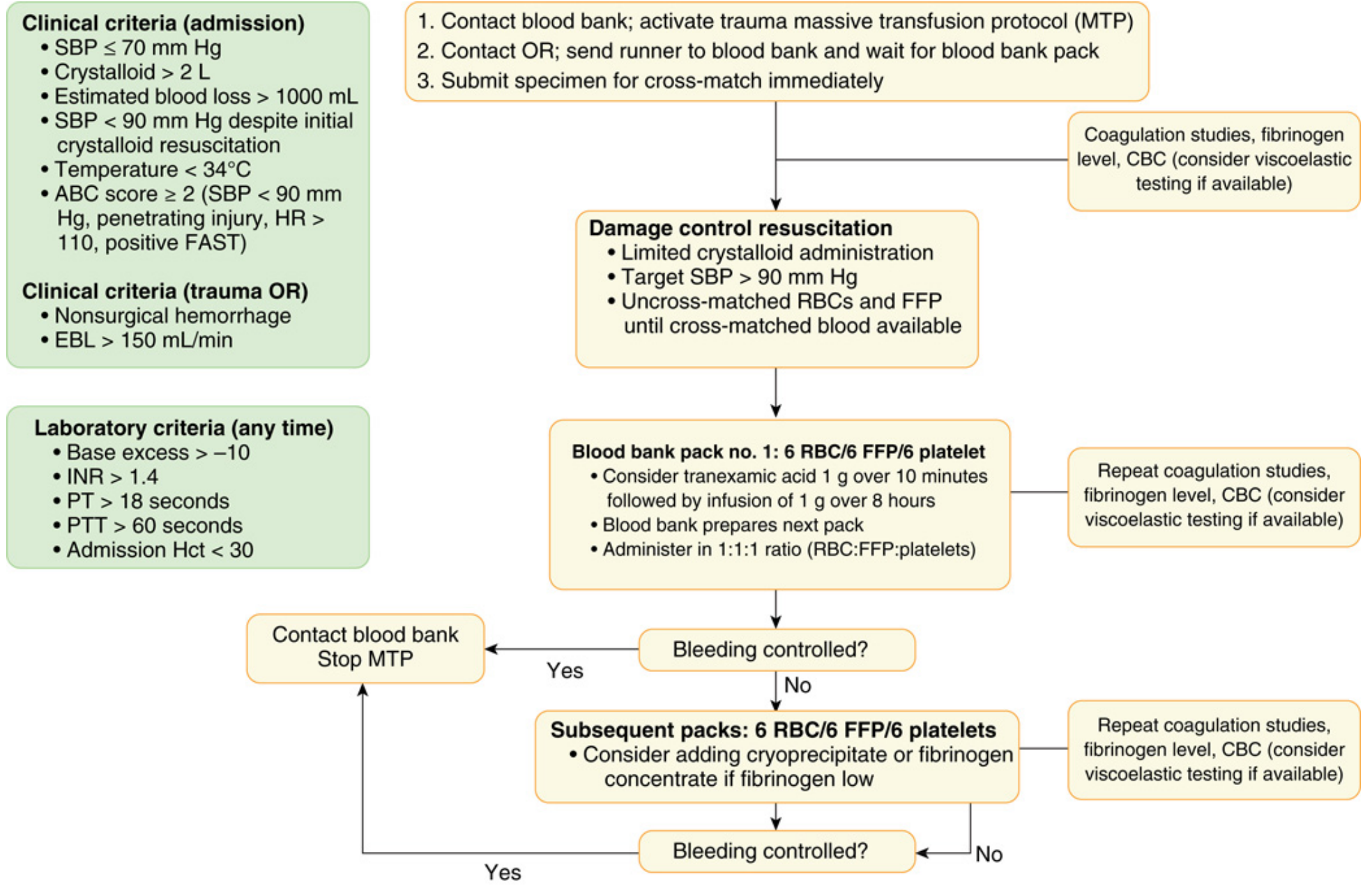
Step 1 (Activate):
- Contact blood bank; activate MTP
- Send runner to blood bank; wait for Pack 1
- Submit specimen for cross-match immediately
- Draw: coagulation studies, fibrinogen, CBC (consider viscoelastic testing if available)
Pack 1: 6 RBC / 6 FFP / 6 Platelets
- Administer in 1:1:1 ratio (RBC : FFP : Platelets)
- Consider tranexamic acid (TXA) 1 g over 10 min, then 1 g infusion over 8 hours
- Blood bank prepares next pack
Subsequent Packs: 6 RBC / 6 FFP / 6 Platelets
- Repeat coagulation studies + fibrinogen + CBC after each pack
- If fibrinogen < 100-150 mg/dL: add cryoprecipitate (10 bags raises fibrinogen ~100 mg/dL) or fibrinogen concentrate (25-50 mg/kg)
- Reassess: bleeding controlled? - Rosen's Emergency Medicine, p. 2617
Stop MTP when bleeding controlled; notify blood bank.
7. Pharmacologic Adjuncts
| Agent | Dose | Indication |
|---|---|---|
| Tranexamic Acid (TXA) | 1 g IV over 10 min, then 1 g over 8h | Hyperfibrinolysis; give within 3 hours of injury (CRASH-2 trial - benefit lost after 3h) |
| Prothrombin Complex Concentrate (PCC) | Per local protocol (factor IX-based dosing) | Warfarin reversal; also used in goal-directed therapy for factor deficiency |
| Vitamin K | 10 mg slow IV (1 mg/min) | Warfarin-associated life-threatening bleeding (alongside PCC) |
| Recombinant Factor VIIa | Per protocol | Refractory coagulopathy (off-label) |
| Fibrinogen Concentrate | 25-50 mg/kg (2-4 g adult) | Fibrinogen < 150 mg/dL |
| Desmopressin (DDAVP) | 0.3 mcg/kg | Platelet dysfunction (aspirin, uremia) |
- Miller's Anesthesia 10e; Rosen's Emergency Medicine
8. Blood Product Dosing Reference
| Product | Adult Dose | Effect |
|---|---|---|
| PRBC (1 unit, ~450 mL) | 1 unit | ↑ Hgb ~1 g/dL, ↑ Hct ~3% |
| FFP | 10-30 mL/kg | Coagulation factor replacement |
| Platelets | 6-pack or 1 apheresis unit | ↑ Platelet count ~40-60 K/μL |
| Cryoprecipitate | ~10 bags | ↑ Fibrinogen ~100 mg/dL |
- Rosen's Emergency Medicine, p. 2609-2611
9. Surgical Damage Control (DCL)
The "lethal triad" is the primary indication for abbreviated surgery followed by ICU stabilization:
Phase 1 - Hemorrhage Control:
- Rapid midline laparotomy (xiphoid to suprapubic)
- Evacuate hemoperitoneum with salvage devices; pack all four quadrants tightly
- Unpack one quadrant at a time, controlling each bleeding source
- Options: packing, vessel ligation, vascular shunts (temporary), bowel stapling without anastomosis
- Allow anesthesia to "catch up" on resuscitation while quadrants packed
Phase 2 - ICU Resuscitation:
- Reverse hypothermia, coagulopathy, acidosis
- Goal: temp > 35°C, pH > 7.35, INR < 1.5, fibrinogen > 150 mg/dL
Phase 3 - Definitive Repair:
-
Return to OR at 24-72 hours for anastomosis, vascular repair, abdominal closure
-
Fischer's Mastery of Surgery 8e; Current Surgical Therapy 14e
10. Hemostatic Surgical Adjuncts
| Class | Agents |
|---|---|
| Porcine gelatin | Gelfoam, Surgifoam |
| Oxidized regenerated cellulose (ORC) | Surgicel |
| Bovine collagen | Avitene |
| Topical thrombin | Thrombin (bovine) |
| Gelatin + thrombin (biphasic) | Floseal, Surgiflow |
| Fibrin sealant | Tisseel, Evicel |
| Polysaccharide spheres | Arista |
- Fischer's Mastery of Surgery 8e, Table 275.4
Cell salvage (intraoperative autotransfusion) should be activated early when major blood loss is anticipated, provided there is no fecal contamination.
11. Monitoring During MTP
| Monitor | Target |
|---|---|
| ABG (pH, lactate, base excess) | pH > 7.35, BE > -6 |
| Temperature | > 35°C |
| Hemoglobin | ≥ 7-8 g/dL (higher in cardiac patients) |
| INR / PT | < 1.5 / < 18 sec |
| Fibrinogen | > 150 mg/dL |
| Platelet count | > 50,000/μL (> 100,000 if TBI or ongoing) |
| Ionized calcium | > 1.0 mmol/L (correct with CaCl₂) - massive transfusion chelates calcium |
| TEG / ROTEM | Preferred over conventional labs for real-time coagulation guidance |
12. Viscoelastic Testing (TEG/ROTEM) - Goal-Directed Approach
TEG and ROTEM provide a real-time, global view of clot formation, strength, and lysis - superior to conventional PT/PTT which:
- Are performed at physiologic pH/temp (do not reflect actual in vivo coagulopathy)
- Take 45-60 minutes (results may be irrelevant by the time they return)
TEG/ROTEM can detect:
- Clotting factor deficiency vs. platelet dysfunction vs. fibrinolysis
- Hyperfibrinolysis (critical for TXA decision)
- Functional platelet dysfunction even with normal platelet counts
Transition from empiric 1:1:1 MTP to goal-directed hemostatic resuscitation using viscoelastic monitoring as soon as hemorrhage is controlled. - Mulholland & Greenfield Surgery 7e, p. 1572
13. Special Considerations
TBI + Hemorrhagic Shock: Permissive hypotension is contraindicated - maintain CPP; target SBP ≥ 90 mmHg.
Obstetric Hemorrhage: Uterotonic agents (oxytocin, misoprostol, carboprost, methylergonovine) form part of the protocol; consider interventional radiology (uterine artery embolization) or hysterectomy.
Anticoagulated Patients:
- Warfarin: PCC + Vitamin K 10 mg IV
- Dabigatran: Idarucizumab (Praxbind) 5 g IV
- Factor Xa inhibitors (rivaroxaban, apixaban): Andexanet alfa or 4F-PCC
Elderly / Blunt Trauma: Be cautious with permissive hypotension - comorbidities and cardiac/carotid disease make even brief hypotension dangerous.
Summary Algorithm
MASSIVE BLEEDING RECOGNIZED
         ↓
CALL FOR HELP + ACTIVATE CODE HEMORRHAGE / MTP
         ↓
SURGICAL: Pack/compress bleeding source immediately
         ↓
ANESTHESIA: Permissive hypotension (SBP 90) + limit crystalloids
         ↓
BLOOD BANK: O-negative RBC + FFP (uncrossmatched) immediately
         ↓
PACK 1: 6 RBC : 6 FFP : 6 Platelets + TXA 1g IV
         ↓
LAB: ABG + TEG/ROTEM + fibrinogen + CBC
         ↓
REASSESS every pack: fibrinogen low → cryoprecipitate/fibrinogen conc
         ↓
SWITCH TO GOAL-DIRECTED THERAPY once controlled
         ↓
DAMAGE CONTROL SURGERY if lethal triad present
Sources:
- Miller's Anesthesia 10e (Hemostatic Resuscitation, Trauma-Induced Coagulopathy chapters)
- Mulholland & Greenfield Surgery 7e (Damage Control Resuscitation chapter)
- Rosen's Emergency Medicine (Massive Transfusion Protocols)
- Fischer's Mastery of Surgery 8e (Operative hemorrhage control)
- Current Surgical Therapy 14e (Damage Control Laparotomy)
- APSF: Management of Massive Intraoperative Hemorrhage
- ISBT: Massive Bleeding Protocols (updated Jan 2026)
This is a shared conversation. Sign in to Orris to start your own chat.