
Periphera.artery disease
Reading File
Peripheral artery disease (PAD) is a common condition caused by atherosclerosis narrowing the arteries that supply the limbs, most often the legs. Let me search the medical library for comprehensive coverage.
Searching sources...
Finding Sources
Finding Sources
Searching PubMed
"peripheral artery disease" AND management
Excellent - Harrison's 22E (2025) and Fuster & Hurst's Heart have dedicated PAD chapters. Let me read the most comprehensive sources in parallel.
Reading File
Reading File
Harrison's 22E has rich content. Let me read more of it plus the Fuster & Hurst section on PAD content.
Reading File
Reading File
Excellent content from both sources. Let me read the treatment section from Harrison's and more from Fuster & Hurst on classification and management.
Reading File
Reading File
I now have comprehensive content. Let me also fetch the key MRA image and read the classification/revascularization section.
Reading File
Loading Image
I now have comprehensive content from Harrison's 22E and Fuster & Hurst's The Heart to compose a thorough answer. Let me compile it.
Peripheral Artery Disease (PAD)
Definition
PAD is defined as a clinical disorder in which there is stenosis or occlusion in the aorta or the arteries of the limbs. Atherosclerosis is the leading cause in patients over 40 years old. Other causes include thrombosis, embolism, vasculitis, fibromuscular dysplasia, entrapment, cystic adventitial disease, and trauma.
- Harrison's Principles of Internal Medicine 22E (2025), p. 2215
Epidemiology
- PAD affects 8-12 million individuals in the United States and over 200 million worldwide
- Prevalence of ~3.6% in the general population; rises to ~20% in those >55 years and up to 60% in those >85 years
- Prevalence is roughly equal in men and women, and higher in persons identified as Black vs. non-Hispanic white
- Only 10-30% of patients experience classic claudication; the majority are asymptomatic or have atypical symptoms
- The PAD Awareness, Risk, and Treatment (PARTNERS) study found 29% prevalence in those aged ≥70 years or aged 50-69 with diabetes/smoking history
- Fuster and Hurst's The Heart, 15th Edition, p. 805
Risk Factors
| Risk Factor | Notes |
|---|---|
| Age | Prevalence rises sharply >55 years |
| Smoking | Strongest modifiable risk factor |
| Diabetes mellitus | Associated with distal vessel involvement |
| Hypercholesterolemia / elevated Lp(a) | Promotes plaque formation |
| Hypertension | Promotes endothelial injury |
| Chronic kidney disease (CKD) | Independent risk factor |
| Homocysteinemia | Associated but less potent |
| Lower socioeconomic status | Independently associated |
Pathology
Segmental atherosclerotic lesions cause stenosis or occlusion in large and medium-sized vessels. Histologically: atherosclerotic plaques with calcium deposition, thinning of the media, destruction of muscle and elastic fibers, fragmentation of the internal elastic lamina, and fibrin-platelet thrombi.
Primary sites of involvement:
- Abdominal aorta and iliac arteries: 30% of symptomatic patients
- Femoral and popliteal arteries: 80-90% of patients
- Tibial and peroneal arteries (distal): 40-50% of patients (most common in elderly and diabetics)
Lesions occur preferentially at arterial branch points due to turbulent flow, altered shear stress, and intimal injury.
- Harrison's 22E, p. 2215
Clinical Presentation
Asymptomatic
Fewer than 50% of patients are symptomatic, though many have impaired gait or slow walking speed.
Intermittent Claudication
The classic symptom: pain, ache, cramp, numbness, or fatigue in muscles during exercise, relieved by rest (2-5 minutes of standing). Location is distal to the stenosis:
- Buttock/hip/thigh/calf: aortoiliac disease (Leriche syndrome if bilateral)
- Calf only: femoral-popliteal disease
Chronic Limb-Threatening Ischemia (CLTI)
When resting blood flow cannot meet basal tissue needs:
- Rest pain: worse at night when legs are horizontal, improves with dependency
- Ulcers and gangrene: signify tissue loss
Acute Limb Ischemia (ALI)
Presents with the "6 Ps": Pain, Pallor, Pulselessness, Paresthesia, Paralysis, Poikilothermia. A surgical emergency.
Pseudoclaudication (Neurogenic)
Spinal stenosis can mimic PAD claudication, but is relieved by sitting or flexion, not simply stopping walking.
Physical Examination
- Decreased or absent pulses distal to obstruction
- Bruits over narrowed arteries
- Muscle atrophy, hair loss, thickened nails, shiny/smooth skin, reduced skin temperature
- Pallor on leg elevation, dependent rubor (reactive hyperemia on lowering)
- Ischemic ulcers or gangrene in severe disease
- Ischemic neuropathy: numbness and hyporeflexia
Diagnosis and Noninvasive Testing
Ankle-Brachial Index (ABI)
The cornerstone of diagnosis:
| ABI Value | Interpretation |
|---|---|
| >1.40 | Non-compressible (calcified arteries, e.g., diabetes) |
| 1.00-1.40 | Normal |
| 0.91-0.99 | Borderline |
| ≤0.90 | PAD (diagnostic threshold) |
| 0.41-0.90 | Mild-to-moderate PAD |
| ≤0.40 | Severe PAD / CLTI |
A post-exercise decline in ABI supports PAD when resting ABI is equivocal.
Other Noninvasive Tests
- Segmental limb pressures: localize stenoses by detecting pressure gradients between sequential cuffs
- Duplex ultrasonography: B-mode + Doppler waveform analysis - images stenoses in native arteries and bypass grafts
- Transcutaneous oximetry: assesses tissue oxygenation
- Pulse volume recordings: waveform amplitude diminishes with significant PAD
Advanced Imaging (pre-revascularization)
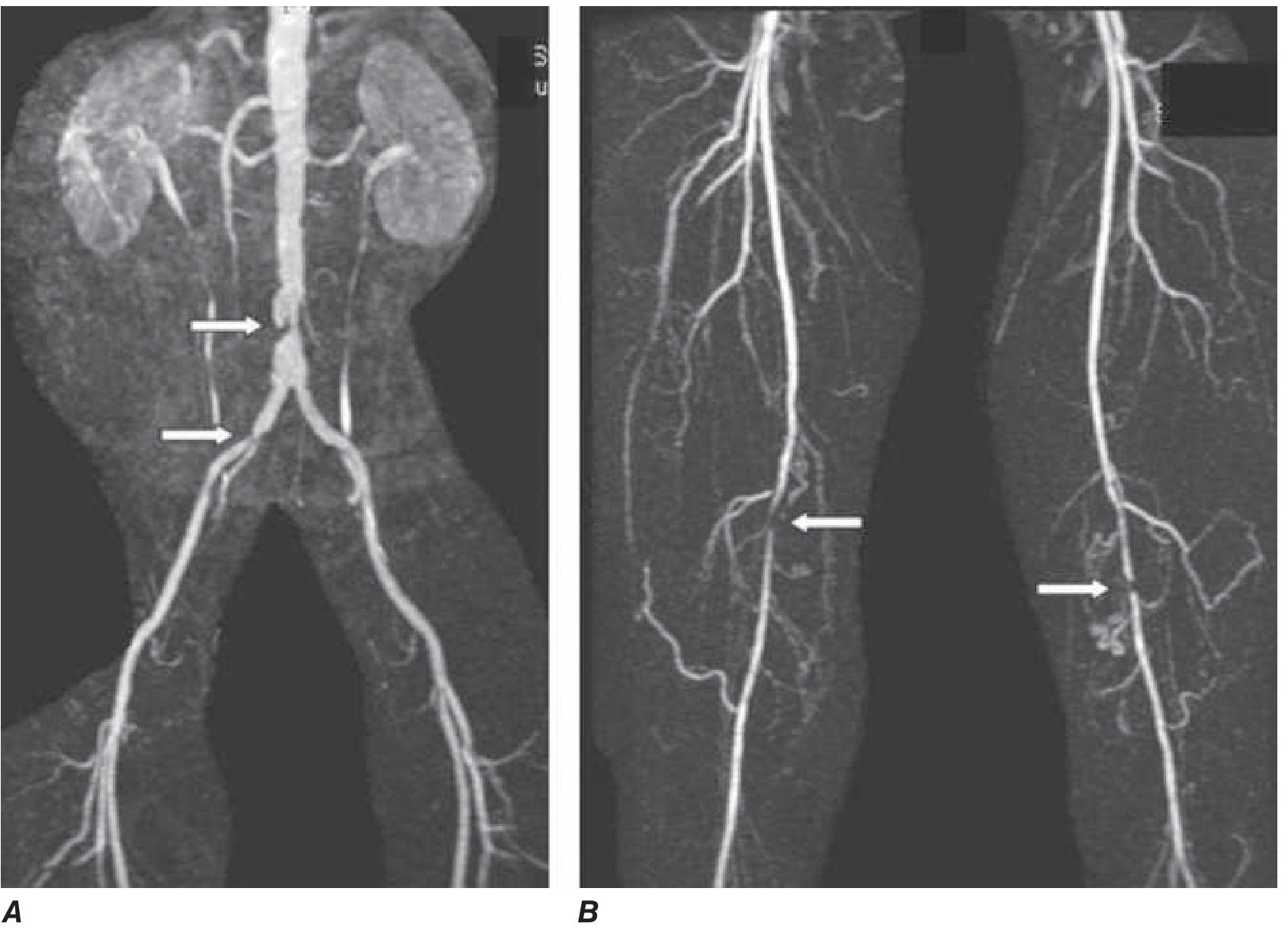
MRA, CTA, and catheter-based angiography are not used for routine diagnosis but are performed before revascularization to plan anatomy.
Classification
Fontaine Classification
| Stage | Description |
|---|---|
| I | Asymptomatic |
| IIa | Mild claudication (>200 m) |
| IIb | Moderate-severe claudication (<200 m) |
| III | Rest pain |
| IV | Tissue loss (ulcer/gangrene) |
Rutherford Classification
| Grade | Category | Description |
|---|---|---|
| 0 | 0 | Asymptomatic |
| I | 1 | Mild claudication |
| I | 2 | Moderate claudication |
| I | 3 | Severe claudication |
| II | 4 | Rest pain |
| III | 5 | Minor tissue loss |
| III | 6 | Major tissue loss |
TASC II Anatomic Classification
Lesions classified as Type A-D based on lesion length and number; guides endovascular vs. surgical approach:
- TASC A: Short focal lesions - best for endovascular
- TASC D: Long, diffuse occlusions - prefer open surgery
WIfI Classification (for CLTI)
The Society of Vascular Surgery's Wound, Ischemia, foot Infection system stratifies amputation risk into very low / low / moderate / high categories, validated across multiple studies.
- Fuster and Hurst's The Heart, 15th Edition, p. 840-841
Prognosis
- PAD patients have a 15-25% 5-year mortality and a 2-4-fold increased risk of death from cardiovascular disease
- ~50% have concurrent coronary artery disease (CAD) by angiography
- Low ABI predicts a 2-fold increased all-cause mortality and cardiovascular death across all Framingham Risk Score ranges
- ABI worsens in ~40% and symptoms progress in ~20-25% over 5 years
- ~11% with symptomatic PAD develop CLTI; without revascularization, ~25% of CLTI patients undergo amputation within 1 year
- Worse prognosis in continued smokers and diabetics
- Harrison's 22E, p. 2216
Treatment
1. Cardiovascular Risk Reduction (All PAD Patients)
| Intervention | Details |
|---|---|
| Smoking cessation | Single most important intervention; counseling + pharmacotherapy (nicotine patch, bupropion, varenicline) |
| Lipid lowering | Statins reduce cardiovascular events and may improve claudication |
| Blood pressure control | ACE inhibitors/ARBs reduce cardiovascular events; beta-blockers do NOT worsen claudication and are safe |
| Glycemic control | Intensive glucose lowering reduces amputations; GLP-1 agonists and SGLT2 inhibitors have cardiovascular benefit |
| Antiplatelet therapy | Aspirin or clopidogrel recommended for all symptomatic PAD |
Antithrombotic specifics:
- Clopidogrel (ADP antagonist): preferred; ticagrelor has similar outcomes
- Dual antiplatelet therapy (aspirin + clopidogrel): benefit over aspirin alone is uncertain
- Vorapaxar (PAR-1 antagonist): reduces cardiovascular events and acute limb ischemia when added to antiplatelet therapy, but increases bleeding
- Low-dose rivaroxaban + aspirin (COMPASS trial): improves cardiovascular and limb outcomes in established PAD and post-revascularization, with increased bleeding risk
- Warfarin: as effective as antiplatelet therapy but causes more major bleeding - not indicated for chronic PAD
- Harrison's 22E, p. 2216-2217
2. Claudication-Specific Treatment
Exercise therapy:
- Supervised programs: 30-45 min sessions, ≥3 times/week, for ≥12 weeks
- Prolongs walking distance - often equal to or better than revascularization
- Structured home/community programs also effective
Pharmacologic:
- Cilostazol (phosphodiesterase-3 inhibitor): increases claudication distance by 40-60%, improves quality of life; contraindicated in heart failure
- Pentoxifylline (xanthine derivative): modestly increases exercise duration in some trials, but efficacy not consistently confirmed
- Vasodilators (alpha-blockers, calcium channel blockers): not effective
3. Revascularization
Indications:
- Refractory claudication limiting lifestyle despite medical therapy and exercise
- CLTI (rest pain, ulcers, gangrene)
- Acute limb ischemia (emergency)
Endovascular options: Percutaneous transluminal angioplasty (PTA), stenting - preferred for short focal lesions (TASC A/B)
Surgical options: Bypass grafting (aortobifemoral, femoro-popliteal, femoro-tibial) - preferred for long/complex occlusions (TASC C/D)
Note on paclitaxel-coated devices: Regulatory scrutiny exists regarding long-term mortality signal; ongoing surveillance.
4. CLTI Management
- Foot care: keep clean, moisturized; well-fitting protective shoes; avoid elastic compression (reduces perfusion)
- Elevating the head of the bed with shock blocks can improve perfusion pressure
- No definitive medical therapy for CLTI; revascularization (endovascular or surgical) is the mainstay
- Amputation when revascularization is not feasible
5. Acute Limb Ischemia Management
- Anticoagulation (IV heparin) immediately
- Catheter-directed thrombolysis for viable limb
- Surgical embolectomy/bypass for immediately threatened limb
Key Points Summary
- PAD is atherosclerotic disease of peripheral arteries, most commonly the lower extremities
- Most patients are asymptomatic - ABI screening is key in high-risk individuals
- ABI ≤0.90 is diagnostic; post-exercise ABI adds sensitivity
- PAD is a systemic atherosclerosis marker - cardiovascular mortality risk is the dominant concern
- Smoking cessation and cardiovascular risk factor modification are the foundation of treatment
- Supervised exercise therapy is highly effective for claudication - comparable to revascularization
- Cilostazol is the most effective pharmacotherapy for claudication
- Revascularization is reserved for CLTI, acute ischemia, or refractory claudication
Sources: Harrison's Principles of Internal Medicine 22E (2025), Chapter 292; Fuster and Hurst's The Heart, 15th Edition, Chapter 26
This is a shared conversation. Sign in to Orris to start your own chat.