
Treatment and complications of urticaria angioedema source from standard paediatrics book
Reading File
Now let me search the medical library for urticaria and angioedema in paediatrics textbooks.
Finding Sources
Finding Sources
Let me search for urticaria content in paediatric textbooks specifically, and also check Tintinalli's (which covers emergency including paediatric presentations) and the Harriet Lane Handbook:
Finding Sources
Finding Sources
Now let me read the Harriet Lane Handbook content on urticaria/angioedema and also the Tintinalli's section simultaneously:
Reading File
Reading File
Good content from Tintinalli's. Let me now get more detail from the Tintinalli's block and also look for Nelson's or other paediatric-specific content:
Reading File
Finding Sources
Let me also read the Fitzpatrick's dermatology section (comprehensive) and look for urticaria in the Harriet Lane block 2 (papular urticaria), and also the Andrews' section:
Reading File
Reading File
Now let me get the Fitzpatrick's treatment section and also the Harriet Lane anaphylaxis/management section for urticaria:
Reading File
Reading File
Let me also get a bit more from the Fitzpatrick's treatment section and the Goldman-Cecil on complications:
Reading File
Reading File
Let me get the Goldman-Cecil treatment and complications section:
Reading File
Reading File
I now have extensive information from multiple standard textbooks. Let me fetch the urticaria clinical image from Tintinalli's to include in the answer:
Loading Image
I now have all the information needed to write a comprehensive answer. Let me compile it.
Urticaria and Angioedema in Children: Treatment and Complications
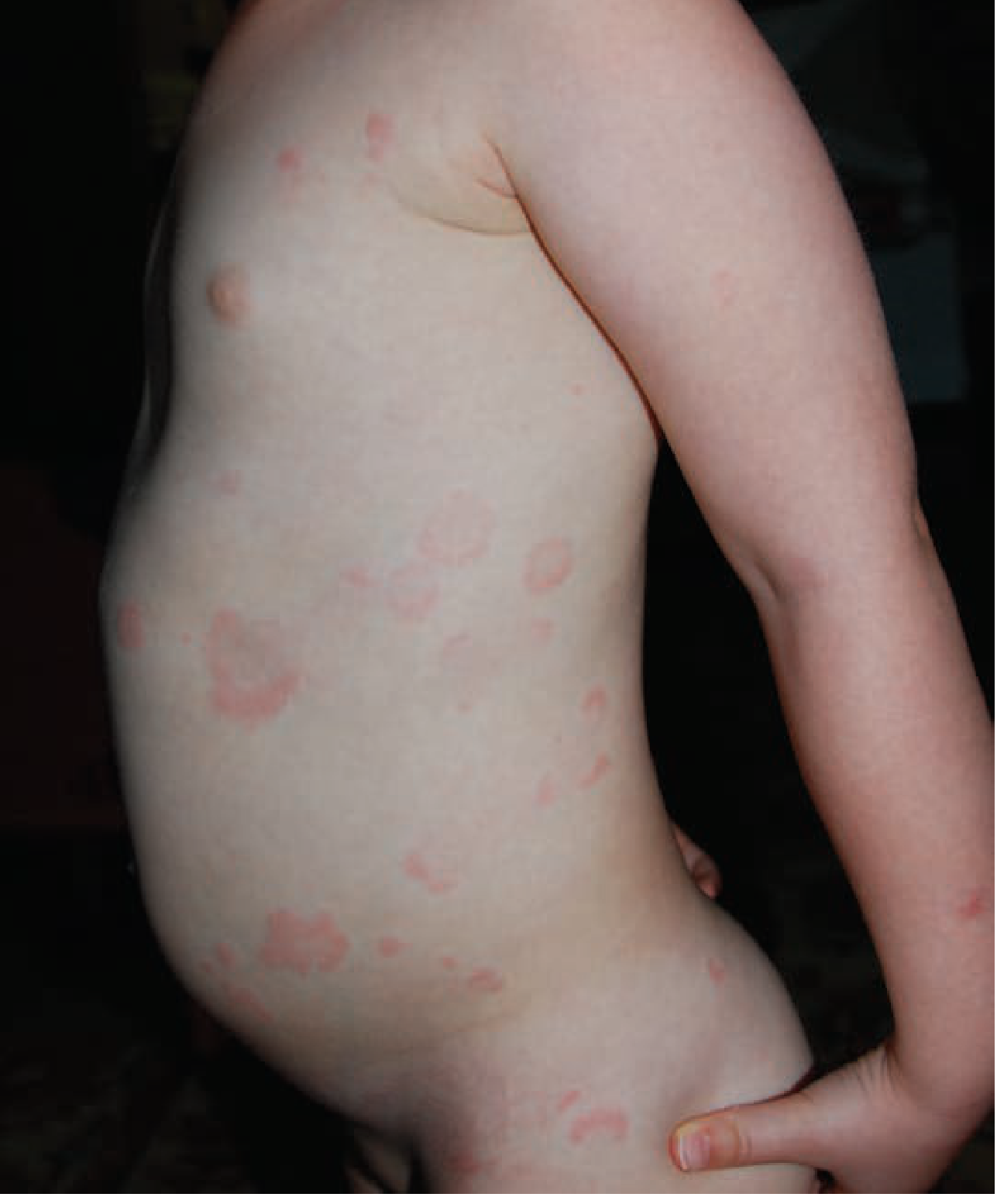
Definitions
- Urticaria: Vascular leak in the superficial dermis producing transient, pruritic, edematous wheals/welts. Individual lesions come and go within 24 hours.
- Angioedema: Larger edematous areas involving the deeper dermis and subcutaneous tissue; less well-demarcated plaques.
- Acute: Duration < 6 weeks. Chronic: Duration > 6 weeks (can persist for years).
Common Triggers in Children
| Category | Examples |
|---|---|
| Food allergy | Milk, egg, peanut (common in children); tree nuts, shellfish (older children/adults) |
| Drugs (IgE-mediated) | Penicillins, sulfonamides, cephalosporins |
| Drugs (non-immunologic) | NSAIDs, aspirin, opiates, radiocontrast material |
| Infections | Viral respiratory illness, post-viral |
| Insect bites | Bees, wasps; also Lone Star tick (alpha-gal meat allergy) |
- In children, milk, egg, and peanut are the most commonly implicated foods in acute urticaria (Goldman-Cecil Medicine).
- NSAIDs/aspirin are the most common causes of non-immunologic urticarial reactions; they alter prostaglandin metabolism, enhancing mast cell degranulation. NSAIDs may also exacerbate chronic urticaria (Andrews' Diseases of the Skin).
Treatment
Step 1 - Trigger Identification and Removal
- Identify and eliminate the causative agent or aggravating factor - this is the most fundamental step.
- In food allergy: implement strict allergen avoidance. Nutritional counseling and growth monitoring are recommended (Harriet Lane Handbook, 23rd ed.).
Step 2 - Pharmacologic Management (Stepwise Approach)
A. First-Line: Second-Generation (Non-Sedating) H1 Antihistamines
These are the mainstay of treatment for all mast cell-mediated urticaria.
| Drug | Dose (Paediatric) |
|---|---|
| Cetirizine (Zyrtec) | 10-20 mg/day |
| Loratadine (Claritin) | 20 mg/day (or age-based dosing) |
| Fexofenadine (Allegra) | 180 mg/day (older children) |
- Long-acting, non-sedating antihistamines lessen new lesions and control pruritus.
- Important paediatric note: First-generation antihistamines (e.g., diphenhydramine, chlorphenamine) are no longer recommended as first-line - they cause carry-over sedation and may produce paradoxical excitation or possibly epilepsy in children (Fitzpatrick's Dermatology, 9th ed.).
- First-generation agents (diphenhydramine, hydroxyzine) remain useful for breakthrough and nighttime pruritus (Tintinalli's Emergency Medicine).
B. Second-Line: Up-titrated Antihistamines
- For cases resistant to standard antihistamine doses, increase to up to fourfold the standard dose, as recommended by EAACI guidelines and AAAAI/ACAAI practice parameters.
- A meta-analysis confirms high-dose antihistamines significantly improve control of pruritus.
C. Add-on Options
- H2 blockers (e.g., ranitidine): Can be used as an adjunct with H1 blockers in chronic urticaria, but not as monotherapy.
- Doxepin (10-25 mg at night): Has combined H1 and H2 blocking properties; sedating, so restricted to bedtime use.
- Antileukotrienes: Added before omalizumab in some guidelines (BSACI, American consensus).
D. Third-Line: Omalizumab
- Omalizumab (anti-IgE monoclonal antibody) is approved for chronic spontaneous urticaria unresponsive to antihistamines.
- Recommended dose: 300 mg/month regardless of serum IgE level (meta-analysis data).
- Clinical effect may appear within 1 week despite taking 2+ months for full FcεRI downregulation.
- The Harriet Lane Handbook (23rd ed.) confirms omalizumab is approved for chronic urticaria in children.
E. Systemic Corticosteroids
- Reserved for severe angioedema and widespread urticaria with acute onset.
- Dose: Prednisone 1 mg/kg/day up to 60 mg PO daily (Tintinalli's), or 40-60 mg/day for 5-7 days.
- Continuous use > 10 days is NOT recommended due to significant side effects.
- Note: A double-blind RCT of 100 adults with acute urticaria found no clinical improvement with prednisone added to an H1 antihistamine (levocetirizine) - reassurance and antihistamines alone may suffice for mild-moderate acute cases.
Step 3 - Management of Angioedema Specifically
- If associated with anaphylaxis: Epinephrine (adrenaline) is the first-line drug - IM injection, dose 0.01 mg/kg of 1:1000 solution.
- Prescribe an epinephrine autoinjector for all at-risk patients.
- Families must be counseled to always have two autoinjectors available and to call emergency services if used.
- An Anaphylaxis Action Plan should be developed and shared with the school.
- ACE inhibitor-induced angioedema: Antihistamines, corticosteroids, and adrenaline are all ineffective; the drug must be stopped.
- Hereditary angioedema (HAE - C1 esterase inhibitor deficiency): Antihistamines, corticosteroids, and adrenaline are also largely ineffective; specific HAE therapies (C1-INH concentrate, icatibant, ecallantide) are required.
Complications
1. Anaphylaxis (Most Serious)
- Urticaria, especially extensive disease around the face or mouth, may be part of a severe anaphylactic reaction.
- Features: bronchospasm, laryngospasm, hypotension, cardiovascular collapse.
- Requires immediate epinephrine administration.
2. Laryngeal/Upper Airway Angioedema
- Angioedema involving the lip, throat, tongue, or larynx can cause life-threatening airway obstruction and asphyxiation.
- More than 50% of patients with hereditary angioedema experience a laryngeal attack in their lifetime.
- May require intubation (up to 18% of severe ACE inhibitor-related angioedema required intubation in case series).
3. Progression from Acute to Chronic Disease
- Patients who have had one episode of angioedema have a 10-fold risk of a second episode, and recurrent episodes may be more severe (Andrews' Diseases of the Skin).
- Chronic urticaria defined as recurrent episodes > 6 weeks; can persist 2-5 years on average.
4. Gastrointestinal Involvement
- In hereditary angioedema, mucosal swelling of the gastrointestinal tract can present as acute abdomen, sometimes leading to unnecessary surgical intervention.
- Can cause severe abdominal pain and colicky episodes.
5. Recurrent/Biphasic Reactions
- Symptoms may recur after initial resolution (biphasic anaphylaxis) - families must be counseled about this possibility and may need a second epinephrine dose.
6. Quality of Life Impact
- Chronic urticaria has a high impact on quality of life - problems with sleep, anxiety, and (in papular urticaria from insect bites in children) social stigma and bullying.
7. Skin Superinfection
- Severe excoriation from pruritus can lead to secondary bacterial skin infection.
Special Considerations in Paediatrics
| Situation | Action |
|---|---|
| Food allergy trigger | "If you can't read it, you can't eat it" approach; strict label reading; nutritional counselling |
| Papular urticaria (insect bite-induced) | Topical steroids, antihistamines; peaks at age 2; usually resolves by age 10 |
| At-risk child (any food/insect anaphylaxis history) | Epinephrine autoinjector prescribed; school Anaphylaxis Action Plan |
| Chronic urticaria unresponsive to antihistamines | Trial omalizumab; refer to allergist/dermatologist |
Sources
- The Harriet Lane Handbook, 23rd ed. (Johns Hopkins Hospital) - Paediatric allergy management
- Tintinalli's Emergency Medicine: A Comprehensive Study - Urticaria/angioedema treatment tables
- Goldman-Cecil Medicine, International Ed. - Pathobiology, classification, treatment algorithm
- Fitzpatrick's Dermatology, 9th ed. - First-line/second-line/third-line therapy framework; paediatric antihistamine cautions
- Andrews' Diseases of the Skin, Clinical Dermatology - Drug-induced urticaria and angioedema complications
This is a shared conversation. Sign in to Orris to start your own chat.