
Vilazodone
Reading File
Finding Sources
Searching PubMed
vilazodone depression
Searching the Web
vilazodone mechanism of action indications side effects
Vilazodone (Viibryd)
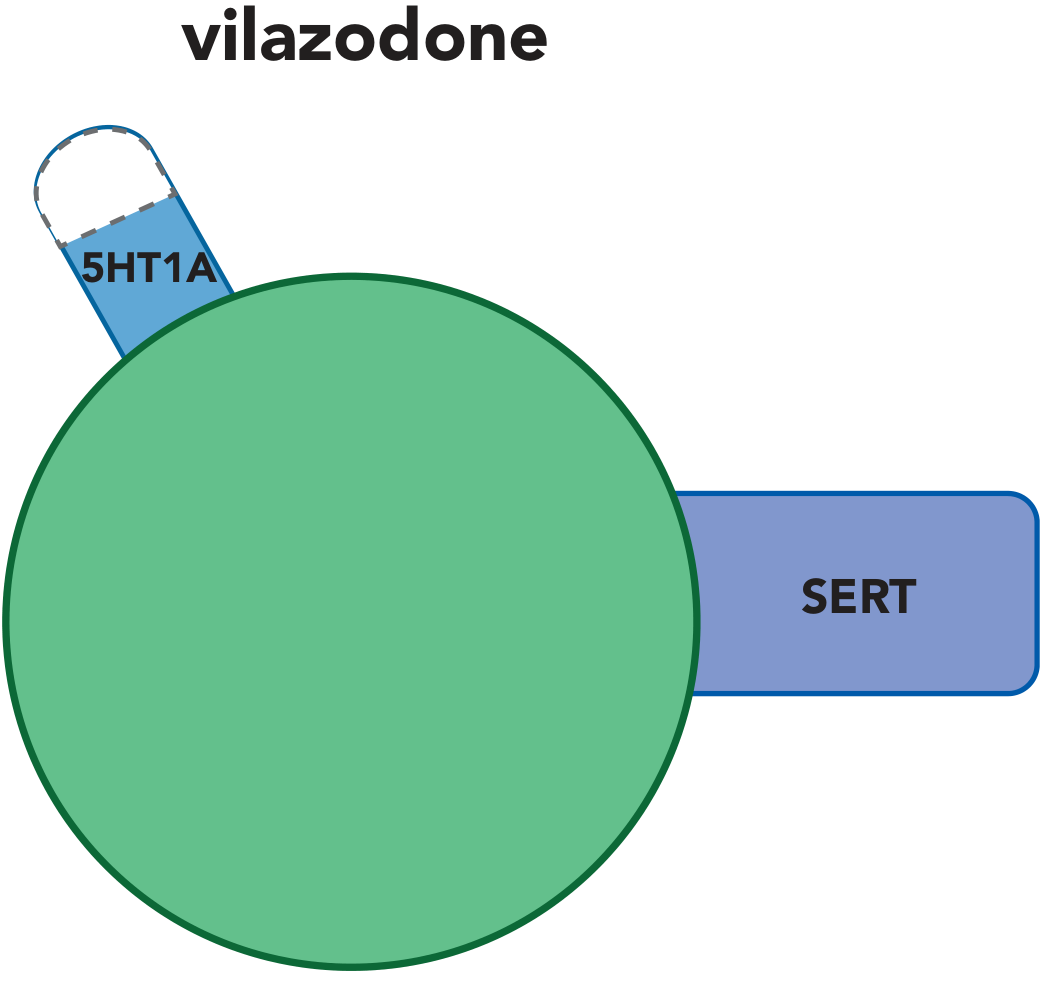
Class: Vilazodone is an atypical antidepressant classified as a serotonin partial agonist/reuptake inhibitor (SPARI). It combines two actions in one molecule: potent, selective inhibition of the serotonin transporter (SERT), like an SSRI, plus partial agonism at the 5-HT1A receptor - a property shared with buspirone (Stahl's Essential Psychopharmacology, "Serotonin Partial Agonist Reuptake Inhibitors (SPARIs)").
Mechanism of action
- Blocks SERT, increasing synaptic serotonin, and simultaneously partially stimulates presynaptic 5-HT1A autoreceptors.
- The theoretical advantage: partial (rather than full) 5-HT1A agonism may desensitize these autoreceptors faster, reducing the initial negative-feedback dampening of serotonin release that normally delays SSRI onset - and the added post-synaptic 5-HT1A stimulation is thought to further boost net serotonergic tone. This was hypothesized to give a faster onset and fewer sexual side effects than plain SSRIs, though large trials have not shown consistent superiority over standard SSRIs (psychiatrist.com review; Psychopharmacology Institute).
Indication
- FDA-approved for Major Depressive Disorder (MDD) in adults. Not approved for pediatric use - safety/efficacy in children has not been established (Kaplan & Sadock's Synopsis of Psychiatry).
- Used off-label for generalized anxiety disorder, social anxiety, and OCD.
Dosing and administration
- Requires titration: typically started low and increased over about 2 weeks to the target dose to minimize GI side effects.
- Must be taken with food. Without food, absorption is markedly reduced and effectiveness may be diminished (Kaplan & Sadock's Synopsis of Psychiatry).
Pharmacokinetics / drug interactions
- Metabolized primarily by CYP3A4.
- Strong CYP3A4 inhibitors (e.g., ketoconazole, grapefruit juice) can raise vilazodone plasma levels by 50% or more, requiring dose reduction; CYP3A4 inducers can lower levels (Katzung's Basic and Clinical Pharmacology; Kaplan & Sadock's Comprehensive Textbook of Psychiatry).
- Vilazodone itself is neither a potent inhibitor nor strong inducer of CYP enzymes.
Adverse effects
Most common (dose-related, GI-predominant):
- Diarrhea (~28% vs 9% placebo in phase III trials)
- Nausea (~23% vs 5% placebo)
- Dizziness, insomnia, vomiting, abnormal dreams, akathisia/restlessness, palpitations, tremor, feeling jittery
Slow titration over about 2 weeks is specifically recommended to reduce these GI effects (Kaplan & Sadock's Comprehensive Textbook of Psychiatry, Table 33.5c-1).
Safety signals / precautions
- Like other serotonergic antidepressants, carries a risk of serotonin syndrome when combined with other serotonergic agents (MAOIs, SSRIs, SNRIs, triptans, tramadol, buspirone, tryptophan) - contraindicated with MAOIs or within 14 days of MAOI use.
- In vitro, vilazodone was clastogenic in some mammalian cell assays though not mutagenic in bacterial reverse mutation testing (per package insert data cited in Kaplan & Sadock's).
- Standard antidepressant class warnings apply (suicidality risk in young adults, discontinuation syndrome if stopped abruptly - see Maudsley Deprescribing Guidelines for tapering advice).
Evidence check
A recent network meta-analysis found antidepressants differ in rates of ejaculatory dysfunction, relevant to vilazodone's proposed lower sexual side-effect burden (PMID 39344496), but I did not find recent systematic reviews/meta-analyses specifically challenging the established efficacy or safety profile of vilazodone summarized above - the textbook data appear current with the literature.
Dosing in vilazodone
Finding Sources
Finding Sources
Reading File
Reading File
Vilazodone Dosing
Standard adult dosing (MDD):
- Available as 10 mg, 20 mg, and 40 mg tablets (a 30-day starter kit contains 7x10mg, 7x20mg, and 16x40mg tablets to facilitate titration).
- Titration schedule:
- Days 1-7: 10 mg once daily
- Days 8-14: 20 mg once daily
- Day 15 onward: 40 mg once daily (target/maintenance dose)
- Must be taken with food - without food, drug absorption is significantly reduced and efficacy may be diminished.
- No additional benefit was shown in trials with doses beyond the standard target.
Special population adjustments
| Population | Adjustment |
|---|---|
| Hepatic impairment (mild-moderate) | No dose adjustment needed |
| Hepatic impairment (severe) | Not studied - use with caution |
| Renal impairment (mild, moderate, severe) | No dose adjustment recommended |
| Geriatric patients | No dose adjustment; pharmacokinetics similar to younger adults (>65 yrs vs 24-55 yrs studied comparably). Label cautions some older individuals may have greater sensitivity and higher hyponatremia risk |
| Pediatric patients | Not FDA-approved; two adolescent (12-17 yr) trials failed to separate from placebo |
| Pregnancy/breastfeeding | No controlled human data available for either |
Dose adjustment for drug interactions
- If co-administered with a strong CYP3A4 inhibitor (e.g., ketoconazole, regular grapefruit juice intake), limit the dose to 20 mg/day maximum, since CYP3A4 inhibition can raise vilazodone plasma levels by 50% or more.
- Caution with CYP3A4 inducers, which may lower efficacy.
Rationale for titration
Slow titration over the full 2 weeks is specifically done to minimize the drug's most common adverse effects - diarrhea (28% vs 9% placebo) and nausea (23% vs 5% placebo) - which are dose-related and most prominent early in treatment.
Sources: Kaplan and Sadock's Synopsis of Psychiatry, p. Dosage and Clinical Guidelines section; Kaplan & Sadock's Comprehensive Textbook of Psychiatry, Table 33.5c-1 / Dosage and Administration section.
One practical note not always emphasized: if a patient misses the titration window or restarts after a gap, clinicians typically restart the titration from 10 mg rather than jumping back to 40 mg, though this isn't explicitly detailed in the sourced text - worth confirming against current product labeling if managing a specific restart scenario.
Vortioxetine
Finding Sources
Finding Sources
Finding Sources
Searching PubMed
vortioxetine depression
Reading File
Vortioxetine (Trintellix)
Class & mechanism: Vortioxetine is a multimodal antidepressant - it inhibits serotonin reuptake (SERT) like an SSRI, but also directly modulates multiple 5-HT receptor subtypes:
- Agonist at 5-HT1A receptors
- Partial agonist at 5-HT1B receptors
- Antagonist at 5-HT3, 5-HT1D, and 5-HT7 receptors
It's the only approved compound with this exact combination of pharmacodynamic actions (Kaplan and Sadock's Synopsis of Psychiatry). The 5-HT3 antagonism was originally intended to reduce the nausea typical of SSRIs, but paradoxically nausea remains the most commonly reported adverse event in trials (Kaplan & Sadock's Comprehensive Textbook of Psychiatry).
Dosing
| Parameter | Detail |
|---|---|
| Tablet strengths | 5, 10, 15, 20 mg |
| Starting dose | 10 mg once daily, without regard to meals |
| Target/titration | Increase to 20 mg/day as tolerated |
| Poor tolerators | Consider reducing to 5 mg/day |
| Maximum dose | 20 mg/day (general); 10 mg/day cap in known CYP2D6 poor metabolizers |
Dose adjustments for drug interactions (CYP2D6 is the primary metabolic pathway)
- CYP2D6 potent inhibitors co-administered (e.g., bupropion, fluoxetine, paroxetine, quinidine): reduce vortioxetine dose by half.
- CYP2D6 poor metabolizers: max dose 10 mg/day.
- CYP inducers co-administered >14 days (e.g., rifampin, carbamazepine, phenytoin): may need to increase dose up to 3x the original dose; once the inducer is stopped, taper back down to the original dose within 14 days.
- Older adults, poor 2D6 metabolizers, or with a 2D6 inhibitor on board: starting dose should be 5 mg/day (Kaplan & Sadock's Comprehensive Textbook of Psychiatry).
Discontinuation
- Can technically be stopped abruptly, but for doses of 15-20 mg/day, tapering is recommended: decrease to 10 mg/day for 1 week before full discontinuation, to avoid transient withdrawal effects (headache, muscle tension) seen in placebo-controlled trials.
- Given its long terminal half-life, a bothersome side effect can be managed by withholding the dose for 3 days and restarting at half-dose rather than stopping altogether.
Side effects
- Nausea is the most common treatment-emergent adverse event (roughly one-fourth to one-third of patients), and the leading cause of discontinuation (dose-dependent, reaching rates comparable to duloxetine 60 mg/day).
- Other common effects: constipation, vomiting, sexual dysfunction (dose-dependent, worse at higher doses).
- Considered to have a comparatively favorable overall tolerability profile among antidepressants otherwise.
Overdose data
Supratherapeutic doses up to 40 mg/day for 4 days were associated with increased nausea and postural symptoms, with limited serious adverse outcomes reported in available data (Kaplan & Sadock's Comprehensive Textbook of Psychiatry).
Evidence check
Several recent meta-analyses/systematic reviews on vortioxetine's efficacy and dose-response were found and are broadly consistent with the dosing framework above - no contradicting signal on the standard 10-20 mg dosing range:
- PMID 39891526 - efficacy meta-analysis in acute MDD treatment (2025)
- PMID 39121757 - umbrella review of dose-response relationship (2024)
- PMID 41058029 - efficacy/adverse effect meta-analysis (2025)
If you want, I can pull specific numbers from any of these (e.g., effect sizes by dose) for a deeper dive.
FDA use of vortioxetine
Finding Sources
Searching the Web
vortioxetine FDA approved indications Trintellix label
FDA-Approved Use of Vortioxetine (Trintellix)
Sole approved indication: Major Depressive Disorder (MDD) in adults.
- Original approval: September 30, 2013, initially marketed as Brintellix, renamed Trintellix in the US in 2016 to avoid confusion with the anticoagulant Brilinta (drugs.com; Takeda newsroom).
- The FDA approval was supported by an initial clinical development program of eleven placebo-controlled trials (five active-referenced) (Kaplan & Sadock's Comprehensive Textbook of Psychiatry).
- As of current labeling, MDD in adults remains the only FDA-approved indication - "To this day, the only approved indication for vortioxetine is for the treatment of MDD in adults" (Kaplan & Sadock's Comprehensive Textbook of Psychiatry, Therapeutic Indications).
Label expansion: cognitive function claim (2018)
In May 2018, the FDA approved a supplemental NDA adding data on processing speed, an aspect of cognitive function, in acute MDD to the US label - based on the FOCUS and CONNECT studies (largely using the Digit Symbol Substitution Test, DSST, often referenced against duloxetine 60 mg/day as an active comparator) (Takeda newsroom; Kaplan & Sadock's Table 33.5c-2).
- Note: Katzung's Basic and Clinical Pharmacology states vortioxetine is "approved in Europe and the USA to treat cognitive dysfunction associated with depression" - this reflects the cognition-related labeling data added to the existing MDD indication, not a separate stand-alone indication for cognitive dysfunction as a distinct disorder. The formal indication remains MDD; the cognition data is additional supporting information within that indication.
Not FDA-approved for:
- Generalized anxiety disorder, other anxiety disorders, or any indication outside adult MDD - these would be off-label uses.
- Pediatric use - not established/approved in children or adolescents.
Global context
Vortioxetine carries the same core MDD indication in the roughly 60-77 countries where it's marketed (including Europe, Canada, Australia, and others), with no additional formal indications noted beyond MDD internationally either.
This is a shared conversation. Sign in to Orris to start your own chat.