
Treatment of diabetic foot
Reading File
Now let me search the medical library and PubMed in parallel for diabetic foot treatment.
Finding Sources
Searching PubMed
"diabetic foot" AND treatment
Searching the Web
diabetic foot treatment guidelines 2024 2025
Good results. Now let me read the most comprehensive sources in parallel - Bailey & Love (surgery), Current Surgical Therapy, Goldman-Cecil Medicine, and Rosen's Emergency Medicine on diabetic foot.
Reading File
Reading File
Reading File
Excellent content. Now let me read the rest of the Bailey & Love section (surgical treatment, antibiotics, osteomyelitis, amputation) and the Current Surgical Therapy section for more management detail.
Reading File
Reading File
Now let me get the wound care and revascularization content from Current Surgical Therapy, and the Goldman-Cecil Medicine section for a medical management overview.
Reading File
Reading File
Excellent - I now have very comprehensive content from multiple authoritative sources. Let me compile a thorough answer.
Loading Image
I now have all the information needed for a comprehensive answer.
Treatment of Diabetic Foot
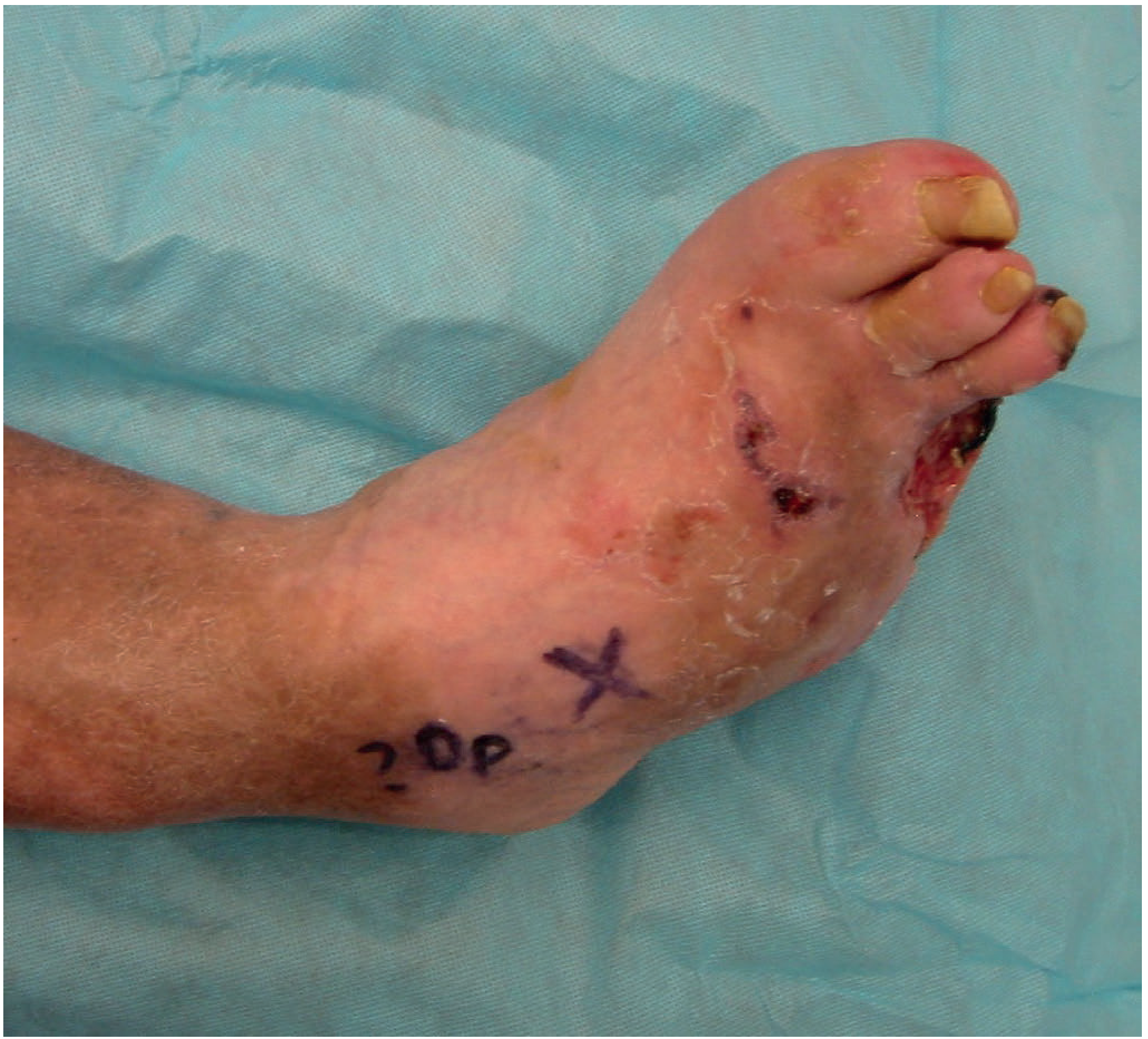
Diabetic foot disease arises from a triad of peripheral neuropathy, peripheral arterial disease (ischemia), and infection, often combined. Approximately 1 in 4 diabetic patients will develop a foot complication during their lifetime, and 15-20% of diabetic foot ulcers (DFUs) lead to lower extremity amputation (LEA) - with 85% of all amputations preceded by a DFU. Management is multidisciplinary and targets each component of this triad.
1. Classification
Before treatment, classify the wound using a validated system. The WIfI (Wound, Ischemia, foot Infection) classification is currently preferred as it predicts 1-year amputation risk and the theoretical benefit of revascularization. Each domain is graded 0 (none) to 3 (severe), yielding 64 combinations. The older Wagner and University of Texas classifications remain widely used.
- Current Surgical Therapy, 14th Ed
2. Glycemic Control
Tight glycemic control is foundational. Hyperglycemia directly impairs wound healing, immune function, and tissue perfusion. Optimization of blood glucose should be initiated alongside all other treatments and maintained throughout the healing process.
- Goldman-Cecil Medicine, 2-Vol Set
3. Pressure Off-Loading
For neuropathic ulcers (plantar surface, under metatarsal heads), removing mechanical pressure is the single most important step in achieving healing:
-
Total contact cast (TCC) - gold standard for off-loading neuropathic plantar ulcers
-
Custom therapeutic footwear and orthotics
-
Special post-operative shoes or removable cast walkers
-
Strict non-weight-bearing status for infected ulcers
-
Goldman-Cecil Medicine; Current Surgical Therapy, 14th Ed
4. Wound Care and Debridement
-
Callus debridement is the first step at every wound assessment - overriding callus hides the true wound extent and prevents wound care product penetration.
-
Sharp/surgical debridement of all necrotic and devitalized tissue is required to convert a chronic wound into an acute, healable wound and achieve source control in infected wounds.
-
Wound base probing (probe-to-bone test) assesses depth and bone involvement.
-
Dressings: Wound environment should be moist but not macerated. Advanced dressings (e.g., hydrocolloids, alginates, silver-containing dressings) are chosen based on wound characteristics.
-
Bioengineered skin substitutes (e.g., Integra dermal regeneration template) and autologous leukocyte/platelet products may benefit non-healing ulcers.
-
Current Surgical Therapy, 14th Ed; Goldman-Cecil Medicine
5. Assessment and Treatment of Infection
Diagnosis
-
Infection is clinical: local signs of inflammation (erythema, warmth, swelling, purulence), crepitation, systemic upset.
-
Blood tests (WBC, CRP, ESR) may be normal or only mildly elevated even in severe infection.
-
Superficial wound swabs are unreliable - they do not reflect the organisms causing deep or bone infection.
-
MRI is the most sensitive modality for diagnosing bone involvement (osteomyelitis).
-
Probe-to-bone test + elevated inflammatory markers + abnormal plain radiograph confirms osteomyelitis.
-
Bone biopsy for culture should be considered in complex or extensive infections.
-
Bailey & Love's Short Practice of Surgery, 28th Ed
Microbiology
-
Mild infections: typically gram-positive cocci (S. aureus, beta-haemolytic streptococci)
-
Moderate-severe/polymicrobial infections: aerobic gram-positive cocci + gram-negative bacilli + anaerobes
-
Pseudomonas aeruginosa is over-represented and empirical cover should be included in severe infections
-
Consider metronidazole for abscesses and/or devitalized tissue (anaerobic cover)
-
Bailey & Love, 28th Ed; Rosen's Emergency Medicine
Antibiotic Selection
| Severity | Regimen |
|---|---|
| Mild | Oral TMP-SMX 800/160 mg BD, or clindamycin 300 mg q8h, or 1st-gen cephalosporin (cephalexin 500 mg QID) |
| Moderate-Severe | IV piperacillin-tazobactam 3.375 g q8h + vancomycin 15 mg/kg IV q12h |
| Osteomyelitis (post-resection, disease-free margin) | 2 weeks oral antibiotics (toe amp) or 4-6 weeks (metatarsal resection or higher) |
September 2024 NICE update: Additional antibiotic choices added if Pseudomonas aeruginosa is suspected/confirmed, with revised safety advice on fluoroquinolones. - NICE diabetic foot guideline
- Rosen's Emergency Medicine; Current Surgical Therapy, 14th Ed; NICE 2024-2025
Surgical Treatment of Infection
-
Surgical debridement is mandatory for collections, necrotic areas, and extensive osteomyelitis.
-
Infected wounds are initially left open for serial debridement assessment before closure.
-
In osteomyelitis, surgical resection of infected bone is recommended; tissue samples are sent for microbiology culture.
-
After achieving a clean wound base, staged closure options include primary closure, skin grafting, or dermal regeneration templates (e.g., Integra).
-
Current Surgical Therapy, 14th Ed; Bailey & Love, 28th Ed
6. Assessment and Treatment of Ischemia
A full vascular assessment is mandatory in any patient with poor peripheral pulses or non-healing ulcers:
- ABI (ankle-brachial index) - note: may be falsely elevated due to medial calcinosis in diabetics; toe pressures (TBI) or TcPO2 are more reliable.
- Doppler duplex ultrasound, CT angiography or MR angiography to map arterial anatomy.
Revascularization
-
Revascularization is required in patients with significant peripheral arterial disease (PAD).
-
Endovascular approaches (percutaneous transluminal angioplasty, stenting) are first-line for suitable lesions.
-
Open bypass surgery (e.g., distal bypass to plantar vessels) for longer segment occlusions not amenable to endovascular treatment.
-
Proximal angioplasty or bypass can improve distal vascularity sufficiently to allow surgical treatment of foot infection to succeed.
-
Revascularization should precede or accompany any major debridement/amputation whenever possible.
-
Bailey & Love, 28th Ed; Current Surgical Therapy, 14th Ed
7. Adjunctive Therapies
| Therapy | Role |
|---|---|
| Negative pressure wound therapy (NPWT/VAC) | Promotes granulation in open wounds; two recent meta-analyses (PMID 39241769, 40377467) confirm benefit over standard dressings in DFUs |
| Hyperbaric oxygen (HBO) | Used for osteomyelitis, gangrene, or inadequate perfusion not amenable to revascularization; last resort before amputation |
| Nutritional support | Oral nutritional supplements support wound healing in chronic wounds (PMID 38696907) |
| Photobiomodulation (low-level laser) | Emerging evidence supports adjunctive wound healing benefit (PMID 40253006) |
| Smart wearable technology | Emerging role in prevention and remote monitoring of offloading and temperature (PMID 40682082) |
8. Amputation
Amputation is not a simple solution - wound healing after amputation in diabetics can be problematic due to neuropathy and ischemia.
-
Excision must be adequate to remove all infected tissue; excess bone may need resection for tension-free closure.
-
Minor amputation (digit, ray, transmetatarsal): preferred limb-sparing approach when feasible.
-
Below-knee amputation: preferred over more proximal amputations; if there is extensive peripheral neuropathy, amputation at a level with better sensation improves healing.
-
Up to one-third of patients with deep diabetic foot infections eventually undergo amputation.
-
Bailey & Love, 28th Ed; Rosen's Emergency Medicine
9. Multidisciplinary Care and Prevention
Optimal management requires a multidisciplinary team: diabetologist, vascular surgeon, orthopaedic/podiatric surgeon, infectious disease specialist, wound care nurse, and orthotist.
Prevention (equally important):
-
Routine foot examination at every medical visit
-
Daily self-inspection for cracks, fissures, ulcers, inflammation
-
Never walk barefoot (even at home); avoid sandals
-
Avoid heating pads or hot-water bottles on feet (thermal injury risk due to LOPS)
-
Referral to foot care specialist for patients with sensory loss, structural deformity, or extensive callus
-
Goldman-Cecil Medicine
Recent Evidence (2024-2026)
- NPWT is supported by high-quality meta-analysis as superior to standard dressings for DFU healing - PMID 39241769, PMID 40377467
- The IWGDF/IDSA 2023 guidelines provide the most current framework for infection classification and antibiotic treatment
- The ADA 2025 Standards of Care incorporate foot care within neuropathy and retinopathy standards
- NICE (July 2025) is reviewing topical oxygen therapy recommendations for DFU
This is a shared conversation. Sign in to Orris to start your own chat.