

04f8d30d-f174-41f4-b044-86417efa43ef.jpeg
Right answer according to... Microbiology, second year.
Reading File
The question asks to enumerate the different complement activation pathways, write briefly about the classical pathway with a suitable flowchart, and enumerate the regulators of complement pathway.
Let me search the medical library for comprehensive complement pathway content.
Finding Sources
Finding Sources
Reading File
Reading File
Finding Sources
Finding Sources
Reading File
Reading File
Reading File
Loading Image
Reading File
Reading File
Reading File
Loading Image
I now have everything needed for a thorough answer. Here is the full long-question response:
Immunology Long Question: Complement Activation Pathways
I. Three Pathways of Complement Activation
The complement system is activated via three distinct pathways, all of which converge at C3 and ultimately produce the Membrane Attack Complex (MAC):
| # | Pathway | Trigger | Key Early Proteins |
|---|---|---|---|
| 1 | Classical | Antigen-antibody (IgM/IgG) complexes | C1 (C1q, C1r, C1s), C4, C2 |
| 2 | Alternative | Direct microbial surfaces (no antibody needed) | C3, Factor B, Factor D, Properdin |
| 3 | Lectin (MBL) | Mannose residues on microbial surfaces | MBL, MASP-1, MASP-2, C4, C2 |
All three pathways share a common terminal (late) pathway: C3b --> C5 convertase --> C5b --> C5b-C6-C7-C8-(C9)n = MAC --> cell lysis.
II. Classical Pathway - Brief Description with Flowchart
Trigger
Binding of IgM or IgG (subclasses 1, 2, 3) to antigen forms an immune complex. IgM is more efficient because as a pentamer, it can bind two C1q molecules simultaneously.
Step-by-Step:
1. Recognition unit - C1 activation
- C1 is a calcium-dependent complex: C1q + C1r2 + C1s2
- C1q binds the Fc region of antibody (μ or γ heavy chains)
- Each C1q must bind at least two Ig Fc regions for activation
- Conformational change in C1q activates C1r, which cleaves and activates C1s
2. Activation unit - C3 convertase formation
- C1s cleaves C4 --> C4a (anaphylatoxin) + C4b (binds cell surface)
- C2 complexes with C4b, then C1s cleaves C2 --> C4b2a = classical C3 convertase
3. C3 cleavage
- C4b2a cleaves C3 --> C3a (anaphylatoxin/chemotaxin) + C3b (opsonin)
- C3b binds to C4b2a --> forms C4b2a3b = classical C5 convertase
4. Terminal pathway (common to all)
- C5 convertase cleaves C5 --> C5a (potent anaphylatoxin + chemotaxin) + C5b
- C5b binds C6, C7, C8, then 12-16 molecules of C9 polymerize
- Forms the MAC (C5b-C9) --> pore in membrane --> osmotic lysis
Classical Pathway Flowchart
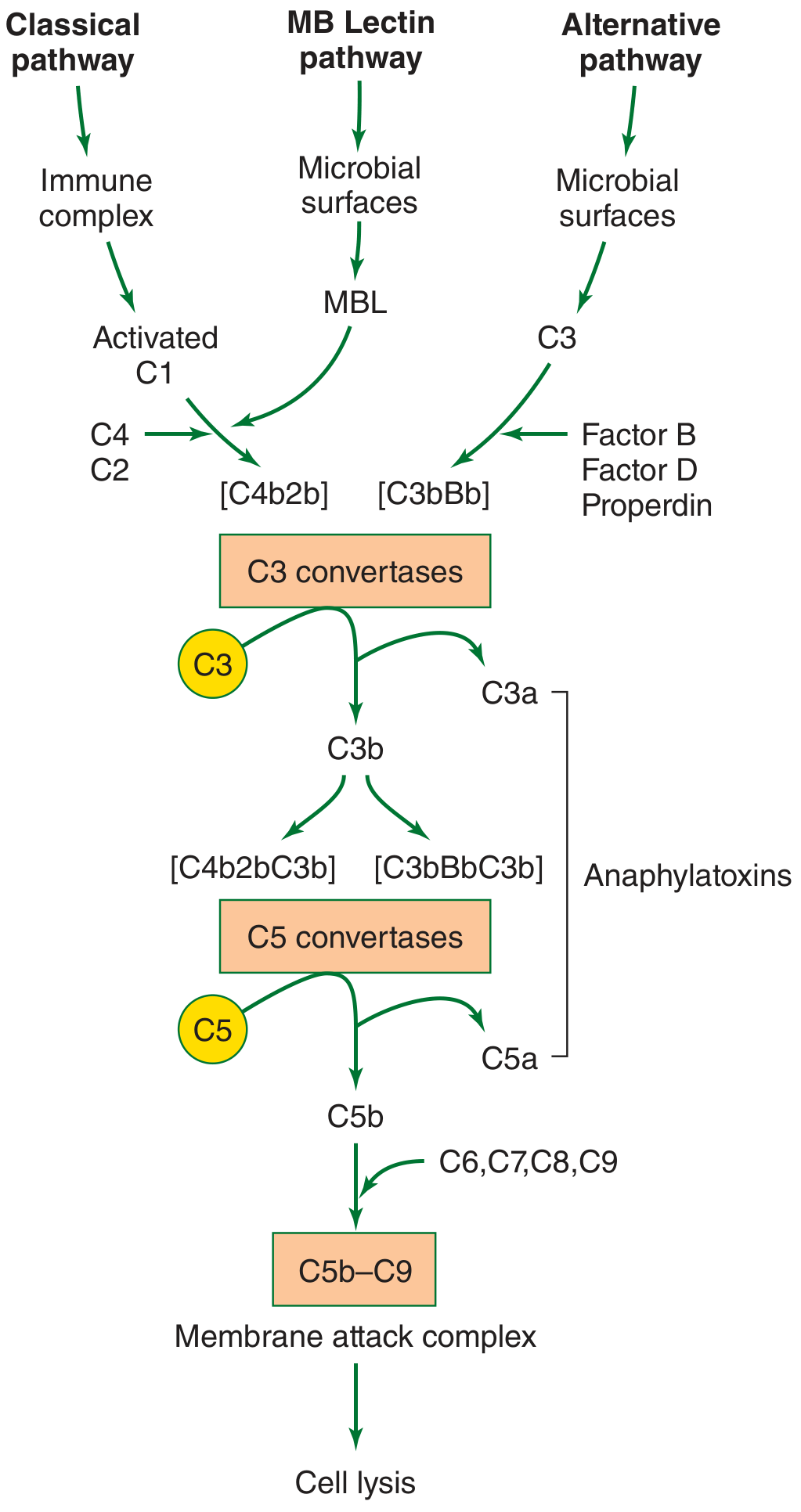
Classical pathway simplified:
Ag-Ab complex (IgG/IgM)
        |
        v
    C1 (C1q binds Fc)
        |
   C1r + C1s activated
        |
   C4 --> C4a + C4b
   C2 --> C2a + C2b
        |
   C4b2a  <--- C3 convertase
        |
   C3 --> C3a (anaphylatoxin) + C3b (opsonin)
        |
   C4b2a3b  <--- C5 convertase
        |
   C5 --> C5a (anaphylatoxin/chemotaxin) + C5b
        |
   C5b + C6 + C7 + C8 + (C9)n
        |
   MAC (C5b-C9) --> Cell Lysis
Biological Effects of Classical Pathway Activation
- Opsonization - C3b coats pathogens, enhancing phagocytosis
- Anaphylatoxins - C3a, C4a, C5a cause mast cell degranulation, histamine release, vasodilation, increased vascular permeability
- Chemotaxis - C5a attracts neutrophils and monocytes to infection site
- Cytolysis - MAC directly lyses target cells/bacteria
III. Regulators of the Complement Pathway
To prevent excessive/uncontrolled complement activation that could damage host tissues, the following regulatory proteins exist:
| Regulator | Point of Action | Mechanism |
|---|---|---|
| C1 inhibitor (C1-INH) | Classical pathway - C1 | Covalently binds and inactivates C1r and C1s serine proteases; dissociates them from C1q; reduces half-life of activated C1 to ~13 sec. Deficiency causes Hereditary Angioedema |
| C4-Binding Protein (C4BP) | Classical pathway - C3 convertase | Enhances spontaneous decay of C4b2a; acts as cofactor for Factor I to degrade C4b |
| Factor I | Classical + Alternative - C3/C4b | Serine protease that cleaves and inactivates C3b and C4b, reducing available C5 convertase |
| Factor H | Alternative pathway - C3b | Enhances Factor I's action on C3b; accelerates decay of C3bBb convertase; acts as a cofactor to degrade C3b into iC3b (inactive) |
| Properdin (Factor P) | Alternative pathway - C3 convertase | A positive regulator - stabilizes C3bBb by delaying Bb release; prolongs the half-life of the alternative pathway C3 convertase |
| Decay Accelerating Factor (DAF / CD55) | All three pathways | Cell surface protein (GPI-anchored on blood cells/endothelium); accelerates dissociation of C3 convertases of all pathways; prevents C3 convertase assembly. Deficiency (with CD59 deficiency) causes PNH |
| CD59 (Protectin / MIRL) | Terminal pathway - MAC | Inhibits MAC formation by preventing C9 polymerization. GPI-anchored membrane protein. Deficiency causes PNH |
| Membrane Cofactor Protein (MCP / CD46) | C3b/C4b on cell surface | Acts as cofactor for Factor I to degrade C3b and C4b on host cells |
| Clusterin (SP-40,40) & Vitronectin (S-protein) | Terminal pathway | Inhibit insertion of C5b-7 complex into membranes; soluble phase regulators |
| Carboxypeptidase N | Anaphylatoxins | Inactivates C3a, C4a, and C5a by cleaving C-terminal arginine |
Key Clinical Points on Regulators:
- C1 inhibitor deficiency → Hereditary angioedema (uncontrolled bradykinin + C2a release)
- DAF (CD55) + CD59 deficiency → Paroxysmal Nocturnal Hemoglobinuria (PNH) - RBCs lysed by complement
- Factor H deficiency → Uncontrolled alternative pathway activation; susceptibility to Neisseria infections
- Factor I deficiency → Secondary C3 depletion; recurrent pyogenic bacterial infections
Sources: Jawetz, Melnick & Adelberg's Medical Microbiology 28e; Mulholland and Greenfield's Surgery 7e; Medical Microbiology 9e
This is a shared conversation. Sign in to Orris to start your own chat.