
Cardiac APD phages
The cardiac action potential duration (APD) is shaped by several ionic currents, and "APD phases" refers to the distinct phases of the cardiac action potential. Let me pull up the authoritative textbook content on this.
Searching sources...
Reading File
Finding Sources
Finding Sources
Reading File
Reading File
Reading File
Reading File
Loading Image
Here is a thorough breakdown of the phases of the cardiac action potential (AP) and their ionic mechanisms, drawn from Braunwald's Heart Disease and Goodman & Gilman's Pharmacology.
Cardiac Action Potential - Phases (APD)
The cardiac AP is divided into 5 phases (0-4). The total duration from phase 0 through phase 3 constitutes the action potential duration (APD).
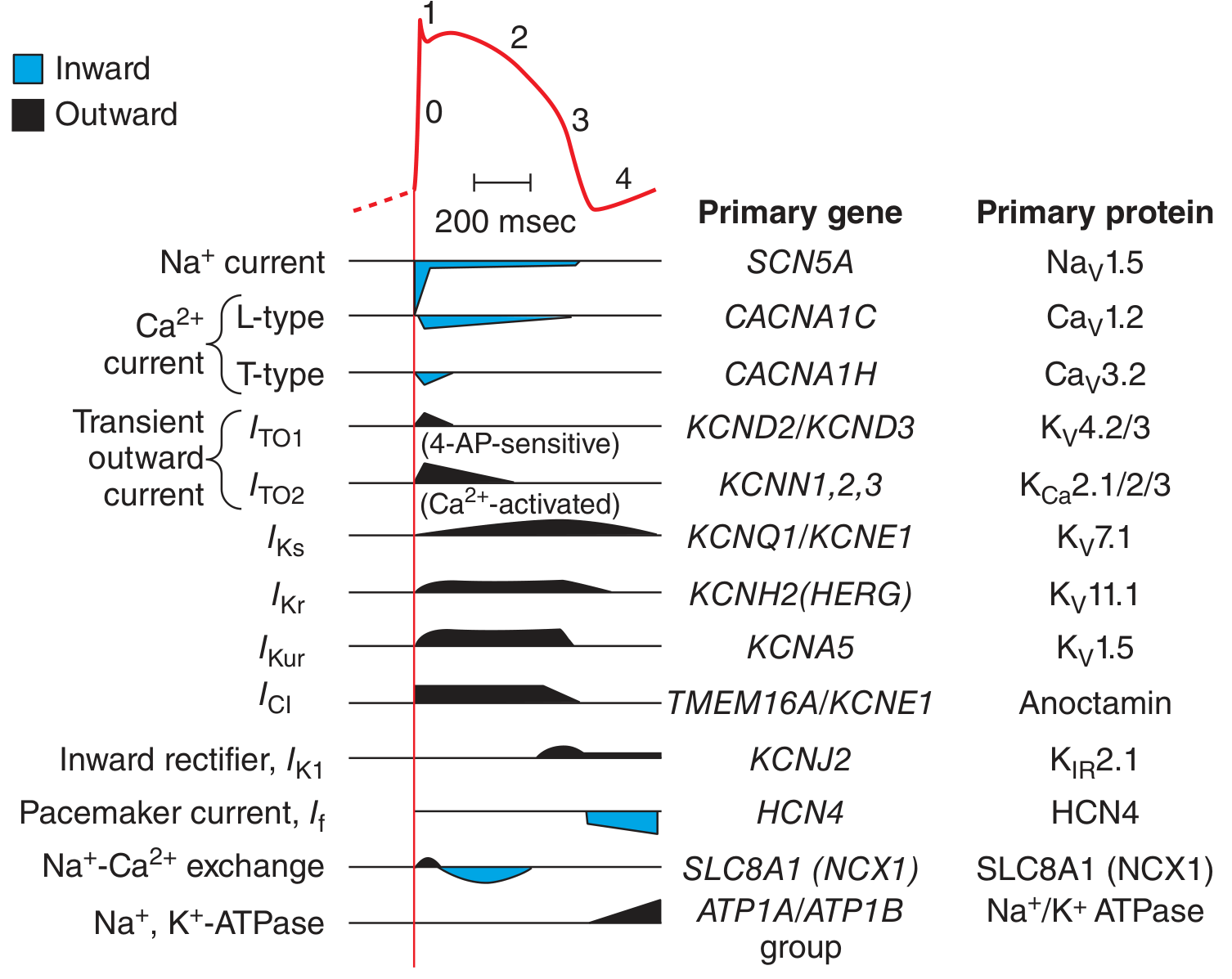
Phase 0 - Rapid Depolarization (Upstroke)
- Ion: Na+ (massive inward current)
- Channel/Gene: Na_V1.5 / SCN5A
- The resting membrane potential of working myocytes is approximately -80 to -90 mV. On reaching threshold, Na_V1.5 channels snap from closed -> open, allowing up to 10^7 Na+ ions/sec to enter.
- The maximal upstroke slope (dV/dt_max or V_max) reflects Na+ current magnitude and is the primary determinant of conduction velocity.
- Na+ channels then rapidly inactivate (~1 ms), ending phase 0.
- A small "late Na+ current" (I_NaL) persists into the plateau in some cells, contributing inward depolarizing current.
Phase 1 - Early Rapid Repolarization ("Notch")
- Ion: K+ (outward, repolarizing)
- Channels: Transient outward K+ channels - I_to1 (K_V4.2/4.3, genes KCND2/KCND3, 4-AP-sensitive) and I_to2 (Ca2+-activated, K_Ca2.1/2.2/2.3, genes KCNN1,2,3)
- At the end of phase 0, membrane potential is positive to E_K, so K+ rushes out, producing a brief downward notch.
- The notch is more prominent in epicardium than endocardium, contributing to transmural repolarization gradients.
- Phase 1 sets the voltage level for the subsequent plateau.
Phase 2 - Plateau
- Balance of inward and outward currents - the most distinctive feature of the cardiac AP
- Inward (depolarizing): L-type Ca2+ current (I_CaL, Ca_V1.2, CACNA1C) - the dominant inward current; also T-type Ca2+ (Ca_V3.2, CACNA1H)
- Outward (repolarizing): Delayed rectifier K+ currents - I_Ks (K_V7.1, KCNQ1/KCNE1), I_Kr (K_V11.1, KCNH2/HERG), I_Kur (K_V1.5, KCNA5, mainly atrial)
- The inward Ca2+ entry during phase 2 triggers calcium-induced calcium release (CICR) from the sarcoplasmic reticulum - this is the mechanism of electromechanical coupling and cellular contraction.
- As Ca2+ channels inactivate and K+ currents (especially I_Kr) build up, the balance tips toward repolarization.
Key pharmacological note: I_Kr (encoded by KCNH2/HERG) has a unique pore structure with aromatic residues that makes it unusually susceptible to drug block. Many drugs that prolong the APD (and QT interval) do so by blocking I_Kr - this is a major concern in drug development.
Phase 3 - Final Rapid Repolarization
- Ion: K+ (large outward current)
- Channels: Continued I_Kr and I_Ks, plus inward rectifier I_K1 (K_IR2.1, KCNJ2)
- Delayed rectifier K+ currents have fully activated; Ca2+ channels have inactivated - net current becomes strongly outward.
- Membrane potential returns to resting level (~-80 to -90 mV).
- Refractory period: From phase 0 until repolarization to approximately -60 mV in phase 3, the cell cannot be re-excited. This is the effective refractory period (ERP) and is closely tied to APD.
Phase 4 - Resting Membrane Potential / Diastolic Depolarization
- Ion: K+ (I_K1 - inward rectifier, outward at rest, sets resting potential)
- In working myocytes (ventricle, atria, His-Purkinje): stable resting potential of -80 to -90 mV, maintained by I_K1.
- In pacemaker cells (SA node, AV node): there is no stable phase 4 - instead, a slow spontaneous diastolic depolarization driven by I_f (the "funny current," HCN4, HCN4), which brings the cell back up to threshold for the next AP. This is the mechanism of automaticity.
SA/AV Node: "Slow Response" APs
The SA and AV nodes are distinct:
- Resting potential: only -50 to -65 mV (less negative)
- No fast Na+ current (inactivated at this voltage range)
- Phase 0 upstroke is slow, driven by L-type Ca2+ (not Na+)
- Automatic diastolic depolarization in phase 4 via I_f (pacemaker current)
- Much slower conduction velocity compared to His-Purkinje system
Summary Table
| Phase | Name | Key Current(s) | Ion Movement | Channel/Gene |
|---|---|---|---|---|
| 0 | Rapid depolarization | I_Na | Na+ in | Na_V1.5 / SCN5A |
| 1 | Early repolarization (notch) | I_to | K+ out | K_V4.2/4.3 / KCND2/3 |
| 2 | Plateau | I_CaL (in), I_Kr/I_Ks (out) | Ca2+ in, K+ out | Ca_V1.2 / CACNA1C; K_V11.1 / KCNH2 |
| 3 | Final repolarization | I_Kr, I_Ks, I_K1 | K+ out | KCNH2, KCNQ1, KCNJ2 |
| 4 | Resting (or pacemaker) | I_K1 (working cells); I_f (nodal) | K+ in/out; mixed | K_IR2.1 / KCNJ2; HCN4 |
Sources:
- Braunwald's Heart Disease (10th/12th ed.), Chapter 62: "The Cardiac Action Potential" and "Phases of the Cardiac Action Potential"
- Goodman & Gilman's Pharmacological Basis of Therapeutics, Chapter 34: "The Cardiac Action Potential"
This is a shared conversation. Sign in to Orris to start your own chat.