
Approach to hemolytic anemia medicine
Reading File
Now let me search the library for hemolytic anemia content in parallel:
Finding Sources
Searching PubMed
"hemolytic anemia" diagnosis management
The best sources are Frameworks for Internal Medicine and Robbins. Let me read them in parallel:
Reading File
Reading File
Reading File
Excellent content. Now let me read the Frameworks section on clinical approach and the Robbins section on specific causes:
Reading File
Reading File
Reading File
Now let me get the TMA/MAHA section and the diagnostic approach sections:
Reading File
Reading File
Now let me fetch the key flowchart image and get the TMA/MAHA content:
Loading Image
Reading File
I now have comprehensive content to write a thorough answer. Let me also fetch the spherocyte image and the detailed classification flowchart:
Loading Image
I now have all the material needed for a comprehensive response. Here is the complete clinical approach to hemolytic anemia:
Approach to Hemolytic Anemia
Definition and Pathophysiology
Hemolytic anemia is defined as accelerated destruction of red blood cells (RBCs), shortening their normal 120-day lifespan. The resulting tissue hypoxia triggers erythropoietin release, driving marrow erythroid hyperplasia and peripheral reticulocytosis - the hallmarks of any hemolytic process. In severe cases, extramedullary hematopoiesis develops in the liver, spleen, and lymph nodes. - Robbins & Kumar Basic Pathology, p. 384
Step 1 - Confirm Hemolysis (Lab Diagnosis)
The following tests confirm that anemia is hemolytic in origin:
| Test | Finding in Hemolysis | Mechanism |
|---|---|---|
| Reticulocyte count | Elevated (reticulocytosis) | Compensatory marrow response |
| Serum haptoglobin | Low / undetectable | Binds free Hb; complex cleared by macrophages |
| Serum LDH (LDH-1) | Elevated | Released from lysed RBCs |
| Indirect (unconjugated) bilirubin | Elevated (~2-2.5 mg/dL) | Hb breakdown product |
| Peripheral blood smear | Fragmented cells, spherocytes, etc. | Morphologic clue to etiology |
| Serum potassium | May be elevated | Intracellular K released on lysis |
| Carboxyhemoglobin (CO) | Elevated | Released during porphyrin ring oxidation |
Low haptoglobin is the most sensitive individual marker; it falls even in purely extravascular hemolysis because macrophages "regurgitate" enough free Hb to consume haptoglobin. - Henry's Clinical Diagnosis and Management by Laboratory Methods, p. 130
Step 2 - Localize: Intravascular vs. Extravascular
This is a critical early branch point:
| Feature | Extravascular | Intravascular |
|---|---|---|
| Site of destruction | Spleen (macrophages) | Within circulation |
| Mechanism | Reduced deformability, opsonization | Complement fixation, mechanical trauma |
| Hemoglobinemia | Absent | Present |
| Hemoglobinuria | Absent | Present (red/brown urine) |
| Hemosiderinuria | Absent | Present (chronic) |
| Iron deficiency | Not seen | May develop (iron lost in urine) |
| Jaundice | Common | May occur |
| Splenomegaly | Common | Less prominent |
| Examples | Hereditary spherocytosis, warm AIHA | TTP, cold AIHA, G6PD crisis, ABO incompatibility |
Both types share low haptoglobin. - Robbins & Kumar Basic Pathology, p. 384
Step 3 - Classify by Etiology: Inherited vs. Acquired
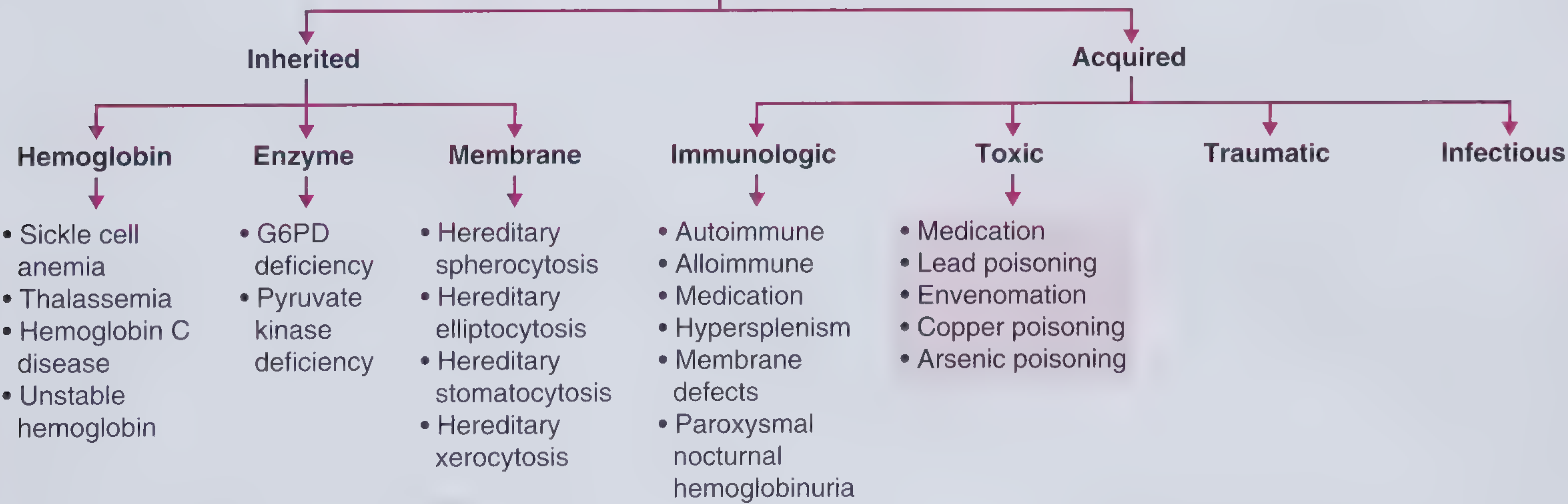
Classification of hemolytic anemia. - Frameworks for Internal Medicine
Clinical clue: Inherited causes tend to present younger, may have a family history (though not always - recessive inheritance or de novo mutations can obscure this). Acquired causes can occur at any age; HUS, for example, is common in children. - Frameworks for Internal Medicine, p. 344
INHERITED CAUSES
A. Hemoglobin Defects (Hemoglobinopathies)
Sickle cell anemia
- Autosomal recessive missense mutation in beta-globin
- Deoxygenated HbS polymerizes, distorting/damaging RBCs
- Moderate-to-severe hemolytic anemia + vaso-occlusive pain crises, stroke, infection risk
- Most prevalent in sub-Saharan Africa and malarial regions
Thalassemia
- Autosomal codominant; alpha- or beta-globin synthesis reduced
- Results in microcytic, hypochromic anemia
- In beta-thalassemia major: unpaired alpha-chains precipitate, causing ineffective erythropoiesis
- Common in Mediterranean and Southeast Asian populations
Others: Hemoglobin C disease, unstable hemoglobin variants
B. Enzyme Defects
G6PD deficiency (most common RBC enzyme defect, affects up to 1/5 of the population in endemic regions)
- X-linked recessive; protective against malaria
- G6PD produces NADPH, which stabilizes antioxidants within RBCs
- Without G6PD, RBCs are susceptible to oxidative stress
- Most patients asymptomatic at baseline; acute hemolysis triggered by:
- Drugs: dapsone, sulfamethoxazole, primaquine, nitrofurantoin
- Foods: fava beans
- Infections
- Smear: Heinz bodies (denatured Hb), "bite cells" (from splenic pitting)
- Heterozygous females can be equally affected due to X-inactivation
Pyruvate kinase (PK) deficiency
- Autosomal recessive; impairs ATP generation in RBCs
- Causes chronic extravascular hemolysis
C. Membrane/Cytoskeleton Defects
Hereditary spherocytosis (most common)
- Autosomal dominant; mutations destabilize the membrane skeleton (spectrin, ankyrin, band 3)
- Loss of membrane lipid bilayer → sphere-shaped, non-deformable RBCs
- Trapped and destroyed in spleen
- Triad: anemia, splenomegaly, cholelithiasis (pigment stones)
- Smear: spherocytes (small RBCs lacking central pallor); positive osmotic fragility test
Hereditary elliptocytosis, stomatocytosis, xerocytosis - less common membrane disorders
ACQUIRED CAUSES
A. Immunologic
Warm AIHA (most common acquired hemolytic anemia in non-malarial countries)
- IgG antibodies react with RBC antigens at body temperature
- Extravascular hemolysis (spleen)
- Causes: primary (idiopathic), SLE, CLL, methyldopa
- Smear: spherocytes
- Diagnosis: Direct Antiglobulin Test (DAT/Coombs) positive
Cold AIHA (Cold Agglutinin Disease)
- IgM antibodies fix complement at low temperatures
- Intravascular hemolysis
- Causes: Mycoplasma pneumoniae (>50% of cases), EBV, CLL
- Symptoms worsen in cold; acrocyanosis
Alloimmune hemolysis
- Alloantibodies after transfusion or pregnancy
- Most dramatic: ABO-incompatible transfusion - IgM activates complement, causing rapid massive intravascular hemolysis → DIC, renal failure, shock, death
Drug-induced immune hemolysis
- Methyldopa: triggers AIHA
- Quinine: triggers TMA (thrombotic microangiopathy)
- Hapten mechanism: penicillin coats RBCs, targeted by drug-dependent antibodies
Paroxysmal Nocturnal Hemoglobinuria (PNH)
- Acquired clonal defect; RBCs lack GPI-anchored complement regulatory proteins (CD55, CD59)
- Complement-mediated intravascular hemolysis
- Classic triad: hemolytic anemia, thrombosis (especially venous), cytopenias
B. Microangiopathic Hemolytic Anemia (MAHA) - Traumatic/Mechanical
RBCs are sheared by fibrin strands or abnormal surfaces:
| Condition | Key Feature |
|---|---|
| TTP | ADAMTS13 deficiency → ultra-large vWF multimers → platelet thrombi in microvasculature. Pentad: MAHA + thrombocytopenia + neurological symptoms + fever + renal failure |
| HUS | Mostly children; Shiga toxin (E. coli O157:H7) or S. pneumoniae; triad: MAHA + thrombocytopenia + AKI. Do NOT use antibiotics (may precipitate HUS) |
| DIC | Intravascular fibrin deposition; MAHA + thrombocytopenia + elevated PT/aPTT + low fibrinogen |
| Prosthetic heart valves | Mechanical shear of RBCs across abnormal valve surfaces |
| Malignant hypertension, eclampsia | Endothelial damage, fibrin deposition |
Smear in all MAHA: schistocytes (helmet cells, RBC fragments) - pathognomonic finding.
Henry's describes a leukoerythroblastic picture when marrow microvasculature is involved (metastatic tumor, myelofibrosis) - releasing nucleated RBCs, myelocytes, and metamyelocytes. - Henry's Clinical Diagnosis and Management by Laboratory Methods
C. Infectious
| Pathogen | Mechanism | Notes |
|---|---|---|
| Malaria | Splenic destruction of infected RBCs (mainly extravascular); Falciparum can cause "blackwater fever" (severe intravascular) | Most common cause of hemolytic anemia worldwide |
| E. coli O157:H7 | Shiga toxin → HUS | Antibiotics contraindicated |
| Mycoplasma pneumoniae | Cold agglutinins (IgM) | Peak weeks 1-4 after infection |
| Clostridium perfringens | Toxin-mediated direct membrane destruction | Mortality ~75%; treat with penicillin + clindamycin |
| Babesia | Direct RBC invasion | Maltese cross tetrad on smear; tick-borne |
| Bartonella bacilliformis | Direct RBC invasion | Endemic to Andes region |
D. Toxic/Chemical
| Agent | Mechanism |
|---|---|
| Dapsone, nitrates, chlorates, cisplatin, methylene blue | Oxidative hemolysis even without G6PD deficiency |
| Lead poisoning | Acquired P5'N-1 deficiency; basophilic stippling on smear |
| Wilson's disease | Copper release from necrotic liver; ~10% of cases |
| Brown recluse spider (Loxosceles reclusa) | Venom causes mixed intravascular/extravascular hemolysis |
| Arsenic poisoning | Direct RBC membrane damage |
E. Hypersplenism
- Spleen traps and destroys otherwise normal RBCs due to massive enlargement
- Pancytopenia pattern common
Step 4 - Key Peripheral Blood Smear Findings
| Morphology | Associated Condition |
|---|---|
| Spherocytes | Hereditary spherocytosis, warm AIHA |
| Schistocytes / helmet cells | MAHA (TTP, HUS, DIC, valve hemolysis) |
| Sickle cells | Sickle cell disease |
| Target cells | Thalassemia, HbC disease |
| Bite cells / Heinz bodies | G6PD deficiency |
| Elliptocytes | Hereditary elliptocytosis |
| Basophilic stippling | Lead poisoning, thalassemia |
| Ring forms (Maltese cross) | Malaria (Falciparum), Babesia |
| Nucleated RBCs + immature WBCs | Myelophthisic / leukoerythroblastic |
Step 5 - Diagnostic Algorithm Summary
Anemia confirmed
      ↓
Reticulocytosis? + Low haptoglobin? + Elevated LDH?
      ↓ YES → Hemolysis confirmed

Peripheral blood smear
      ↓
┌─────────────────────────────────────┐
│ Schistocytes?                       │
│ → MAHA workup: TTP, HUS, DIC, valve│
│ Spherocytes?                        │
│ → DAT/Coombs: AIHA vs. HS          │
│ Sickle cells?                       │
│ → Hb electrophoresis                │
│ Ring forms?                         │
│ → Malaria smear, Babesia PCR        │
│ Bite cells?                         │
│ → G6PD assay                        │
└─────────────────────────────────────┘
      ↓
Intravascular or Extravascular?
      ↓
Hemoglobinuria → Intravascular → PNH (flow cytometry), TTP, ABO incompatibility
No hemoglobinuria → Extravascular → Spleen-based destruction

Age/History:
  Young + family history → Inherited (HS, G6PD, SCC, Thal)
  Older + new onset → Acquired (AIHA, MAHA, drugs, infection)
Management Principles by Cause
| Cause | Treatment |
|---|---|
| Warm AIHA | Corticosteroids (first-line); rituximab, splenectomy (refractory) |
| Cold AIHA | Cold avoidance; rituximab; treat underlying cause |
| TTP | Emergency plasma exchange (PEX); rituximab for acquired TTP |
| HUS (STEC) | Supportive; dialysis if needed; NO antibiotics |
| G6PD crisis | Remove trigger; supportive; transfuse if severe |
| Hereditary spherocytosis | Splenectomy (curative); folate supplementation |
| Sickle cell | Hydroxyurea, pain management, exchange transfusion for crises |
| Drug-induced | Stop the offending drug |
| PNH | Eculizumab (anti-C5 complement inhibitor) |
| Malaria | Antimalarials (artemisinin-based) |
Recent Evidence
Recent reviews from Hematology ASH Education Program (2025) on AIHA management and cold agglutinin disease confirm that rituximab is increasingly used as second-line therapy, and novel complement inhibitors are expanding the treatment landscape for cold AIHA and PNH. The first consensus recommendations for Evans syndrome (AIHA + ITP) were published in Lancet Haematology in 2024.
Sources: Robbins & Kumar Basic Pathology | Frameworks for Internal Medicine | Henry's Clinical Diagnosis and Management by Laboratory Methods | PubMed (PMID 41347987, 41348049, 38968944)
This is a shared conversation. Sign in to Orris to start your own chat.