Here is your complete 5-mark short note + high-yield flashcard.
🧬 SHORT NOTE: Thyroid Carcinomas (Papillary / Follicular / Medullary / Anaplastic)
Quick Mnemonic: P F M A = "Please Find My Answer"
Arranged from best to worst prognosis and well-differentiated → undifferentiated
OVERVIEW MINDMAP
THYROID CARCINOMAS
|
┌──────────┬───────┴────────┬──────────┐
PAPILLARY FOLLICULAR MEDULLARY ANAPLASTIC
(80%) (15%) (5%) (<1%)
Follicular Follicular C-cells Undifferentiated
epithelium epithelium (Parafollicular) (worst)
1. PAPILLARY CARCINOMA 🟢 (Most Common - Best Prognosis)
| Feature | Detail |
|---|
| Incidence | 80% of thyroid cancers; most common post-radiation |
| Who | Young females; any age |
| Mutation | RET/PTC rearrangement, BRAF mutation |
| Gross | Solitary/multifocal; may be encapsulated or infiltrative |
| Histology | Branching papillae with fibrovascular core |
| Nuclear features | ⭐ Orphan Annie eye nuclei (ground-glass, empty-looking) + intranuclear pseudo-inclusions/grooves |
| Psammoma bodies | Concentric calcified structures - almost NEVER in follicular/medullary |
| Spread | Lymphatic → cervical LN (up to 50% cases) |
| Prognosis | Excellent - 10-year survival >95% |
| Marker | Thyroglobulin |
Exam pearl: Nuclear features alone (Orphan Annie nuclei + pseudo-inclusions) are diagnostic even without papillary architecture!
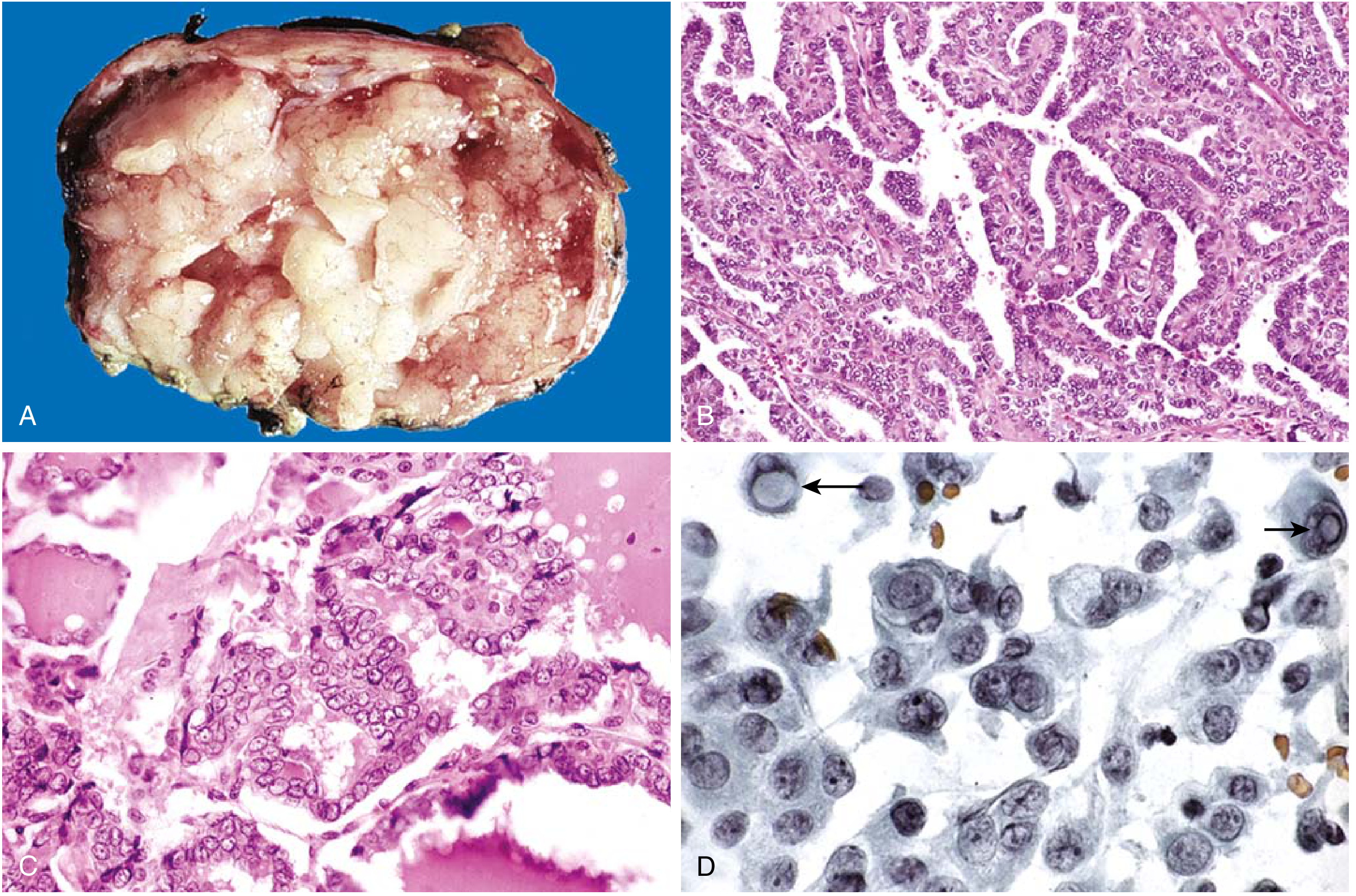
Histology (Robbins Fig 18.12):
A - Gross papillary surface. B - Papillae with fibrovascular stalks. C - Orphan Annie (ground-glass) nuclei. D - FNA: intranuclear inclusions (arrows).
2. FOLLICULAR CARCINOMA 🔵 (2nd Most Common)
| Feature | Detail |
|---|
| Incidence | ~15%; more common in iodine-deficient areas |
| Who | F:M = 3:1; peak age 40-60 years |
| Mutation | RAS mutation; PAX8-PPARG fusion (follicular variant of PTC too) |
| Gross | Single nodule; well-circumscribed or infiltrative; light-tan cut surface |
| Histology | Uniform cells in small follicles resembling normal thyroid; no psammoma bodies |
| Key diagnosis | ⭐ Capsular AND/OR vascular invasion - requires extensive histologic sampling |
| Spread | Hematogenous → lung, bone (NOT lymphatic) |
| Prognosis | Good if encapsulated; worse if widely invasive |
| Marker | Thyroglobulin |
Exam pearl: You CANNOT distinguish follicular adenoma from carcinoma on FNA - need excision + capsule sampling. Vascular invasion = carcinoma.
Histology (Robbins Fig 18.14 - Capsular invasion):
3. MEDULLARY CARCINOMA 🟠 (Neuroendocrine - C cells)
| Feature | Detail |
|---|
| Origin | Parafollicular C-cells (NOT follicular epithelium) |
| Incidence | ~5% |
| Sporadic vs Familial | 70% sporadic / 30% familial |
| Familial associations | ⭐ MEN 2A (medullary + pheo + parathyroid hyperplasia) / MEN 2B (medullary + pheo + mucosal neuromas) / Familial MTC |
| Mutation | Germline RET mutation (familial); acquired RET in ~50% sporadic |
| Secretes | ⭐ Calcitonin (diagnostic marker + follow-up) + somatostatin, serotonin, VIP |
| Histology | Polygonal-to-spindle cells; nests/trabeculae; amyloid in stroma (from calcitonin) |
| Gross | Solid, bilateral in familial cases |
| Spread | Local + lymph node; distant mets possible |
| Management pearl | RET carriers → prophylactic thyroidectomy |
Exam pearl: Amyloid stroma derived from CALCITONIN molecules - confirmable by Congo red stain. Familial = bilateral, multicentric + C-cell hyperplasia in surrounding thyroid.
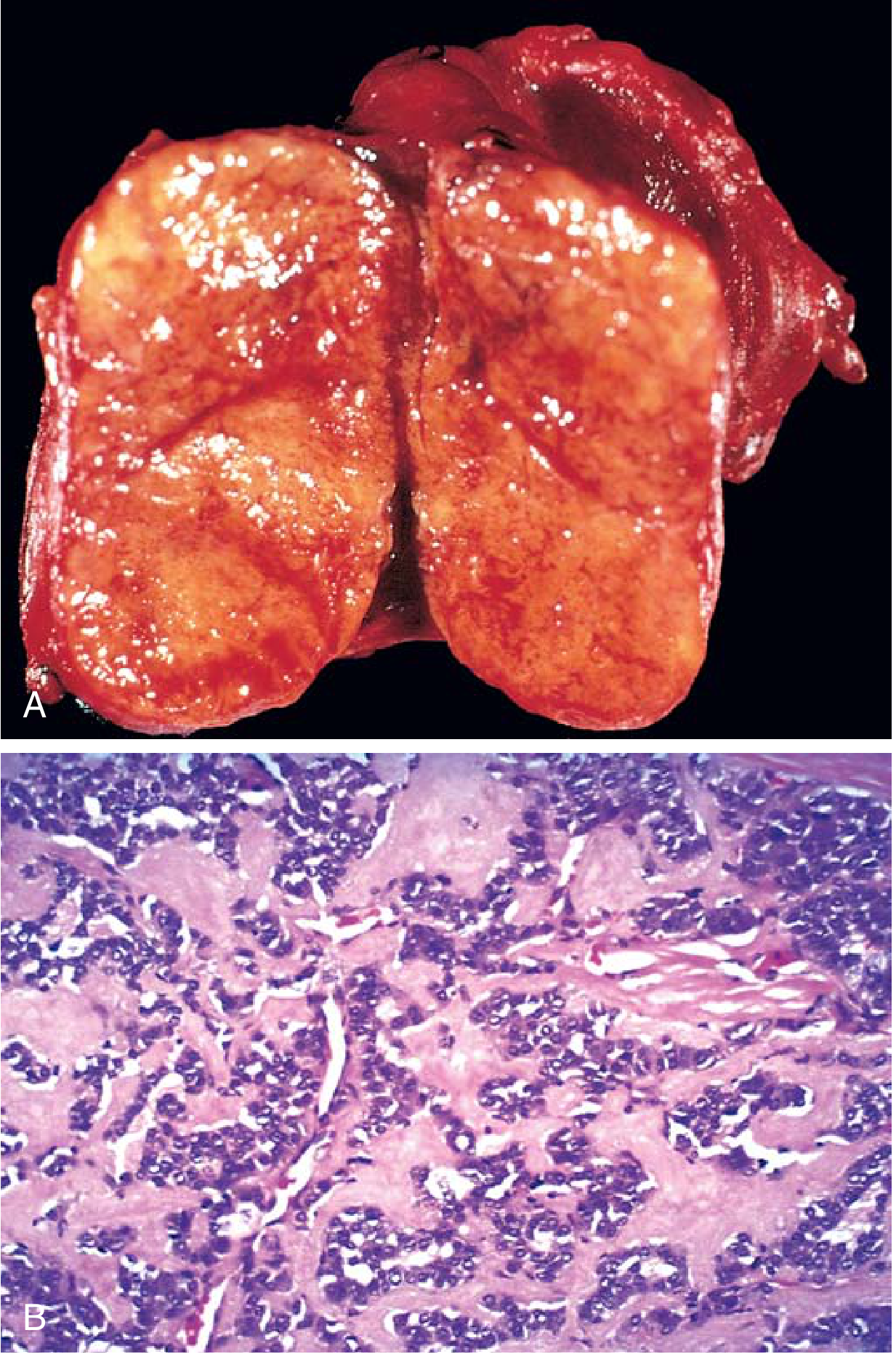
Histology (Robbins Fig 18.16):
A - Solid mass without fibrous capsule. B - Amyloid stroma (pink homogeneous material).
4. ANAPLASTIC CARCINOMA 🔴 (Most Deadly - Undifferentiated)
| Feature | Detail |
|---|
| Origin | Undifferentiated follicular epithelium - de novo OR progression from PTC/FTC |
| Who | Elderly, mean age 65 years |
| Mutation | ⭐ TP53 loss-of-function + RAS/PIK3CA mutations shared with differentiated carcinomas |
| Gross | Bulky mass, rapid growth BEYOND thyroid capsule into neck |
| Histology | Large pleomorphic cells OR spindle cells OR mixed; high mitosis; may have foci of PTC/FTC (origin clue) |
| Spread | Rapid local invasion + distant mets |
| Prognosis | ⭐ Mortality ~100%; death in <1 year from local disease and airway compromise |
Exam pearl: 1/4 patients have a prior history of well-differentiated thyroid cancer. 1/4 have a concurrent well-differentiated tumor in same specimen.
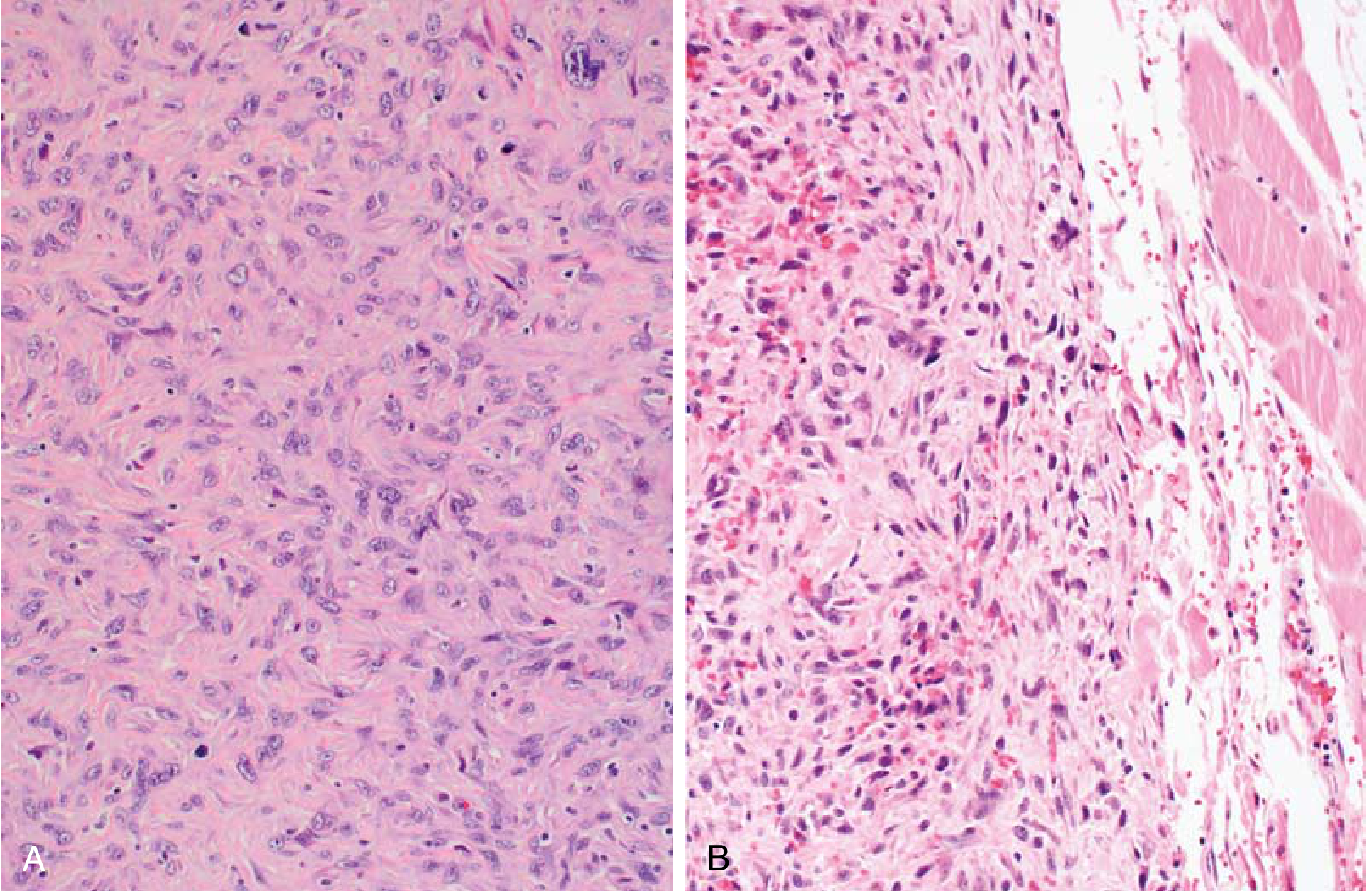
Histology (Robbins Fig 18.15):
A - Pleomorphic/spindle cells with desmoplasia. B - Invasion into adjacent skeletal muscle.
COMPARISON TABLE (High Yield)
| Feature | Papillary | Follicular | Medullary | Anaplastic |
|---|
| % incidence | 80% | 15% | 5% | <1% |
| Cell origin | Follicular epithelium | Follicular epithelium | C-cells | Follicular epithelium |
| Mutation | BRAF/RET-PTC | RAS/PAX8-PPARG | RET | TP53 |
| Spread | Lymphatic | Hematogenous | Both | Direct/distant |
| Marker | Thyroglobulin | Thyroglobulin | Calcitonin | None useful |
| Special histo | Orphan Annie + Psammoma | Capsular/vasc. invasion | Amyloid stroma | Pleomorphic spindle |
| Prognosis | Excellent (>95% 10yr) | Good-moderate | Moderate | Lethal (<1 yr) |
| Iodine relation | Assoc. with radiation | Iodine deficiency areas | No | No |
PROGRESSION CONCEPT (Important!)
Well-differentiated PTC/FTC
↓ (TP53 mutation acquired)
Anaplastic Carcinoma
(25% of anaplastic = prior history of PTC/FTC)
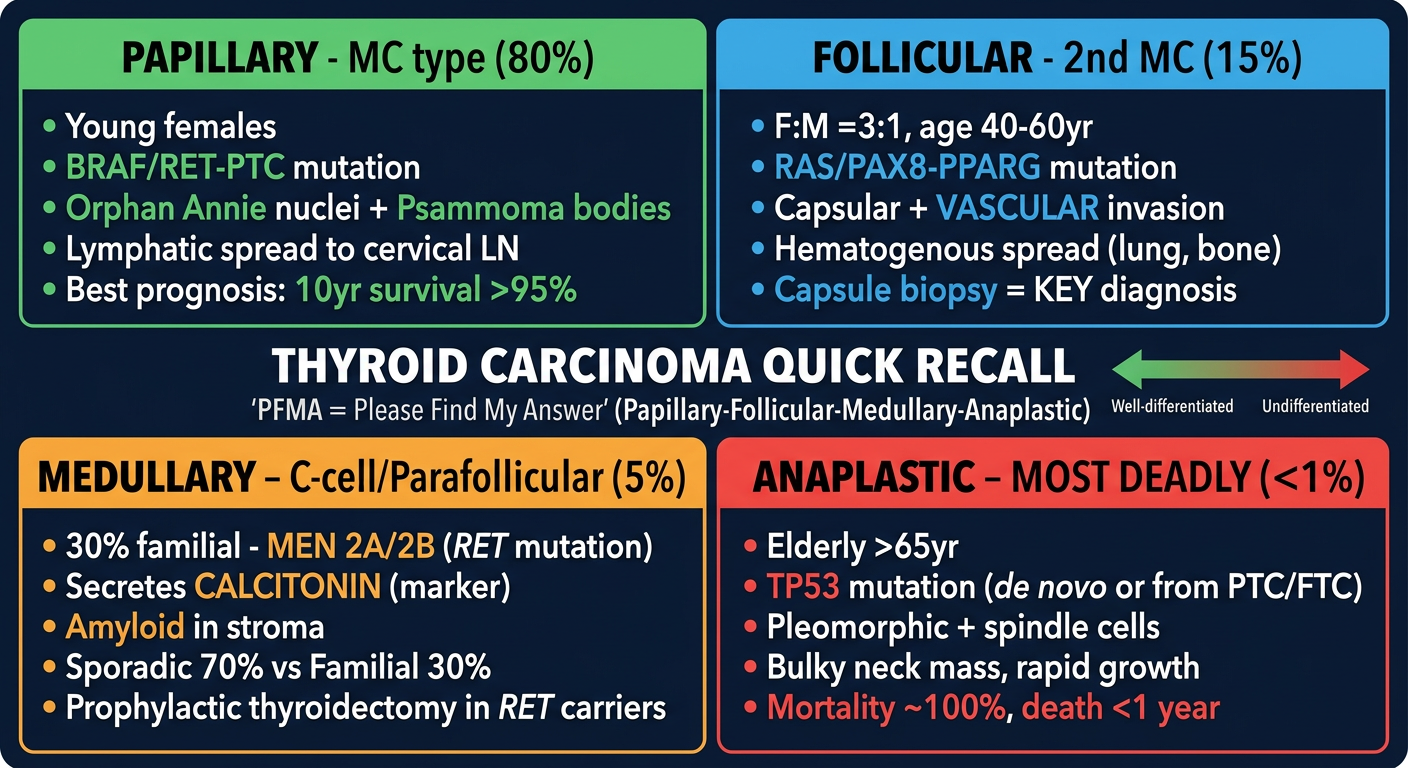
🃏 HIGH-YIELD FLASHCARD (Pre-Exam Revision)
QUICK-FIRE EXAM MNEMONICS
| Mnemonic | Meaning |
|---|
| "Orphan Annie Goes to Psammo's Party" | Orphan Annie nuclei + Psammoma bodies = PTC |
| "Follicular needs a VISAcard" | VASCular invasion = malignant in follicular |
| "MEN 2 = C-cells Call" | Medullary = C cells = Calcitonin = RET = MEN2 |
| "Anaplastic = Apocalyptic" | Worst prognosis, TP53, elderly, death <1yr |
Source: Robbins & Kumar Basic Pathology, Chapter 18 (Endocrine System)