
Gross anatomy of human skeleton complete notes on this topic proper
Reading File
Finding Sources
Finding Sources
Searching the Web
gross anatomy human skeleton complete notes bones classification
Finding Sources
Finding Sources
Finding Sources
Finding Sources
Reading File
Reading File
Reading File
Reading File
Reading File
Reading File
Finding Sources
Finding Sources
Reading File
Reading File
Reading File
Loading Image
Loading Image
I now have all the content needed to write comprehensive, detailed notes. Let me compile the complete notes now.
Gross Anatomy of the Human Skeleton - Complete Notes
Sources: Gray's Anatomy for Students (9780323934237); General Anatomy and Musculoskeletal System - THIEME Atlas (9781626237186)
1. Introduction and Definition
Gross anatomy (from the Greek temnein - "to cut") refers to the study of structures visible to the naked eye without magnification. The skeletal system is the rigid framework of the body composed of bones, cartilages, joints, and ligaments.
The adult human skeleton contains 206 bones (at full skeletal maturity, typically 20-25 years of age).
2. Divisions of the Skeleton
The skeleton is divided into two major subdivisions:
A. Axial Skeleton (80 bones)
Forms the longitudinal axis of the body. Includes:
- Skull (cranium) - 22 bones (8 cranial + 14 facial)
- Vertebral column - 33 vertebrae (7 cervical, 12 thoracic, 5 lumbar, 5 fused sacral, 4 fused coccygeal)
- Thoracic cage (ribs + sternum) - 25 bones (12 pairs of ribs + 1 sternum)
- Hyoid bone - 1 bone (sometimes grouped with skull)
B. Appendicular Skeleton (126 bones)
Consists of the bones of the limbs and their girdles:
- Upper limb girdle - Pectoral girdle (clavicle + scapula) x2 = 4 bones
- Upper limbs - Humerus, radius, ulna, carpals (8), metacarpals (5), phalanges (14) x2 = 60 bones
- Lower limb girdle - Pelvic girdle (each os coxa = ilium + ischium + pubis fused) x2 = 2 bones
- Lower limbs - Femur, patella, tibia, fibula, tarsals (7), metatarsals (5), phalanges (14) x2 = 62 bones
3. Functions of the Skeleton
- Support - provides structural framework holding the body upright
- Protection - protects vital organs (skull/brain, thoracic cage/heart+lungs, vertebral column/spinal cord, pelvis/reproductive and urinary organs)
- Lever system - acts as levers on which muscles act to produce movement
- Mineral reservoir - stores calcium (99% of body's calcium) and phosphorus
- Hemopoiesis - red bone marrow produces blood cells (RBCs, WBCs, platelets)
- Fat storage - yellow bone marrow stores lipids (energy reserve)
4. Cartilage
Cartilage is an avascular form of connective tissue consisting of extracellular fibers embedded in a matrix, with cells (chondrocytes) localized in small cavities called lacunae.
- Has no blood vessels, lymphatics, or nerves
- Nourished entirely by diffusion from surrounding perichondrium
Types of Cartilage
| Type | Matrix Composition | Example Locations |
|---|---|---|
| Hyaline (most common) | Moderate collagen fibers; glassy appearance | Articular surfaces, costal cartilages, trachea, fetal skeleton |
| Elastic | Collagen + abundant elastic fibers; flexible | External ear (pinna), epiglottis, auditory tube |
| Fibrocartilage | Dense collagen fibers; minimal ground substance; very strong | Intervertebral discs, pubic symphysis, menisci of knee |
Functions of Cartilage
- Supports soft tissues
- Provides smooth, gliding surfaces for bone articulations at joints
- Enables development and growth of long bones (via epiphyseal plates)
5. Bone (Os)
Bone is a calcified, living connective tissue that forms the majority of the skeleton. It consists of:
- An intercellular calcified matrix (hydroxyapatite crystals + collagen fibers)
- Several types of cells within the matrix
5.1 Cells of Bone
| Cell Type | Function |
|---|---|
| Osteoblasts | Bone-forming cells; secrete organic matrix (osteoid) |
| Osteocytes | Mature bone cells trapped in lacunae; maintain bone matrix |
| Osteoclasts | Multinucleated cells; resorb (break down) bone |
5.2 Bone Matrix
- Organic component (35%): Type I collagen (provides tensile strength)
- Inorganic component (65%): Hydroxyapatite [Ca10(PO4)6(OH)2] (provides compressive strength)
5.3 Types of Bone Tissue
1. Compact (Cortical) Bone
- Dense, solid bone that forms the outer layer (cortex) of all bones
- Makes up the shaft (diaphysis) of long bones
- Organized into osteons (Haversian systems) - concentric lamellae surrounding a central Haversian canal
- Provides strength and resistance to bending
2. Spongy (Trabecular/Cancellous) Bone
- Lattice-like network of thin columns called trabeculae
- Spaces between trabeculae filled with red or yellow bone marrow
- Found in the interior of flat bones, epiphyses of long bones
- Lighter than compact bone; good for shock absorption
6. Classification of Bones by Shape
| Type | Description | Examples |
|---|---|---|
| Long bones | Longer than they are wide; diaphysis + 2 epiphyses | Femur, humerus, radius, ulna, tibia, fibula |
| Short bones | Roughly cube-shaped; mostly spongy with thin compact shell | Carpals (wrist), tarsals (ankle) |
| Flat bones | Thin, flat, often curved; two layers of compact sandwiching spongy | Skull bones, sternum, ribs, scapula |
| Irregular bones | Complex shapes that don't fit other categories | Vertebrae, sphenoid, ethmoid, hip bones |
| Sesamoid bones | Rounded; form within tendons; protect tendons from wear | Patella (largest), pisiform |
| Sutural (Wormian) bones | Small, variable; found within cranial sutures | Variable; in skull sutures |
7. Gross Structure of a Long Bone
A long bone (e.g., femur or humerus) has the following named parts:
| Part | Description |
|---|---|
| Diaphysis | Shaft; cylindrical tube of compact bone surrounding medullary cavity |
| Epiphysis | Expanded ends (proximal and distal); mostly spongy bone covered by thin compact shell; articulates with adjacent bones |
| Metaphysis | Region between diaphysis and epiphysis; site of epiphyseal (growth) plate in growing bone |
| Epiphyseal plate (physis) | Hyaline cartilage disc in growing bone; site of longitudinal growth |
| Epiphyseal line | Remnant of epiphyseal plate in adult after ossification is complete |
| Articular cartilage | Thin layer of hyaline cartilage covering joint surfaces of epiphyses; reduces friction |
| Periosteum | Dense connective tissue membrane covering outer bone surface (except articular cartilage); contains osteogenic cells; site of muscle/tendon attachment |
| Endosteum | Thin membrane lining medullary cavity and surfaces of trabeculae; also contains osteogenic cells |
| Medullary (marrow) cavity | Central hollow space in diaphysis; contains yellow marrow in adults |
| Nutrient foramen | Opening in diaphysis where nutrient artery enters |
8. Bone Marrow
| Type | Composition | Location | Function |
|---|---|---|---|
| Red marrow (myeloid tissue) | Hemopoietic tissue | Axial skeleton + flat bones; epiphyses of long bones in children; in adults mainly in sternum, vertebrae, ribs, skull, iliac crest | Produces RBCs, WBCs, platelets |
| Yellow marrow | Primarily fat (adipocytes) | Medullary cavities of long bones in adults | Energy storage; can revert to red marrow in severe anemia |
Key fact: At birth, most marrow is red. With age, red marrow is progressively converted to yellow marrow within the medullary cavities of long and flat bones.
Bone marrow contains two types of stem cells:
- Hemopoietic stem cells - give rise to all blood cell lineages
- Mesenchymal stem cells - differentiate into bone, cartilage, and muscle
9. Bone Development (Ossification)
9.1 Intramembranous Ossification
- Bone forms directly within a membrane of condensed mesenchyme (without a cartilage precursor)
- Produces flat bones of the skull (frontal, parietal, occipital), mandible, and clavicle
- Process: Mesenchymal cells → osteoblasts → secrete osteoid → calcification → woven bone → remodeling into lamellar bone
9.2 Endochondral Ossification
- Bone replaces a hyaline cartilage model
- Produces all long bones and most other bones of the body
- Process: Cartilage model forms → primary ossification center in diaphysis → medullary cavity forms → secondary ossification centers in epiphyses → epiphyseal plates remain for growth
9.3 Bone Growth
- Longitudinal growth occurs at the epiphyseal (growth) plate until skeletal maturity (20-25 years)
- Appositional growth (increase in diameter) occurs by periosteal osteoblast activity
- Skeletal maturity: growth plates close and are replaced by epiphyseal lines
9.4 Skeletal Age
- Bone development is predictable and can be assessed radiographically (typically left hand/wrist X-ray compared to standard radiographs)
- Bone age may lag behind chronological age in malnutrition and hypothyroidism
- Modern software using AI algorithms can automate bone age assessment
10. Bone Blood Supply
Each bone receives blood from:
- Nutrient artery - enters through nutrient foramen; main supply to medullary cavity
- Periosteal arteries - supply compact bone from periosteum
- Metaphyseal and epiphyseal arteries - supply spongy bone at bone ends
- The epiphyseal plate acts as a barrier between epiphyseal and metaphyseal vessels in growing children - clinically important in osteomyelitis (infection spreads in metaphysis)
11. Joints (Articulations)
A joint is the site where two or more bones meet. Joints are classified by structure and function (mobility).
11.1 Structural Classification
A. Fibrous Joints
- Bones united by fibrous connective tissue; no joint cavity
- Subtypes:
- Sutures - only in skull; thin fibrous tissue between skull bones; essentially immovable in adults
- Syndesmoses - bones united by a ligament or interosseous membrane (e.g., distal tibiofibular joint, interosseous membrane of forearm)
- Gomphoses - peg in socket; teeth in jaw sockets (periodontal ligament)
B. Cartilaginous Joints (Solid Joints)
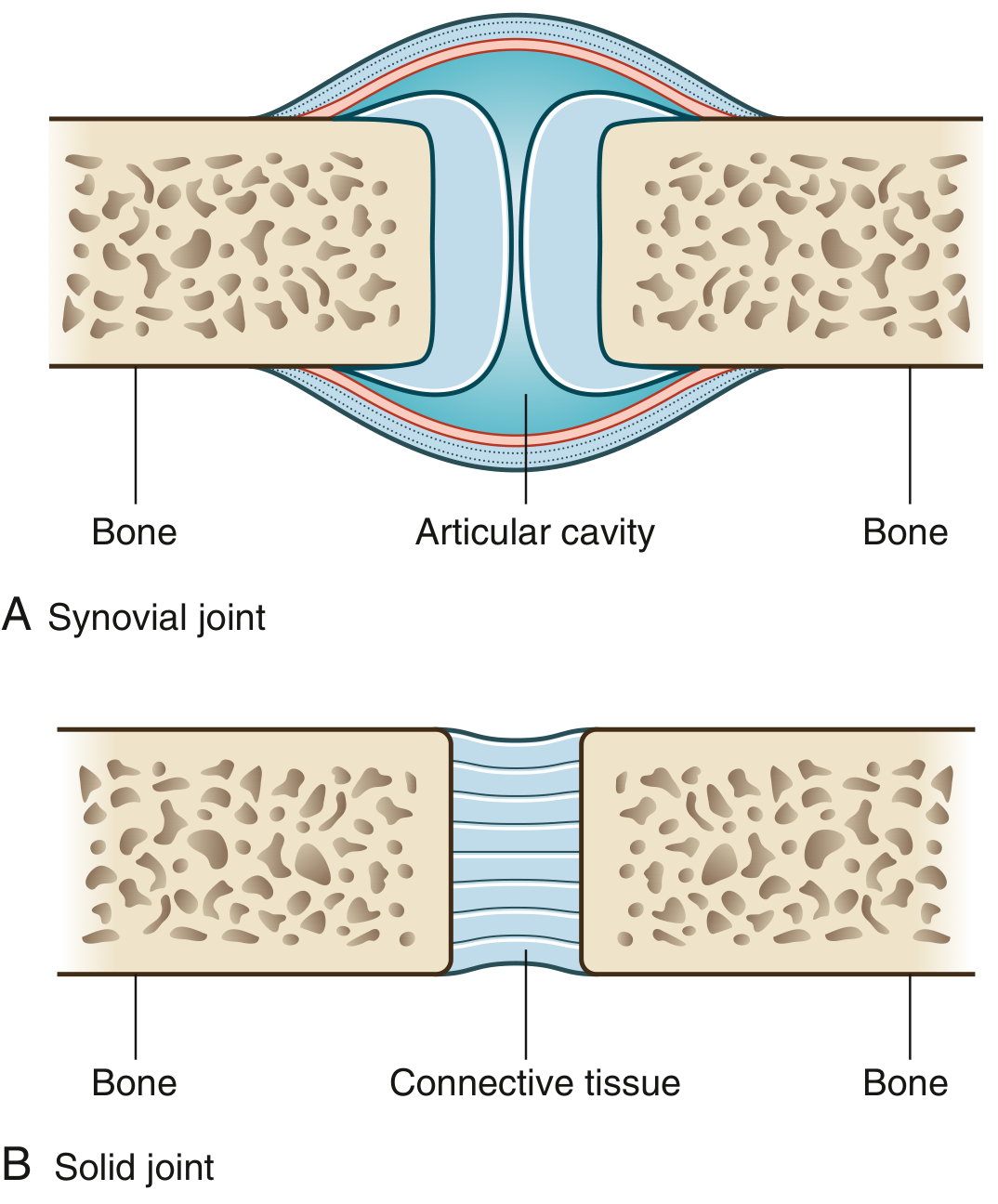
Bones united by cartilage; no joint cavity:
- Primary cartilaginous (synchondroses) - hyaline cartilage unites bones; temporary (e.g., epiphyseal plates); immovable
- Secondary cartilaginous (symphyses) - fibrocartilage unites bones (e.g., pubic symphysis, intervertebral discs); slightly movable
C. Synovial Joints
Most common type; freely movable; contains a joint (articular) cavity. Key features:
- Articular cartilage (usually hyaline) covers articulating bone surfaces - no bone-to-bone contact
- Joint capsule with:
- Inner synovial membrane - secretes synovial fluid for lubrication; highly vascular
- Outer fibrous membrane - dense connective tissue; may thicken into ligaments
- Articular cavity - contains synovial fluid
- Optional accessory structures: articular discs, fat pads, intracapsular tendons, bursae
Synovial fluid functions:
- Lubricates articulating surfaces
- Nourishes avascular articular cartilage
- Removes metabolic waste
11.2 Subtypes of Synovial Joints (by Shape and Movement)
| Type | Shape | Movement | Examples |
|---|---|---|---|
| Plane (gliding) | Flat surfaces | Gliding (biaxial) | Intercarpal, intertarsal, acromioclavicular |
| Hinge (ginglymus) | Convex + concave | Uniaxial: flexion/extension | Elbow (humeroulnar), knee, ankle, interphalangeal |
| Pivot (trochoid) | Cylindrical peg in ring | Uniaxial: rotation | Atlantoaxial (C1-C2), proximal/distal radioulnar |
| Bicondylar | Two convex condyles + two concave | Biaxial: flexion/extension + limited rotation | Knee (tibiofemoral), temporomandibular |
| Condylar (ellipsoid) | Oval convex + oval concave | Biaxial: flexion/extension + abduction/adduction | Wrist (radiocarpal), metacarpophalangeal |
| Saddle (sellar) | Reciprocal concavo-convex | Biaxial: flexion/extension + abduction/adduction | 1st carpometacarpal (thumb) |
| Ball and socket (spheroid) | Spherical head in cup | Multiaxial: all movements + circumduction | Hip, shoulder (glenohumeral) |
12. Bursae and Tendon Sheaths
- Synovial bursae - closed sacs of synovial membrane outside joints; reduce friction between tendons/bones, tendons/joints, or skin/bone (e.g., subacromial bursa, prepatellar bursa)
- Tendon sheaths - elongated synovial bursae surrounding tendons; reduce friction as tendons slide (e.g., tendons of hand and foot)
13. Regional Skeleton - Overview
13.1 Axial Skeleton in Detail
Skull (22 bones)
Cranial bones (8):
- Frontal (1), Parietal (2), Temporal (2), Occipital (1), Sphenoid (1), Ethmoid (1)
Facial bones (14):
- Nasal (2), Lacrimal (2), Zygomatic (2), Maxilla (2), Palatine (2), Inferior nasal conchae (2), Vomer (1), Mandible (1)
Major skull foramina:
- Foramen magnum (occipital bone) - transmits spinal cord, vertebral arteries, spinal accessory nerve roots
- Jugular foramen - CN IX, X, XI + internal jugular vein
- Foramen ovale - CN V3 (mandibular nerve)
- Foramen rotundum - CN V2 (maxillary nerve)
- Superior orbital fissure - CN III, IV, V1, VI + ophthalmic veins
- Carotid canal - internal carotid artery
Vertebral Column (33 vertebrae)
| Region | Number | Key Features |
|---|---|---|
| Cervical | 7 | Transverse foramina (for vertebral arteries); C1 (Atlas - no body; ring-like), C2 (Axis - odontoid process/dens), C7 (vertebra prominens) |
| Thoracic | 12 | Costal facets for rib articulation; long, inferiorly directed spinous processes |
| Lumbar | 5 | Largest vertebrae; massive bodies; thick, blunt spinous processes; no costal facets or transverse foramina |
| Sacrum | 5 fused | Wedge-shaped; sacral foramina; articulates with ilium (sacroiliac joint); transmits weight |
| Coccyx | 4 fused (variable) | Remnant of tail; 3-5 small segments |
Spinal curvatures:
- Primary (kyphotic) curves - thoracic and sacral; concave anteriorly; present from fetal life
- Secondary (lordotic) curves - cervical (develops when infant holds head up) and lumbar (develops when infant walks); concave posteriorly
Clinical pathological curves:
- Scoliosis (lateral deviation), Kyphosis (excessive thoracic curvature), Lordosis (excessive lumbar curvature)
Thoracic Cage
- Sternum: Manubrium + Body + Xiphoid process
- Manubriosternal joint (sternal angle/angle of Louis) = level of T4/T5 disc; articulates with 2nd rib
- Xiphisternal joint = T9 level
- Ribs (12 pairs):
- True ribs (1-7): attach directly to sternum via costal cartilage
- False ribs (8-10): costal cartilages join rib 7 cartilage (not sternum directly)
- Floating ribs (11-12): no anterior attachment; free-ending
13.2 Appendicular Skeleton in Detail
Upper Limb
- Pectoral girdle: Clavicle (S-shaped; only bony connection between upper limb and axial skeleton) + Scapula (flat, triangular; glenoid cavity for glenohumeral joint)
- Arm: Humerus (head, anatomical neck, surgical neck, greater/lesser tubercle, deltoid tuberosity, capitulum, trochlea, medial/lateral epicondyle)
- Forearm: Radius (lateral; head articulates with capitulum; radial tuberosity for biceps) + Ulna (medial; olecranon, coronoid process; trochlear notch articulates with humerus)
- Wrist (carpals - 8 bones, 2 rows):
- Proximal row (lateral to medial): Scaphoid, Lunate, Triquetrum, Pisiform
- Distal row: Trapezium, Trapezoid, Capitate, Hamate
- Mnemonic: "Some Lovers Try Positions That They Can't Handle"
- Hand: 5 Metacarpals (I-V) + 14 Phalanges (digits 1 has 2, digits 2-5 have 3 each: proximal, middle, distal)
Lower Limb
- Pelvic girdle: Os coxa (= Ilium + Ischium + Pubis fused at acetabulum) x2 + Sacrum = Pelvis
- Acetabulum - cup-shaped socket for femoral head
- Obturator foramen - large opening between pubis and ischium
- Female pelvis vs Male pelvis:
- Female: wider, shallower; broader pubic arch (>80°); oval pelvic inlet; adapted for childbirth
- Male: narrower, deeper; narrower pubic arch (<70°); heart-shaped pelvic inlet
- Thigh: Femur (longest, strongest bone; head, neck, greater/lesser trochanter, linea aspera, lateral/medial condyle) + Patella (largest sesamoid bone; in quadriceps tendon)
- Leg: Tibia (medial; weight-bearing; medial malleolus; tibial tuberosity for patellar ligament) + Fibula (lateral; non-weight-bearing; lateral malleolus)
- Ankle/Foot (tarsals - 7 bones):
- Calcaneus (heel bone; largest tarsal), Talus (articulates with tibia/fibula), Navicular, Cuboid, 3 Cuneiforms (medial, intermediate, lateral)
- Foot: 5 Metatarsals (I-V) + 14 Phalanges (same as hand)
14. Bone Fractures
A fracture is a break in the continuity of bone. Classification:
| Type | Description |
|---|---|
| Closed (simple) | Skin intact over fracture site |
| Open (compound) | Bone breaks through skin; risk of infection |
| Transverse | Break perpendicular to long axis |
| Oblique | Break at an angle to long axis |
| Spiral | Fracture spirals around shaft; caused by twisting force |
| Comminuted | Bone shatters into multiple fragments |
| Greenstick | Incomplete break; one cortex intact; common in children |
| Stress fracture | Incomplete fracture from repetitive stress (overuse) |
| Pathological | Fracture through diseased/weakened bone (e.g., osteoporosis, metastasis) |
| Avulsion | Bone fragment pulled off at ligament/tendon attachment |
Fracture healing stages:
- Hematoma formation (days 1-3)
- Fibrocartilaginous callus (days 3-8)
- Bony callus (weeks 3-8) - woven bone bridges gap
- Bone remodeling (months to years) - woven bone → lamellar bone
15. Movements at Joints
| Movement | Definition |
|---|---|
| Flexion | Decreases angle between body parts |
| Extension | Increases angle between body parts |
| Abduction | Movement away from median plane |
| Adduction | Movement toward median plane |
| Medial (internal) rotation | Rotation toward median plane |
| Lateral (external) rotation | Rotation away from median plane |
| Circumduction | Combination of flexion, abduction, extension, adduction in sequence; circular movement |
| Pronation | Rotation of forearm so palm faces posteriorly |
| Supination | Rotation of forearm so palm faces anteriorly |
| Dorsiflexion | Foot movement bringing dorsum toward shin |
| Plantarflexion | Foot movement pointing toe downward |
| Inversion | Sole turns inward (medially) |
| Eversion | Sole turns outward (laterally) |
| Opposition | Movement of thumb pad toward finger pads |
| Protraction | Forward movement in horizontal plane |
| Retraction | Backward movement in horizontal plane |
| Elevation | Moving part superiorly |
| Depression | Moving part inferiorly |
16. Ligaments
- Ligaments connect bone to bone
- Composed of dense regular connective tissue (Type I collagen)
- Provide passive stability at joints
- Poorly vascularized (slow healing)
- Classified as intrinsic (thickenings of joint capsule) or extrinsic (separate from capsule)
17. Key Clinical Correlations
| Condition | Bones/Joints Involved | Key Points |
|---|---|---|
| Osteoporosis | Vertebrae, hip (femoral neck), wrist | Reduced bone density; increased fracture risk; common post-menopause |
| Osteoarthritis | Hip, knee, spine, hand joints | Degenerative joint disease; erosion of articular cartilage |
| Rheumatoid arthritis | Small joints of hands/feet first | Autoimmune; synovial membrane inflammation; pannus formation |
| Rickets/Osteomalacia | Long bones (bowing) | Defective mineralization due to Vitamin D deficiency |
| Osteomyelitis | Metaphysis of long bones | Infection; commonest site is metaphysis due to sluggish blood flow |
| Paget's disease | Skull, pelvis, spine, femur | Abnormal bone remodeling; increased osteoclast + osteoblast activity |
| Bone marrow transplant | Sternum, iliac crest (donor sites) | Used in leukemia; harvests hemopoietic stem cells |
18. Summary Table: Bone Counts by Region
| Region | Bones | Count |
|---|---|---|
| Skull (cranial) | Frontal, Parietal x2, Temporal x2, Occipital, Sphenoid, Ethmoid | 8 |
| Skull (facial) | Nasal x2, Lacrimal x2, Zygomatic x2, Maxilla x2, Palatine x2, Inf. nasal conchae x2, Vomer, Mandible | 14 |
| Hyoid | Hyoid | 1 |
| Vertebral column | 7C + 12T + 5L + 1 Sacrum (5 fused) + 1 Coccyx (4 fused) | 26 |
| Thorax | Sternum + 12 pairs ribs | 25 |
| Axial Total | 80 | |
| Upper limb (x2) | Clavicle, Scapula, Humerus, Radius, Ulna, 8 Carpals, 5 Metacarpals, 14 Phalanges | 64 |
| Lower limb (x2) | Hip bone (os coxa), Femur, Patella, Tibia, Fibula, 7 Tarsals, 5 Metatarsals, 14 Phalanges | 62 |
| Appendicular Total | 126 | |
| TOTAL | 206 |
19. Anatomical Terminology (Essential for Skeletal Anatomy)
| Term | Meaning |
|---|---|
| Anterior/Ventral | Toward the front |
| Posterior/Dorsal | Toward the back |
| Superior/Cranial | Toward the head |
| Inferior/Caudal | Toward the feet |
| Medial | Toward the median plane |
| Lateral | Away from the median plane |
| Proximal | Closer to origin/trunk |
| Distal | Farther from origin/trunk |
| Superficial | Toward body surface |
| Deep | Away from body surface |
| Ipsilateral | Same side |
| Contralateral | Opposite side |
These notes are compiled from Gray's Anatomy for Students (Gray's Anatomy for Students, pp. 28-35) and General Anatomy and Musculoskeletal System - THIEME Atlas of Anatomy (pp. 19-238). All bone counts, classifications, and clinical notes are sourced from these authoritative texts.
This is a shared conversation. Sign in to Orris to start your own chat.