
Hiv Refer to apurba s sastry
Reading File
The query is broad - "HIV" covers a huge topic. Let me clarify what the user needs.
Asking for Preferences
Which aspect of HIV would you like to cover from Apurba Sastry?
Finding Sources
Finding Sources
Finding Sources
Apurba Sastry is not in the library by name - the library has Jawetz, Murray (Medical Microbiology 9e), and Sherris. These are the standard microbiology references. Apurba Sastry's "Essentials of Medical Microbiology" is a widely used Indian textbook. I'll source HIV comprehensively from the available microbiology textbooks (Jawetz and Murray/Medical Microbiology) which cover the same content, and I'll note the source. Let me now search all HIV sections in parallel.
Finding Sources
Finding Sources
Finding Sources
Finding Sources
Good - I have the key file paths. Let me read the core HIV content from Jawetz (closest to the Apurba Sastry style used in Indian medical education) in parallel.
Reading File
Reading File
Excellent content from Jawetz. Let me now read the clinical disease, diagnosis, and treatment sections.
Reading File
Reading File
Reading File
Reading File
I now have comprehensive content. Let me also quickly fetch the key HIV course image and check treatment details.
Reading File
Loading Image
I now have all the material needed. Let me also read the treatment/ART section.
Reading File
I now have comprehensive HIV content from Jawetz Medical Microbiology. Let me also quickly get the ART/treatment section content that was truncated earlier.
Reading File
Note: Apurba S. Sastry's Essentials of Medical Microbiology is not available in the digital library. The content below is sourced from Jawetz, Melnick & Adelberg's Medical Microbiology (28th ed.) - the international standard microbiology textbook on which Apurba Sastry's text is closely modeled. All key exam topics covered by Sastry are reflected here.
HIV (Human Immunodeficiency Virus) - Comprehensive Notes
1. INTRODUCTION & CLASSIFICATION
- HIV types are derived from primate lentiviruses and are the etiologic agents of Acquired Immune Deficiency Syndrome (AIDS)
- AIDS was first described in 1981 in homosexual men; HIV-1 was isolated by end of 1983
- HIV belongs to:
- Family: Retroviridae
- Genus: Lentivirus (meaning "slow virus" - long incubation)
- Two types:
- HIV-1 - major cause of AIDS worldwide; divided into Groups M, N, O, P
- HIV-2 - less virulent, predominantly in West Africa, slower progression
- HIV-1 Group M is responsible for most infections; Subtype C predominates in southern Africa (including India), Subtype B in USA/Europe
2. STRUCTURE AND COMPOSITION
Morphology
- Enveloped spherical virus, ~100-120 nm in diameter
- Unique feature: cylindrical (bar-shaped) nucleoid (cone-shaped core) visible on electron microscopy
Genome
- Diploid RNA genome (two identical copies of ssRNA, positive-sense)
- Contains 9 genes total: 3 structural + 6 regulatory/accessory
| Gene | Product | Function |
|---|---|---|
| gag | p55 precursor → p17 (MA), p24 (CA), p7 (NC), p6 | Core/capsid proteins; p24 is the major capsid antigen |
| pol | p66 (Reverse Transcriptase), Integrase, Protease | Enzymes for replication |
| env | gp160 → gp120 (SU) + gp41 (TM) | Envelope glycoproteins - receptor binding & fusion |
| tat | Tat protein | Transactivation - activates other viral genes (increases virulence) |
| rev | Rev protein | Exports unspliced viral mRNAs from nucleus (required for structural proteins) |
| nef | Nef protein | Increases viral infectivity; downregulates CD4 and MHC class I; activates resting T cells |
| vpr | Vpr protein | Transports preintegration complex into nucleus; arrests cells in G2 phase |
| vpu | Vpu protein | Promotes CD4 degradation (HIV-1 only; HIV-2 has vpx instead) |
| vif | Vif protein | Suppresses host restriction factor APOBEC3G (allows viral replication) |
Key Surface Proteins
- gp120 - outer envelope glycoprotein; binds to CD4 receptor; has 5 hypervariable (V) regions (V1-V5); site of greatest genetic diversity
- gp41 - transmembrane glycoprotein; mediates fusion with host cell
- p24 - major capsid antigen; used in 4th generation HIV tests
Host Restriction Factors
- APOBEC3G - cytidine deaminase that inhibits HIV replication (countered by Vif)
- TRIM5α - binds incoming retrovirus particles and recruits them to proteasomes
3. REPLICATION CYCLE (Life Cycle)
The HIV life cycle is the basis for antiretroviral drug targets:
Step 1 - Attachment/Adsorption:
- gp120 binds to CD4 receptor on helper T cells (CD4+ T lymphocytes), macrophages, dendritic cells
- Co-receptor binding is then required:
- CCR5 (β-chemokine receptor) - used by macrophage-tropic (M-tropic) strains; early infection
- CXCR4 (α-chemokine receptor, fusin) - used by T cell-tropic strains; late infection
- Some strains are dual-tropic (use both)
- Individuals with homozygous CCR5-Δ32 deletion are highly resistant to HIV infection
Step 2 - Fusion & Entry:
- Conformational change in gp41 triggers membrane fusion
- Viral core enters the cytoplasm
- Target: Fusion inhibitors (e.g., enfuvirtide)
Step 3 - Reverse Transcription:
- Reverse transcriptase (RT) converts viral ssRNA → double-stranded DNA (dsDNA)
- High error rate of RT → rapid mutation → quasispecies diversity
- Target: NRTIs and NNRTIs
Step 4 - Integration:
- Viral dsDNA enters the nucleus as the preintegration complex (aided by Vpr)
- Integrase catalyzes integration of viral DNA into host chromosome → provirus
- Provirus is permanent; persists for the life of the cell
- Target: Integrase strand transfer inhibitors (INSTIs)
Step 5 - Transcription & Translation:
- Host RNA polymerase transcribes proviral DNA
- Tat protein greatly amplifies transcription
- Rev protein facilitates export of unspliced mRNA
- Viral proteins synthesized as polyprotein precursors
Step 6 - Assembly, Budding & Maturation:
- Viral proteins and RNA assemble at cell membrane
- Budding occurs
- Protease cleaves Gag-Pol polyprotein → maturation into infectious virion
- Target: Protease inhibitors
4. PATHOGENESIS
Target Cells
- CD4+ T lymphocytes - major target; progressive depletion leads to immunodeficiency
- Macrophages and monocytes - reservoir; not killed but harbor virus
- Dendritic cells - DC-SIGN binds HIV; facilitates transport to lymphoid organs (does not mediate direct entry)
- Integrin α-4β-7 - receptor in gut mucosa
Course of Infection (3 Stages)
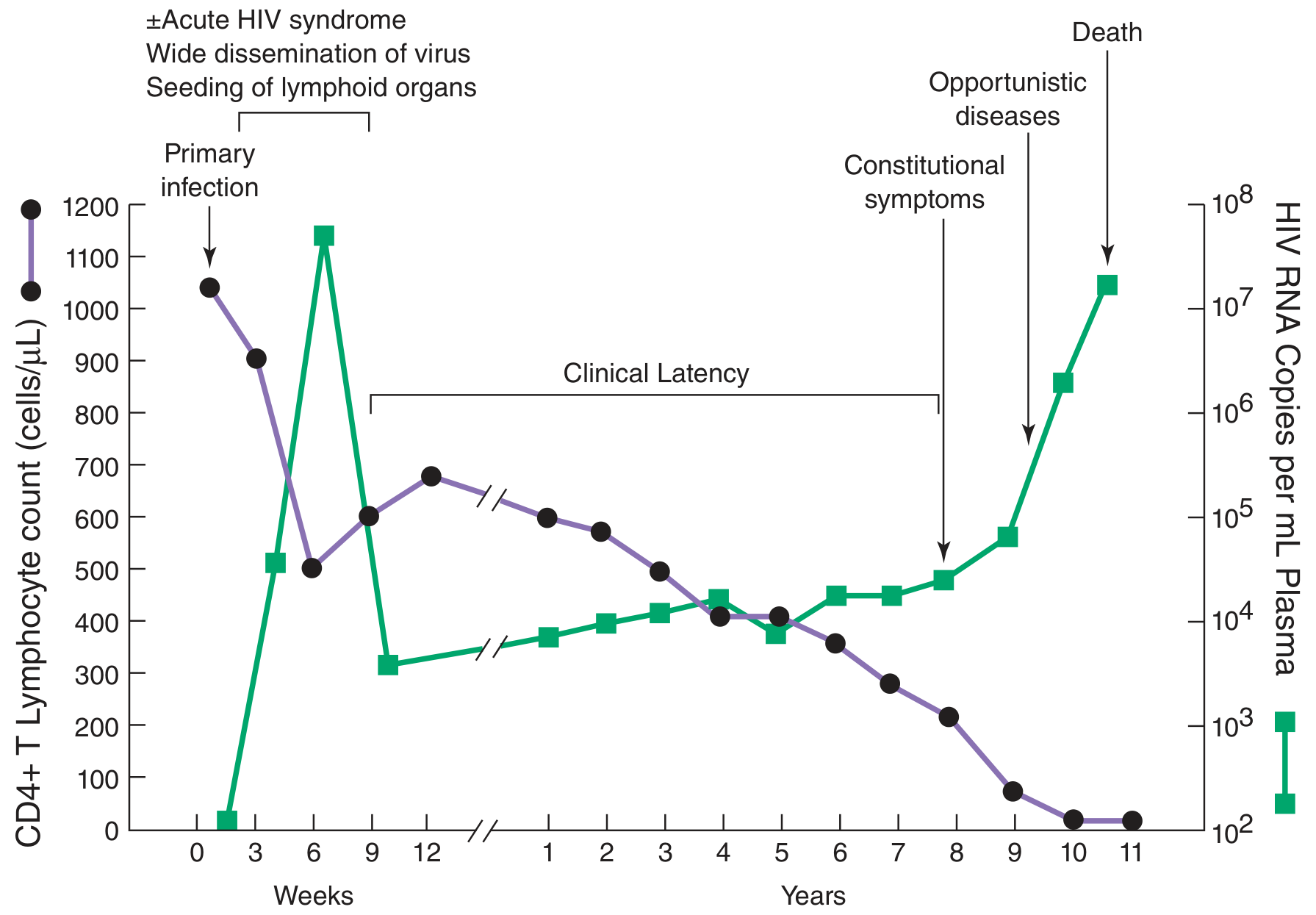
Stage 1 - Primary (Acute) HIV Infection:
- 4-11 day incubation period (mucosal infection → initial viremia)
- Viremia detectable for ~8-12 weeks
- Acute mononucleosis-like syndrome in 50-75% patients, at 3-6 weeks:
- Fever, rash, headache, fatigue, nausea, night sweats, pharyngitis, lymphadenopathy
- Sharp drop in CD4+ T cell count
- Immune response develops at 1 week to 3 months → viremia falls → CD4 rebounds
- Virus remains in lymphoid organs despite apparent recovery
Stage 2 - Clinical Latency (Chronic Asymptomatic HIV):
- May last 10 years or more (average 8-10 years without treatment)
- Apparent clinical latency but ongoing high viral replication:
- ~10 billion HIV particles produced and destroyed daily
- Plasma half-life of virus: ~6 hours
- Half-life of infected CD4 cell: ~1.6 days
- Steady-state viral set point established; higher set point = faster progression
- Gradual decline in CD4+ count throughout this period
- Lymphoid organs are the main site of active replication
Stage 3 - AIDS (Symptomatic Disease):
- CD4 count falls to <200 cells/μL → AIDS diagnosis
- Opportunistic infections and AIDS-defining malignancies appear
- Prodrome ("diarrhea and dwindling"): fatigue, weight loss, fever, chronic diarrhea, oral candidiasis, hairy leukoplakia, lymphadenopathy
- Death typically occurs ~2 years after onset of symptoms (without treatment)
Role of Viral Load (Set Point)
- Plasma viral load is the key prognostic marker
- Higher set point at 6 months → faster CD4 decline → earlier AIDS development
- Viral load monitoring guides treatment decisions
5. OPPORTUNISTIC INFECTIONS IN AIDS
Occur when CD4 count <200 cells/μL:
| Category | Organisms |
|---|---|
| Protozoa | Toxoplasma gondii, Cryptosporidium spp., Isospora belli |
| Fungi | Candida albicans, Cryptococcus neoformans, Pneumocystis jiroveci (PCP), Histoplasma capsulatum, Coccidioides immitis |
| Bacteria | Mycobacterium avium-intracellulare (MAC), M. tuberculosis, Listeria, Nocardia, Salmonella |
| Viruses | CMV (most common severe ocular complication = CMV retinitis), HSV, VZV, JC virus (PML), HBV, HCV |
HIV-TB co-infection: HIV increases TB risk 20-fold; TB dramatically increases HIV viremia
6. AIDS-DEFINING MALIGNANCIES
Due to immune suppression + viral cofactors:
| Cancer | Viral Cofactor | Notes |
|---|---|---|
| Kaposi Sarcoma | HHV-8 | 20,000× more common in AIDS; vascular tumor of endothelial origin |
| Non-Hodgkin Lymphoma | EBV | Burkitt lymphoma 1000× more common in AIDS |
| CNS Lymphoma | EBV | |
| Cervical Cancer | HPV | AIDS-defining in women |
| Anogenital Cancers | HPV |
7. DIAGNOSIS OF HIV
Window Period
- Mean time to seroconversion: 3-4 weeks after infection
- Most individuals: detectable antibodies within 6-12 weeks
- Virtually all positive by 6 months
Diagnostic Tests (in order of sensitivity for early detection):
1st Generation Tests - IgG antibody only; window period ~6-12 weeks
3rd Generation Tests - IgG + IgM antibody detection; reduces window to ~3-4 weeks
4th Generation Tests (current standard):
- Detect HIV-1/2 antibodies + p24 antigen simultaneously
- Further reduces window period
- If positive → confirm with HIV-1/HIV-2 differentiation assay
5th Generation Tests:
- Simultaneously detect and differentiate HIV-1 Ab, HIV-2 Ab, and p24 Ag separately
Western Blot (WB):
- Confirmatory test; detects antibodies to specific HIV proteins
- Antibodies to envelope (gp41, gp120, gp160) are maintained
- Anti-p24 (Gag) antibodies decline as disease progresses - heralds clinical deterioration
Nucleic Acid Tests (NAT/PCR):
- RT-PCR / bDNA (branched DNA) assays - detect HIV RNA
- Used for: viral load monitoring, diagnosis in infants (maternal antibodies make serology useless), acute HIV (window period), post-exposure evaluation
- DNA PCR - detects integrated proviral DNA (used in infants)
- Reduces infectious window period to ~10-12 days
CD4 Count:
- Normal: ~1000 cells/μL
- <500: begin ARV therapy (previous guideline; now treat all)
- <200: AIDS diagnosis + PCP prophylaxis
- <50: MAC prophylaxis
HIV Resistance Testing:
- HIV genotyping (sequencing of RT and protease genes) - most common
- Identifies mutations conferring drug resistance
- Guides selection of ART regimen
8. TREATMENT - ANTIRETROVIRAL THERAPY (ART)
Principle: Target multiple steps in HIV replication cycle; combination = HAART (Highly Active Antiretroviral Therapy)
| Drug Class | Mechanism | Examples |
|---|---|---|
| NRTIs (Nucleoside Reverse Transcriptase Inhibitors) | Terminate DNA chain (lack 3'-OH) | Zidovudine (AZT), Lamivudine (3TC), Tenofovir, Abacavir, Emtricitabine |
| NNRTIs (Non-Nucleoside RT Inhibitors) | Bind RT allosteric site; non-competitive inhibition | Nevirapine, Efavirenz, Rilpivirine |
| PIs (Protease Inhibitors) | Block viral protease → immature, non-infectious virions | Lopinavir, Atazanavir, Ritonavir (booster) |
| INSTIs (Integrase Strand Transfer Inhibitors) | Block integration of proviral DNA | Raltegravir, Dolutegravir, Bictegravir |
| Fusion Inhibitors | Block gp41-mediated membrane fusion | Enfuvirtide (T-20) |
| CCR5 Antagonists | Block CCR5 co-receptor | Maraviroc (requires tropism testing first) |
| Post-Attachment Inhibitors | Block CD4-gp120 interaction | Ibalizumab |
Standard first-line ART: 2 NRTIs + 1 INSTI (preferred) or 2 NRTIs + 1 NNRTI/PI
Prevention of Mother-to-Child Transmission (PMTCT):
- ART to HIV+ pregnant women throughout pregnancy and breastfeeding
- Cesarean section if viral load >1000 copies/mL at 36 weeks
- Neonatal prophylaxis with AZT or nevirapine
- Avoid breastfeeding where safe alternatives exist
9. EPIDEMIOLOGY & TRANSMISSION
Routes of Transmission
- Sexual contact (vaginal, anal, oral-genital) - most common worldwide; anal intercourse highest risk
- Blood/blood products - IV drug use (shared needles), transfusions, needle-stick injuries
- Mother to child (vertical) - transplacental, during delivery, breastfeeding
NOT transmitted by: casual contact, sneezing, coughing, sharing meals, food handling
Global Epidemiology
-
35 million people worldwide living with HIV/AIDS
- Sub-Saharan Africa - highest burden; in some African cities 1 in 3 adults infected
- Subtype C predominates in southern Africa and India
- HIV-2 localized mainly to West Africa
Classification of HIV-1
- Group M (Main) - >90% of infections; subtypes A through K
- Group O (Outlier) - West/Central Africa
- Group N (Non-M, Non-O)
- Group P
10. PREVENTION
- Safe sex - consistent condom use
- Harm reduction - needle exchange programs, no sharing of needles
- Blood screening - all donated blood tested by NAT
- PrEP (Pre-Exposure Prophylaxis) - Tenofovir/Emtricitabine for high-risk individuals
- PEP (Post-Exposure Prophylaxis) - ART started within 72 hours of exposure
- PMTCT - ART throughout pregnancy
- Topical microbicides - vaginal tenofovir gel reduces transmission by ~39%
- Vaccines - No effective vaccine available; challenges include rapid mutation, envelope variability, lack of appropriate animal model (chimpanzees don't develop immunodeficiency)
KEY EXAM POINTS (Apurba Sastry Style)
| Point | Fact |
|---|---|
| Family/Genus | Retroviridae / Lentivirus |
| Unique morphology | Cylindrical (bar-shaped) nucleoid / cone-shaped core |
| Key receptor | CD4 + CCR5 (early) or CXCR4 (late) |
| Resistance to HIV | Homozygous CCR5-Δ32 deletion |
| HIV-1 vs HIV-2 difference | HIV-1 has vpu; HIV-2 has vpx |
| Clinical latency | Average 8-10 years |
| AIDS-defining CD4 count | <200 cells/μL |
| Daily viral production | ~10 billion particles/day |
| Most common severe ocular OI | CMV retinitis |
| Kaposi sarcoma cofactor | HHV-8 |
| Confirmation test | Western Blot (antibodies to gp41, gp120, gp160 most persistent) |
| p24 antigen decline | Heralds poor prognosis (complexed with antibodies) |
| Best prognostic marker | Plasma viral load |
| AZT mechanism | NRTI - chain terminator |
| Window period 4th gen test | Shorter than 3rd gen (detects p24 Ag + Ab) |
| Vaccine status | No effective vaccine; rapid mutation is the main challenge |
| HIV increase in TB risk | 20-fold |
Source: Jawetz, Melnick & Adelberg's Medical Microbiology, 28th Edition (Chapter 44) - content consistent with Apurba S. Sastry's Essentials of Medical Microbiology> Note: Apurba S. Sastry's Essentials of Medical Microbiology is not available in this digital library. The notes below are sourced from Jawetz, Melnick & Adelberg's Medical Microbiology (28th ed.) - the primary international reference on which Apurba Sastry's text is closely based, covering all topics Sastry addresses.
HIV (Human Immunodeficiency Virus) - Complete Notes
1. INTRODUCTION & CLASSIFICATION
- HIV = etiologic agent of Acquired Immune Deficiency Syndrome (AIDS)
- AIDS first described in 1981 (homosexual men, USA); HIV-1 isolated by 1983
- Classification:
- Family: Retroviridae
- Genus: Lentivirus ("slow virus" - long incubation)
- Two types:
- HIV-1 - causes most AIDS worldwide; multiple subtypes
- HIV-2 - less virulent, slower progression, mainly West Africa
- HIV-1 Group M subtypes: Subtype C dominant in India & southern Africa; Subtype B in USA/Europe
2. STRUCTURE & COMPOSITION
Morphology
- Enveloped, spherical, ~100-120 nm
- Unique: cylindrical (bar-shaped/cone-shaped) nucleoid - seen on electron microscopy
Genome (9 genes)
The RNA genome is more complex than simple retroviruses:
| Gene | Protein | Function |
|---|---|---|
| gag | p17 (MA), p24 (CA), p7 (NC) | Core/capsid; p24 = major capsid antigen, used in diagnostics |
| pol | RT (p66), Integrase, Protease | Enzymes for replication |
| env | gp160 → gp120 (SU) + gp41 (TM) | Receptor binding & fusion |
| tat | Tat | Transactivation of viral genes; amplifies viral replication |
| rev | Rev | Exports unspliced mRNA from nucleus (needed for structural proteins) |
| nef | Nef | Downregulates CD4 & MHC-I; increases infectivity; activates resting T cells |
| vpr | Vpr | Nuclear import of preintegration complex; G2 arrest |
| vpu | Vpu | Degrades CD4; promotes virion release (HIV-1 only; HIV-2 has vpx) |
| vif | Vif | Overcomes host restriction factor APOBEC3G |
Surface Proteins
- gp120 - binds CD4; has 5 hypervariable regions (V1-V5); greatest genetic diversity here
- gp41 - transmembrane; mediates viral-cell membrane fusion
- p24 - major capsid antigen; detected in 4th generation tests
Host Restriction Factors (countered by HIV)
- APOBEC3G (countered by Vif) - deaminase that inhibits HIV
- TRIM5α - directs incoming viral particles to proteasomal degradation
3. REPLICATION CYCLE / LIFE CYCLE
This is the basis of all ARV drug targets:
| Step | Event | Drug Target |
|---|---|---|
| 1. Attachment | gp120 binds CD4 receptor | - |
| 2. Co-receptor binding | gp120 binds CCR5 (early/M-tropic) or CXCR4 (late/T-tropic) | CCR5 antagonists (Maraviroc) |
| 3. Fusion | gp41 conformational change → membrane fusion | Fusion inhibitors (Enfuvirtide) |
| 4. Reverse Transcription | RT converts ssRNA → dsDNA; high error rate → mutations | NRTIs, NNRTIs |
| 5. Integration | Integrase inserts viral DNA into host chromosome → provirus | INSTIs (Dolutegravir) |
| 6. Transcription | Host RNA pol + Tat amplification | - |
| 7. Translation | Structural proteins made as polyprotein precursors | - |
| 8. Maturation | Protease cleaves polyproteins → infectious virion | Protease Inhibitors |
Key: Individuals with homozygous CCR5-Δ32 deletion are highly resistant to HIV infection
4. PATHOGENESIS
Primary Target: CD4+ T Lymphocytes
- Normal CD4 count: ~1000 cells/μL
- Macrophages & monocytes: reservoir (not killed, harbor virus)
- DC-SIGN on dendritic cells: binds HIV, transports to lymph nodes (does not mediate direct entry)
Three Stages of Untreated HIV Infection
Stage 1 - Acute (Primary) HIV:
- Incubation: 4-11 days (mucosal infection → viremia)
- Viremia peaks, then detected for 8-12 weeks
- Acute mononucleosis-like syndrome in 50-75% (at 3-6 weeks): fever, rash, headache, pharyngitis, lymphadenopathy, night sweats
- Sharp drop in CD4 count
- Immune response at 1 week-3 months → viremia falls, CD4 rebounds
- But virus persists in lymphoid organs - infection is lifelong
Stage 2 - Clinical Latency (Chronic Asymptomatic):
- Lasts 8-10 years average without treatment
- Apparent latency but massive ongoing replication:
- ~10 billion particles produced & destroyed daily
- Plasma HIV half-life: 6 hours
- Infected CD4 half-life: 1.6 days
- Viral set point established - higher set point = faster progression to AIDS
- Gradual CD4 decline throughout
- Lymphoid organs = main replication site
Stage 3 - AIDS:
- CD4 falls to <200 cells/μL
- Prodrome = "diarrhea and dwindling": weight loss, fever, fatigue, chronic diarrhea, oral candidiasis (hairy leukoplakia), lymphadenopathy
- Opportunistic infections & AIDS-defining malignancies
- Death ~2 years after symptom onset (untreated)
5. OPPORTUNISTIC INFECTIONS (OI) IN AIDS
Occur when CD4 < 200 cells/μL:
| Category | Key Organisms |
|---|---|
| Protozoa | Toxoplasma gondii, Cryptosporidium spp., Isospora belli |
| Fungi | Candida (oral/esophageal), Cryptococcus neoformans, PCP (Pneumocystis jiroveci), Histoplasma, Coccidioides |
| Bacteria | M. avium-intracellulare (MAC), M. tuberculosis, Listeria, Nocardia, Salmonella |
| Viruses | CMV (CMV retinitis = most common severe eye complication), HSV, VZV, JC virus (→ PML), HBV, HCV |
- HIV + TB: HIV increases TB risk 20-fold; active TB dramatically increases HIV viremia
6. AIDS-DEFINING CANCERS
| Cancer | Viral Co-factor | Key Fact |
|---|---|---|
| Kaposi Sarcoma | HHV-8 | 20,000× more common in AIDS; vascular tumor of endothelial origin |
| Non-Hodgkin Lymphoma (Burkitt) | EBV | 1000× more common in AIDS |
| CNS Lymphoma | EBV | |
| Cervical Cancer | HPV | AIDS-defining in women |
| Anogenital Cancer | HPV |
7. DIAGNOSIS
Window Period
- Mean seroconversion: 3-4 weeks
- Most seropositive by: 6-12 weeks
- Virtually all positive by: 6 months
Tests
| Test | What It Detects | Use |
|---|---|---|
| 3rd Gen ELISA | HIV-1 & HIV-2 IgG + IgM antibodies | Screening |
| 4th Gen ELISA | HIV Ab + p24 antigen | Standard screening; shorter window period |
| 5th Gen test | HIV-1 Ab, HIV-2 Ab, p24 Ag (simultaneously differentiated) | Most advanced |
| Western Blot | Antibodies to specific bands (gp41, gp120, gp160 persist longest; p24 Ab declines with progression) | Confirmatory |
| RT-PCR / viral load | HIV RNA (quantitative) | Viral load monitoring, acute HIV, window period diagnosis |
| DNA PCR | Proviral DNA | Diagnosis in infants (maternal Ab makes serology useless) |
| Rapid tests | HIV antibodies (blood or oral fluid) | Field/resource-limited settings |
| HIV Genotyping | Mutations in RT & protease genes | Resistance testing before ART |
p24 antigen declines after antibodies develop (complexed with anti-p24); reappearance of p24 = poor prognosis
CD4 Count Thresholds
| CD4 Count | Action |
|---|---|
| <500 (old guideline) | Start ART |
| <350 | Prophylaxis for Toxoplasma |
| <200 | AIDS diagnosis; PCP prophylaxis with co-trimoxazole |
| <50 | MAC prophylaxis with azithromycin/clarithromycin |
8. ANTIRETROVIRAL THERAPY (ART / HAART)
Principle: Combination therapy at multiple steps prevents drug resistance
| Drug Class | Mechanism | Examples |
|---|---|---|
| NRTIs | Chain terminators (lack 3'-OH) → block RT | Zidovudine (AZT), Lamivudine (3TC), Tenofovir (TDF), Abacavir, Emtricitabine (FTC) |
| NNRTIs | Allosteric (non-competitive) RT inhibitors | Nevirapine, Efavirenz, Rilpivirine |
| PIs | Block viral protease → immature, non-infectious virions | Lopinavir, Atazanavir, Ritonavir (booster), Darunavir |
| INSTIs | Block integration of proviral DNA | Raltegravir, Dolutegravir (preferred), Bictegravir |
| Fusion inhibitors | Block gp41-mediated fusion | Enfuvirtide (T-20) |
| CCR5 antagonists | Block CCR5 co-receptor (requires tropism testing) | Maraviroc |
First-line ART: 2 NRTIs + 1 INSTI (current preferred regimen)
PEP (Post-Exposure Prophylaxis): Start within 72 hours, continue for 28 days
PrEP (Pre-Exposure Prophylaxis): Tenofovir/Emtricitabine daily for high-risk individuals
9. EPIDEMIOLOGY & TRANSMISSION
Routes
- Sexual (anal > vaginal > oral) - most common globally
- Blood - IV drug use, transfusions, needle-stick
- Vertical (Mother to Child) - transplacental, delivery, breastfeeding
- NOT transmitted by: casual contact, sneezing, coughing, food, toilet sharing
Global
-
35 million living with HIV/AIDS
- Sub-Saharan Africa most affected; some cities - 1 in 3 adults infected
- HIV-2 confined to West Africa
- India: Subtype C predominates
10. PREVENTION & VACCINES
- Condoms, needle exchange, PrEP, PEP, PMTCT (ART in pregnancy)
- Blood donor screening with NAT
- Vaginal tenofovir gel microbicide: reduces transmission by ~39%
- No effective vaccine available
- Challenges: rapid mutation, envelope variability, lack of animal model, unknown correlates of protective immunity
- Chimpanzees susceptible to HIV but do not develop immunodeficiency
QUICK REVISION TABLE
| Topic | Key Fact |
|---|---|
| Family / Genus | Retroviridae / Lentivirus |
| Unique morphology | Cylindrical/bar-shaped nucleoid on EM |
| Primary receptor | CD4 |
| Co-receptors | CCR5 (early) and CXCR4 (late) |
| Natural resistance | Homozygous CCR5-Δ32 deletion |
| HIV-1 vs HIV-2 gene difference | HIV-1 = vpu; HIV-2 = vpx |
| Accessory protein that fights APOBEC3G | Vif |
| Transactivation protein | Tat |
| mRNA export protein | Rev |
| MHC-I & CD4 downregulator | Nef |
| Clinical latency duration | Average 8-10 years |
| AIDS-defining CD4 cut-off | <200 cells/μL |
| Daily viral production | ~10 billion particles |
| Most common severe eye OI | CMV retinitis |
| Kaposi Sarcoma cofactor | HHV-8 |
| Anti-HIV Ab that persists longest | Anti-gp120/gp41/gp160 (envelope) |
| Anti-HIV Ab that declines with progression | Anti-p24 |
| Best prognostic marker | Plasma viral load |
| Resistance testing method | HIV genotyping (RT + protease sequencing) |
| Window period | ~3-4 weeks (seroconversion); most +ve by 6-12 weeks |
| Mechanism of AZT | NRTI - chain terminator |
| Preferred 1st-line ART backbone | 2 NRTIs + INSTI |
| HIV-TB risk increase | 20-fold |
| Vaccine status | No effective vaccine |
Sources: Jawetz, Melnick & Adelberg's Medical Microbiology 28th ed. (Chapter 44) - aligned with Apurba S. Sastry's Essentials of Medical Microbiology
This is a shared conversation. Sign in to Orris to start your own chat.