
Cavernous sinus thrombosis in detail according to standard ENT textbook
Reading File
Now let me search the ENT textbook library for cavernous sinus thrombosis content.
Finding Sources
Finding Sources
Excellent findings. Let me read the primary ENT textbook sources simultaneously - Cummings, Scott-Brown Vol 1, Scott-Brown Vol 2, and KJ Lee's Essential Otolaryngology.
Reading File
Reading File
Reading File
Reading File
Good content from multiple ENT sources. Now let me get broader content - the anatomy, pathophysiology, microbiology, orbital stages, and complications from Scott-Brown Vol 1 (the most detailed ENT source), plus some additional context on pathogenesis:
Reading File
Finding Sources
Finding Sources
Now let me get the Gray's Anatomy content on cavernous sinus anatomy, and the Harrison's pathophysiology section, plus the Chandler classification/staging:
Reading File
Reading File
Reading File
I now have comprehensive content. Let me also quickly get the Wills Eye Manual content on CST for clinical features, and fetch the key clinical image:
Reading File
Loading Image
I now have comprehensive content from multiple ENT and medical textbooks. Let me compile the detailed answer.
Cavernous Sinus Thrombosis (CST)
1. Anatomy of the Cavernous Sinus
The cavernous sinuses are paired dural venous sinuses located at the base of the skull, on either side of the sella turcica and body of the sphenoid bone. Each sinus is a trabeculated venous space with important neurovascular contents:
Contents of the lateral wall (from superior to inferior):
- Oculomotor nerve (CN III)
- Trochlear nerve (CN IV)
- Ophthalmic division of trigeminal nerve (V1)
- Maxillary division of trigeminal nerve (V2)
Contents within the sinus itself:
- Internal carotid artery (with its sympathetic plexus)
- Abducens nerve (CN VI) - runs freely inside the sinus, not in the lateral wall, making it most vulnerable
Venous connections:
- Receives blood from the superior and inferior ophthalmic veins, sphenoparietal sinuses, and facial veins
- Drains via the superior petrosal sinuses into the transverse sinuses
- Drains via the inferior petrosal sinuses into the internal jugular veins
- The two cavernous sinuses communicate with each other via intercavernous sinuses anterior and posterior to the pituitary stalk
Critically, the ophthalmic veins are valveless, allowing bidirectional blood flow. This is the anatomical basis for infection spreading from the face, orbit, paranasal sinuses, and upper dentition retrogradely into the cavernous sinus.
- Gray's Anatomy for Students, p. 1026
2. Aetiology and Predisposing Sources
CST is most commonly septic (infectious) in the ENT context. Primary sources of infection include:
| Source | Route |
|---|---|
| Paranasal sinuses (sphenoid and ethmoid most common) | Direct spread via emissary veins |
| Facial furuncles / nasal vestibule infections ("danger triangle") | Via facial vein → ophthalmic veins (valveless) |
| Orbital cellulitis (Stage V - Chandler) | Septic thrombophlebitis of orbital veins |
| Upper dentition / odontogenic infections | Via pterygoid plexus → inferior ophthalmic vein |
| Tonsils / pharynx | Via pterygoid venous plexus |
Isolated sphenoid sinusitis can spread by direct extension. Ethmoid sinusitis is the most common sinus source overall for orbital complications progressing to CST, accounting for approximately 9% of all intracranial complications of sinusitis.
- Scott-Brown's ORL HNS Vol 1, p. 1162; Harrison's Principles of Internal Medicine 22e
3. Pathogenesis
Infection spreads from the primary focus to the cavernous sinus via two main mechanisms:
- Septic thrombophlebitis - infected thrombus propagates centrally through the valveless venous system
- Septic emboli - infected emboli travel directly to the sinus
Once bacteria reach the cavernous sinus, several factors perpetuate the infection:
- Bacteria are themselves pro-thrombotic, promoting further clot formation
- The thrombus provides a protected niche for bacterial growth - organisms within the thrombus are shielded by outer layers from antibiotic penetration
- These sequestered bacteria can re-infect as the thrombus recanals later
The bilateral intercavernous connections mean that thrombosis can rapidly spread to the contralateral cavernous sinus, producing bilateral clinical signs - a hallmark of CST.
- Scott-Brown's ORL HNS Vol 1, p. 1162
4. Microbiology
-
Staphylococcus aureus - most common organism (including MRSA)
-
Streptococcus pyogenes (Group A Streptococcus)
-
Streptococcus pneumoniae
-
Gram-negative organisms
-
Mucormycosis (Rhizopus, Mucor) - in diabetic patients and immunocompromised; causes angio-invasive fungal sinusitis and CST, with very high mortality
-
Harrison's Principles of Internal Medicine 22e; Kanski's Clinical Ophthalmology
5. Chandler Classification (Orbital Staging)
CST represents Stage V in the Chandler classification of orbital complications of sinusitis:
| Stage | Description |
|---|---|
| I | Preseptal (periorbital) cellulitis - ~50% of cases |
| II | Postseptal (orbital) cellulitis without abscess - ~35% |
| III | Subperiosteal abscess - ~15% |
| IV | Orbital abscess - <1% |
| V | Cavernous sinus thrombosis |
Note: The Chandler classification pre-dates routine CT scanning and is now understood as an anatomical rather than a strictly sequential progression - not all cases pass through each stage.
- Scott-Brown's ORL HNS Vol 1, p. 1163
6. Clinical Features
CST is a life-threatening condition with an adult mortality rate of 30-40%.
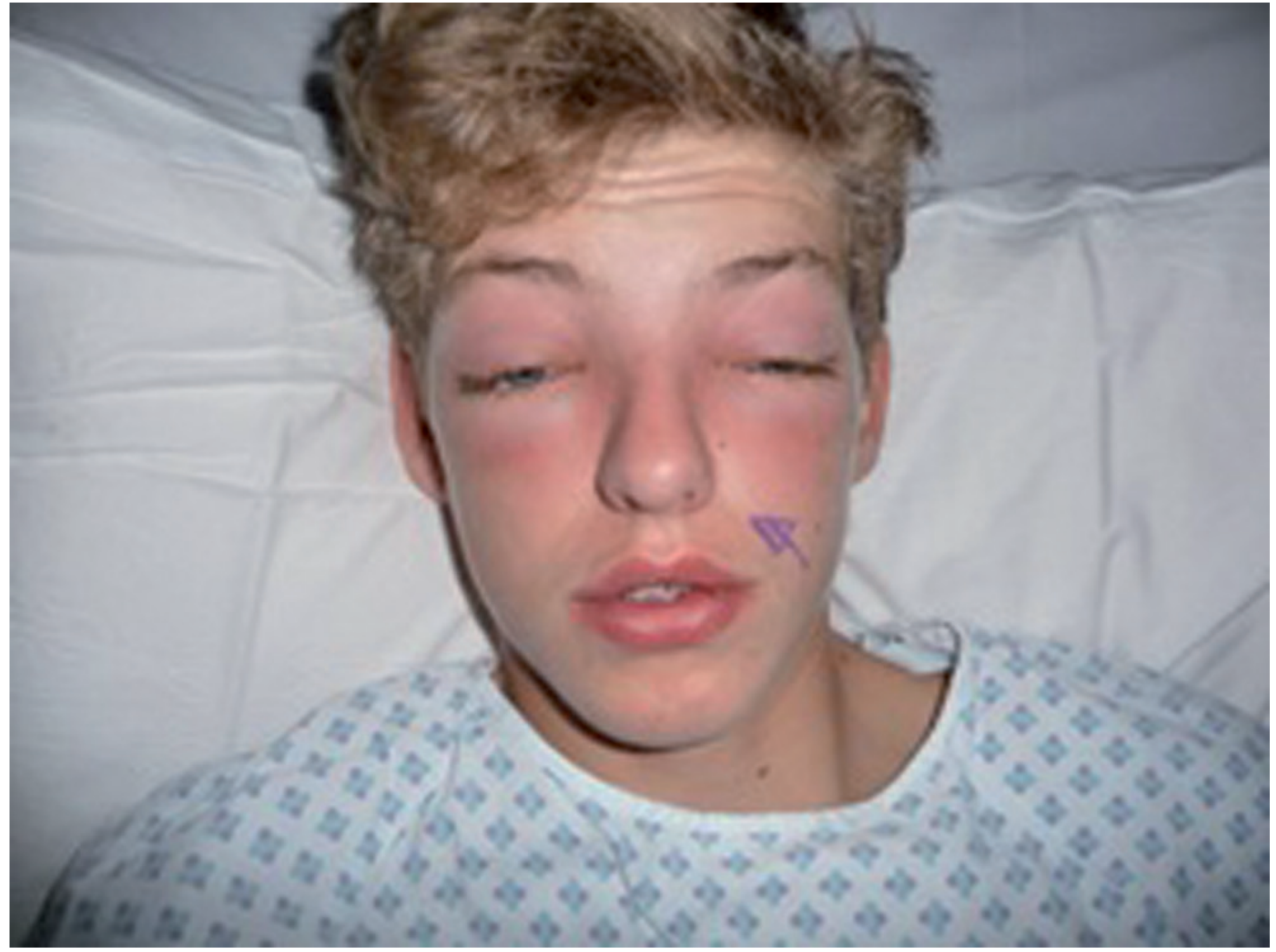
Pre-operative photograph of an adolescent male with cavernous sinus thrombosis secondary to rhinosinusitis - bilateral periorbital oedema, cellulitis, and subtle left CN VI palsy (Scott-Brown's ORL HNS Vol 1)
Symptoms
- High fever with rigors (spiking "picket-fence" pattern)
- Severe headache - retro-orbital and frontal
- Lethargy, malaise
- Orbital / periorbital pain
- Diplopia
- Visual impairment (late sign)
- Trigeminal paraesthesia (ophthalmic and maxillary distributions)
Signs
| Sign | Mechanism |
|---|---|
| Proptosis | Venous obstruction causing orbital congestion |
| Chemosis (conjunctival oedema) | Same mechanism |
| Periorbital oedema (bilateral) | Venous congestion of eyelid veins |
| Bilateral ptosis | CN III palsy |
| Ophthalmoplegia (CN III, IV, VI palsies) | CN involvement within sinus |
| Dilated pupil with sluggish light reflex | CN III involvement (parasympathetic fibres) |
| Papilloedema | Raised intracranial venous pressure |
| Signs of meningeal irritation | Meningeal inflammation |
| Reduced corneal reflex | V1 involvement |
| Confusion / reduced consciousness | Septic encephalopathy / meningitis |
Bilaterality of signs (especially bilateral proptosis and ophthalmoplegia) strongly differentiates CST from unilateral orbital cellulitis and is a key diagnostic pointer.
- Scott-Brown's ORL HNS Vol 2, p. 4318; Harrison's Principles of Internal Medicine 22e
7. Investigations
Bloods
- Full blood count: leukocytosis
- CRP, ESR: markedly elevated
- Blood cultures (before antibiotics)
- Coagulation screen
Imaging
MRI brain with contrast is the investigation of choice:
- Demonstrates dural enhancement in the region of the cavernous sinus
- Shows absent flow void within the thrombosed sinus
- Can detect associated complications (cerebral abscess, subdural empyema)
MR Venography (MRV) is especially sensitive - shows absence of flow in the thrombosed sinus.
CT with IV contrast is an acceptable alternative, demonstrating filling defects within the cavernous sinus. CT is more widely available for emergency assessment and also identifies the primary sinus source.
CSF Analysis
-
Not routinely required but may show signs of meningism if there is meningeal involvement
-
Scott-Brown's ORL HNS Vol 2, p. 4318; Cummings Otolaryngology
8. Differential Diagnosis
- Orbital cellulitis / subperiosteal abscess (unilateral, no CST signs)
- Carotid-cavernous fistula (pulsatile proptosis, bruit, non-septic context)
- Tolosa-Hunt syndrome (granulomatous inflammation, steroid-responsive)
- Superior orbital fissure syndrome (compression of CN III, IV, VI without proptosis)
- Orbital apex syndrome (as above + optic nerve involvement)
- Mucormycosis (fungal - especially in diabetics, black eschar on palate/nasal mucosa)
9. Treatment
Medical
1. Broad-spectrum intravenous antibiotics - mainstay of treatment:
- Must cover Staphylococcus aureus (including MRSA in high-risk patients), Streptococcus, gram-negative organisms, and anaerobes
- Duration: at least 2 weeks beyond clinical resolution - because bacteria sequestered within the thrombus may not be killed until dural sinus recanalization occurs
- Relapse of meningeal and ocular signs has been reported up to 6 weeks after recovery, so follow-up for at least 6 months is advised
- Switch from IV to oral only once clinical improvement is well established
2. Anticoagulation - remains controversial:
- Arguments in favour: prevents thrombus propagation; anti-inflammatory properties; improves outcome in some series
- Arguments against: thrombus may wall off infection and prevent spread; risk of intracranial haemorrhage in an already inflamed environment
- If used: unfractionated heparin infusion initially (rapidly reversible), targeting APTT 1.5-2x normal; switch to low-molecular-weight heparin once improved
- Imaging must first exclude intracerebral haemorrhage before anticoagulation
- Aseptic CST: systemic anticoagulation (heparin then warfarin) or aspirin 325 mg daily is standard
3. Corticosteroids:
- Not routinely recommended due to immunosuppressive effects in an active infection
- May be considered if there is evidence of pituitary insufficiency secondary to CST
- No strong evidence base for routine steroid use in complications of rhinosinusitis
4. Supportive care:
- Critical-care / high-dependency monitoring
- IV fluid resuscitation
- Treatment of exposure keratopathy (lubricating drops/ointment)
- Treatment of secondary glaucoma
- Infectious disease specialist input
Surgical
-
Surgery is directed at the primary sinus source (sphenoid, ethmoid), not at the cavernous sinus itself
-
Functional endoscopic sinus surgery (FESS) to drain involved sinuses and establish ventilation
-
Any co-existing orbital abscess requires drainage
-
Joint neurosurgical involvement if intracranial suppuration is present
-
Note: the operative field in acute complications is often inflamed and highly haemorrhagic, making endoscopic surgery more challenging than in chronic rhinosinusitis
-
Scott-Brown's ORL HNS Vol 1, p. 1167; Scott-Brown's ORL HNS Vol 2, p. 4349; Wills Eye Manual
10. Complications and Prognosis
Complications
- Meningitis - secondary to spread from the thrombosed sinus
- Brain abscess - haematogenous seeding
- Pituitary infarction / insufficiency - from thrombosis of pituitary blood supply
- Blindness - from optic nerve ischaemia or central retinal artery/vein involvement
- Stroke - carotid artery involvement or septic emboli
- Subdural empyema / epidural abscess
- Septic emboli to lungs, joints
Prognosis
- Mortality: 30-40% in adults
- Paediatric mortality for all intracranial complications of sinusitis: 10-20% (specific CST paediatric data limited)
- Morbidity is significant even in survivors - cranial nerve deficits, visual loss, pituitary dysfunction
- Relapse can occur up to 6 weeks after apparent recovery
- Minimum follow-up: 6 months
Summary Table
| Feature | Details |
|---|---|
| Definition | Septic thrombosis of the cavernous sinus, usually from paranasal sinusitis |
| Commonest sinus source | Sphenoid > ethmoid |
| Organism | Staphylococcus aureus (most common) |
| Key anatomy | CN III, IV, V1, V2, VI + internal carotid artery pass through sinus |
| Pathognomonic sign | Bilateral proptosis + ophthalmoplegia |
| Investigation of choice | MRI brain with contrast / MR venography |
| Treatment | IV antibiotics ≥2 weeks beyond resolution + consider anticoagulation + sinus drainage |
| Mortality | 30-40% (adults) |
Sources: Cummings Otolaryngology Head and Neck Surgery; Scott-Brown's Otorhinolaryngology HNS Vol 1 & Vol 2; K.J. Lee's Essential Otolaryngology; Harrison's Principles of Internal Medicine 22e; Gray's Anatomy for Students; Wills Eye Manual
This is a shared conversation. Sign in to Orris to start your own chat.