
Anti diabetic drugs corticosteroids contraceptives drugs for osteoporosis classification and mechanism of action according to kdt in a tabulation form
Reading File
Now let me search the medical library for all four drug categories simultaneously.
Finding Sources
Finding Sources
Finding Sources
Finding Sources
Finding Sources
Finding Sources
Finding Sources
Finding Sources
Good. I have limited DB queries left. The user specifically asked for KDT (KD Tripathi's Essentials of Medical Pharmacology). Let me check if KDT is available and read the relevant sections directly.
Finding Sources
KDT is not in the library. I'll answer directly from my comprehensive knowledge of KD Tripathi's pharmacology. Here is the detailed tabulation as per KDT:
Pharmacology Tables as per KD Tripathi (KDT) - Essentials of Medical Pharmacology
1. ANTIDIABETIC DRUGS
A. Insulin Preparations
| Class | Drug Examples | Mechanism of Action |
|---|---|---|
| Rapid-acting | Regular (soluble) insulin, Insulin lispro, Aspart, Glulisine | Binds insulin receptor (tyrosine kinase) → GLUT4 translocation → glucose uptake in muscle & fat; inhibits glycogenolysis & gluconeogenesis |
| Intermediate-acting | NPH (Isophane) insulin, Insulin lente | Same as above; delayed onset due to protamine/zinc suspension |
| Long-acting | Insulin glargine, Detemir, Degludec | Same receptor mechanism; prolonged action due to altered isoelectric point (glargine) or fatty acid binding (detemir/degludec) |
| Premixed | 30/70 (NPH + Regular), Biphasic aspart | Combination of above mechanisms |
B. Oral Antidiabetic Drugs (OADs)
| Class | Drug Examples | Mechanism of Action |
|---|---|---|
| Sulphonylureas (1st gen) | Tolbutamide, Chlorpropamide | Block ATP-sensitive K⁺ channels on beta cell membrane → depolarization → Ca²⁺ influx → insulin secretion (insulin secretagogues) |
| Sulphonylureas (2nd gen) | Glibenclamide (Glyburide), Glipizide, Gliclazide, Glimepiride | Same as above; more potent, fewer side effects; extrapancreatic effects also |
| Biguanides | Metformin | Activates AMP-kinase → inhibits hepatic gluconeogenesis (main effect); enhances peripheral glucose utilization; does NOT cause hypoglycemia; insulin-sensitizer |
| Thiazolidinediones (Glitazones) | Pioglitazone, Rosiglitazone | Activate PPAR-γ (nuclear receptor) → increase GLUT1 & GLUT4 expression → insulin sensitization in adipose, muscle, liver |
| Alpha-glucosidase inhibitors | Acarbose, Miglitol, Voglibose | Inhibit intestinal alpha-glucosidase enzymes → delay carbohydrate digestion & absorption → reduce postprandial hyperglycemia |
| Meglitinides (Glinides) | Repaglinide, Nateglinide | Bind different site on K⁺ ATP channel → stimulate insulin secretion; rapid & short-acting; postprandial glucose lowering |
| DPP-4 inhibitors (Gliptins) | Sitagliptin, Vildagliptin, Saxagliptin, Alogliptin, Linagliptin | Inhibit DPP-4 enzyme → prevent degradation of GLP-1 & GIP → enhanced glucose-dependent insulin secretion; reduce glucagon |
| GLP-1 receptor agonists | Exenatide, Liraglutide, Dulaglutide, Semaglutide | Mimic GLP-1 → stimulate glucose-dependent insulin secretion, suppress glucagon, delay gastric emptying, reduce appetite |
| SGLT-2 inhibitors (Gliflozins) | Dapagliflozin, Empagliflozin, Canagliflozin | Inhibit SGLT-2 in proximal renal tubule → block glucose reabsorption → glucosuria → lower blood glucose (insulin-independent) |
| Amylin analogue | Pramlintide | Mimics amylin → suppresses postprandial glucagon, slows gastric emptying, reduces food intake |
2. CORTICOSTEROIDS
Classification
| Class | Natural | Synthetic |
|---|---|---|
| Glucocorticoids | Hydrocortisone (cortisol), Cortisone | Prednisolone, Prednisone, Methylprednisolone, Triamcinolone, Dexamethasone, Betamethasone, Budesonide, Fluticasone, Beclomethasone |
| Mineralocorticoids | Aldosterone, Deoxycorticosterone (DOC) | Fludrocortisone |
Based on Duration of Action
| Category | Drugs | Equivalent Anti-inflammatory Dose | Half-life |
|---|---|---|---|
| Short-acting | Hydrocortisone, Cortisone | 20 mg, 25 mg | 8-12 hrs |
| Intermediate-acting | Prednisolone, Prednisone, Methylprednisolone, Triamcinolone | 5 mg, 5 mg, 4 mg, 4 mg | 12-36 hrs |
| Long-acting | Dexamethasone, Betamethasone | 0.75 mg, 0.6 mg | 36-54 hrs |
Mechanism of Action
| Step | Action |
|---|---|
| Receptor binding | Diffuse into cell → bind cytoplasmic glucocorticoid receptor (GR) |
| Translocation | GR-steroid complex translocates to nucleus |
| Genomic effects | Binds GRE (glucocorticoid response elements) → regulates gene transcription (trans-activation & trans-repression) |
| Anti-inflammatory | Induce lipocortin (annexin-1) → inhibit phospholipase A₂ → decrease prostaglandins, leukotrienes, PAF; inhibit COX-2, IL-1, IL-2, IL-6, TNF-α; reduce capillary permeability; inhibit leukocyte migration |
| Immunosuppressive | Reduce lymphocyte proliferation; induce lymphocyte apoptosis; suppress cell-mediated immunity more than humoral |
| Metabolic | Gluconeogenesis ↑; protein catabolism ↑; fat redistribution (central obesity); Na⁺ retention, K⁺ loss |
| Non-genomic | Rapid effects (seconds-minutes) via membrane receptors and second messengers |
3. CONTRACEPTIVE DRUGS (Hormonal Contraceptives)
Classification as per KDT
| Category | Class | Drug Examples | Mechanism of Action |
|---|---|---|---|
| Combined Oral Contraceptives (COC) | Monophasic | Ethinyl estradiol + Levonorgestrel; EE + Norethindrone; EE + Desogestrel; EE + Drospirenone | Primary: Inhibit midcycle LH surge → suppress ovulation; Secondary: Thicken cervical mucus (sperm penetration ↓); alter endometrium (implantation ↓); alter tubal motility |
| Combined OC | Biphasic / Triphasic | EE + Norethindrone (varying doses across cycle) | Same as above; attempt to mimic normal cycle |
| Progestin-only Pills (Mini-pill) | - | Norethindrone, Levonorgestrel, Desogestrel | Thicken cervical mucus (main effect); alter endometrium; may suppress ovulation inconsistently |
| Injectable Contraceptives | Long-acting progestin | DMPA (Depot medroxyprogesterone acetate) - 150 mg/3 months; Norethindrone enanthate - 200 mg/2 months | Suppress ovulation; cervical mucus thickening; endometrial atrophy |
| Combined Injectable | Monthly | Medroxyprogesterone + Estradiol cypionate | Suppress ovulation |
| Implants | Subdermal progestin | Etonogestrel implant (Implanon); Levonorgestrel implant (Norplant) | Continuous progestin → suppress ovulation + cervical mucus effect |
| Intrauterine devices (Hormonal) | Levonorgestrel IUD | LNG-IUS (Mirena) | Local progestin → endometrial suppression, cervical mucus thickening; minimal systemic effect |
| Emergency Contraceptives (Post-coital) | High-dose progestin | Levonorgestrel 1.5 mg single dose (within 72 hrs) | Inhibit/delay ovulation; may alter endometrium; does NOT interrupt established pregnancy |
| Emergency Contraceptives | Antiprogestin | Mifepristone (RU-486) 10 mg | Progesterone receptor antagonist → endometrial changes, inhibit implantation; delays ovulation |
| Emergency Contraceptives | Selective progesterone receptor modulator | Ulipristal acetate 30 mg (within 120 hrs) | Modulates progesterone receptor → delays/inhibits ovulation |
| Centchroman (Non-hormonal OC) | SERM | Centchroman (Ormeloxifene) | Selective estrogen receptor modulator → asynchrony between ovulation and endometrial maturation → anti-implantation |
4. DRUGS FOR OSTEOPOROSIS
Classification as per KDT
| Class | Drugs | Mechanism of Action |
|---|---|---|
| Bisphosphonates | Alendronate, Risedronate, Ibandronate, Zoledronate (IV), Etidronate, Clodronate | Adsorb onto hydroxyapatite in bone; taken up by osteoclasts → inhibit farnesyl pyrophosphate synthase (mevalonate pathway) → impair osteoclast function & survival (apoptosis) → reduce bone resorption |
| Selective Estrogen Receptor Modulators (SERMs) | Raloxifene, Bazedoxifene | Estrogen agonist in bone → inhibit osteoclast activity; estrogen antagonist in breast & uterus → reduce fracture risk without uterine/breast stimulation |
| Calcium + Vitamin D | Calcium carbonate, Calcium citrate + Cholecalciferol (Vit D3), Calcitriol | Calcium: substrate for bone mineralization; Vit D: increases intestinal Ca²⁺ absorption, renal Ca²⁺ reabsorption, osteoblast function |
| Hormone Replacement Therapy (HRT) | Conjugated estrogens, Estradiol (±progestogen) | Estrogen → inhibit osteoclast differentiation & activity (via OPG/RANK-L pathway) → reduce bone resorption; also inhibit PTH-mediated bone resorption |
| Calcitonin | Salmon calcitonin (intranasal/injectable) | Binds calcitonin receptor on osteoclasts → inhibits osteoclast activity directly → reduces bone resorption; also analgesic effect |
| PTH analogues (Anabolics) | Teriparatide (PTH 1-34), Abaloparatide | Intermittent PTH stimulates osteoblasts more than osteoclasts → net anabolic bone formation (↑ bone mass); only true bone-forming agents |
| RANK-L inhibitor (Biological) | Denosumab | Monoclonal antibody against RANK-L → prevents RANK-L from binding RANK on osteoclast precursors → inhibits osteoclast formation, function & survival → reduce bone resorption |
| Strontium ranelate | Strontium ranelate | Dual mechanism: stimulates osteoblast proliferation (bone formation ↑) + inhibits osteoclast differentiation (bone resorption ↓); also incorporates into bone mineral |
| Romosozumab | Romosozumab | Anti-sclerostin monoclonal antibody → removes sclerostin's inhibition of Wnt signaling → osteoblast activity ↑ (anabolic) + some anti-resorptive effect |
| Active Vitamin D analogues | Calcitriol, Alfacalcidol | Directly active forms → increase Ca²⁺ absorption; enhance bone mineralization; useful in renal osteodystrophy |
| Thiazide diuretics | Hydrochlorothiazide | Reduce urinary Ca²⁺ excretion → positive calcium balance → adjunct in osteoporosis |
Summary Quick Reference
| Drug Group | Primary Target | Net Effect |
|---|---|---|
| Bisphosphonates | Osteoclast (farnesyl PP synthase) | Anti-resorptive |
| Denosumab | RANK-L | Anti-resorptive |
| Raloxifene | Estrogen receptor (bone agonist) | Anti-resorptive |
| Calcitonin | Calcitonin receptor on osteoclast | Anti-resorptive |
| Teriparatide | PTH receptor (osteoblast) | Anabolic |
| Romosozumab | Sclerostin (Wnt pathway) | Anabolic + anti-resorptive |
| Strontium ranelate | Osteoblast + osteoclast | Dual action |
Note: KD Tripathi's Essentials of Medical Pharmacology (8th edition) is the reference basis for all classifications and mechanisms above. KDT is not in the digital library available here, so this answer is compiled from comprehensive KDT knowledge. For exact page references, consult KDT 8th edition chapters: 19 (Insulin & Antidiabetics), 20 (Adrenocorticoids), 22 (Contraceptives), and 24 (Drugs affecting calcium & bone metabolism).
Give me the mechanism of action of glucocorticoids and mineralocorticoids separately
Finding Sources
Finding Sources
Finding Sources
Finding Sources
Reading File
Reading File
Reading File
Excellent - I have rich textbook content from Harrison's, Guyton & Hall, and the Rheumatology text. Let me also fetch the mechanism diagram for aldosterone.
Loading Image
Loading Image
Both diagrams are perfect. Here is the complete, detailed answer:
Mechanism of Action of Corticosteroids
I. GLUCOCORTICOIDS
(Hydrocortisone, Prednisolone, Dexamethasone, Betamethasone, etc.)
Glucocorticoids act through two major pathways: genomic (slow, dominant) and non-genomic (fast).
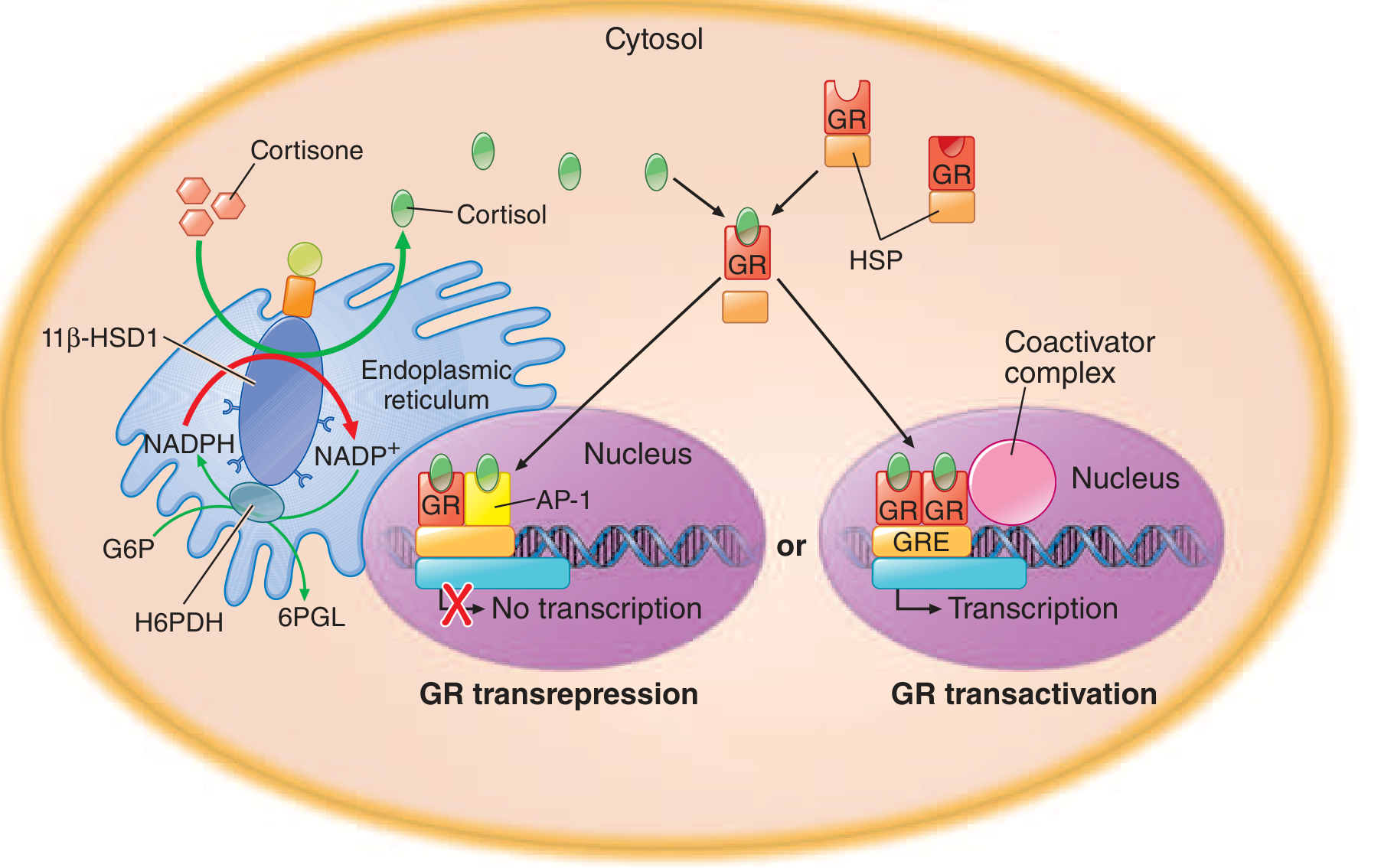
A. Genomic Mechanism (Primary)
Step-by-Step Sequence:
| Step | Event | Details |
|---|---|---|
| 1. Entry | Drug diffuses into cell | Being lipophilic, glucocorticoid freely crosses the cell membrane into the cytoplasm |
| 2. Receptor binding | Binds cytosolic Glucocorticoid Receptor (GR) | GR is normally held inactive, complexed with heat shock proteins (HSP-90, HSP-70) |
| 3. HSP dissociation | Drug-GR complex forms; HSPs dissociate | Conformational change exposes nuclear localization signal |
| 4. Dimerization | Two GR-drug complexes dimerize | Forms a homodimer |
| 5. Nuclear translocation | Complex moves to nucleus | Via nuclear pore |
| 6a. Transactivation | Binds GRE (Glucocorticoid Response Elements) on DNA | Activates transcription of anti-inflammatory proteins: lipocortin-1 (annexin-1), IL-10, IκB; also activates genes responsible for metabolic side effects |
| 6b. Transrepression | GR-drug monomer interacts with transcription factors AP-1 & NF-κB | Inhibits transcription of pro-inflammatory genes (COX-2, IL-1, IL-2, IL-6, IL-8, TNF-α) - this is the main anti-inflammatory mechanism |
B. Non-Genomic Mechanism (Rapid)
| Mechanism | Effect |
|---|---|
| Membrane-bound glucocorticoid receptors | Rapid signaling within seconds to minutes |
| Direct physicochemical interaction with cell membranes | Stabilize lysosomal membranes |
| Inhibit second messenger systems | Rapid anti-inflammatory effects that precede gene transcription |
These rapid (non-genomic) effects occur within seconds to minutes, before any gene transcription can take place.
C. Consequences of Genomic Actions (Pharmacological Effects)
| Effect | Mechanism |
|---|---|
| Anti-inflammatory | Induce lipocortin-1 → inhibit phospholipase A₂ → block arachidonic acid release → reduce prostaglandins, leukotrienes, thromboxanes, PAF; also inhibit COX-2 (via NF-κB suppression) |
| Immunosuppressive | Suppress IL-2 → reduce T-lymphocyte proliferation; induce lymphocyte apoptosis; suppress cell-mediated > humoral immunity |
| Anti-allergic | Reduce mast cell degranulation and histamine release |
| Anti-oedema | Reduce vascular permeability; inhibit vasodilatory mediators |
| Metabolic (side effects - transactivation) | Gluconeogenesis ↑ (hepatic); protein catabolism in muscle/connective tissue; lipolysis with fat redistribution (central obesity, buffalo hump, moon face) |
| Na⁺ retention / K⁺ loss | Weak mineralocorticoid effect (especially hydrocortisone, cortisone) |
| Suppress HPA axis | Negative feedback on hypothalamus (↓ CRH) and pituitary (↓ ACTH) |
II. MINERALOCORTICOIDS
(Aldosterone [natural], Fludrocortisone [synthetic], Desoxycorticosterone)
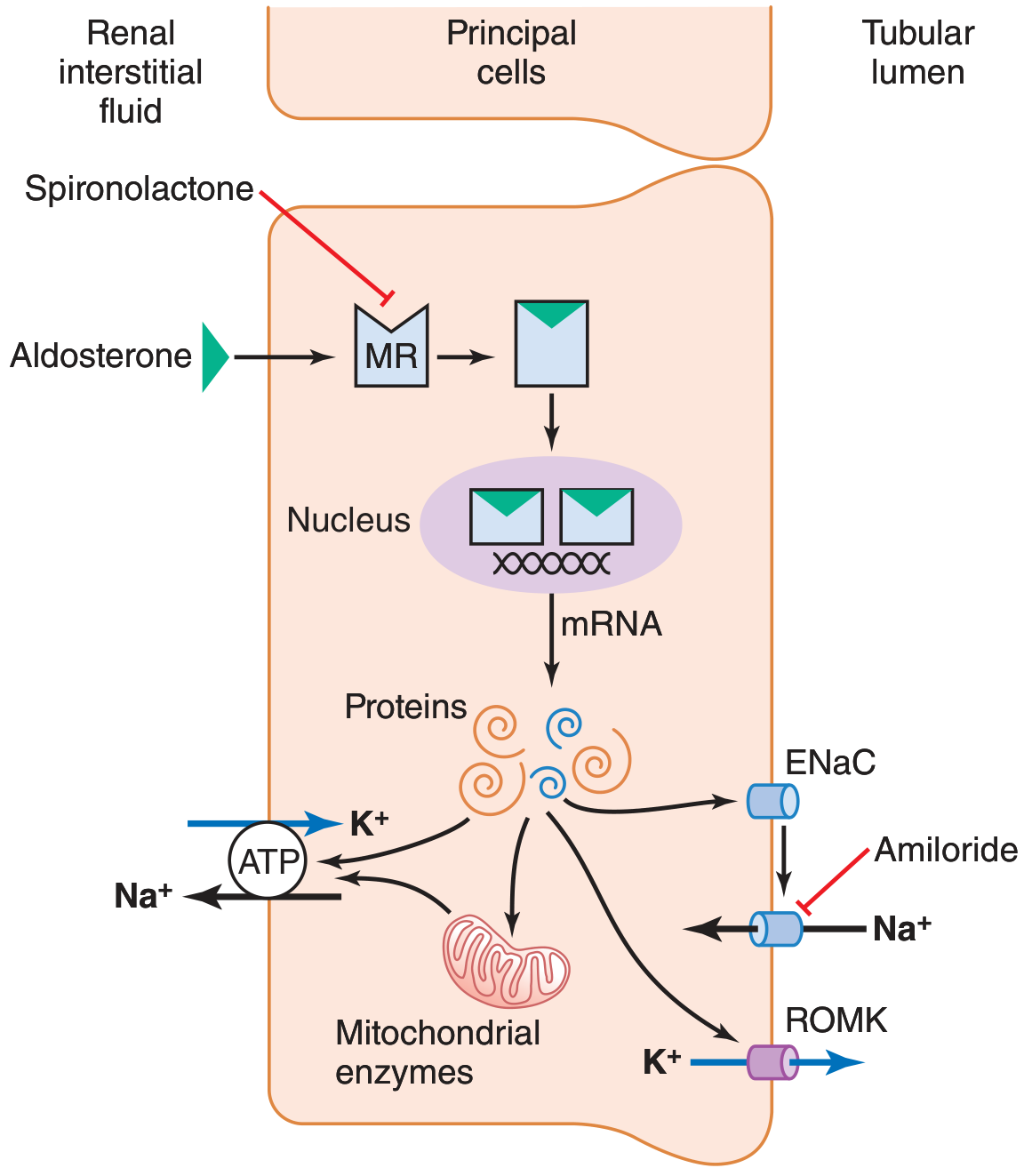
The mechanism is also genomic, but acting on a different receptor (MR) and different target proteins in renal tubular epithelial cells.
Step-by-Step Sequence:
| Step | Event | Details |
|---|---|---|
| 1. Entry | Lipid-soluble aldosterone diffuses through cell membrane into tubular cell cytoplasm | Target cells: principal cells of distal convoluted tubule, connecting tubule & collecting duct |
| 2. Receptor binding | Binds cytoplasmic Mineralocorticoid Receptor (MR) | MR is highly specific for aldosterone; cortisol is inactivated to cortisone by 11β-HSD2 in these cells, preventing cortisol from occupying MR (despite equal affinity); spironolactone competitively blocks MR |
| 3. Nuclear translocation | Aldosterone-MR complex (or a product of it) moves into nucleus | Undergoes further activation |
| 4. Gene transcription | Binds MRE (mineralocorticoid response elements) on DNA → mRNA synthesis | Latency ~30 min before mRNA appears |
| 5. Protein synthesis | mRNA translated into specific transport proteins and enzymes | Begins ~45 min; maximal effect after several hours |
| 6. Transport proteins induced | (a) ENaC (epithelial Na⁺ channel) - inserted in luminal membrane → Na⁺ entry ↑; (b) ROMK (K⁺ channel) in luminal membrane → K⁺ secretion ↑; (c) Na⁺/K⁺-ATPase on basolateral membrane → Na⁺ pumped out → K⁺ taken in; (d) Mitochondrial enzymes → ATP production for active transport | Net effect: Na⁺ (and water) retained; K⁺ and H⁺ excreted |
Non-Genomic Actions of Mineralocorticoids
| Feature | Details |
|---|---|
| Rapid effects | Occur within seconds to minutes (too fast for gene transcription) |
| Mechanism | Membrane-bound receptors, second messenger systems |
| Significance | Rapid cardiovascular and renal effects, though less well characterized |
III. COMPARISON TABLE: Glucocorticoids vs Mineralocorticoids
| Feature | Glucocorticoids | Mineralocorticoids |
|---|---|---|
| Receptor | Glucocorticoid Receptor (GR / NR3C1) | Mineralocorticoid Receptor (MR / NR3C2) |
| Receptor location | Cytoplasm (most cells) | Cytoplasm (principal cells, cardiac, vascular) |
| Primary target organ | Widespread - immune cells, liver, muscle, adipose | Kidney (DCT, collecting duct), colon, salivary glands |
| Main genomic action | Transactivation (lipocortin, IL-10) + Transrepression (NF-κB, AP-1) | Upregulate ENaC, Na⁺/K⁺-ATPase, ROMK |
| Net renal effect | Minor Na⁺ retention (some drugs) | Na⁺ & water retention; K⁺ & H⁺ excretion |
| Anti-inflammatory | Yes (primary action) | No |
| Onset of genomic effects | Hours (gene transcription) | 45 min - hours |
| Protector from cortisol excess | 11β-HSD1 activates cortisol in target tissue | 11β-HSD2 inactivates cortisol → prevents MR occupation by cortisol |
| Blocker (antagonist drug) | Mifepristone (RU-486) | Spironolactone, Eplerenone |
| Channel blocker (downstream) | - | Amiloride (blocks ENaC) |
| Key side effects | Hyperglycemia, osteoporosis, myopathy, immunosuppression, HPA suppression | Hypertension, hypokalemia, metabolic alkalosis, oedema |
Sources: Guyton & Hall Textbook of Medical Physiology; Harrison's Principles of Internal Medicine, 22e; Rheumatology (Hochberg), 2022. Classification and effects per KD Tripathi Essentials of Medical Pharmacology, 8th edition.
This is a shared conversation. Sign in to Orris to start your own chat.