
Teach me Renal calculus for exam point of view short and easy and impactful with diagrams including all the important things like definitions cause type and treatment diagnosis everything
Reading File
Now let me search the medical library for comprehensive renal calculi content.
Finding Sources
Finding Sources
Finding Sources
Reading File
Reading File
Reading File
Reading File
Finding Sources
Excellent! Now let me pull the core content from Campbell-Walsh (most comprehensive urology source) and Goldman-Cecil Medicine for the full clinical picture.
Reading File
Reading File
Reading File
Reading File
I now have comprehensive content. Let me also grab the key images from the library and fetch them for the response.
Loading Image
Loading Image
Loading Image
I now have all the content needed. Let me compile the complete, exam-ready guide.
🪨 Renal Calculi (Nephrolithiasis / Urolithiasis) - Complete Exam Guide
1. DEFINITION
Renal calculi = solid crystalline deposits that form within the kidney when the urinary concentration of stone-forming ions exceeds their solubility (supersaturation), leading to nucleation and crystal aggregation in a protein matrix.
Also called: urolithiasis, nephrolithiasis, kidney stones.
2. EPIDEMIOLOGY (High-Yield Numbers)
| Fact | Value |
|---|---|
| Lifetime risk - men | ~15% |
| Lifetime risk - women | ~10% |
| Peak incidence | 4th-5th decade |
| Annual incidence | >1 per 1000 persons |
| Most common stone | Calcium oxalate (60%) |
- More common in hot, dry climates (concentrated urine)
- More common in whites vs other ethnic groups
- Obesity (BMI >30) is a major risk factor
3. STONE TYPES & COMPOSITION
Quick Reference Table
| Stone Type | % | Appearance on X-ray | pH | Key Association |
|---|---|---|---|---|
| Calcium oxalate | 60% | Radiopaque | Acidic | Most common overall |
| Hydroxyapatite (Ca-phosphate) | 20% | Radiopaque | Alkaline | Hyperparathyroidism |
| Struvite (MgNH4PO4) | 7% | Radiopaque (staghorn) | Alkaline (>7) | Urease-splitting bacteria |
| Uric acid | 7% | Radiolucent | Acidic (<5.5) | Gout, high-purine diet |
| Cystine | 1-3% | Faintly opaque | Acidic | Cystinuria (genetic) |
| Drug stones | <1% | Variable | - | Indinavir, triamterene |
Exam Mnemonic - Radiopaque stones: "Can Sometimes Be Radiopaque" = Calcium oxalate, Struvite, Brushite, (all calcium-containing). Radiolucent = Uric Acid (and indinavir).
4. PATHOPHYSIOLOGY (Stone Formation Steps)
Normal urine
     ↓
Supersaturation (↑ stone-forming ions OR ↓ urine volume)
     ↓
Nucleation (ions bond → crystal seeds form)
     ↓
Crystal Growth & Aggregation
     ↓
Stone formation
Promoters of stone formation:
- Hypercalciuria, hyperoxaluria, hyperuricosuria
- Hypocitraturia (citrate is a key INHIBITOR)
- Low urine volume (dehydration)
- High urine pH (promotes Ca-phosphate, struvite)
- Low urine pH (promotes uric acid, Ca-oxalate)
Natural inhibitors (that prevent stones):
- Citrate (chelates calcium)
- Tamm-Horsfall protein
- Osteopontin
- Pyrophosphate, nephrocalcin
5. CAUSES & RISK FACTORS
A. Calcium Stones (Hypercalciuria - 3 Types)
┌─────────────────────────────────────────────────────────┐
│              HYPERCALCIURIA TYPES                        │
├────────────────┬────────────────┬────────────────────────┤
│ ABSORPTIVE     │ RENAL          │ RESORPTIVE             │
│ (most common,  │ (Impaired Ca   │ (1° Hyperparathy-      │
│ 20-40%)        │ reabsorption   │ roidism, 3-5%)         │
│ ↑ GI Ca absorb │ in tubules,    │ ↑ PTH → bone           │
│ → ↑ urinary Ca │ 5-8%)          │ resorption             │
└────────────────┴────────────────┴────────────────────────┘
Other causes of calcium stones:
- Hyperoxaluria - dietary (spinach, nuts, tea, cocoa), enteric (Crohn's, celiac - malabsorbed fats bind Ca, free oxalate absorbed), primary (genetic - AGXT gene mutation)
- Hypocitraturia - RTA (renal tubular acidosis), diarrhea, hypokalemia
- Hyperuricosuria - purine-rich diet, gout
B. Struvite Stones (Infection Stones)
- Caused by urease-producing bacteria: Proteus mirabilis (#1), Klebsiella, Pseudomonas, Staphylococcus
- Urease splits urea → ammonia → alkaline urine (pH >7) → precipitates MgNH4PO4
- Forms staghorn calculi (fills entire renal pelvis + calyces)
- Almost always associated with recurrent UTIs
C. Uric Acid Stones
- Causes: gout, high-purine diet (red meat, organ meats, shellfish), myeloproliferative disorders, tumor lysis syndrome, diabetes/obesity
- Acidic urine pH <5.5 promotes uric acid precipitation (uric acid is poorly soluble in acid)
- Unique: radiolucent on plain X-ray but visible on CT
D. Cystine Stones
- Autosomal recessive defect in cystine-dibasic amino acid transporter (SLC3A1, SLC7A9 genes)
- Amino acids affected: Cystine, Ornithine, Lysine, Arginine → "COLA" mnemonic
- Cystine is insoluble → forms staghorn-like stones
- Appears hexagonal crystals on urine microscopy
6. CLINICAL FEATURES
Classic Presentation
┌──────────────────────────────────────────────────────────┐
│           RENAL COLIC - CLASSIC FEATURES                 │
│                                                          │
│  • Sudden, SEVERE, COLICKY flank pain                    │
│  • Radiates: flank → groin → labia/scrotum              │
│  • "Worst pain of my life" (restless, can't lie still)  │
│  • Nausea & vomiting                                     │
│  • Hematuria (gross or microscopic) - 90%               │
│  • Dysuria/urgency (if stone near UVJ)                  │
│  • NO peritoneal signs (patient constantly moves)        │
└──────────────────────────────────────────────────────────┘
Pain Location by Stone Location
      [Renal pelvis/calyces]
             ↓
      Flank pain / CVA tenderness
             ↓
      [Upper ureter]
             ↓
      Flank → upper abdomen (may mimic appendicitis/cholecystitis)
             ↓
      [Mid-ureter crossing iliac vessels]  ← Common obstruction site
             ↓
      Lower abdomen / pelvis
             ↓
      [Ureterovesical junction (UVJ)]  ← Most common site of obstruction
             ↓
      Urgency, frequency, dysuria, groin pain
3 Points Where Stones Get Stuck (EXAM FAVORITE!)
- Ureteropelvic junction (UPJ)
- Ureter crossing iliac vessels (pelvic brim)
- Ureterovesical junction (UVJ) - narrowest, most common
7. DIAGNOSIS
Step 1 - Urine Tests
- Urinalysis: hematuria (90%), crystalluria (RBCs + crystals), pyuria (if infected)
- Urine pH: acidic in uric acid stones; alkaline (>7) in struvite; helps narrow stone type
- Urine culture: to rule out infection (especially struvite stones)
- 24-hour urine collection (for recurrent stones): calcium, oxalate, uric acid, citrate, phosphate, sodium, creatinine
Step 2 - Blood Tests
- BMP/CMP: serum Ca, uric acid, BUN/Cr (renal function)
- PTH: if hypercalcemia present (to exclude hyperparathyroidism)
- CBC: leukocytosis if infected stone
Step 3 - Imaging
Gold standard: Non-contrast CT (NCCT) abdomen/pelvis
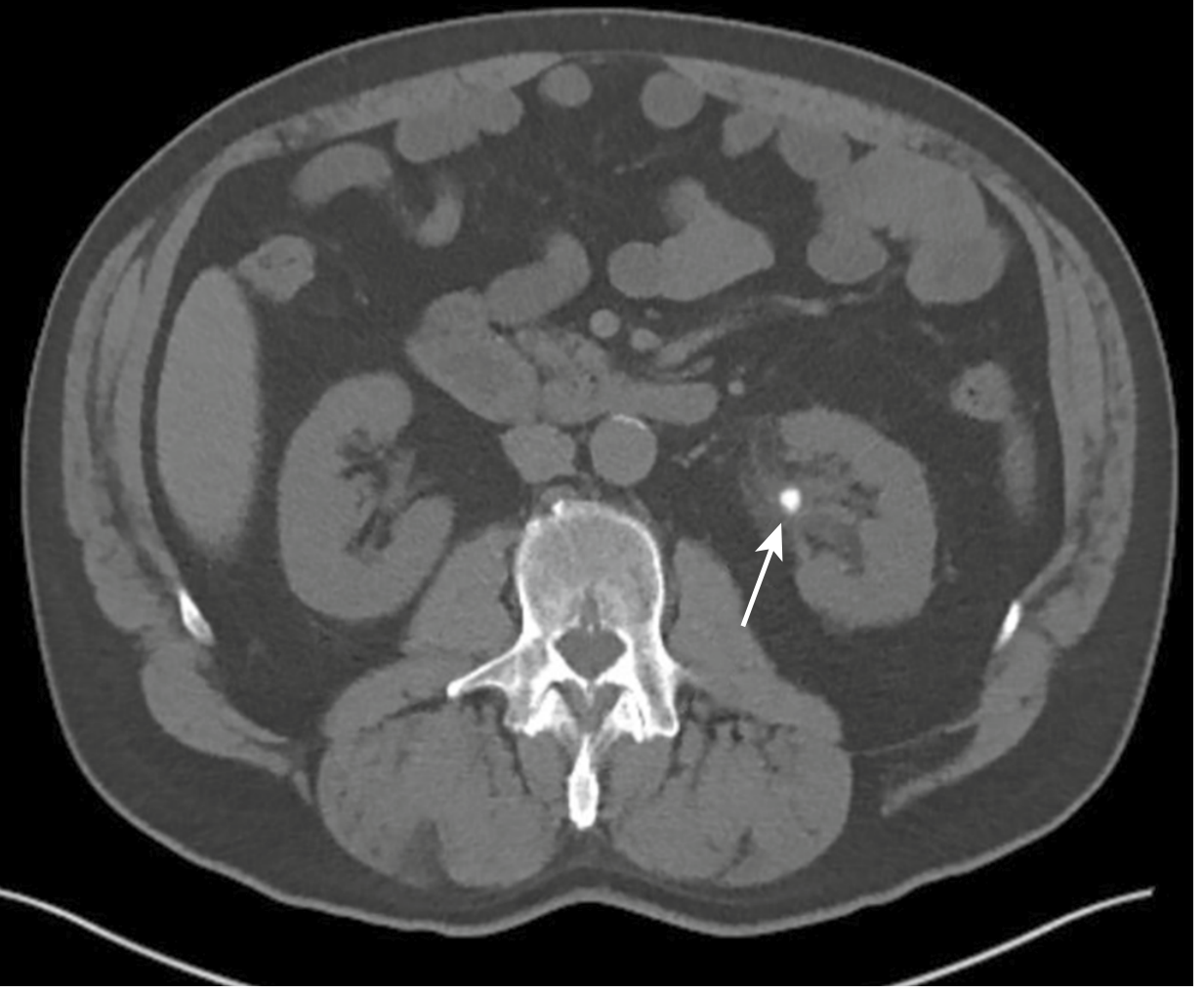
CT KUB: 8mm obstructing calculus at the left UPJ (arrow) - gold standard imaging. Source: National Kidney Foundation Primer on Kidney Diseases, 8e
- Sensitivity & specificity >95% for all stone types (including radiolucent uric acid stones)
- Shows hydronephrosis, periureteral stranding, stone size/location
- "Low-dose CT protocol" available to reduce radiation
Plain X-ray (KUB - Kidney, Ureter, Bladder):
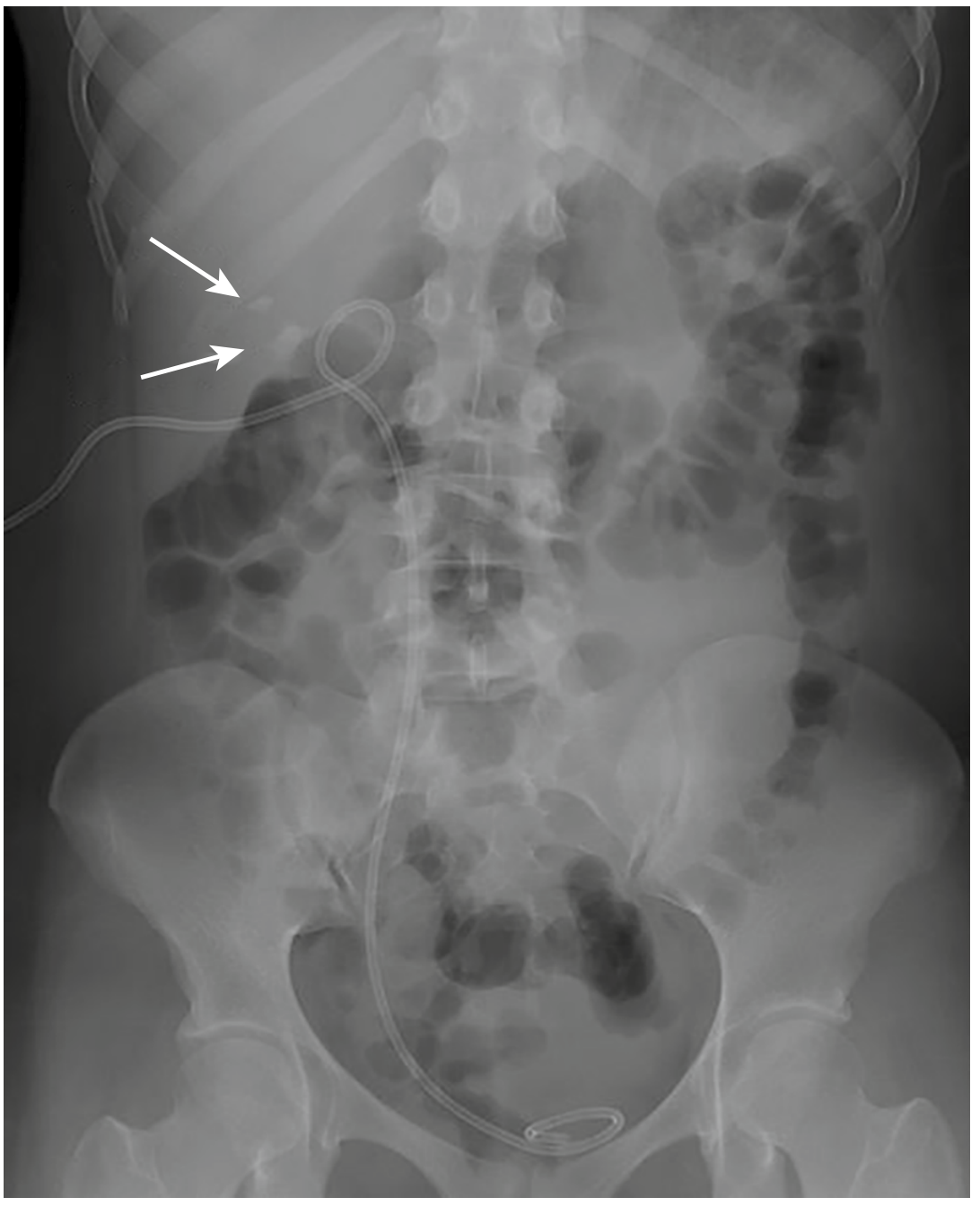
KUB X-ray: radiopaque calculi in right kidney (arrows). Source: National Kidney Foundation Primer on Kidney Diseases, 8e
- Detects radiopaque stones (Ca-oxalate, Ca-phosphate, struvite, cystine)
- MISSES radiolucent stones (uric acid, indinavir)
- Sensitivity ~60% - less reliable than CT
Ultrasound:
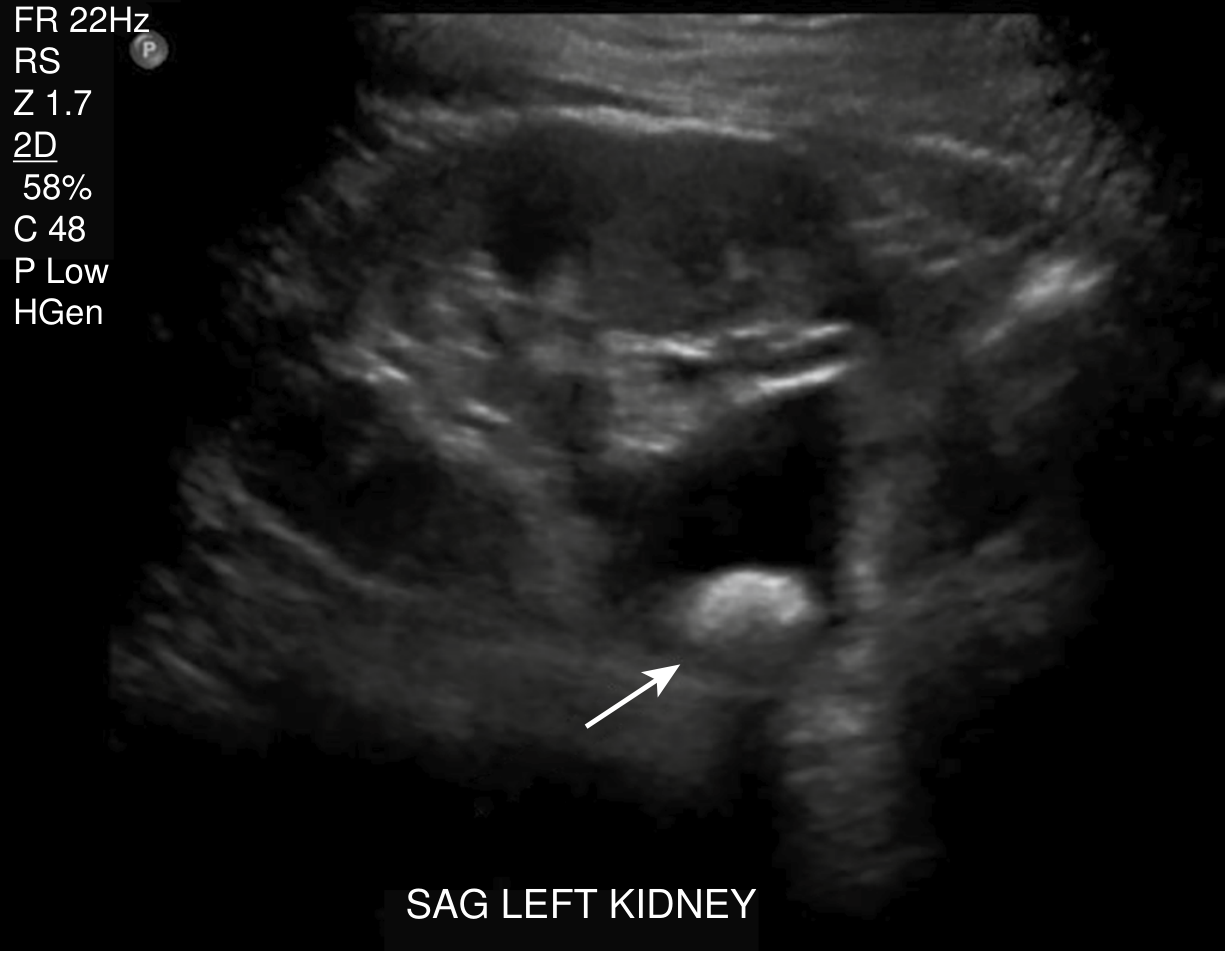
Renal ultrasound: hyperechoic stone with acoustic shadow (arrow). Source: National Kidney Foundation Primer on Kidney Diseases, 8e
- First-line in: pregnant patients, children, recurrent disease (no radiation)
- Detects hydronephrosis and larger stones >5mm
- Less sensitive than CT for small/ureteral stones
- Finding: hyperechoic focus + posterior acoustic shadowing
Imaging Summary Table
| Modality | Sensitivity | Best For | Misses |
|---|---|---|---|
| NCCT | >95% | Gold standard, all stones | Radiation |
| KUB X-ray | ~60% | Follow-up of radiopaque stones | Uric acid stones |
| Ultrasound | ~45-78% | Pregnancy, kids, hydronephrosis | Small/ureteral stones |
| IVP/IVU | Good | Anatomy, radiolucent stones | Largely replaced by CT |
| MRI | Poor | Not standard for stones | Most calculi (no MR signal) |
8. TREATMENT
Algorithm Based on Stone Size
Stone Detected
     │
     ├─── ≤4 mm ──→ 95% pass spontaneously
     │              Medical expulsive therapy (MET)
     │              Hydration, pain control
     │
     ├─── 4-6 mm ──→ ~50% pass spontaneously
     │               MET + α-blocker (tamsulosin)
     │               Wait up to 4 weeks
     │
     ├─── 6-10 mm ──→ Unlikely to pass spontaneously
     │                Consider procedural intervention
     │
     └─── >10 mm ──→ Intervention needed
                     Choose based on location/type
A. Conservative/Medical Management (Acute Colic)
| Treatment | Purpose |
|---|---|
| IV/oral hydration | Dilute urine, encourage stone passage |
| NSAIDs (ketorolac, ibuprofen) | First-line pain control (better than opioids) |
| Opioids (morphine) | Rescue analgesia |
| α-blockers (tamsulosin 0.4 mg) | Relax ureteral smooth muscle → ↑ passage rate |
| Anti-emetics (ondansetron) | Nausea/vomiting |
B. Interventional Procedures
| Procedure | Best For | Mechanism |
|---|---|---|
| ESWL (Extracorporeal Shock Wave Lithotripsy) | Stones <2 cm, renal pelvis, upper ureter | External shock waves fragment stone |
| URS (Ureteroscopy + laser lithotripsy) | Ureteral stones, any size | Endoscope + holmium laser |
| PCNL (Percutaneous Nephrolithotomy) | Large stones >2 cm, staghorn calculi | Nephroscope through flank |
| Open/laparoscopic surgery | Complex/rare cases | Rarely needed |
C. Emergency Indications (IMMEDIATE intervention)
- Infected obstructing stone (urosepsis) - most urgent
- Bilateral obstruction or solitary kidney
- Refractory pain/vomiting
- Worsening renal function
9. STONE-SPECIFIC MEDICAL PREVENTION
| Stone Type | Prevention Strategy |
|---|---|
| Calcium oxalate | ↑ fluids (>2-2.5 L/day), low-oxalate diet, normal (not low) Ca intake, thiazide diuretics (for hypercalciuria), potassium citrate (for hypocitraturia) |
| Calcium phosphate | Thiazide diuretics, potassium citrate |
| Uric acid | Alkalinize urine (potassium citrate → pH 6-7), allopurinol (for hyperuricosuria), low-purine diet |
| Struvite | Antibiotics (treat underlying infection), acetohydroxamic acid (urease inhibitor), surgical removal |
| Cystine | High fluid intake (>3 L/day), alkalinize urine, D-penicillamine or tiopronin (chelates cystine) |
10. COMPLICATIONS
| Complication | Key Point |
|---|---|
| Urinary obstruction | → Hydronephrosis → obstructive nephropathy |
| Pyelonephritis/urosepsis | Infected obstructing stone = surgical emergency |
| CKD/renal failure | Recurrent stones → progressive nephron loss |
| Recurrence | ~50% within 5-10 years if no prevention |
| Ureteral stricture | From repeated stone passage |
11. HIGH-YIELD EXAM FAST FACTS
| Fact | Answer |
|---|---|
| Most common stone | Calcium oxalate |
| Only radiolucent stone | Uric acid (also indinavir) |
| Stone in alkaline urine | Struvite, Calcium phosphate |
| Stone in acidic urine | Uric acid, Calcium oxalate |
| Staghorn calculus = | Struvite (or rarely cystine) |
| "COLA" amino acids lost in cystinuria | Cystine, Ornithine, Lysine, Arginine |
| Crystal shape: uric acid | Rhomboid/needle shaped |
| Crystal shape: cystine | Hexagonal (pathognomonic) |
| Crystal shape: Ca-oxalate dihydrate | Envelope/bipyramid |
| Crystal shape: struvite | Coffin-lid shaped |
| Gold standard imaging | Non-contrast CT |
| First-line imaging in pregnancy | Ultrasound |
| Most common site of obstruction | Ureterovesical junction (UVJ) |
| Inhibitor of stone formation | Citrate |
| Bacteria causing struvite | Proteus mirabilis (#1) |
| MET agent | Tamsulosin (α-blocker) |
| Large stone (>2cm) treatment | PCNL |
12. QUICK MEMORY DIAGRAM - Stone Types at a Glance
                    KIDNEY STONES
                        │
        ┌───────────────┼────────────────┐
        │               │                │
   CALCIUM (80%)    URIC ACID (7%)   STRUVITE (7%)
   ├─ Oxalate 60%   Radiolucent      Urease bacteria
   ├─ Phosphate 20%  pH <5.5         pH >7 (alkaline)
   └─ Brushite 2%   Gout/obesity    Staghorn calculi

   CYSTINE (1-3%)        DRUG STONES (<1%)
   Genetic/AR            Indinavir,
   Hexagonal crystals    Triamterene
   COLA amino acids
Sources: Goldman-Cecil Medicine, 26e | Campbell-Walsh-Wein Urology | National Kidney Foundation Primer on Kidney Diseases, 8e | Robbins Pathologic Basis of Disease
Generate a PDF quick reference card summarizing stone classifications, diagnostic criteria, and treatment protocols
Reading File
Running Command
mkdir -p /tmp/workspace/renal-calculi && ls /tmp/workspace/
Writing File
~/renal-calculi/generate_pdf.py
from reportlab.lib.pagesizes import A4
from reportlab.lib import colors
from reportlab.lib.units import cm, mm
from reportlab.lib.styles import getSampleStyleSheet, ParagraphStyle
from reportlab.platypus import (
    SimpleDocTemplate, Paragraph, Table, TableStyle, Spacer,
    HRFlowable, KeepTogether
)
from reportlab.lib.enums import TA_CENTER, TA_LEFT, TA_RIGHT
from reportlab.pdfgen import canvas
from reportlab.platypus import BaseDocTemplate, Frame, PageTemplate

OUTPUT = "/tmp/workspace/renal-calculi/Renal_Calculi_Quick_Reference.pdf"

# ── Colour palette ────────────────────────────────────────────────────────────
NAVY       = colors.HexColor("#1B3A6B")
STEEL      = colors.HexColor("#2E6DA4")
LIGHT_BLUE = colors.HexColor("#D6E8F7")
TEAL       = colors.HexColor("#1A7A7A")
LIGHT_TEAL = colors.HexColor("#D0EFEF")
ORANGE     = colors.HexColor("#C0540A")
ORANGE_LT  = colors.HexColor("#FDE8D8")
RED        = colors.HexColor("#B22222")
RED_LT     = colors.HexColor("#FAE0E0")
GREEN      = colors.HexColor("#1B6B2F")
GREEN_LT   = colors.HexColor("#D8F0DE")
PURPLE     = colors.HexColor("#5B2C8D")
PURPLE_LT  = colors.HexColor("#EAD8F8")
GOLD       = colors.HexColor("#B8860B")
GOLD_LT    = colors.HexColor("#FFF8DC")
GREY_DARK  = colors.HexColor("#333333")
GREY_MID   = colors.HexColor("#666666")
GREY_LIGHT = colors.HexColor("#F4F6FA")
WHITE      = colors.white

# ── Page dimensions ───────────────────────────────────────────────────────────
W, H = A4   # 595.27 x 841.89 pts
MARGIN = 1.5 * cm

# ── Styles ────────────────────────────────────────────────────────────────────
styles = getSampleStyleSheet()

def style(name, **kw):
    s = ParagraphStyle(name, **kw)
    return s

HDR1 = style("HDR1", fontSize=18, fontName="Helvetica-Bold",
             textColor=WHITE, alignment=TA_CENTER, leading=22)
HDR2 = style("HDR2", fontSize=11, fontName="Helvetica-Bold",
             textColor=WHITE, alignment=TA_LEFT, leading=14)
HDR3 = style("HDR3", fontSize=9.5, fontName="Helvetica-Bold",
             textColor=NAVY, alignment=TA_LEFT, leading=12)
BODY = style("BODY", fontSize=8.2, fontName="Helvetica",
             textColor=GREY_DARK, leading=11)
BODY_B = style("BODY_B", fontSize=8.2, fontName="Helvetica-Bold",
               textColor=GREY_DARK, leading=11)
SMALL = style("SMALL", fontSize=7.5, fontName="Helvetica",
              textColor=GREY_MID, leading=10)
SMALL_B = style("SMALL_B", fontSize=7.5, fontName="Helvetica-Bold",
                textColor=GREY_DARK, leading=10)
CELL  = style("CELL",  fontSize=7.8, fontName="Helvetica",
              textColor=GREY_DARK, leading=10, alignment=TA_LEFT)
CELL_B = style("CELL_B", fontSize=7.8, fontName="Helvetica-Bold",
               textColor=GREY_DARK, leading=10)
CELL_W = style("CELL_W", fontSize=8, fontName="Helvetica-Bold",
               textColor=WHITE, leading=10, alignment=TA_LEFT)
ALERT = style("ALERT", fontSize=8, fontName="Helvetica-Bold",
              textColor=RED, leading=10)
MNEM  = style("MNEM", fontSize=8, fontName="Helvetica-BoldOblique",
              textColor=PURPLE, leading=10)

usable_w = W - 2 * MARGIN   # ≈ 165 mm

# ── Helper: section header bar ────────────────────────────────────────────────
def section_header(text, bg=NAVY, fg=WHITE):
    tbl = Table([[Paragraph(text, style("_sh", fontSize=10,
                                        fontName="Helvetica-Bold",
                                        textColor=fg, leading=13))]],
                colWidths=[usable_w])
    tbl.setStyle(TableStyle([
        ("BACKGROUND", (0,0), (-1,-1), bg),
        ("TOPPADDING",  (0,0), (-1,-1), 4),
        ("BOTTOMPADDING",(0,0), (-1,-1), 4),
        ("LEFTPADDING", (0,0), (-1,-1), 6),
        ("RIGHTPADDING",(0,0), (-1,-1), 6),
        ("ROUNDEDCORNERS", [4, 4, 4, 4]),
    ]))
    return tbl

# ── Helper: two-col layout ────────────────────────────────────────────────────
def two_col(left_items, right_items, ratio=(1, 1)):
    total = sum(ratio)
    lw = usable_w * ratio[0] / total - 3
    rw = usable_w * ratio[1] / total - 3
    rows = max(len(left_items), len(right_items))
    data = []
    for i in range(rows):
        l = left_items[i]  if i < len(left_items)  else ""
        r = right_items[i] if i < len(right_items) else ""
        data.append([l, r])
    tbl = Table(data, colWidths=[lw, rw], hAlign="LEFT")
    tbl.setStyle(TableStyle([
        ("VALIGN", (0,0), (-1,-1), "TOP"),
        ("LEFTPADDING", (0,0), (-1,-1), 0),
        ("RIGHTPADDING",(0,0), (-1,-1), 4),
        ("TOPPADDING",  (0,0), (-1,-1), 0),
        ("BOTTOMPADDING",(0,0), (-1,-1), 0),
    ]))
    return tbl

# ══════════════════════════════════════════════════════════════════════════════
# Build story
# ══════════════════════════════════════════════════════════════════════════════
story = []

# ── TITLE BANNER ──────────────────────────────────────────────────────────────
title_data = [[
    Paragraph("🪨  RENAL CALCULI", style("T1", fontSize=20,
              fontName="Helvetica-Bold", textColor=WHITE, leading=24)),
    Paragraph("Quick Reference Card", style("T2", fontSize=11,
              fontName="Helvetica-BoldOblique", textColor=LIGHT_BLUE,
              alignment=TA_RIGHT, leading=14)),
]]
title_tbl = Table(title_data, colWidths=[usable_w * 0.6, usable_w * 0.4])
title_tbl.setStyle(TableStyle([
    ("BACKGROUND", (0,0), (-1,-1), NAVY),
    ("TOPPADDING",  (0,0), (-1,-1), 10),
    ("BOTTOMPADDING",(0,0), (-1,-1), 10),
    ("LEFTPADDING", (0,0), (-1,-1), 10),
    ("RIGHTPADDING",(0,0), (-1,-1), 10),
    ("VALIGN",      (0,0), (-1,-1), "MIDDLE"),
]))
story.append(title_tbl)

sub_data = [[
    Paragraph("Nephrolithiasis / Urolithiasis", style("S1", fontSize=9,
              fontName="Helvetica", textColor=WHITE, leading=11)),
    Paragraph("Classification · Diagnosis · Treatment · Prevention",
              style("S2", fontSize=8, fontName="Helvetica-Oblique",
                    textColor=LIGHT_BLUE, alignment=TA_RIGHT, leading=11)),
]]
sub_tbl = Table(sub_data, colWidths=[usable_w * 0.55, usable_w * 0.45])
sub_tbl.setStyle(TableStyle([
    ("BACKGROUND", (0,0), (-1,-1), STEEL),
    ("TOPPADDING",  (0,0), (-1,-1), 4),
    ("BOTTOMPADDING",(0,0), (-1,-1), 4),
    ("LEFTPADDING", (0,0), (-1,-1), 10),
    ("RIGHTPADDING",(0,0), (-1,-1), 10),
    ("VALIGN",      (0,0), (-1,-1), "MIDDLE"),
]))
story.append(sub_tbl)
story.append(Spacer(1, 6))

# ══════════════════════════════════════════════════════════════════════════════
# SECTION 1 – DEFINITION & EPIDEMIOLOGY
# ══════════════════════════════════════════════════════════════════════════════
story.append(section_header("1. DEFINITION & EPIDEMIOLOGY", NAVY))
story.append(Spacer(1, 4))

def_items = [
    Paragraph("<b>Definition:</b> Crystalline deposits formed in the kidney when urine becomes "
              "supersaturated with stone-forming ions, exceeding their solubility "
              "→ nucleation → crystal growth → stone.", BODY),
    Spacer(1, 4),
    Paragraph("<b>Mechanism:</b> Supersaturation → Nucleation (homo/heterogeneous) → "
              "Aggregation → Stone (inhibitors: citrate, Tamm-Horsfall protein, osteopontin)", BODY),
]

epi_rows = [
    [Paragraph("Fact", CELL_W), Paragraph("Value", CELL_W)],
    [Paragraph("Lifetime risk – Men", CELL_B), Paragraph("~15%", CELL)],
    [Paragraph("Lifetime risk – Women", CELL_B), Paragraph("~10%", CELL)],
    [Paragraph("Peak incidence", CELL_B), Paragraph("4th–5th decade", CELL)],
    [Paragraph("Annual incidence", CELL_B), Paragraph(">1 per 1,000 persons", CELL)],
    [Paragraph("Most common stone", CELL_B), Paragraph("Calcium oxalate (60%)", CELL)],
    [Paragraph("Key risk factors", CELL_B), Paragraph("Obesity, hot climate, low fluid intake, family Hx", CELL)],
]
epi_tbl = Table(epi_rows, colWidths=[usable_w*0.42, usable_w*0.58])
epi_tbl.setStyle(TableStyle([
    ("BACKGROUND", (0,0), (-1,0), STEEL),
    ("BACKGROUND", (0,1), (-1,1), LIGHT_BLUE),
    ("BACKGROUND", (0,2), (-1,2), WHITE),
    ("BACKGROUND", (0,3), (-1,3), LIGHT_BLUE),
    ("BACKGROUND", (0,4), (-1,4), WHITE),
    ("BACKGROUND", (0,5), (-1,5), LIGHT_BLUE),
    ("BACKGROUND", (0,6), (-1,6), WHITE),
    ("GRID",       (0,0), (-1,-1), 0.4, colors.HexColor("#BBCDE0")),
    ("TOPPADDING",    (0,0), (-1,-1), 3),
    ("BOTTOMPADDING", (0,0), (-1,-1), 3),
    ("LEFTPADDING",   (0,0), (-1,-1), 5),
    ("RIGHTPADDING",  (0,0), (-1,-1), 5),
    ("VALIGN",        (0,0), (-1,-1), "MIDDLE"),
]))

story.append(two_col(def_items, [epi_tbl], ratio=(55, 45)))
story.append(Spacer(1, 7))

# ══════════════════════════════════════════════════════════════════════════════
# SECTION 2 – STONE CLASSIFICATION
# ══════════════════════════════════════════════════════════════════════════════
story.append(section_header("2. STONE CLASSIFICATION (Composition & Key Features)", TEAL))
story.append(Spacer(1, 4))

hdr = [Paragraph(h, CELL_W) for h in
       ["Stone Type", "% of All", "X-Ray", "Urine pH", "Crystal Shape", "Key Association"]]
stone_rows = [
    hdr,
    [Paragraph("Calcium Oxalate", CELL_B),
     Paragraph("60%", CELL),
     Paragraph("Radiopaque", CELL),
     Paragraph("Acidic", CELL),
     Paragraph("Envelope/bipyramid (dihydrate)\nDumbbell (monohydrate)", SMALL),
     Paragraph("Hypercalciuria, hyperoxaluria, hypocitraturia", CELL)],
    [Paragraph("Calcium Phosphate\n(Hydroxyapatite)", CELL_B),
     Paragraph("20%", CELL),
     Paragraph("Radiopaque", CELL),
     Paragraph("Alkaline", CELL),
     Paragraph("Amorphous / needle", SMALL),
     Paragraph("Hyperparathyroidism, RTA type 1", CELL)],
    [Paragraph("Struvite\n(MgNH₄PO₄)", CELL_B),
     Paragraph("7%", CELL),
     Paragraph("Radiopaque", CELL),
     Paragraph("Alkaline >7", CELL),
     Paragraph("Coffin-lid", SMALL),
     Paragraph("Urease bacteria (Proteus #1)\nStaghorn calculi, recurrent UTIs", CELL)],
    [Paragraph("Uric Acid", CELL_B),
     Paragraph("7%", CELL),
     Paragraph("Radiolucent ★", CELL),
     Paragraph("Acidic <5.5", CELL),
     Paragraph("Rhomboid/needle", SMALL),
     Paragraph("Gout, obesity, high-purine diet,\ntumor lysis, diabetes", CELL)],
    [Paragraph("Cystine", CELL_B),
     Paragraph("1–3%", CELL),
     Paragraph("Faint opaque", CELL),
     Paragraph("Acidic", CELL),
     Paragraph("Hexagonal ★★", SMALL),
     Paragraph("Cystinuria (AR) – COLA: Cystine,\nOrnithine, Lysine, Arginine", CELL)],
    [Paragraph("Drug Stones", CELL_B),
     Paragraph("<1%", CELL),
     Paragraph("Radiolucent\n(indinavir)", CELL),
     Paragraph("Variable", CELL),
     Paragraph("Variable", SMALL),
     Paragraph("Indinavir, triamterene, ephedrine,\nsilica", CELL)],
]
stone_tbl = Table(stone_rows, colWidths=[
    usable_w*0.16, usable_w*0.07, usable_w*0.10,
    usable_w*0.10, usable_w*0.17, usable_w*0.40
])
stone_tbl.setStyle(TableStyle([
    ("BACKGROUND", (0,0), (-1,0), TEAL),
    ("ROWBACKGROUNDS", (0,1), (-1,-1), [LIGHT_TEAL, WHITE]),
    ("GRID",       (0,0), (-1,-1), 0.4, colors.HexColor("#A0C8C8")),
    ("TOPPADDING",    (0,0), (-1,-1), 3),
    ("BOTTOMPADDING", (0,0), (-1,-1), 3),
    ("LEFTPADDING",   (0,0), (-1,-1), 4),
    ("RIGHTPADDING",  (0,0), (-1,-1), 4),
    ("VALIGN",        (0,0), (-1,-1), "TOP"),
    ("FONTNAME",   (0,1), (-1,-1), "Helvetica"),
    ("FONTSIZE",   (0,1), (-1,-1), 7.8),
]))
story.append(stone_tbl)
story.append(Paragraph(
    "★ Uric acid stones are the ONLY radiolucent stones on plain X-ray but are visible on CT  "
    "★★ Hexagonal crystals on urine microscopy are pathognomonic for cystinuria",
    style("fn", fontSize=7, fontName="Helvetica-Oblique",
          textColor=GREY_MID, leading=9)))
story.append(Spacer(1, 7))

# ══════════════════════════════════════════════════════════════════════════════
# SECTION 3 – CAUSES / RISK FACTORS
# ══════════════════════════════════════════════════════════════════════════════
story.append(section_header("3. CAUSES & RISK FACTORS", ORANGE))
story.append(Spacer(1, 4))

# Hypercalciuria box
hyper_rows = [
    [Paragraph("HYPERCALCIURIA (3 types)", CELL_W), Paragraph("Prevalence", CELL_W), Paragraph("Mechanism", CELL_W)],
    [Paragraph("Absorptive (most common)", CELL_B), Paragraph("20–40%", CELL), Paragraph("↑ GI Ca absorption → ↑ urinary Ca", CELL)],
    [Paragraph("Renal", CELL_B), Paragraph("5–8%", CELL), Paragraph("Impaired tubular Ca reabsorption", CELL)],
    [Paragraph("Resorptive (1° HPT)", CELL_B), Paragraph("3–5%", CELL), Paragraph("↑ PTH → bone Ca release → ↑ urine Ca", CELL)],
]
hyper_tbl = Table(hyper_rows, colWidths=[usable_w*0.35, usable_w*0.15, usable_w*0.50])
hyper_tbl.setStyle(TableStyle([
    ("BACKGROUND", (0,0), (-1,0), ORANGE),
    ("ROWBACKGROUNDS", (0,1), (-1,-1), [ORANGE_LT, WHITE]),
    ("GRID",       (0,0), (-1,-1), 0.4, colors.HexColor("#E0A080")),
    ("TOPPADDING",    (0,0), (-1,-1), 3),
    ("BOTTOMPADDING", (0,0), (-1,-1), 3),
    ("LEFTPADDING",   (0,0), (-1,-1), 4),
    ("RIGHTPADDING",  (0,0), (-1,-1), 4),
    ("VALIGN",        (0,0), (-1,-1), "MIDDLE"),
]))

# Other causes
other_rows = [
    [Paragraph("Condition", CELL_W), Paragraph("Mechanism / Association", CELL_W)],
    [Paragraph("Hyperoxaluria", CELL_B),
     Paragraph("Dietary (spinach, nuts, tea) | Enteric (Crohn's, celiac – malabsorbed fat binds Ca, free oxalate absorbed) | Primary (AGXT gene defect)", CELL)],
    [Paragraph("Hypocitraturia", CELL_B),
     Paragraph("RTA type 1, chronic diarrhea, hypokalemia – citrate is key stone INHIBITOR", CELL)],
    [Paragraph("Hyperuricosuria", CELL_B),
     Paragraph("High purine diet, gout, myeloproliferative disease – promotes Ca-oxalate & uric acid stones", CELL)],
    [Paragraph("Dehydration / Low UO", CELL_B),
     Paragraph("Hot climate, occupation, exercise → concentrated urine → supersaturation", CELL)],
    [Paragraph("Urease bacteria", CELL_B),
     Paragraph("Proteus mirabilis, Klebsiella, Pseudomonas → alkaline pH → struvite", CELL)],
    [Paragraph("Cystinuria (AR)", CELL_B),
     Paragraph("SLC3A1 / SLC7A9 mutations → defective COLA transport → cystine in urine", CELL)],
]
other_tbl = Table(other_rows, colWidths=[usable_w*0.22, usable_w*0.78])
other_tbl.setStyle(TableStyle([
    ("BACKGROUND", (0,0), (-1,0), colors.HexColor("#7A3A0A")),
    ("ROWBACKGROUNDS", (0,1), (-1,-1), [ORANGE_LT, WHITE]),
    ("GRID",       (0,0), (-1,-1), 0.4, colors.HexColor("#E0A080")),
    ("TOPPADDING",    (0,0), (-1,-1), 3),
    ("BOTTOMPADDING", (0,0), (-1,-1), 3),
    ("LEFTPADDING",   (0,0), (-1,-1), 4),
    ("RIGHTPADDING",  (0,0), (-1,-1), 4),
    ("VALIGN",        (0,0), (-1,-1), "TOP"),
]))

story.append(hyper_tbl)
story.append(Spacer(1, 4))
story.append(other_tbl)
story.append(Spacer(1, 7))

# ══════════════════════════════════════════════════════════════════════════════
# SECTION 4 – CLINICAL FEATURES
# ══════════════════════════════════════════════════════════════════════════════
story.append(section_header("4. CLINICAL FEATURES", RED))
story.append(Spacer(1, 4))

# Symptoms column
sx_items = [
    Paragraph("<b>Classic Renal Colic:</b>", BODY_B),
    Paragraph("• Sudden, severe, colicky flank pain", BODY),
    Paragraph("• Radiates: flank → groin → labia/scrotum", BODY),
    Paragraph("• Restless (can't get comfortable)", BODY),
    Paragraph("• Nausea & vomiting", BODY),
    Paragraph("• Haematuria (90% – gross or micro)", BODY),
    Paragraph("• Dysuria/urgency (stone near UVJ)", BODY),
    Spacer(1, 4),
    Paragraph("<b>No peritoneal signs</b> (patient constantly moves)", ALERT),
]

# 3 points of obstruction
obs_data = [
    [Paragraph("Site", CELL_W), Paragraph("Location / Pain", CELL_W)],
    [Paragraph("① UPJ", CELL_B), Paragraph("Ureteropelvic junction → flank pain", CELL)],
    [Paragraph("② Iliac brim", CELL_B), Paragraph("Ureter crosses iliac vessels → lower abdomen", CELL)],
    [Paragraph("③ UVJ ★", CELL_B), Paragraph("Ureterovesical junction (narrowest) → urgency, groin pain – MOST COMMON OBSTRUCTION SITE", CELL)],
]
obs_tbl = Table(obs_data, colWidths=[usable_w*0.20, usable_w*0.80])
obs_tbl.setStyle(TableStyle([
    ("BACKGROUND", (0,0), (-1,0), RED),
    ("ROWBACKGROUNDS", (0,1), (-1,-1), [RED_LT, WHITE]),
    ("GRID",       (0,0), (-1,-1), 0.4, colors.HexColor("#D08080")),
    ("TOPPADDING",    (0,0), (-1,-1), 3),
    ("BOTTOMPADDING", (0,0), (-1,-1), 3),
    ("LEFTPADDING",   (0,0), (-1,-1), 4),
    ("RIGHTPADDING",  (0,0), (-1,-1), 4),
    ("VALIGN",        (0,0), (-1,-1), "TOP"),
]))

obs_block = [
    Paragraph("<b>3 Sites of Stone Impaction (Exam Favourite)</b>", BODY_B),
    Spacer(1, 3),
    obs_tbl,
]

story.append(two_col(sx_items, obs_block, ratio=(45, 55)))
story.append(Spacer(1, 7))

# ══════════════════════════════════════════════════════════════════════════════
# SECTION 5 – DIAGNOSTIC CRITERIA
# ══════════════════════════════════════════════════════════════════════════════
story.append(section_header("5. DIAGNOSTIC CRITERIA & INVESTIGATIONS", PURPLE))
story.append(Spacer(1, 4))

diag_rows = [
    [Paragraph("Investigation", CELL_W), Paragraph("Findings / Purpose", CELL_W), Paragraph("Notes", CELL_W)],
    [Paragraph("Urinalysis", CELL_B),
     Paragraph("Haematuria (90%), crystalluria, pyuria (if infected), urine pH", CELL),
     Paragraph("Essential first step", CELL)],
    [Paragraph("Urine culture", CELL_B),
     Paragraph("Rule out/confirm infection, especially struvite", CELL),
     Paragraph("Alkaline pH + bacteriuria = struvite until proven otherwise", CELL)],
    [Paragraph("24-hr urine (recurrent stones)", CELL_B),
     Paragraph("Calcium, oxalate, uric acid, citrate, phosphate, Na, Cr", CELL),
     Paragraph("Guides prevention therapy", CELL)],
    [Paragraph("Serum BMP/Ca/Uric acid", CELL_B),
     Paragraph("Renal function, hypercalcaemia, hyperuricaemia", CELL),
     Paragraph("Check Cr before contrast", CELL)],
    [Paragraph("PTH", CELL_B),
     Paragraph("If serum Ca elevated → exclude 1° hyperparathyroidism", CELL),
     Paragraph("Resorptive hypercalciuria", CELL)],
    [Paragraph("★ NCCT (Non-contrast CT) KUB", CELL_B),
     Paragraph("GOLD STANDARD – >95% sensitivity & specificity. Detects all stone types, hydronephrosis, ureteral stranding", CELL),
     Paragraph("Preferred in ED. Visible: ALL stones incl. uric acid", CELL)],
    [Paragraph("KUB X-ray (Plain)", CELL_B),
     Paragraph("Radiopaque stones only (~60% sensitive). Useful for follow-up of known radiopaque stones", CELL),
     Paragraph("MISSES uric acid/indinavir stones", CELL)],
    [Paragraph("Ultrasound", CELL_B),
     Paragraph("Detects hydronephrosis, larger stones >5 mm. Hyperechoic + posterior acoustic shadowing", CELL),
     Paragraph("1st line in PREGNANCY & CHILDREN (no radiation)", CELL)],
    [Paragraph("IVP/IVU", CELL_B),
     Paragraph("Anatomic detail, radiolucent stones visible as filling defects", CELL),
     Paragraph("Largely replaced by NCCT", CELL)],
    [Paragraph("MRI", CELL_B),
     Paragraph("Poor sensitivity for calculi (no MR signal from most stones)", CELL),
     Paragraph("Not standard", CELL)],
]
diag_tbl = Table(diag_rows, colWidths=[usable_w*0.22, usable_w*0.46, usable_w*0.32])
diag_tbl.setStyle(TableStyle([
    ("BACKGROUND", (0,0), (-1,0), PURPLE),
    ("ROWBACKGROUNDS", (0,1), (-1,-1), [PURPLE_LT, WHITE]),
    # Highlight CT row
    ("BACKGROUND", (0,6), (-1,6), colors.HexColor("#D0B8F5")),
    ("FONTNAME", (0,6), (0,6), "Helvetica-Bold"),
    ("GRID",       (0,0), (-1,-1), 0.4, colors.HexColor("#C0A0E0")),
    ("TOPPADDING",    (0,0), (-1,-1), 3),
    ("BOTTOMPADDING", (0,0), (-1,-1), 3),
    ("LEFTPADDING",   (0,0), (-1,-1), 4),
    ("RIGHTPADDING",  (0,0), (-1,-1), 4),
    ("VALIGN",        (0,0), (-1,-1), "TOP"),
]))
story.append(diag_tbl)
story.append(Spacer(1, 7))

# ══════════════════════════════════════════════════════════════════════════════
# SECTION 6 – TREATMENT PROTOCOLS
# ══════════════════════════════════════════════════════════════════════════════
story.append(section_header("6. TREATMENT PROTOCOLS", GREEN))
story.append(Spacer(1, 4))

# Treatment algorithm as a highlighted box
algo_data = [
    [Paragraph("SIZE", CELL_W),
     Paragraph("SPONTANEOUS PASSAGE", CELL_W),
     Paragraph("FIRST-LINE APPROACH", CELL_W)],
    [Paragraph("≤ 4 mm", CELL_B),
     Paragraph("~95% pass", CELL),
     Paragraph("Conservative: hydration + NSAIDs + tamsulosin. Wait up to 4 weeks", CELL)],
    [Paragraph("4–6 mm", CELL_B),
     Paragraph("~50% pass", CELL),
     Paragraph("MET with α-blocker (tamsulosin 0.4 mg). Monitor 4 weeks", CELL)],
    [Paragraph("6–10 mm", CELL_B),
     Paragraph("Unlikely", CELL),
     Paragraph("Plan intervention. MET while waiting; consider ESWL or URS", CELL)],
    [Paragraph("> 10 mm", CELL_B),
     Paragraph("Will not pass", CELL),
     Paragraph("Intervention required (see procedural table)", CELL)],
]
algo_tbl = Table(algo_data, colWidths=[usable_w*0.12, usable_w*0.20, usable_w*0.68])
algo_tbl.setStyle(TableStyle([
    ("BACKGROUND", (0,0), (-1,0), GREEN),
    ("ROWBACKGROUNDS", (0,1), (-1,-1), [GREEN_LT, WHITE]),
    ("GRID",       (0,0), (-1,-1), 0.4, colors.HexColor("#80C090")),
    ("TOPPADDING",    (0,0), (-1,-1), 3),
    ("BOTTOMPADDING", (0,0), (-1,-1), 3),
    ("LEFTPADDING",   (0,0), (-1,-1), 4),
    ("RIGHTPADDING",  (0,0), (-1,-1), 4),
    ("VALIGN",        (0,0), (-1,-1), "MIDDLE"),
]))
story.append(algo_tbl)
story.append(Spacer(1, 4))

# Acute management + Procedural
acute_rows = [
    [Paragraph("Acute Pain Management", CELL_W), Paragraph("", CELL_W)],
    [Paragraph("NSAIDs (ketorolac/ibuprofen)", CELL_B), Paragraph("First-line analgesia (↓ ureteral spasm, superior to opioids)", CELL)],
    [Paragraph("Opioids (morphine)", CELL_B), Paragraph("Rescue analgesia when NSAIDs insufficient", CELL)],
    [Paragraph("Tamsulosin (α-blocker)", CELL_B), Paragraph("Medical expulsive therapy – relaxes ureteral smooth muscle", CELL)],
    [Paragraph("Anti-emetics (ondansetron)", CELL_B), Paragraph("For nausea/vomiting", CELL)],
    [Paragraph("IV hydration", CELL_B), Paragraph("Dilute urine, encourage passage", CELL)],
]
acute_tbl = Table(acute_rows, colWidths=[usable_w*0.38, usable_w*0.62])
acute_tbl.setStyle(TableStyle([
    ("BACKGROUND", (0,0), (-1,0), GREEN),
    ("SPAN",       (0,0), (-1,0)),
    ("ROWBACKGROUNDS", (0,1), (-1,-1), [GREEN_LT, WHITE]),
    ("GRID",       (0,0), (-1,-1), 0.4, colors.HexColor("#80C090")),
    ("TOPPADDING",    (0,0), (-1,-1), 3),
    ("BOTTOMPADDING", (0,0), (-1,-1), 3),
    ("LEFTPADDING",   (0,0), (-1,-1), 4),
    ("RIGHTPADDING",  (0,0), (-1,-1), 4),
    ("VALIGN",        (0,0), (-1,-1), "MIDDLE"),
]))

proc_rows = [
    [Paragraph("Procedure", CELL_W), Paragraph("Indication", CELL_W), Paragraph("Mechanism", CELL_W)],
    [Paragraph("ESWL", CELL_B),
     Paragraph("Stones <2 cm, renal pelvis, upper ureter", CELL),
     Paragraph("External shock waves fragment stone", CELL)],
    [Paragraph("URS + Laser", CELL_B),
     Paragraph("Ureteral stones (any size), failed ESWL", CELL),
     Paragraph("Endoscope + holmium laser lithotripsy", CELL)],
    [Paragraph("PCNL", CELL_B),
     Paragraph("Large stones >2 cm, staghorn calculi", CELL),
     Paragraph("Nephroscope via percutaneous flank access", CELL)],
    [Paragraph("Open/Laparoscopic", CELL_B),
     Paragraph("Complex/rare cases only", CELL),
     Paragraph("Rarely needed today", CELL)],
]
proc_tbl = Table(proc_rows, colWidths=[usable_w*0.15, usable_w*0.45, usable_w*0.40])
proc_tbl.setStyle(TableStyle([
    ("BACKGROUND", (0,0), (-1,0), colors.HexColor("#1B5C30")),
    ("ROWBACKGROUNDS", (0,1), (-1,-1), [GREEN_LT, WHITE]),
    ("GRID",       (0,0), (-1,-1), 0.4, colors.HexColor("#80C090")),
    ("TOPPADDING",    (0,0), (-1,-1), 3),
    ("BOTTOMPADDING", (0,0), (-1,-1), 3),
    ("LEFTPADDING",   (0,0), (-1,-1), 4),
    ("RIGHTPADDING",  (0,0), (-1,-1), 4),
    ("VALIGN",        (0,0), (-1,-1), "MIDDLE"),
]))

story.append(two_col(
    [Paragraph("<b>Acute / Medical Management</b>", BODY_B), Spacer(1,3), acute_tbl],
    [Paragraph("<b>Interventional Procedures</b>", BODY_B), Spacer(1,3), proc_tbl],
    ratio=(45, 55)
))
story.append(Spacer(1, 4))

# Emergency box
emerg_data = [[
    Paragraph("⚠ EMERGENCY INDICATIONS (Immediate Intervention Required):", ALERT),
    Paragraph("• Infected obstructing stone / Urosepsis (most urgent)   "
              "• Bilateral obstruction   "
              "• Solitary kidney obstruction   "
              "• Refractory pain/vomiting   "
              "• Deteriorating renal function",
              style("em2", fontSize=7.8, fontName="Helvetica", textColor=GREY_DARK, leading=11))
]]
emerg_tbl = Table(emerg_data, colWidths=[usable_w])
emerg_tbl.setStyle(TableStyle([
    ("BACKGROUND", (0,0), (-1,-1), RED_LT),
    ("BOX",        (0,0), (-1,-1), 1.2, RED),
    ("TOPPADDING",    (0,0), (-1,-1), 5),
    ("BOTTOMPADDING", (0,0), (-1,-1), 5),
    ("LEFTPADDING",   (0,0), (-1,-1), 6),
    ("RIGHTPADDING",  (0,0), (-1,-1), 6),
    ("VALIGN",        (0,0), (-1,-1), "TOP"),
]))
story.append(emerg_tbl)
story.append(Spacer(1, 7))

# ══════════════════════════════════════════════════════════════════════════════
# SECTION 7 – PREVENTION (Stone-specific)
# ══════════════════════════════════════════════════════════════════════════════
story.append(section_header("7. STONE-SPECIFIC PREVENTION", GOLD))
story.append(Spacer(1, 4))

prev_rows = [
    [Paragraph("Stone Type", CELL_W),
     Paragraph("Dietary Measures", CELL_W),
     Paragraph("Medical Therapy", CELL_W)],
    [Paragraph("Calcium Oxalate", CELL_B),
     Paragraph("↑ fluids >2.5 L/day; normal (not low) Ca diet; low oxalate, low Na, low protein", CELL),
     Paragraph("Thiazide diuretics (hypercalciuria); Potassium citrate (hypocitraturia); Pyridoxine (hyperoxaluria)", CELL)],
    [Paragraph("Calcium Phosphate", CELL_B),
     Paragraph("↑ fluids; low Na", CELL),
     Paragraph("Thiazide diuretics; Potassium citrate", CELL)],
    [Paragraph("Uric Acid", CELL_B),
     Paragraph("Low-purine diet (avoid red meat, organ meats, shellfish); ↑ fluids", CELL),
     Paragraph("Potassium citrate (alkalinise urine pH 6–7); Allopurinol (hyperuricosuria)", CELL)],
    [Paragraph("Struvite", CELL_B),
     Paragraph("Adequate hydration; treat UTIs promptly", CELL),
     Paragraph("Antibiotics; Acetohydroxamic acid (urease inhibitor); Surgical stone removal", CELL)],
    [Paragraph("Cystine", CELL_B),
     Paragraph("High fluid intake >3 L/day (most important!); limit Na & protein", CELL),
     Paragraph("Alkalinise urine; D-penicillamine or Tiopronin (chelates cystine)", CELL)],
]
prev_tbl = Table(prev_rows, colWidths=[usable_w*0.17, usable_w*0.42, usable_w*0.41])
prev_tbl.setStyle(TableStyle([
    ("BACKGROUND", (0,0), (-1,0), GOLD),
    ("ROWBACKGROUNDS", (0,1), (-1,-1), [GOLD_LT, WHITE]),
    ("GRID",       (0,0), (-1,-1), 0.4, colors.HexColor("#D0B000")),
    ("TOPPADDING",    (0,0), (-1,-1), 3),
    ("BOTTOMPADDING", (0,0), (-1,-1), 3),
    ("LEFTPADDING",   (0,0), (-1,-1), 4),
    ("RIGHTPADDING",  (0,0), (-1,-1), 4),
    ("VALIGN",        (0,0), (-1,-1), "TOP"),
]))
story.append(prev_tbl)
story.append(Spacer(1, 7))

# ══════════════════════════════════════════════════════════════════════════════
# SECTION 8 – HIGH-YIELD EXAM FACTS
# ══════════════════════════════════════════════════════════════════════════════
story.append(section_header("8. HIGH-YIELD EXAM FACTS & MNEMONICS", NAVY))
story.append(Spacer(1, 4))

hyfacts_l = [
    [Paragraph("Q", CELL_W), Paragraph("A", CELL_W)],
    [Paragraph("Most common stone?", CELL_B), Paragraph("Calcium oxalate (60%)", CELL)],
    [Paragraph("Only radiolucent stone?", CELL_B), Paragraph("Uric acid (+ indinavir)", CELL)],
    [Paragraph("Staghorn calculus =?", CELL_B), Paragraph("Struvite (infection stone)", CELL)],
    [Paragraph("Stone in alkaline urine?", CELL_B), Paragraph("Struvite, Ca-phosphate", CELL)],
    [Paragraph("Stone in acidic urine?", CELL_B), Paragraph("Uric acid, Ca-oxalate", CELL)],
    [Paragraph("Gold standard imaging?", CELL_B), Paragraph("Non-contrast CT (NCCT)", CELL)],
    [Paragraph("Imaging in pregnancy?", CELL_B), Paragraph("Ultrasound", CELL)],
    [Paragraph("Most common obstruction site?", CELL_B), Paragraph("Ureterovesical junction (UVJ)", CELL)],
    [Paragraph("Key stone inhibitor?", CELL_B), Paragraph("Citrate", CELL)],
    [Paragraph("Urease bacteria #1?", CELL_B), Paragraph("Proteus mirabilis", CELL)],
    [Paragraph("Medical expulsive therapy?", CELL_B), Paragraph("Tamsulosin (α-blocker)", CELL)],
    [Paragraph("Large stone >2 cm treatment?", CELL_B), Paragraph("PCNL", CELL)],
]
hyfacts_tbl_l = Table(hyfacts_l, colWidths=[usable_w*0.32, usable_w*0.28])
hyfacts_tbl_l.setStyle(TableStyle([
    ("BACKGROUND", (0,0), (-1,0), NAVY),
    ("ROWBACKGROUNDS", (0,1), (-1,-1), [LIGHT_BLUE, WHITE]),
    ("GRID",       (0,0), (-1,-1), 0.4, colors.HexColor("#BBCDE0")),
    ("TOPPADDING",    (0,0), (-1,-1), 2.5),
    ("BOTTOMPADDING", (0,0), (-1,-1), 2.5),
    ("LEFTPADDING",   (0,0), (-1,-1), 4),
    ("RIGHTPADDING",  (0,0), (-1,-1), 4),
    ("VALIGN",        (0,0), (-1,-1), "MIDDLE"),
]))

# Mnemonics box
mnem_items = [
    Paragraph("<b>MNEMONICS</b>", BODY_B),
    Spacer(1, 4),
    Paragraph("<b>COLA</b> (Cystinuria – amino acids lost)", MNEM),
    Paragraph("Cystine · Ornithine · Lysine · Arginine", SMALL),
    Spacer(1, 4),
    Paragraph("<b>Radiolucent = U</b>nidentified on X-ray = <b>U</b>ric Acid", MNEM),
    Spacer(1, 4),
    Paragraph("<b>STRUVITE</b> bugs = Urease-splitting", MNEM),
    Paragraph("Proteus, Klebsiella, Pseudomonas, Staph saprophyticus", SMALL),
    Spacer(1, 4),
    Paragraph("<b>Crystal shapes (exam key):</b>", BODY_B),
    Paragraph("• Hexagonal → Cystine", SMALL_B),
    Paragraph("• Coffin-lid → Struvite", SMALL),
    Paragraph("• Envelope/bipyramid → CaOx dihydrate", SMALL),
    Paragraph("• Rhomboid/needle → Uric acid", SMALL),
    Spacer(1, 4),
    Paragraph("<b>Complications:</b>", BODY_B),
    Paragraph("Obstruction → Hydronephrosis → Obstructive nephropathy → CKD", SMALL),
    Paragraph("Infected stone + obstruction = UROSEPSIS (surgical emergency)", ALERT),
    Spacer(1, 4),
    Paragraph("<b>Recurrence rate:</b> ~50% within 5–10 yrs without prevention", SMALL),
]

story.append(two_col([hyfacts_tbl_l], mnem_items, ratio=(60, 40)))
story.append(Spacer(1, 8))

# ── FOOTER ────────────────────────────────────────────────────────────────────
story.append(HRFlowable(width=usable_w, thickness=0.8, color=NAVY))
story.append(Spacer(1, 3))
footer_data = [[
    Paragraph("Sources: Goldman-Cecil Medicine 26e | Campbell-Walsh-Wein Urology | "
              "NKF Primer on Kidney Diseases 8e | Robbins Pathologic Basis of Disease",
              style("ft", fontSize=6.8, fontName="Helvetica-Oblique",
                    textColor=GREY_MID, leading=9)),
    Paragraph("Renal Calculi Quick Reference · Orris",
              style("ft2", fontSize=6.8, fontName="Helvetica-Bold",
                    textColor=GREY_MID, alignment=TA_RIGHT, leading=9)),
]]
footer_tbl = Table(footer_data, colWidths=[usable_w*0.72, usable_w*0.28])
footer_tbl.setStyle(TableStyle([
    ("VALIGN", (0,0), (-1,-1), "TOP"),
    ("LEFTPADDING",  (0,0), (-1,-1), 0),
    ("RIGHTPADDING", (0,0), (-1,-1), 0),
    ("TOPPADDING",   (0,0), (-1,-1), 0),
    ("BOTTOMPADDING",(0,0), (-1,-1), 0),
]))
story.append(footer_tbl)

# ── Build PDF ─────────────────────────────────────────────────────────────────
doc = SimpleDocTemplate(
    OUTPUT,
    pagesize=A4,
    leftMargin=MARGIN,
    rightMargin=MARGIN,
    topMargin=MARGIN,
    bottomMargin=MARGIN,
    title="Renal Calculi Quick Reference Card",
    author="Orris",
    subject="Nephrolithiasis – Classification, Diagnosis, Treatment",
)
doc.build(story)
print(f"PDF saved to: {OUTPUT}")
Running Command
cd /tmp/workspace/renal-calculi && python generate_pdf.py 2>&1
Running Command
ls -lh /tmp/workspace/renal-calculi/Renal_Calculi_Quick_Reference.pdf
Your PDF quick reference card is ready!
Renal Calculi Quick Reference
PDF Document · PDF
Here's what's packed into the single A4 card:
| Section | Content |
|---|---|
| 1. Definition & Epidemiology | Mechanism of stone formation, lifetime risk, peak age, key risk factors table |
| 2. Stone Classification | All 6 stone types - % occurrence, X-ray opacity, urine pH, crystal shape, key associations in a colour-coded table |
| 3. Causes & Risk Factors | 3 types of hypercalciuria (absorptive/renal/resorptive) with prevalence, plus hyperoxaluria, hypocitraturia, cystinuria |
| 4. Clinical Features | Classic renal colic symptoms + the 3 sites of stone impaction (UPJ, iliac brim, UVJ) |
| 5. Diagnostic Criteria | All imaging modalities (CT, KUB, US, IVP, MRI) with sensitivity, uses, and limitations; lab investigations |
| 6. Treatment Protocols | Size-based treatment algorithm (≤4mm to >10mm), acute medical management, procedural options (ESWL/URS/PCNL), emergency indications box |
| 7. Stone-specific Prevention | Dietary + medical prevention for each stone type |
| 8. High-yield Exam Facts | Q&A rapid-fire table + mnemonics (COLA, crystal shapes, complication chain) |
This is a shared conversation. Sign in to Orris to start your own chat.