
Treatment for irritable bowel syndrome
I'll start by reading the medical library skill, then search for IBS treatment information in parallel.
Searching sources...
Reading File
Now I'll run parallel searches across the library and PubMed simultaneously.
Finding Sources
Searching PubMed
"irritable bowel syndrome"[MeSH Terms] AND treatment
Good - found a dedicated section in Katzung's pharmacology. Now let me read it and search for broader IBS management content in parallel.
Reading File
Finding Sources
Excellent content found. Let me now read more from Katzung (the IBS drug section continues) and from Goldman-Cecil and Sleisenger in parallel.
Reading File
Reading File
I have rich content. Let me read the rest of the Katzung IBS section (which was truncated) to get the full picture on constipation-predominant IBS drugs.
Reading File
Reading File
I have a very comprehensive picture now. Let me fetch the two treatment algorithm images from Goldman-Cecil to include visually, and also read the rest of the Goldman table that was truncated.
Loading Image
Loading Image
Reading File
I now have comprehensive, authoritative content from multiple textbooks plus current PubMed evidence. I can write a thorough answer.
Treatment of Irritable Bowel Syndrome (IBS)
IBS is an idiopathic, chronic, relapsing disorder characterized by abdominal pain/discomfort (cramping, bloating, distension) associated with altered bowel habits. Treatment is guided by the predominant symptom subtype: IBS-D (diarrhea-predominant), IBS-C (constipation-predominant), or IBS-M (mixed).
1. General / First-Line Approach
Dietary Modifications
The low-FODMAP diet (limiting fermentable oligosaccharides, disaccharides, monosaccharides, and polyols) is the most evidence-supported dietary intervention for IBS-D. Other dietary strategies include lactose restriction and a trial of a gluten-free diet. A 2025 Lancet Gastroenterology network meta-analysis (PMID 40258374) confirms dietary interventions are among the most effective first-line options.
Lifestyle and Psychological Therapies
Psychological treatments are effective for stress-sensitive IBS symptoms and should be considered at any stage:
- Cognitive-behavioral therapy (CBT) - standard or minimal-contact formats
- Gut-directed hypnotherapy - focuses on relaxation and reinterpreting visceral signals
- Mindfulness meditation, relaxation training, psychotherapy
- An integrated care model with physicians, dietitians, and health psychologists (including internet-based programs) improves outcomes for refractory cases
(Goldman-Cecil Medicine, pp. 1420-1421)
2. Pharmacological Treatment by Symptom
For Pain and Spasm
| Drug | Dose | Notes |
|---|---|---|
| Peppermint oil | 1-2 capsules TID or PRN | Heartburn, nausea |
| Hyoscyamine (anticholinergic) | 0.125 mg TID-QID or PRN | Dry mouth, blurred vision, constipation |
| Dicyclomine (anticholinergic) | 10 mg TID-QID or PRN | Dry mouth, blurred vision |
Antispasmodics (dicyclomine, hyoscyamine) work via muscarinic receptor blockade on enteric neurons and smooth muscle. They provide short-term relief of abdominal pain but lack convincing long-term efficacy. At higher doses they cause significant anticholinergic side effects. (Katzung's Basic and Clinical Pharmacology, 16th ed., p. 1714)
Central Neuromodulators (for Chronic Pain)
Low-dose tricyclic antidepressants (TCAs) are effective for chronic abdominal pain at sub-antidepressant doses - they alter central processing of visceral afferent information, modify enteric serotonin receptor activity, and reduce stool frequency via anticholinergic effects:
| Drug | Dose | Notes |
|---|---|---|
| Amitriptyline | 10-25 mg at bedtime (up to 100 mg) | Sedation, dry mouth, constipation |
| Desipramine | 10-25 mg at bedtime (up to 100 mg) | Dry mouth, dizziness |
| Nortriptyline | 10-25 mg at bedtime (up to 100 mg) | - |
SSRIs are an alternative, especially when mood comorbidity is present:
- Citalopram 5-20 mg daily; Fluoxetine 20-40 mg daily; Paroxetine 10-50 mg daily; Sertraline 25-150 mg daily
A 2025 Lancet Gastroenterology meta-analysis on gut-brain neuromodulators (PMID 40258375) confirms their updated efficacy across IBS subtypes.
3. IBS-C (Constipation-Predominant) - Treatment Algorithm
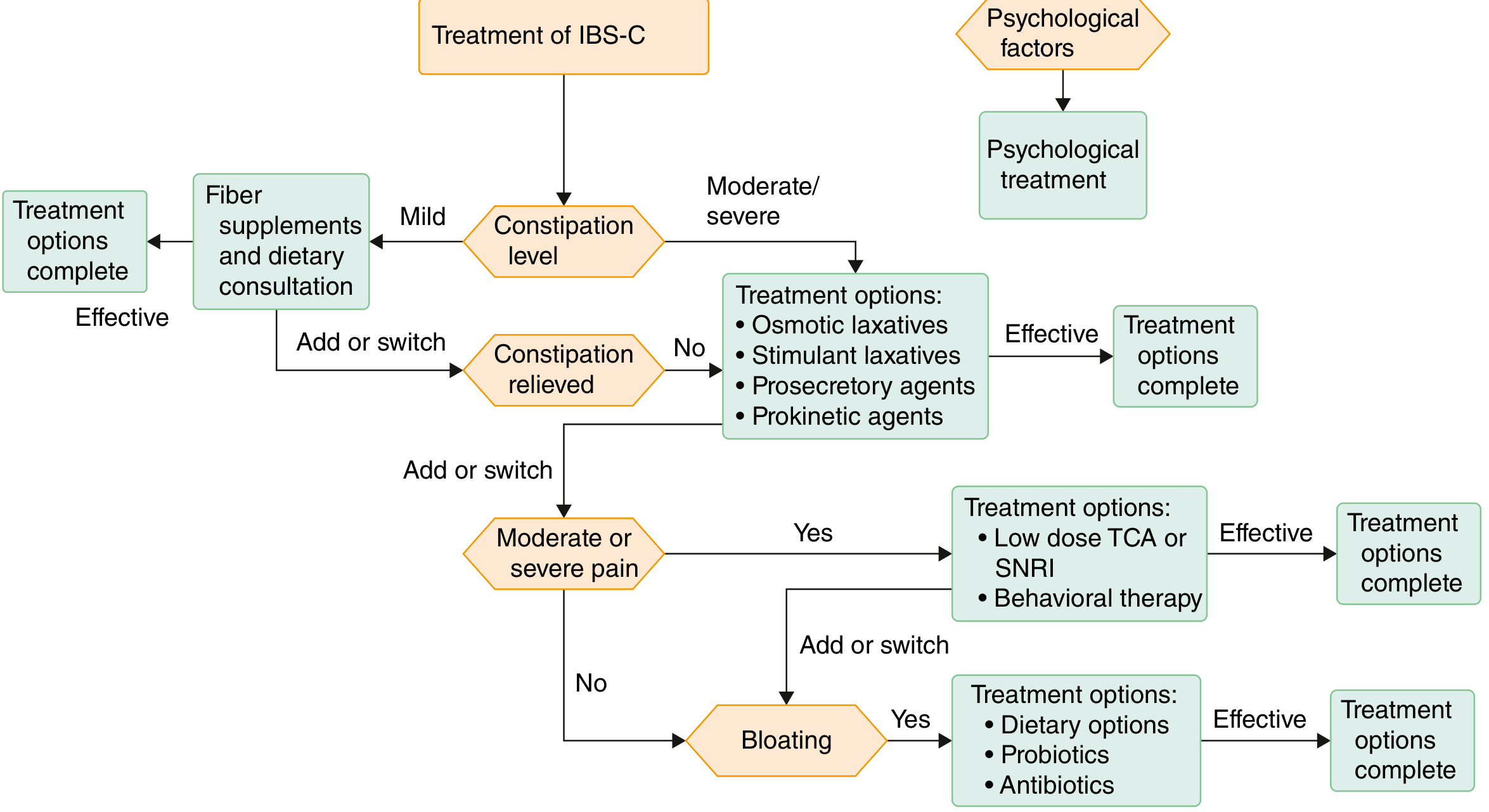
Step-up approach:
- Mild: Fiber supplements (soluble fiber preferred) + dietary consultation
- Moderate/severe: Osmotic laxatives → stimulant laxatives → prosecretory agents → prokinetics
- If pain persists: Low-dose TCA/SNRI + behavioral therapy
- If bloating persists: Dietary options, probiotics, antibiotics
| Drug | Dose | Mechanism |
|---|---|---|
| Polyethylene glycol (PEG) | 17 g in 125 mL water daily | Osmotic laxative |
| Lactulose | 10-40 g daily | Osmotic laxative |
| Lubiprostone | 8 µg twice daily | ClC-2 chloride channel activator (approved for women with IBS-C) |
| Linaclotide | 290 µg once daily | Guanylyl cyclase-C agonist → CFTR activation → chloride secretion |
| Plecanatide | 3 mg once daily | Guanylyl cyclase-C agonist (similar to linaclotide) |
| Tenapanor | 50 mg twice daily | NHE3 inhibitor; reduces sodium/water absorption |
| Tegaserod | 6 mg twice daily | 5-HT4 agonist; prokinetic - restricted to women <65 without cardiovascular history |
Linaclotide and plecanatide are contraindicated in pediatric patients. Lubiprostone is category C in pregnancy and should be used with caution in women of childbearing age. (Katzung, p. 1715)
4. IBS-D (Diarrhea-Predominant) - Treatment Algorithm
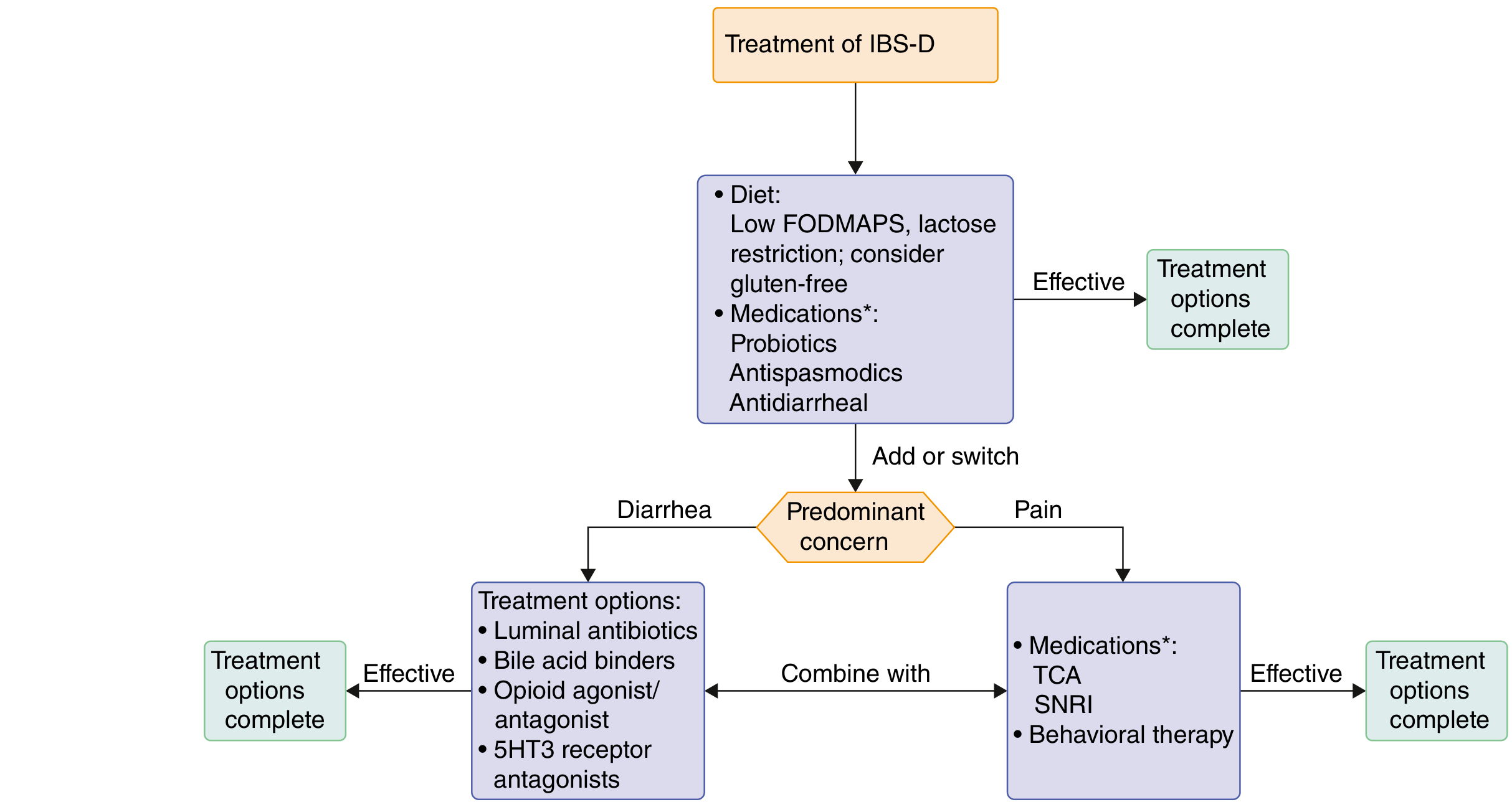
First-line: Low-FODMAP diet, lactose restriction, probiotics, antispasmodics, antidiarrheals
If inadequate response, branch by predominant concern:
For diarrhea control:
| Drug | Dose | Notes |
|---|---|---|
| Loperamide | 2 mg, up to 4 mg QID | Peripheral μ-opioid agonist; reduces stool frequency and urgency |
| Eluxadoline | 75-100 mg twice daily | Mixed μ/κ opioid agonist + δ antagonist; contraindicated without gallbladder, hepatic impairment, alcohol use disorder, pancreatitis |
| Rifaximin | 550 mg three times daily × 14 days | Minimally absorbed broad-spectrum antibiotic; can be retreated up to 3 courses |
| Alosetron | 0.5-1 mg twice daily | 5-HT3 antagonist; restricted to women with severe IBS-D failing conventional therapy due to risk of ischemic colitis (3/1000) and serious constipation |
| Bile acid sequestrants | (cholestyramine, colesevelam) | For patients with confirmed or suspected bile acid diarrhea |
For pain: TCAs, SNRIs, behavioral therapy (combine with diarrhea treatments as needed)
5. Summary: Drug Classes at a Glance
| Category | Agents | Subtype |
|---|---|---|
| Antispasmodics | Hyoscyamine, dicyclomine, peppermint oil | All/pain |
| Antidiarrheals | Loperamide | IBS-D |
| 5-HT3 antagonists | Alosetron | IBS-D (women, severe) |
| Opioid mixed | Eluxadoline | IBS-D |
| Antibiotics | Rifaximin | IBS-D |
| Bile acid binders | Cholestyramine, colesevelam | IBS-D (bile acid diarrhea) |
| Osmotic laxatives | PEG, lactulose | IBS-C |
| ClC-2 activators | Lubiprostone | IBS-C (women) |
| GC-C agonists | Linaclotide, plecanatide | IBS-C |
| NHE3 inhibitor | Tenapanor | IBS-C |
| 5-HT4 agonist | Tegaserod | IBS-C (women <65) |
| TCAs | Amitriptyline, desipramine, nortriptyline | Pain (all subtypes) |
| SSRIs | Citalopram, fluoxetine, sertraline | Pain/mood |
Key Clinical Points
- No single drug is universally effective; treatment must be tailored to the predominant symptom
- Psychological therapies are evidence-based and should be integrated, not reserved as a last resort
- Alosetron is tightly restricted to women with severe, refractory IBS-D given the risk of ischemic colitis
- Eluxadoline is contraindicated in patients without a gallbladder (risk of sphincter of Oddi dysfunction/pancreatitis)
- For IBS-C, expensive prosecretory agents (linaclotide, plecanatide) have not been compared head-to-head against cheaper osmotic laxatives
- An integrated multidisciplinary model (physician + dietitian + psychologist) is recommended for refractory cases
Sources: Katzung's Basic and Clinical Pharmacology, 16th ed., pp. 1714-1715; Goldman-Cecil Medicine, pp. 1419-1421
This is a shared conversation. Sign in to Orris to start your own chat.