
Role of TSH in thyroid hormone synthesis
Reading File
Finding Sources
Finding Sources
Searching Images
thyroid hormone synthesis pathway TSH receptor thyroid follicular cell diagram
Searching PubMed
"thyroid stimulating hormone" AND thyroid hormone synthesis
Reading File
Reading File
Role of TSH in Thyroid Hormone Synthesis
TSH (thyrotropin) is a 31-kDa glycoprotein hormone secreted by thyrotrope cells of the anterior pituitary. It sits at the center of the hypothalamic-pituitary-thyroid axis and is the principal driver of every major step in thyroid hormone (T4/T3) production - Harrison's Principles of Internal Medicine 22E, p. 2915-2921.
1. Upstream control
- The hypothalamus releases thyrotropin-releasing hormone (TRH), which stimulates the anterior pituitary to synthesize and secrete TSH.
- Circulating T4 and T3 feed back negatively on both TRH (hypothalamus) and TSH (pituitary) production, keeping thyroid hormone levels in a tight physiologic range - Medical Physiology, p. 2338; Katzung's Basic and Clinical Pharmacology, 16th Ed., p. 850-856.
2. Binding and signaling at the thyroid follicular cell
- TSH binds the TSH receptor (TSH-R) on the basolateral membrane of thyroid follicular cells (the cells that surround the colloid-filled follicles containing thyroglobulin).
- This activates an adenylyl cyclase-mediated (cAMP) signaling cascade inside the follicular cell - Katzung's Basic and Clinical Pharmacology, p. 850-856.
3. Effects TSH drives on hormone synthesis
Through this receptor signaling, TSH stimulates essentially every step of thyroid hormone biosynthesis:
- Iodide trapping: upregulates the sodium-iodide symporter (NIS) that actively transports iodide into the follicular cell - Tietz Textbook of Laboratory Medicine, 7th Ed. (this is also the classic exam point: TSH is the stimulus for iodide uptake).
- Organification: promotes iodination of tyrosine residues on thyroglobulin (Tg) via thyroid peroxidase (TPO), forming MIT/DIT, and their coupling into T4 and T3 within the Tg molecule stored in the colloid.
- Tg reabsorption and proteolysis: when hormone output is needed, TSH stimulates endocytosis of colloid Tg back into the follicular cell, where proteolysis releases free T4 and T3 for secretion into the bloodstream - Harrison's Principles of Internal Medicine 22E, p. 2915-2921.
- TSH also has trophic effects, promoting follicular cell growth and gland hypertrophy/hyperplasia with chronic stimulation (the basis of goiter in states of TSH excess).
4. Clinical correlate
Because TSH secretion responds inversely to circulating thyroid hormone levels, serum TSH is the most sensitive single marker of thyroid function: it rises in primary hypothyroidism (low T4/T3, loss of feedback inhibition) and falls in hyperthyroidism (high T4/T3) - Bailey and Love's Short Practice of Surgery, 28th Ed.
Summary flow:
TRH (hypothalamus) → TSH (anterior pituitary) → TSH-R on thyroid follicular cell basolateral membrane → cAMP signaling → increased NIS-mediated iodide uptake + TPO-mediated iodination/coupling on thyroglobulin + Tg reabsorption/proteolysis → release of T4 and T3 → negative feedback on TRH/TSH.
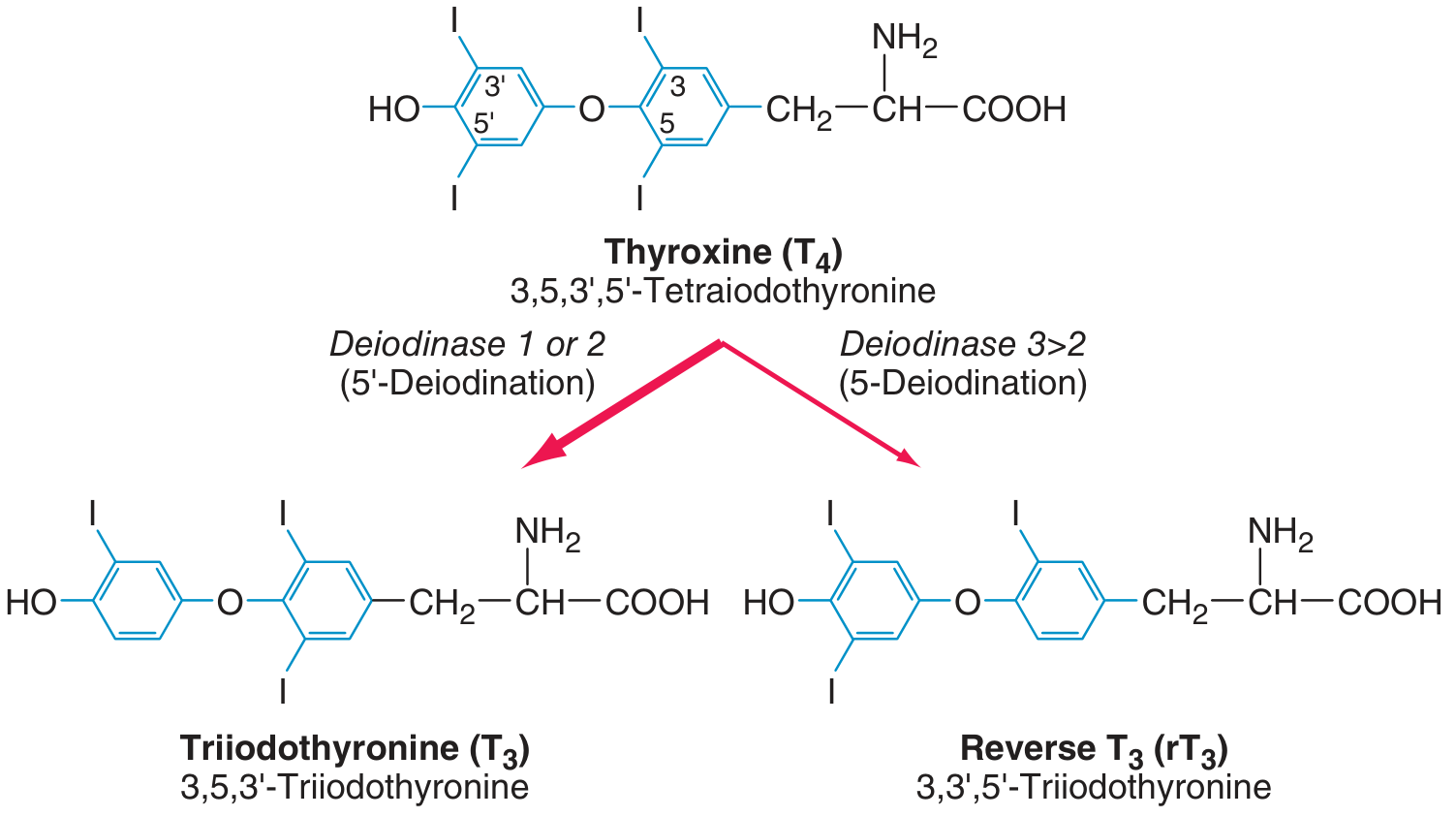
A relevant illustration from Harrison's shows the T4-to-T3/reverse-T3 deiodination pathway that determines hormone potency downstream of TSH-driven synthesis:
Note on recent literature: A 2024 systematic review/meta-analysis on TSHR gene polymorphism (rs179247) and autoimmune thyroid disease susceptibility (PMID: 39086275), and reviews on recombinant TSH use in thyroid cancer management (PMID: 38271262) and TSH suppression effects on cardiac structure (PMID: 38007181) exist, but these address clinical/genetic applications rather than contradicting the core physiology above - the fundamental synthesis pathway described is well-established and unchanged.
This is a shared conversation. Sign in to Orris to start your own chat.