
Clubbing grades
Reading File
Finding Sources
Searching Images
finger clubbing grades
Finding Sources
Reading File
Reading File
Reading File
Finding Sources
Finding Sources
Finding Sources
Reading File
Loading Image
Loading Image
Here is a comprehensive summary of the grading of finger clubbing:
Grades of Finger Clubbing
The most widely used grading system (Wynne-Davies / Curth / modified) classifies clubbing into 5 grades:
| Grade | Features |
|---|---|
| Grade 1 | Fluctuation and softening of the nail bed (increased nail bed fluctuancy); the nail feels "floating." Loss of Lovibond angle begins — the normal ~165° angle between the nail plate and proximal nail fold starts to flatten. |
| Grade 2 | Obliteration of the Lovibond angle (nail-fold angle = 180° or more). Loss of the diamond-shaped "Schamroth window" when matching fingers are placed together. Nail plate appears straightened. |
| Grade 3 | Increased convexity of the nail plate in both longitudinal and transverse axes. Bulbous, drumstick enlargement of the distal phalanx begins. Periungual tissues become shiny and erythematous. |
| Grade 4 | All of the above plus hypertrophic osteoarthropathy (HOA): periosteal new bone formation at distal long bones (radius, ulna, tibia, fibula), causing pain and swelling. Associated with advanced/severe disease. |
| Grade 5 (some classifications) | Features of grade 4 plus pachydermoperiostosis (thickening of the skin of the face, forehead, scalp; hypertrophy of extremities). |
Note: Some textbooks use a simpler 3-grade scale (mild / moderate / severe), while others describe only 4 grades. The 5-grade scale is common in surgical/clinical examination texts.
Key Diagnostic Signs Used in Grading
- Lovibond angle (normal ~165°): The angle between the nail plate and the proximal nail fold. In clubbing, this becomes ≥180°.
- Schamroth's window test: When matching fingers are placed dorsum-to-dorsum, a diamond-shaped window is normally visible at the nail base. Loss of this window = early clubbing (Grade 2).
- Profile sign (Wicki's sign): The profile of the nail curvature becomes abnormal in grade 3+.
- Nail-bed fluctuation: The earliest sign (Grade 1), detected by balloting the nail bed.
Causes Correlating with Grade
| Degree | Typical Causes |
|---|---|
| Lesser (Grade 1–2) | Carcinoma of the lung, pulmonary TB, Crohn's disease, ulcerative colitis, cirrhosis |
| Greater (Grade 3–4) | Cyanotic congenital heart disease, bronchiectasis, empyema, lung abscess, cystic fibrosis |
| With HOA | Bronchogenic carcinoma (most common), other intrathoracic malignancies, cystic fibrosis |
Key Points
- COPD does not cause clubbing — its presence in a COPD patient should raise suspicion for lung cancer.
- Clubbing can develop rapidly (~2 weeks) in empyema and reverse similarly after corrective cardiac surgery.
- Unilateral clubbing: consider ipsilateral vascular/neurological cause (arteriovenous fistula, brachial plexus invasion, hemiplegia).
- The main pathological mechanism is increased capillary density and vasodilation in the distal digit, driven by VEGF, PDGF, and hypoxia-inducible factors.
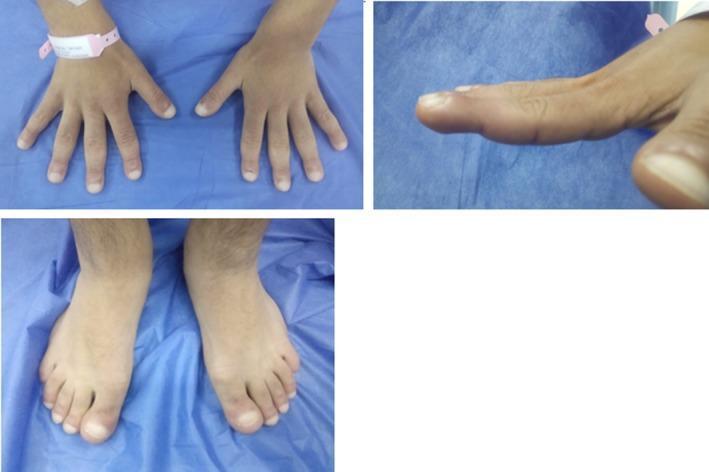
Clinical photograph showing grade 4 digital clubbing (Hippocratic fingers) with bilateral drumstick deformity and loss of Lovibond angle.
Sources: S Das - A Manual on Clinical Surgery 13th Ed; Fishman's Pulmonary Diseases; Murray & Nadel's Respiratory Medicine; Dermatology 2-Volume Set 5e
This is a shared conversation. Sign in to Orris to start your own chat.