I will provide you answer can you arrange it properly and systematically to write in exam if needed by adding points and reasoning by referring standard books
MY NO Formulation: L-T4 is available in oral formulation only Should be crushed & mixed in 1-2 ml of liquid Should not be administered along with soy milk, iron or calcium. Not needed to be given on empty stomach in children. Monitoring: TSH, serum T4 & T3 levels are monitored every 1-2 months in 1 6 months of life; every 3-4 months in 6months-3 years of age. Goals of treatment: Maintain TSH in the reference age, 13 & T4 levels in upper half of ref range. 35% of infants with normal location of thyroid gland have transient hypothyroidism. Prognosis: Prompt treatment is essential to prevent irreversible brain damage. Neonates treated after delay, have psychomotor impairment, hearing deficit, growth retardation. PEDIATRIC PULSE-EXAM NOTES here is the notes can you do it now after this I will send notes of acquired hypothyroidism
Congenital Hypothyroidism — Treatment & Prognosis
A. Drug of Choice
- Levothyroxine (L-T4) is the drug of choice for congenital hypothyroidism.
- It is a synthetic form of thyroxine (T4) that undergoes peripheral conversion to the active T3.
B. Formulation & Administration
| Point | Detail |
|---|---|
| Available form | Oral formulation only (tablet) |
| Preparation | Tablet must be crushed and mixed in 1–2 mL of liquid (breast milk or water) before administration |
| Timing | Need NOT be given on empty stomach in infants/children (unlike adults, where 30–60 min before meals is standard) |
| What to avoid | Do NOT administer with: soy milk, iron supplements, or calcium — all reduce absorption of L-T4 |
Reasoning: Soy, iron, and calcium bind to levothyroxine in the gut, reducing its bioavailability and causing under-treatment. In adults, empty-stomach dosing is advised, but this restriction is relaxed in children given practical feeding constraints (Katzung's Pharmacology, 16th ed.).
C. Monitoring
| Age Group | Monitoring Interval | Parameters |
|---|---|---|
| 0 – 6 months | Every 1–2 months | TSH, serum T4, serum T3 |
| 6 months – 3 years | Every 3–4 months | TSH, serum T4, serum T3 |
| > 3 years | Every 6–12 months | TSH, serum T4 |
Reasoning: The first 3 years of life represent the critical window of brain development. Frequent monitoring ensures the child is neither over- nor under-replaced, as both extremes are harmful during this period.
D. Goals of Treatment
- Maintain TSH within the age-specific reference range
- Maintain T3 and T4 levels in the upper half of the reference range
Rationale: Targeting the upper half of normal for T3/T4 ensures adequate hormone availability for ongoing neurodevelopment and myelination, while keeping TSH normal confirms appropriate pituitary feedback.
E. Special Note — Transient Hypothyroidism
- 35% of infants with a normally located thyroid gland on imaging have transient hypothyroidism
- These infants may ultimately not require lifelong therapy
- Re-evaluation is done at ~3 years of age by temporary withdrawal of L-T4
F. Prognosis
| Factor | Outcome |
|---|---|
| Early treatment (within 2 weeks of birth) | Near-normal intellectual and psychomotor development |
| Delayed treatment | Irreversible brain damage |
Consequences of Delayed/Untreated Congenital Hypothyroidism:
- Psychomotor impairment (intellectual disability, developmental delay)
- Hearing deficit (sensorineural)
- Growth retardation (short stature)
- Collectively known as Cretinism in severe untreated cases
Key Point for Exam: Congenital hypothyroidism is the most common preventable cause of intellectual disability — making newborn screening and prompt L-T4 initiation a public health priority.
Summary Box (Quick Recall)
| Drug | Levothyroxine (L-T4) oral |
| Preparation | Crushed + 1–2 mL liquid |
| Avoid | Soy, iron, calcium |
| Empty stomach | NOT required in children |
| Monitor 0–6 m | Every 1–2 months |
| Monitor 6m–3y | Every 3–4 months |
| TSH goal | Age-appropriate reference range |
| T3/T4 goal | Upper half of reference range |
| Transient CH | 35% with eutopic gland |
| Prognosis if delayed | Brain damage, growth failure, hearing loss |
Sorry here is the entire notes 04. HYPOTHYROIDISM MY NOTES Watch Video Lecture on RAAONLINE APP Specialty: Pediatrics Course: Endocrinology Faculty: Dr. Abinaya.K.A Duration: 31 mins Hypothyroidism: Insufficient circulating thyroid hormone, Deficient production due to defect in thyroid gland (primary). OR Reduced thyrotropin stimulation(TSH) (central or secondary). Congenital or aquired. Congenital Hypothyroidism: Causes: Most common cause: Thyroid Dysgenesis. (Hypoplastic (on Aplastic) Next: dyshormonogenesis. nonogenesis. (Synthetic defect in the Thyroid hormone synthesis) Mostly detected on newborn screening programmes. Severe cases only: manifests in 1" week of life. Epidemiology: 1 in 4000 infants worldwide. Etiologic Classification of Congenital Hypothyroidism: Primary hypothyroidism: Thyroid dysgenesis: hypothyrodism due to a developmental anomaly of thyroid gland (Thyroid ectopia, hypoplasia, hemiagenesis). Associated mutations: (These account for only 2% of thyroid * dysgenesis cases; 98%unknown). TTF-2, NKX2.1, NKX2.5, PAX-9. Thyroid dyshormonogenesis: hypothyroidism due to impaired hormone production. Associated mutations: Sodium-iodide symporter defect. Thyroid peroxidase defects. Hydrogen peroxide generation defects (DUOX2, DUOXA2 gene mutations). MY NOTES Pendrin defect (Pendred Syndrome). Thyroglobulin defect ⚫lodotyrosine deiodinase defect (DEHALI, SECISBP2 gene mutations). Resistance to TSH binding or signaling. Associated mutations: TSH Receptor Defect. G-protein mutation: pseudohypoparathyroidism type la. Central hypothyroidism (syn: Secondary hypothyroidism): Isolated TSH deficiency (TSH ẞ subunit gene mutation), pituitary is Thyrotropin-releasing hormone deficiency. Isolated, pituitary stalk interruption syndrome (PSIS), hypothalamic lesion, e,g hamartoma. hormom is releand but rezistent) Thyrotropin-releasing hormone resistance( TRH receptor gene mutation. Hypothyroidism due to deficient transaction factors involved in pituitary development or function. HESXI, LHX3, LHX4, PITI, PROPI gene mutations. Peripheral hypothyroidism: Thyroxin production where Resistance to Thyroid hormone. Thyroid receptor & mutation. Abnormalities of thyroid hormone transport. Allan- Herndon-Dudley syndrome (monocarboxylase transporter 8 (MCT8) gene mutation). Primary Hypothyroidism: Thyroid Dysgenesis: Most Common Cause (80-85%). 33% cases: no thyroid tissue- Agenesis. 64% cases: rudiments are present (Hypoplasia) or ectopic Location. M:F-2:1. Cause: unknown. Can be sporadic or familial. 342 unable to secrete The toy author hormons Some tres TSH dif defcunty (y prolack) at pititary Undu deuclopent 343 Genes Involved: NKX 2.1 (TTF1). FOXE 1 (TTF2) PAX 8. TSHR gene. GNAS (G protein stimulatory alpha subunit). LNKX 2.1: Expressed in thyroid, lung & CNS. Recessive mutations of NKX2.1 gene causes: thyroid dysgenesis, respiratory distress & chorea, ataxia. Despite early treatment. 2. FOXEI: Thyroid dysgenesis, spiky or curly hair, cleft palate. Choanal atresia, bifid epiglottis. BAMFORTH-LAZARUS syndrome. 3. TSHR gene: Elevated TSH levels but dean'i ad on thyroid 50 Ti Ty wil be low 4. GNAS: Pseudohypoparathyroidism Type la. Impaired signaling of the TSH receptor, Dyshormonogenesis: 15% of cases of congenital hypothyroidism. 1 in 30000-50000 live births. Recessive inheritance. GOITRE is almost always present. Types: Defective iodide transport. Pendred syndrome. Defects of iodide organification. Defects of thyroglobulin synthesis. →Defects in deiodination. Figure 1: Goitre in Congenital Hypothyroidism MY NOTES Thyroid development Derivative of foregue outpouching of forgur nar baseren Recom of Il descenas douin and and comes to be thyesid carstage and Thyrotropin reciating hormone (TRH) (polype hormone) secreted from Hypothalamus TSH (glycoprotein) purchas from ant-pitutary TRH and TSH Secretan begins at 10-12 wkI OF GA Thyroglobulin synthess begin at weeks of G Ts & Ty Synther begy at 12 weeks of GA Development and JH migration to Normal Site & mediated by Special transcription factors - NEX2-1, FOXE 1 and PAX 8 maturation of the hypothalamic-pituitary thepsid axis occuo Over the 2nd halt of gestation. but feedback relation an not mature Unta 1-3 monks of postnatal life- Thyroid Hormone Synthesis: Hypothalamic-Pituitary-Thyroid Axis Hypothalam Anterior Pituitary Gland Thyroid Chand ↓ Target Tissues Table 1: Thyroid hormone synthesis Process Step 1. TRH Release Hypothalamus releases TRH onto Anterior Pituitary 2. TSH Release Anterior Pituitary releases TSH onto Thyroid Gland Thyroglobulin Production Iodide Uptake Iodide Oxidation 3. Thyroid Hormone Synthesis Thyroglobulin Jodination MIT/DIT Coupling Thyroglobulin Proteolysis 4. Thyroid Hormone Release Thyroid Gland releases TH; TH circulates in blood Figure 2: Thyroid Hormone Synthesis Structure/Enzyme Involved Hypothalamus Anterior Pituitary Gland Thyroid Follicular Cells Sodium/iodide Symporter Thyroid Peroxidase (TPO) Thyroid Peroxidase (TPO) Thyroid Peroxidase (TPO) Protease ↓ Thyroxine-Binding Globulin (TBG) Thyroid Hormone Synthesis Pathway: Step 1: TSH binds to TSH receptors on thyroid follicular cells, which enhances thyroglobulin production in the follicular cell and release into the colloid of the follicle. Thyroid Hormone Synthesis Circulation -(Jodine) MY NOTES Jardine Jodide() Actten of T While entering cen cytoprasan Teronica Uting Jouthase T-metabolically Dit Tacts is t nucleus where Thyroid hormone produces Thyroid hormone response elemino (TRE) It franscription MRNA synisers of new proteing These new proteks prodie Varous metabol Effects in the Cas Tend to affeer grown, development of cel 344 Figure 3: Steps of Thyroid Hormone Synthesis. Details in the videos PEDIATRIC PULSE-EXAM NOTES ENDOCRINOLOGYHormona Svethesis Pathway Mep 2 7X11 increases the expression and activity of Na+/- Symporters, which increases iodide uptake from the blood into the thyroid follicular cell (lodide Trapping), lodide is transported imo the colloid via Pendrim. MY NOTES Thyrbit Hormone Synthesa H₂OL peroxide Thyroid Hormone Synthesis Pathway: Step 3: Thyroid peroxidase (TPO) oxidizes iodide into iodine (Iodide Oxidation). Thyroid Hormone Synthesis circulation Thyed foltich Colto of FOIECE 3 →→ Relean T 0 (Regulated by Tie) Thyroid Hormone Synthesis Pathway Step 4: Thyroid peroxidase (TPO) places iodine on thyroglobulin tyrosine amino acids (Organification or iodination) to form monoiodotyrosine (MIT) and diiodotyrosine (DIT). Thyroid Hormone Synthesis Jodination: Iothe + tyrosine present in ↓ combines to fom MIT MIT Coupling forms DIT lodide Sodian 345 Thyraid Hormone Synthesis Pathways Step 5: Thyroid perosidase (TPO) combines monoiodotyrosine (MIT) and diiodotyrosine (DIT) to form T3 and 14 (Coupling). Thyroid poruxidase has 3 roles: Oxidation, Jodination, Coupling (3 Stars) Thyroid Hormone Synthesi - Thyroid Hormone Synthesis Pathway: Step 6: Thyroglobulin with 13 and T4 bound to it,re-enters the thyroid follicular cell (Endocytosis) and 13 and T4 are cleaved using lysosomal proteases. Thyroid Hormone Synthesis Thyroid Hormone Synthesis Pathway: Step 7: 13 and T4 are released into the bloodstream where they act on target tissues. Most T3 and T4 is bound to thyroxine-binding globulin (TBG). 70-1. of Ty 50% of Ts Cliculating are bound to TBS 30% of Ti $ του of are bound to Albumin and/or pre albumin (Transthyretio) 346 Thyroid Hormone Synthesis Todide MY NOTES D2T+H27 about 11 to the Co receptor 210-12サッ greater affinity then Je of Ty it second by periphenet teve fo Using Jodotyrosine detodinase Type 112 This de Jodinen Conven active Brain (particulary Fitentary gland metabolically acha nem rich in Type 2 deod Entry of Ty and Ty in to car is fecititated by specifi thyroid hormone transporice sep cip. Mono Carboxylate Transpone (MCT-8) TBG is thyroid Tran protein which is predict by liver which came and back to 7, TGT ng protein e hormone levels inlood Free Tu-0-054 Free -0.3 Defective lodide Transport: MY NOTES Very rare disorder. Crused by mitations in sodium-indide symporter (NIS). Responsible for concentrating indide in thyroid gland NIS symporter Found in salivary gland also. Common in Japan. Uptake of radio iodine & pertechnetate is LOW This condition responds to large doses of potassium lodide, but Jevothyroxine is preferred. Pendred Syndrome: AR Sensorineural Deafness & Goiter. hypothymiduam Mutations in Pendringene. MOA: responsible for chloride iodide transport. PENDRIN transports iodide into the colloid, results in organification. Some patients only have deafness, normal thyroid dysfunction. Defects of lodide Organification: Most common type of thyroid hormone defect. TPO requires locally generated H₂O; & hematin (co factor) for organification. Marked discharge of radioactivity 2 hours after administration (40-90% as opposed to <10% in normal). Enzyme DUOX2 produces H₂O; DUOX 2 mutations cause permanent/transient hypothyroidism. 4.Defects of Thyroglobulin Synthesis: Goiter+. [TSH raponsible for Thyroglobulin synthers in the cal They also present & gaster] 5. Defects in deiodination: ⚫lodotyrosine deiodinase enzyme defect. Causes halt in peripheral conversion of Ty to Ty 6.Defects in thyroid hormone transport: Transport of thyroid hormone into cell facilitated by: MCTS. Thyrotropin Receptor Blocking Antibodies: 2% of cases of congenital hypothyroidism. Transplacentally acquired. PEDIATRIC PULSE-EXAM NOTES MY NOTES h/o maternal auto immune thyroiditis, similar h/o in siblings. USG: small thyroid. Radio iodine uptake: nil. Serum thyroglobulin level: LOW. Rx: levothyroxine. Spontaneous remission in 3-6 months. Radio Iodine Administration: Radio iodine mistakenly administered during pregnancy to mother. Fetal thyroid actively traps lodine by 70-75 days of gestation. Hence, iodine administration in women of child bearing age should be done after ruling out pregnancy. Iodine Exposure: Mothers taking excessive iodine (>12mg/day) as nutritional supplements or seaweed. Drugs Containing Iodine- amiodarone. It's a TRANSIENT phenomenon-resolves after discontinuation. Goiter+ Iodine Deficiency (Endemic Goiter): Most common cause of congenital hypothyroidism worldwide. RDA of lodine: 150micg/day. RDA during Pregnancy: 220 micg/day. Iodine deficiency in mothers cause: congenital hypothyroidism. Figure 4: Endemic Goitre Central (Secondary) Hypothryoidism: Developmental defects of pituitary or hypothalamus. 1 in 30000 LB. 75% of cases have multiple endocrine deficiencies. Either TSH deficiency or TRH receptor mutation. Various genes involved. Genes Involved: POUIFI mutation: deficiency of TSH + GH + Prolactin. PROPI mutation: deficiency of TSH + GH + Prolactin + FSH + LH. 348 ENDOCRINOLOGY HESXI mutation deficiency of TSH OH Prolactin + ACTH MY NOTES Inst) mutation: isolated TSH deficiency. Thyroid function in preterm & LBW: Postnatal TSH surge is less & Total serum T4 levels become normal by weeks of life: but FT4 is normal. Reasons: Immaturity of Hypothalamic-pituitary-thyroid axis. Maternal contribution of thyroid hormone is less. Illnesses needing steroids, dopamine. Clinical Features: of congenital Hypogeitum Asymptomatic at birth even in severe cases. Due to the transplacental transfer of maternal T4. Only identified through newborn screening program (TSH & T4 levels). Birth weight & length: Normal. Head size: mild increase (myxedema of brain). Posterior Fontanelle: >5mm. Prolonged jaundice (indirect). Sluggish cry. protruded tongu ↑ Feeding difficulties- macroglossia, choking spells. Respiratory difficulties- noisy respiration, nasal obstruction, apneic spells. Figure Sa: Newborn Screening for TSH & T4 Umbilical hernia is allo cean Constipation not responding to treatment. Sub normal temperature <35degree C. (Hypo-thermia) Systone teaturi CVS: cardiomegaly, heart murmurs, asymptomatic pericardial. effusion. Genital edema & edema of extremities. Slow Pulse. cold peripheries all thypothermin Macrocytic anemia. Hearing loss. Figure 5c: Features of Congenital Hypothyroidism If not treated at once, physical & mental development decreases. Short stature, short extremities, broad nasal bridge, swollen eyelids. Open mouth, delayed dentition, macroglossia. Newborn thyasd screening I establluted for all newborns world ande at 48 to 72 hor (DOL) Both TSt and Ty levels are coded to check Why on IDOL Tote am advised? dit gransplacental Tronifer of maremal Tu Figure 5b: Prolonged Jaundice If not diagnond and Reed Systemic symptoms stads Showing like cus INON PEDIATRIC PULSE-EXAM NOTES ENDOCRINOLOGY Short & thick neck. MY NOTES Fat deposits between neck & shoulders, Buffale homp Dry & scaly skin with little perspiration. General pallor with sallow complexion. Myxedema of eyelids, back of hands & external genitalia. Coarse, brittle & scanty hair. Hairline reaches far down on forehead. Development: Delay in both gross & fine motor. Lethargic infants. Hoarse voice. Speech delay. Sexual maturation is delayed. Thu seen in Chronically untreated congenital hypothymic Kocher-Debre-Semelaigne Syndrome: Usually muscles are hypotonic. Affected older children can have an athletic appearance. Generalized pseudo-hypertrophy. Particularly calf muscles. Males more common. Figure 6: Kocher-Debre-Semelaigne Syndrome Ectopic Thyroid: Produce normal thyroid levels for a variable period of time. So, remain euthyroid. Surgical removal results in hypothyroidism. Lab Findings: Newborn Screening. Day 2-5, heel prick method. Mostly, TSH measurement is done. Figure 7: Ectopic Thyroid Jdcally TSH and Ty levels should be accused Disadvantages: central hypothyroidism & some cases of primary congenital hypothyroidism. Some centers: measure T4 first, if its low then TSH is measured. 350 Normal Age Specific Values: MY NOTES Table 2 Age TSH (alU/mL) T4 (pg/dL) T3 (ng/dL) Free T4 1.0-17.4 7.4-13.0 15-75 (ng/dL) Cord blood 4 days 1.0-39.0 14.0-28.4 100-740 2.2-5.3 0.9-22 220 weeks 1.7-9.1 7.2-15.7 105-245 4.24 months 0.8-8.2 7.2-15.7 0923 105-269 0.8-1.8 2.7 years 0.7-5.7 6.0-14.2 94-241 1.0-2.1 9.20 years 0.7-5.7 4.7-12.4 80-210 0.8-1.9 21-45 years 0.4-4.2 5.3-10.5 70-204 0.9-2.5 TRH TSH secretion by activethadone Thyroid Gland Thyroid Specific Antibodies ↑ ↑ ↓ + ↓ - Thyroid Hormones ↓ ↓ Free T4 and T3 Figure 8: Primary & Secondary Hypothyroidism At Risk Groups: LBW. Prematurity. Trisomy
HYPOTHYROIDISM — CONGENITAL
Pediatric Endocrinology | Exam Notes
1. DEFINITION
- Primary: Defect in the thyroid gland itself
- Central (Secondary): Reduced TSH stimulation from pituitary/hypothalamus
2. EPIDEMIOLOGY
- Incidence: 1 in 4000 infants worldwide
- Most common endocrine disorder of infancy
- Most common preventable cause of intellectual disability
- Most cases are asymptomatic at birth → detected only by newborn screening
3. ETIOLOGIC CLASSIFICATION
A. Primary Hypothyroidism
i. Thyroid Dysgenesis (Most Common — 80–85% of cases)
- Developmental anomaly of the thyroid gland
- 33% — complete agenesis (no thyroid tissue)
- 64% — hypoplasia or ectopic location (rudimentary tissue)
- M:F = 2:1; mostly sporadic; cause largely unknown
| Gene | Effect |
|---|---|
| NKX2.1 (TTF1) | Thyroid dysgenesis + respiratory distress + chorea/ataxia |
| FOXE1 (TTF2) | Bamforth-Lazarus syndrome: dysgenesis + cleft palate + choanal atresia + spiky hair |
| PAX8 | Thyroid dysgenesis |
| TSHR gene | Elevated TSH, low T3/T4 (TSH receptor unresponsive) |
| GNAS | Pseudohypoparathyroidism Type Ia — impaired TSH receptor signaling |
Note: Gene mutations account for only 2% of dysgenesis cases; 98% are unknown.
ii. Thyroid Dyshormonogenesis (15% of cases)
- Incidence: 1 in 30,000–50,000 live births
- Autosomal recessive inheritance
- Goitre is almost always present
| Type | Defect |
|---|---|
| Defective iodide transport | NIS (sodium-iodide symporter) mutation; common in Japan |
| Pendred Syndrome | Pendrin gene mutation → AR sensorineural deafness + goitre |
| Iodide organification defect | TPO deficiency; most common type; >40% radioiodine discharge at 2h |
| Thyroglobulin synthesis defect | Goitre present |
| Deiodination defect | Iodotyrosine deiodinase enzyme defect → impaired T4→T3 conversion |
| Hormone transport defect | MCT8 gene mutation → Allan-Herndon-Dudley Syndrome |
TPO has 3 roles: Oxidation, Iodination (organification), Coupling
iii. Thyrotropin Receptor Blocking Antibodies
- ~2% of congenital hypothyroidism cases
- Transplacentally acquired from mothers with autoimmune thyroiditis
- History of similar condition in siblings
- USG: small thyroid; Radioiodine uptake: nil; Serum thyroglobulin: LOW
- Spontaneous remission in 3–6 months
- Treatment: Levothyroxine until remission
iv. Iodine-Related Causes
| Cause | Detail |
|---|---|
| Iodine deficiency | Most common cause worldwide (endemic goitre); RDA = 150 µg/day; in pregnancy = 220 µg/day |
| Excess iodine | Mothers taking >12 mg/day (seaweed, amiodarone) → transient; resolves on stopping |
| Radioiodine during pregnancy | Fetal thyroid traps iodine by 70–75 days of gestation — always rule out pregnancy before radioiodine |
B. Central (Secondary) Hypothyroidism
- Incidence: 1 in 30,000 live births
- 75% have multiple pituitary hormone deficiencies
- Cause: TSH deficiency or TRH receptor mutation
| Gene Mutation | Hormones Deficient |
|---|---|
| POU1F1 (PIT1) | TSH + GH + Prolactin |
| PROP1 | TSH + GH + Prolactin + FSH + LH |
| HESX1 | TSH + GH + Prolactin + ACTH |
| TSH β-subunit | Isolated TSH deficiency |
| TRH receptor | TRH resistance |
C. Peripheral Hypothyroidism
- Resistance to Thyroid Hormone — thyroid receptor β mutation
- MCT8 mutation → Allan-Herndon-Dudley Syndrome (impaired T3/T4 transport into cells)
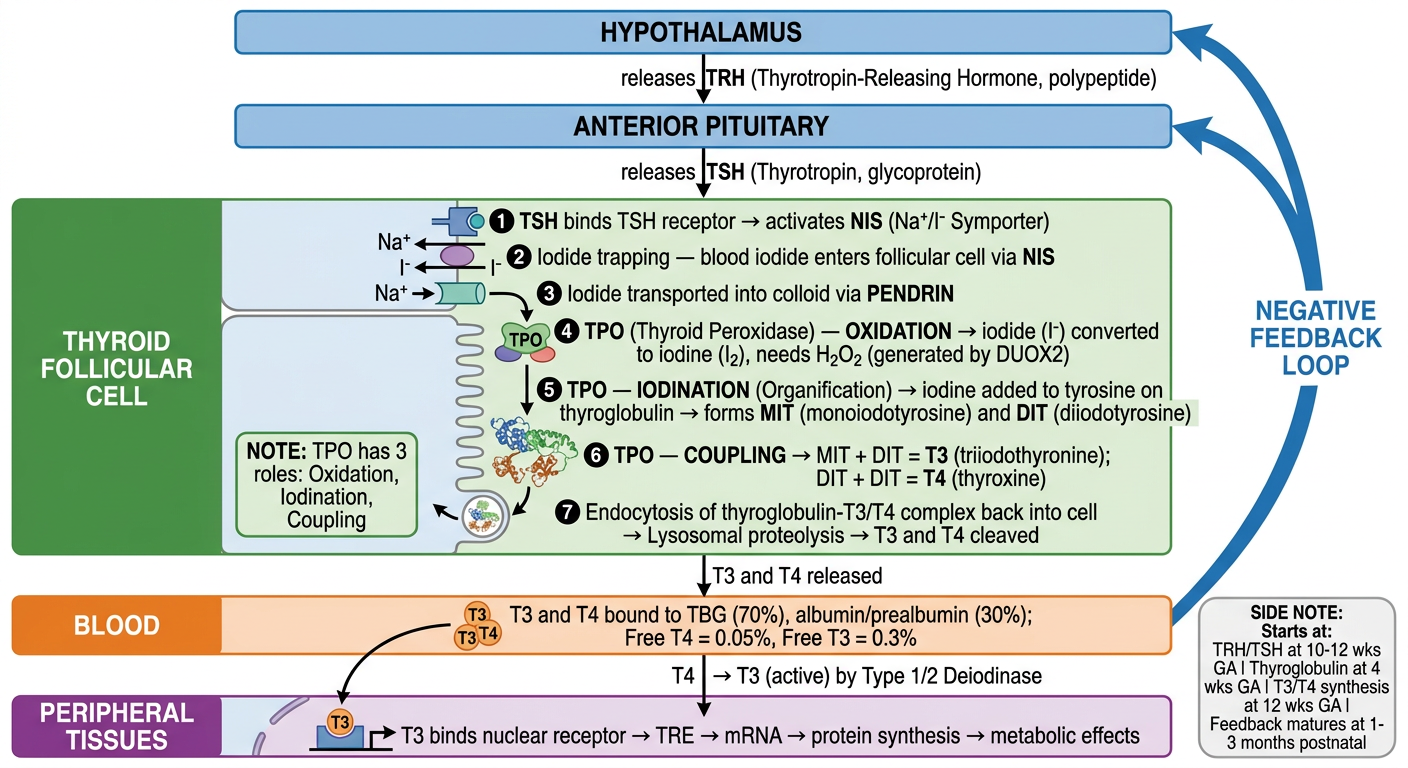
4. THYROID HORMONE SYNTHESIS — PATHWAY SUMMARY
| Step | Process | Enzyme/Structure |
|---|---|---|
| 1 | TRH released from hypothalamus | Hypothalamus |
| 2 | TSH released from anterior pituitary | Anterior pituitary |
| 3 | Iodide trapping into follicular cell | Na⁺/I⁻ symporter (NIS) |
| 4 | Iodide transport into colloid | Pendrin |
| 5 | Iodide oxidation → iodine | Thyroid Peroxidase (TPO) |
| 6 | Iodination of thyroglobulin → MIT, DIT | TPO |
| 7 | Coupling: MIT+DIT → T3; DIT+DIT → T4 | TPO |
| 8 | Endocytosis + proteolysis | Lysosomal proteases |
| 9 | T3/T4 released into blood; bound to TBG | TBG (70%), albumin/prealbumin (30%) |
TRH and TSH secretion begin at 10–12 weeks GA Thyroglobulin synthesis begins at 4 weeks GA; T3/T4 synthesis at 12 weeks GA Hypothalamic-pituitary-thyroid feedback is not mature until 1–3 months postnatal
5. THYROID HORMONE BINDING IN BLOOD
| Protein | T4 bound | T3 bound |
|---|---|---|
| TBG | 70% | 50% |
| Albumin/Prealbumin (Transthyretin) | 30% | remaining |
| Free T4 | 0.05% | — |
| Free T3 | 0.3% | — |
T3 has 10–12× greater affinity to receptor than T4; T4 is peripherally converted to T3 (active) by Type 1 & 2 deiodinases; Brain is rich in Type 2 deiodinase
6. THYROID FUNCTION IN PRETERM / LBW
- Postnatal TSH surge is blunted
- Total serum T4 becomes normal by 6 weeks of life; Free T4 is normal
- Reasons:
- Immature HPT axis
- Reduced maternal thyroid hormone contribution
- Illnesses requiring steroids or dopamine (suppress TSH)
7. CLINICAL FEATURES
A. At Birth (Mild / Asymptomatic)
- Birth weight and length: Normal
- Transplacental transfer of maternal T4 protects the neonate initially
B. Early Features (Days–Weeks)
| Feature | Mechanism |
|---|---|
| Prolonged indirect jaundice | Reduced hepatic conjugation |
| Posterior fontanelle >5 mm | Delayed ossification |
| Feeding difficulties, macroglossia, choking | Large tongue |
| Sluggish/hoarse cry | Myxedema of larynx |
| Constipation (not responding to treatment) | Reduced gut motility |
| Hypothermia (<35°C) | Reduced thermogenesis |
| Umbilical hernia | Abdominal wall muscle hypotonia |
| Respiratory difficulties (noisy, apneic spells) | Nasal obstruction, hypotonia |
| Genital/extremity edema | Myxedema |
| Slow pulse, cold peripheries | Reduced cardiac output |
| Macrocytic anemia | Reduced erythropoiesis |
| Asymptomatic pericardial effusion, cardiomegaly | Myxedema |
| Hearing loss | Cochlear myxedema |
C. If Untreated — Later Features
| Feature | Detail |
|---|---|
| Short stature, short extremities | Growth failure |
| Broad nasal bridge, swollen eyelids | Myxedema |
| Delayed dentition, open mouth | Macroglossia |
| Short & thick neck | Fat deposition |
| Buffalo hump | Fat deposits between neck and shoulders |
| Dry, scaly skin; sparse brittle hair | Hypothyroid skin changes |
| Low hairline on forehead | Classic feature |
| Delayed gross & fine motor development | Neurological |
| Speech delay, hoarse voice | Neurological |
| Lethargy | CNS depression |
| Delayed sexual maturation | Hypothalamic-pituitary effects |
D. Kocher-Debre-Semelaigne Syndrome
- Seen in chronically untreated congenital hypothyroidism
- Muscles usually hypotonic, but older children show athletic appearance
- Generalized pseudo-hypertrophy, especially calf muscles
- More common in males
E. Ectopic Thyroid
- May produce near-normal thyroid hormone for variable period → child remains euthyroid
- Surgical removal → hypothyroidism
8. LAB DIAGNOSIS
A. Newborn Screening
- Done at 48–72 hours of life (Day 2–5), heel-prick blood
- Screening at 48–72h (not at birth) because transplacental maternal T4 masks early deficiency
- Ideal: Measure both TSH and T4
- Most centers: Measure TSH first; if elevated → measure T4
- Limitation: Primary TSH screening misses central hypothyroidism
B. Normal Age-Specific Values
| Age | TSH (mIU/mL) | T4 (µg/dL) | T3 (ng/dL) | Free T4 |
|---|---|---|---|---|
| Cord blood | 1.0–17.4 | 7.4–13.0 | 15–75 | — |
| 4 days | 1.0–39.0 | 14.0–28.4 | 100–740 | 2.2–5.3 |
| 2–20 weeks | 1.7–9.1 | 7.2–15.7 | 105–245 | — |
| 4–24 months | 0.8–8.2 | 7.2–15.7 | 105–269 | 0.8–1.8 |
| 2–7 years | 0.7–5.7 | 6.0–14.2 | 94–241 | 1.0–2.1 |
| 9–20 years | 0.7–5.7 | 4.7–12.4 | 80–210 | 0.8–1.9 |
| Adults (21–45y) | 0.4–4.2 | 5.3–10.5 | 70–204 | 0.9–2.5 |
C. Primary vs. Secondary Hypothyroidism
| Parameter | Primary | Secondary (Central) |
|---|---|---|
| TSH | ↑ (High) | ↓ (Low) |
| T4 / Free T4 | ↓ | ↓ |
| Thyroid antibodies | + (if autoimmune) | − |
| TRH stimulation | ↑ TSH response | Blunted/absent |
D. At-Risk Groups for Screening
- Low birth weight (LBW)
- Prematurity
- Trisomy 21 (Down syndrome)
9. TREATMENT
A. Drug of Choice
B. Formulation & Administration
| Point | Detail |
|---|---|
| Form | Oral tablet — crush and mix in 1–2 mL of liquid |
| Timing | Not required on empty stomach in children (unlike adults) |
| Avoid co-administration with | Soy milk, iron, calcium (reduce absorption) |
C. Monitoring
| Age | Frequency | Parameters |
|---|---|---|
| 0–6 months | Every 1–2 months | TSH, T4, T3 |
| 6 months–3 years | Every 3–4 months | TSH, T4, T3 |
| >3 years | Every 6–12 months | TSH, T4 |
D. Goals of Treatment
- Maintain TSH within age-specific reference range
- Maintain T3 and T4 in the upper half of the reference range
Targeting upper half of normal for T4 ensures adequate substrate for brain myelination and neurodevelopment during the critical window.
10. SPECIAL POINT — TRANSIENT HYPOTHYROIDISM
- 35% of infants with a normally located (eutopic) thyroid have transient hypothyroidism
- Re-evaluate at ~3 years of age by temporary L-T4 withdrawal
- If TSH remains normal off treatment → transient; discontinue therapy
11. PROGNOSIS
| Scenario | Outcome |
|---|---|
| Treatment within first 2 weeks of life | Near-normal intellectual and physical development |
| Delayed treatment | Irreversible brain damage |
Consequences of Delayed/Untreated Disease:
- Psychomotor impairment (intellectual disability)
- Sensorineural hearing deficit
- Growth retardation (short stature, skeletal dysmaturity)
- Cretinism — severe untreated congenital hypothyroidism
Prompt treatment is the single most critical factor in determining neurological outcome.
Quick Recall Box
| Most common cause | Thyroid dysgenesis (80–85%) |
| Most common cause worldwide | Iodine deficiency |
| Incidence | 1 in 4000 |
| Key screening time | 48–72 hours (heel prick) |
| Drug | Levothyroxine (L-T4) oral |
| Avoid with L-T4 | Soy, iron, calcium |
| Monitor 0–6m | Every 1–2 months |
| Monitor 6m–3y | Every 3–4 months |
| T3/T4 target | Upper half of reference range |
| Transient CH | 35% with eutopic gland |
| Pseudo-hypertrophy syndrome | Kocher-Debre-Semelaigne |
| Key prognosis factor | Early treatment = normal brain development |
Make a flowchart for thyroid hormone synthesis pathway for quick recall
A clean, detailed medical flowchart for thyroid hormone synthesis pathway for medical student exam quick recall. The flowchart should flow top to bottom with labeled boxes and arrows showing: 1. HYPOTHALAMUS → releases TRH (Thyrotropin-Releasing Hormone, polypeptide) 2. ANTERIOR PITUITARY → releases TSH (Thyrotropin, glycoprotein) — negative feedback loop arrow from T3/T4 back to hypothalamus and pituitary 3. THYROID FOLLICULAR CELL block containing sequential steps: Step 1: TSH binds TSH receptor → activates NIS (Na+/I- Symporter) Step 2: Iodide trapping — blood iodide enters follicular cell via NIS Step 3: Iodide transported into colloid via PENDRIN Step 4: TPO (Thyroid Peroxidase) — OXIDATION → iodide (I-) converted to iodine (I2), needs H2O2 (generated by DUOX2) Step 5: TPO — IODINATION (Organification) → iodine added to tyrosine on thyroglobulin → forms MIT (monoiodotyrosine) and DIT (diiodotyrosine) Step 6: TPO — COUPLING → MIT + DIT = T3 (triiodothyronine); DIT + DIT = T4 (thyroxine) Note box: "TPO has 3 roles: Oxidation, Iodination, Coupling" Step 7: Endocytosis of thyroglobulin-T3/T4 complex back into cell → Lysosomal proteolysis → T3 and T4 cleaved 4. BLOOD: T3 and T4 released → bound to TBG (70%), albumin/prealbumin (30%); Free T4 = 0.05%, Free T3 = 0.3% 5. PERIPHERAL TISSUES: T4 → T3 (active) by Type 1/2 Deiodinase; T3 binds nuclear receptor → TRE → mRNA → protein synthesis → metabolic effects 6. Negative feedback arrow from T3/T4 back up to hypothalamus and pituitary Include a small side note box: "Starts at: TRH/TSH at 10-12 wks GA | Thyroglobulin at 4 wks GA | T3/T4 synthesis at 12 wks GA | Feedback matures at 1-3 months postnatal" Use a white background, color-coded sections (blue for hypothalamus/pituitary axis, green for thyroid follicular cell steps, orange for blood transport, purple for peripheral conversion), bold labels, clean sans-serif font, medical textbook style diagram with clear arrows.