
All types of viva questions with answers from the chapter of epidemiology.
Reading File
Finding Sources
Park's Preventive and Social Medicine is in the library. Let me search the epidemiology chapters.
Finding Sources
Finding Sources
Reading File
Reading File
Reading File
Reading File
Reading File
Reading File
Reading File
Reading File
Reading File
Reading File
Reading File
Reading File
I now have comprehensive content from Park's Epidemiology chapter. Let me compile a thorough viva Q&A.
Reading File
Reading File
I now have extensive content from Park's textbook on epidemiology. Let me compile the comprehensive viva Q&A response.
Viva Questions and Answers: Epidemiology
(Based on Park's Textbook of Preventive and Social Medicine)
SECTION 1: DEFINITION AND BASICS
Q1. What is epidemiology? Give the IEA definition.
A. Epidemiology is defined as: "The study of the occurrence and distribution of health-related events, states, and processes in specified populations, including the study of the determinants influencing such processes, and the application of this knowledge to control relevant health problems."
- Study includes surveillance, observation, screening, hypothesis testing, analytic research, experiments, and prediction.
- Distribution = analysis by time, place, and population.
- Determinants = geophysical, biological, behavioural, social, cultural, economic, and political factors influencing health.
Q2. What is the derivation/etymology of the word "epidemiology"?
A. The word is derived from Greek: epi (among) + demos (people) + logos (study). It originally referred to the study of epidemics. The Epidemiological Society in London was founded in the 1850s.
Q3. Who gave early definitions of epidemiology?
A.
- Parkin (1873): "That branch of medical science which treats epidemics."
- Frost (1927): "The science of the mass phenomena of infectious diseases."
- Greenwood (1934): "The study of disease, any disease, as a mass phenomenon."
- MacMahon (1960): "The study of the distribution and determinants of disease frequency in man."
Q4. Who was the first professor of epidemiology?
A.
- In the USA: W.H. Frost (1927)
- In the UK: Major Greenwood - first professor of epidemiology and medical statistics, University of London.
Q5. What are the three aims of epidemiology according to IEA?
A.
- To describe the distribution and magnitude of health and disease problems in human populations.
- To identify aetiological factors (risk factors) in the pathogenesis of disease.
- To provide data essential for planning, implementation, and evaluation of health services, and setting priorities.
The ultimate aim is to lead to effective action - to eliminate/reduce health problems and to promote health and well-being of society as a whole.
Q6. How does epidemiology differ from clinical medicine?
A.
| Feature | Epidemiology | Clinical Medicine |
|---|---|---|
| Unit of study | Defined population / population at-risk | Individual case/cases |
| Concern | Disease patterns in the entire population (both sick and healthy) | Disease in the individual patient |
| Expression | Rate (cases : population) | Diagnosis, prognosis, treatment |
"Clinicians are interested in cases with the disease, the statistician with the population from which the cases are derived, and the epidemiologist is interested in the relationship between cases and the population in the form of a rate."
SECTION 2: SCOPE AND MEASUREMENTS
Q7. What are the three scopes/approaches of epidemiology?
A.
- Descriptive epidemiology - distribution of disease (who, when, where)
- Analytical epidemiology - determinants of disease (test hypotheses)
- Experimental epidemiology - intervention studies (control/prevention)
Q8. What are the basic measurements in epidemiology?
A. The scope is broad and includes:
a. Measurement of mortality
b. Measurement of morbidity
c. Measurement of disability
d. Measurement of natality
e. Presence/absence/distribution of disease characteristics
f. Measurement of medical needs, health care facilities, utilization of health services
g. Presence/absence of environmental factors suspected of causing disease
h. Measurement of demographic variables
Q9. What are the basic tools of measurement in epidemiology?
A. Three basic tools:
- Rates
- Ratios
- Proportions
Basic requirements of measurements: Validity, reliability, accuracy, sensitivity, and specificity.
Q10. Define a RATE. What are its components?
A. A rate measures the occurrence of a particular event (development of disease or death) in a defined population during a given time period. It is a statement of the risk of developing a condition.
Components of a rate:
- Numerator - number of events
- Denominator - population at risk
- Time specification - usually a calendar year
- Multiplier - per 1000 or 10,000 or 100,000 (to avoid fractions)
Example: Death rate = (Number of deaths in one year ÷ Mid-year population) × 1000
Categories of rates:
- Crude rates - actual observed rates; also called unstandardized rates (e.g., birth rate, death rate)
- Specific rates - rates for specific causes, age-sex groups, or time periods
- Standardized rates - obtained by direct or indirect standardization (e.g., age-sex standardized rates)
Q11. Define RATIO. How does it differ from a rate?
A. A ratio expresses a relation in size between two random quantities. The numerator is NOT a component of the denominator. It is written as x:y or x/y.
Examples:
- Sex ratio
- Doctor-population ratio
- WBC : RBC = 1 : 600
Q12. Define PROPORTION.
A. A proportion is a type of ratio in which the numerator is included in the denominator. It expresses the relationship of a part to a whole. It is usually expressed as a percentage.
Q13. What is Case Fatality Rate? What does it represent?
A.
- CFR = (Total deaths due to a disease ÷ Total cases of the same disease) × 100
- Represents the killing power of a disease
- It is a ratio (not a true rate) since time interval is not specified
- Useful in acute infectious diseases (cholera, food poisoning, measles)
- Limited usefulness in chronic diseases due to long, variable onset-to-death period
- Closely related to virulence of the agent
Q14. What is Proportional Mortality Rate (PMR)?
A. PMR expresses the number of deaths due to a particular cause (or in a specific age group) per 100 (or 1000) total deaths.
(a) PMR from specific disease = (Deaths from specific disease in a year ÷ Total deaths from all causes) × 100
(b) Under-5 proportionate mortality rate = (Deaths under 5 years ÷ Total deaths) × 100
(c) PMR for ≥50 years = (Deaths ≥50 years ÷ Total deaths of all ages) × 100
Limitations: Proportional rates are used when population data are not available. Since both numerator and denominator may differ, they are of limited value for comparisons between populations or time periods.
SECTION 3: EPIDEMIOLOGICAL TRIANGLE & CAUSATION
Q15. What is the "Triangle of Epidemiology"? Describe its components.
A. The traditional triangle of epidemiology (also called the epidemiological triad) shows the interaction and interdependence of agent, host, environment, and time in disease investigation.
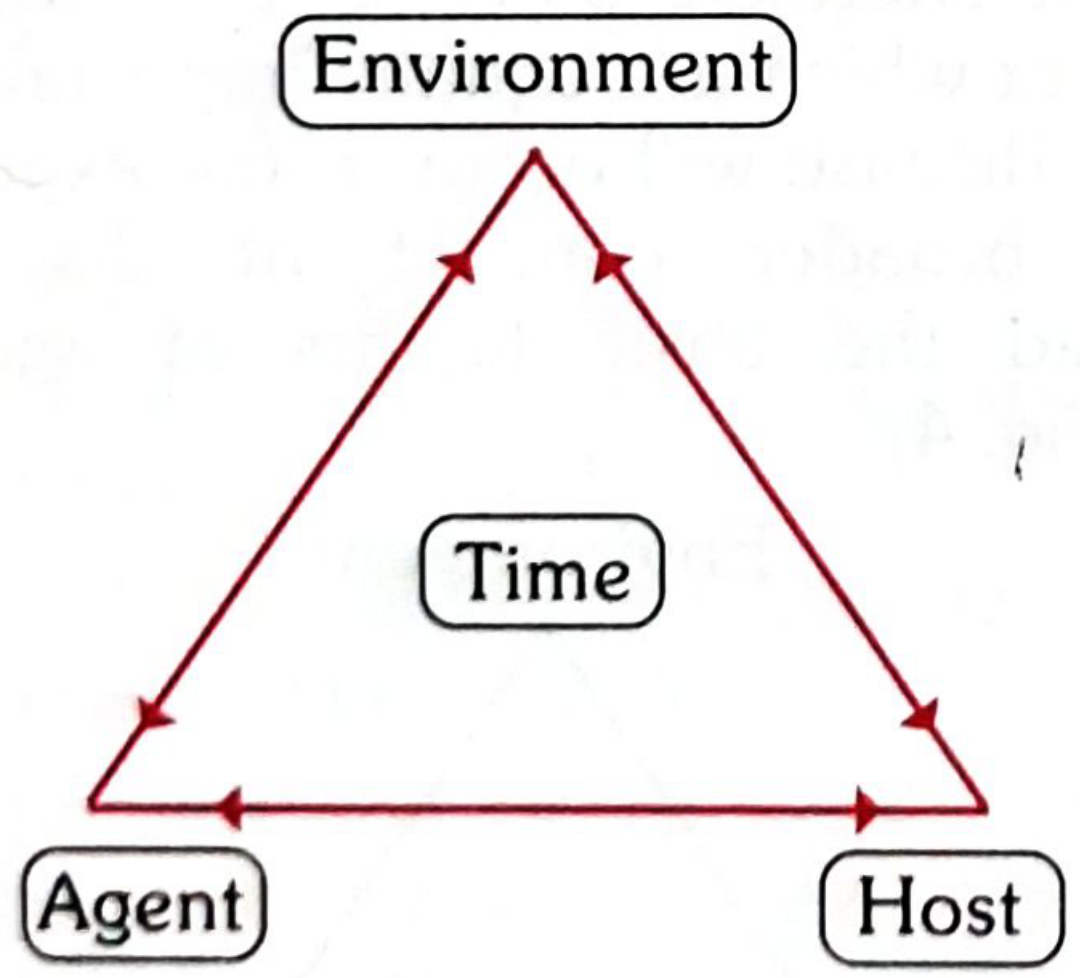
- Agent - cause of disease (bacteria, viruses, chemicals, radiation, nutritional deficiencies)
- Host - organism harbouring the disease; immunity, genetics, exposure level, and health status determine disease effect
- Environment - biological, social, cultural, physical surroundings; can be within or external to the host
- Time - incubation periods, duration of illness, epidemic threshold, life expectancy of host/pathogen
Primary mission: Break one leg of the triangle to disrupt the connection among agent, host, and environment, thereby stopping the outbreak.
Q16. What is the concept of multifactorial causation?
A. Disease is caused by multiple factors, not a single cause. Pettenkofer of Munich (1819-1901) was an early proponent. The "germ theory" / "single cause idea" of the late 19th century later overshadowed this concept. With the decline of communicable diseases and rise of chronic diseases (CVD, cancer, mental illness), the multifactorial concept became dominant again.
SECTION 4: DESCRIPTIVE EPIDEMIOLOGY
Q17. What is descriptive epidemiology?
A. Descriptive studies are usually the first phase of epidemiological investigation. They are concerned with observing the distribution of disease or health-related characteristics in human populations and identifying characteristics with which the disease seems to be associated.
They answer three basic questions:
- When is the disease occurring? - Time distribution
- Where is it occurring? - Place distribution
- Who is getting the disease? - Person distribution
Q18. What are the procedures in descriptive studies?
A.
- Defining the population to be studied
- Defining the disease under study
- Describing the disease by time, place, person
- Measurement of disease
- Comparing with known indices
- Formulation of an aetiological hypothesis
Q19. What are the uses of descriptive epidemiology?
A.
a. They can suggest aetiological hypotheses - existence of possible causal association between a factor and a disease is usually first recognized in descriptive studies.
b. If disease is more frequent in a particular group, hypotheses are formulated to explain the increased frequency.
c. Provide background data for planning, organizing, and evaluating preventive and curative services.
d. Contribute to research by describing variations in disease occurrence by time, place and person.
SECTION 5: ANALYTICAL EPIDEMIOLOGY
Q20. What is analytical epidemiology?
A. Analytical studies are the second major type of epidemiological studies. In contrast to descriptive studies (which look at entire populations), analytical studies evaluate the individual within the population. The object is not to formulate, but to TEST hypotheses.
Two distinct types:
- Case Control Study
- Cohort Study
From each, one can determine:
a. Whether or not a statistical association exists between a disease and a suspected factor.
b. If one exists, the strength of the association.
Q21. What is a Case Control Study? What are its basic steps?
A. Case control studies, often called "retrospective studies", are a common first approach to testing causal hypotheses. They begin with people who already have the disease (cases) and a comparison group without the disease (controls), then look backwards to identify exposures.
Basic steps:
- Selection of cases and controls
- Matching
- Measurement of exposure
- Analysis and interpretation
2×2 contingency table:
| Cases (Disease +) | Controls (Disease -) | |
|---|---|---|
| Exposed (factor present) | a | b |
| Not exposed (factor absent) | c | d |
| Total | a+c | b+d |
Key association test: If frequency of exposure in cases [a/(a+c)] is higher than in controls [b/(b+d)], an association exists.
Major use: Chronic disease problems where the causal pathway may span many decades (e.g., cancer).
Q22. What is a Cohort Study? Give examples.
A. A cohort study is a prospective (forward-looking) observational study. A group of people (cohort) without the disease of interest is followed over time, and disease development is compared between those exposed and not exposed to a risk factor.
Types of comparison groups:
- (a) Internal comparisons - single cohort classified by levels of exposure (e.g., cigarettes per day)
- (b) External comparisons - exposed group vs. separate control cohort (e.g., smokers vs. non-smokers)
- (c) Comparison with general population rates - using standard mortality ratios
Classic examples:
- Doll and Hill's study on smoking and lung cancer in British doctors
- Framingham Heart Study (1948) - studied serum cholesterol, BP, weight, smoking vs. cardiovascular disease; followed 5,127 participants every 2 years for 20 years; showed increasing risk of CHD with rising serum cholesterol and smoking; became a prototype of similar studies worldwide
- Royal College of General Practitioners' study (1968-1974) on oral contraceptives and health - 23,000 pill users + 23,000 controls; showed increased risk of hypertension and increased cardiovascular mortality in pill users
SECTION 6: EXPERIMENTAL EPIDEMIOLOGY
Q23. What is experimental epidemiology?
A. In modern usage, experimental epidemiology is often equated with Randomized Controlled Trials (RCTs).
Experimental/intervention studies are similar to cohort studies except that the conditions are under direct control of the investigator. They involve some action, intervention, or manipulation in the experimental group, while no change is made in the control group. This contrasts with observational studies where the epidemiologist only observes.
Aims:
a. To provide "scientific proof" of aetiological/risk factors which may permit modification or control of disease.
b. To measure the effectiveness and efficiency of health services for prevention, control, and treatment of disease.
Additional problems compared to observational studies: Cost, ethics, and feasibility.
Q24. What is the role of animal studies in experimental epidemiology?
A. Animal experiments contribute to:
a. Experimental reproduction of human disease in animals to confirm aetiological hypothesis
b. Testing efficacy of preventive and therapeutic measures (vaccines, drugs)
c. Completing the natural history of disease (e.g., naturally occurring leprosy found in armadillos)
Advantages: Animals can be bred and manipulated easily; multiply rapidly enabling genetic experiments.
Limitations: Not all human diseases can be reproduced in animals; conclusions may not be directly applicable to humans. Classic example: WHO typhoid vaccine trial in Yugoslavia showed that animal findings did not translate to humans - the alcohol-preserved vaccine was found to be less than half as effective as the traditional phenol-preserved vaccine in humans, contrary to laboratory evidence.
SECTION 7: USES OF EPIDEMIOLOGY
Q25. What are the uses of epidemiology? (Morris's 7 uses)
A. Morris (1957) identified seven uses of epidemiology:
-
Study historically the rise and fall of disease in the population - studying disease profiles and time trends to make projections; identify emerging health problems (e.g., smallpox eradicated, AIDS identified)
-
Community diagnosis - identification and quantification of health problems in a community in terms of mortality and morbidity rates; determining the relative magnitude of various health problems
-
Working of health services - evaluation of adequacy, efficiency, and effectiveness of health services
-
Individual risks and chances - probability that an individual will fall ill or die of a particular disease given their characteristics (risk factors)
-
Completing the clinical picture - description of the natural history of disease; includes subclinical, mild, and severe cases that the clinician may not encounter
-
Identification of syndromes - defining clinical entities by determining groups of symptoms/signs that tend to occur together
-
Search for causes - identifying risk factors; determining the role of various factors in disease causation (the central use of analytical epidemiology)
SECTION 8: INFECTIOUS DISEASE EPIDEMIOLOGY - KEY TERMINOLOGY
Q26. Define the following terms: Epidemic, Endemic, Pandemic, Sporadic.
A.
| Term | Definition |
|---|---|
| Epidemic | An unusual occurrence (greater than expected) of a disease in a community or region above the normal expected level |
| Endemic | The constant presence of a disease or infectious agent within a given geographic area or population group; also the usual prevalence of a given disease in such area |
| Pandemic | An epidemic occurring worldwide or over a very wide area, crossing international boundaries and usually affecting a large number of people (e.g., COVID-19, influenza) |
| Sporadic | Occurring irregularly, without any definite pattern; only occasional cases |
Q27. What is Herd Immunity?
A. Herd immunity (community immunity) is the resistance of a group to attack by a disease to which a large proportion of the members of the group are immune. When a sufficient proportion of the population is immune (either through vaccination or natural infection), the chain of transmission is broken, protecting even non-immune individuals.
Q28. What is a Zoonosis? Define related terms.
A.
- Zoonosis - A disease or infection naturally transmitted between vertebrate animals and humans (e.g., Trypanosoma cruzi, Schistosoma japonicum)
- Epizootic - An outbreak (epidemic) of disease in an animal population (may also affect humans). Notable: anthrax, brucellosis, rabies, influenza, Rift Valley fever, Q fever, Japanese encephalitis
- Epornithic - An outbreak of disease in a bird population
- Enzootic - An endemic occurring in animals (e.g., anthrax, rabies, brucellosis, bovine TB)
Q29. What is a Nosocomial Infection?
A. Nosocomial (hospital-acquired) infection is an infection originating in a patient while in a hospital or other health care facility. Key features:
- It is a new disorder, unrelated to the primary condition
- Was not present or incubating at admission, or is a residual from a previous admission
- Includes infections acquired in hospital but appearing after discharge
- Also includes infections among hospital staff
Examples: Surgical wound infections, hepatitis B, urinary tract infections.
Q30. What is an Opportunistic Infection?
A. Infection with organisms that are normally innocuous (e.g., commensals) but become pathogenic when the body's immunological defenses are compromised, as in AIDS.
Q31. What is Iatrogenic Disease?
A. Literally means "doctor-generated." Broadly refers to adverse effects of preventive, diagnostic, therapeutic, surgical, or other medical/public health procedures or interventions. The process through which a professional activity generates an adverse health effect.
SECTION 9: CAUSAL ASSOCIATION AND CRITERIA
Q32. What is biological plausibility in establishing causation?
A. Biological plausibility means the proposed causal association is consistent with known biological or pathophysiological mechanisms. For example, in the smoking-lung cancer hypothesis, it is biologically plausible to visualize inhalation of hot smoke and deposition of chemical carcinogens over time building up to a threshold and initiating neoplastic changes. Experimental animal studies have also shown lung cancer can be produced by tracheobronchial implantation of tobacco extracts.
Q33. What is coherence of association?
A. Coherence means the association must be consistent with known facts that are thought to be relevant. For example, the historical evidence of rising tobacco consumption and rising incidence of lung cancer are coherent. Male-female differences in lung cancer death rate trends are coherent with the more recent adoption of cigarette smoking by women.
Q34. Name the criteria for judging causality of an association (Hill's criteria).
A. The classic criteria (Bradford Hill, 1965) include:
- Strength of association - strong associations are more likely causal
- Consistency - repeated observation by different researchers in different settings
- Specificity - one cause leading to one effect
- Temporality - cause must precede the effect
- Biological gradient (dose-response) - more exposure = more disease (e.g., more cigarettes = more lung cancer deaths)
- Biological plausibility - consistent with known biology
- Coherence - consistent with natural history and biology of the disease
- Experiment - evidence from experimental/intervention studies
- Analogy - effect of similar factors may be considered
SECTION 10: VARIATE AND CIRCUMSTANCE
Q35. What is a "Variate" in epidemiology?
A. Any piece of information referring to the patient or their disease is called a variate. A variate can be:
- Discrete - present or absent (e.g., cancer lung, broken leg, rash in measles)
- Continuously distributed - e.g., blood pressure, serum cholesterol, height
Q36. What is a "Circumstance" in epidemiology?
A. A circumstance is any factor in the environment that might be suspected of causing a disease (e.g., air pollution, polluted water). The frequency of a discrete variable is expressed as a rate; continuously distributed variables are expressed as frequency distributions using mean, centiles, standard deviations, etc.
QUICK RECALL / SHORT-ANSWER QUESTIONS
Q37. The "best study of mankind" quote refers to which type of study?
A. Descriptive epidemiology - "The best study of mankind is man" (emphasizing meticulous observations on individuals or populations).
Q38. What is "population at risk"?
A. The population that is susceptible to a particular disease and from which cases arise. It forms the denominator in calculating disease rates.
Q39. What type of variable can be expressed as a frequency distribution?
A. Continuously distributed variables (e.g., blood pressure, serum cholesterol, height) are expressed using mean, centiles, and standard deviations.
Q40. What is the Framingham Heart Study important for?
A. It was initiated in 1948 to study cardiovascular risk factors (cholesterol, BP, weight, smoking). It followed 5,127 people every 2 years for 20 years and became the prototype of similar prospective cohort studies worldwide. It established serum lipids, blood pressure, and smoking as key predictors of CHD.
Source: Park's Textbook of Preventive and Social Medicine (PSM), Epidemiology chapter.
Make the answers a little shorter
Viva Questions and Answers: Epidemiology
(Park's Textbook of Preventive and Social Medicine)
SECTION 1: DEFINITION AND BASICS
Q1. What is epidemiology? Give the IEA definition.
A. "The study of the occurrence and distribution of health-related events, states, and processes in specified populations, including the study of the determinants influencing such processes, and the application of this knowledge to control relevant health problems."
Q2. What is the etymology of "epidemiology"?
A. Greek: epi (among) + demos (people) + logos (study). Originally referred to the study of epidemics.
Q3. Who gave early definitions of epidemiology?
A.
- Parkin (1873): Branch of medical science that treats epidemics.
- Frost (1927): Science of mass phenomena of infectious diseases.
- Greenwood (1934): Study of disease as a mass phenomenon.
- MacMahon (1960): Study of distribution and determinants of disease frequency in man.
Q4. Who was the first professor of epidemiology?
A.
- USA: W.H. Frost (1927)
- UK: Major Greenwood - first professor of epidemiology and medical statistics, University of London.
Q5. What are the three aims of epidemiology (IEA)?
A.
- Describe the distribution and magnitude of health/disease problems.
- Identify aetiological (risk) factors in pathogenesis of disease.
- Provide data for planning, implementation, and evaluation of health services.
Ultimate aim: Eliminate/reduce health problems and promote health and well-being of society.
Q6. How does epidemiology differ from clinical medicine?
A.
| Feature | Epidemiology | Clinical Medicine |
|---|---|---|
| Unit of study | Defined population | Individual case |
| Focus | Disease patterns (sick + healthy) | Disease in an individual |
| Expression | Rate | Diagnosis + Treatment |
SECTION 2: SCOPE AND MEASUREMENTS
Q7. What are the three types of epidemiological studies?
A.
- Descriptive - distribution of disease (who, when, where)
- Analytical - determinants of disease (test hypotheses)
- Experimental - intervention studies (prevention/control)
Q8. What are the basic measurements in epidemiology?
A.
- Mortality, morbidity, disability, natality
- Disease characteristics, environmental factors
- Health care utilization and demographic variables
Q9. What are the basic tools of measurement in epidemiology?
A.
- Rates
- Ratios
- Proportions
Basic requirements: Validity, reliability, accuracy, sensitivity, specificity.
Q10. Define a RATE. What are its components?
A. A rate measures the occurrence of an event (disease/death) in a defined population during a given time period.
Components: Numerator, denominator, time specification, multiplier (per 1000/10,000/100,000).
Categories:
- Crude - actual observed (unstandardized)
- Specific - by cause, age-sex group, or time period
- Standardized - adjusted by direct or indirect method
Q11. Define RATIO. How does it differ from a rate?
A. A ratio compares two quantities where the numerator is NOT part of the denominator (e.g., sex ratio, WBC:RBC = 1:600).
Q12. Define PROPORTION.
A. A proportion is a ratio where the numerator IS included in the denominator. Usually expressed as a percentage.
Q13. What is Case Fatality Rate?
A. CFR = (Deaths due to a disease ÷ Total cases of same disease) × 100
- Represents killing power of a disease.
- It is a ratio, not a true rate (time not specified).
- Used in acute infectious diseases; closely related to virulence.
Q14. What is Proportional Mortality Rate (PMR)?
A. Number of deaths due to a specific cause per 100 total deaths.
PMR = (Deaths from specific disease ÷ Total deaths from all causes) × 100
Used when population data are not available. Limited for comparisons between populations.
SECTION 3: EPIDEMIOLOGICAL TRIANGLE
Q15. What is the Triangle of Epidemiology?
A. Shows the interaction of Agent, Host, Environment, and Time in disease causation.
- Agent - bacteria, viruses, chemicals, radiation
- Host - immunity, genetics, exposure level determine disease effect
- Environment - biological, social, physical surroundings
- Time - incubation period, duration of illness, epidemic threshold
Primary mission: Break one leg of the triangle to stop the outbreak.
Q16. What is multifactorial causation?
A. Disease is caused by multiple factors, not a single cause. Pettenkofer (1819-1901) was an early proponent. Became dominant with the rise of chronic diseases when the single "germ theory" proved insufficient.
SECTION 4: DESCRIPTIVE EPIDEMIOLOGY
Q17. What is descriptive epidemiology?
A. The first phase of epidemiological investigation - observes the distribution of disease in human populations. Asks three questions:
- When? - Time distribution
- Where? - Place distribution
- Who? - Person distribution
Q18. What are the procedures in descriptive studies?
A.
- Define the population
- Define the disease
- Describe by time, place, person
- Measure disease
- Compare with known indices
- Formulate an aetiological hypothesis
Q19. What are the uses of descriptive epidemiology?
A.
- Suggests aetiological hypotheses
- Provides background data for planning health services
- Contributes to research by describing disease variation by time, place, person
SECTION 5: ANALYTICAL EPIDEMIOLOGY
Q20. What is analytical epidemiology?
A. Studies individuals within a population to test hypotheses (not just formulate them). Two types:
- Case Control Study
- Cohort Study
Q21. What is a Case Control Study?
A. Often called a retrospective study. Starts with people who have disease (cases) and a comparison group without disease (controls), then looks backwards for past exposure.
Basic steps: Selection of cases and controls → Matching → Measurement of exposure → Analysis.
2×2 Table:
| Cases | Controls | |
|---|---|---|
| Exposed | a | b |
| Not Exposed | c | d |
Association exists if exposure frequency in cases [a/(a+c)] > controls [b/(b+d)].
Best for: Chronic diseases with long causal pathway (e.g., cancer).
Q22. What is a Cohort Study? Give examples.
A. Prospective study - a group without disease is followed over time; disease development compared between exposed vs. unexposed.
Comparison groups: Internal, external, or general population rates.
Classic examples:
- Doll & Hill - smoking and lung cancer in British doctors
- Framingham Heart Study (1948) - followed 5,127 people for 20 years; identified cholesterol, BP, and smoking as CHD risk factors
- RCGP Oral Contraceptive Study (1968) - 23,000 pill users; showed increased cardiovascular mortality
SECTION 6: EXPERIMENTAL EPIDEMIOLOGY
Q23. What is experimental epidemiology?
A. Equated with Randomized Controlled Trials (RCTs). Similar to cohort studies, but conditions are under direct control of the investigator - an intervention is applied in the experimental group while the control group is left unchanged.
Additional problems vs. observational studies: Cost, ethics, feasibility.
Q24. What is the role of animal studies?
A. Used to:
- Reproduce human disease to confirm aetiological hypothesis
- Test efficacy of vaccines and drugs
- Complete natural history of disease
Limitation: Findings may not translate to humans (e.g., WHO typhoid vaccine trial in Yugoslavia - animal data contradicted human trial results).
SECTION 7: USES OF EPIDEMIOLOGY (Morris's 7 Uses)
Q25. What are the 7 uses of epidemiology?
A.
- Study historical rise and fall of disease - trends and projections
- Community diagnosis - quantify health problems by mortality/morbidity
- Working of health services - evaluate adequacy and effectiveness
- Individual risks and chances - probability of an individual developing disease
- Complete the clinical picture - natural history including mild/subclinical cases
- Identify syndromes - define clinical entities by clustering of symptoms
- Search for causes - identify risk factors (central analytical use)
SECTION 8: KEY TERMINOLOGY
Q26. Define: Epidemic, Endemic, Pandemic, Sporadic.
A.
- Epidemic - Unusual occurrence of disease above the expected level in a community
- Endemic - Constant presence of disease in a given area/population
- Pandemic - Epidemic occurring worldwide, crossing international boundaries
- Sporadic - Irregular, occasional cases without a definite pattern
Q27. What is Herd Immunity?
A. Resistance of a group to disease because a large proportion of members are immune, thereby breaking the chain of transmission and protecting even non-immune individuals.
Q28. Define Zoonosis and related terms.
A.
- Zoonosis - Disease transmitted between vertebrate animals and humans (e.g., rabies, brucellosis)
- Epizootic - Epidemic in an animal population
- Epornithic - Outbreak in a bird population
- Enzootic - Endemic in animals
Q29. What is a Nosocomial Infection?
A. Hospital-acquired infection - not present or incubating at admission; unrelated to the primary condition. Includes infections appearing after discharge and among hospital staff. Examples: surgical wound infection, hepatitis B, UTI.
Q30. What is an Opportunistic Infection?
A. Infection by normally harmless organisms that become pathogenic when the host's immune defenses are compromised (e.g., AIDS).
Q31. What is Iatrogenic Disease?
A. "Doctor-generated" adverse effects arising from preventive, diagnostic, or therapeutic medical procedures/interventions.
SECTION 9: CAUSAL CRITERIA (Hill's Criteria)
Q32. Name Hill's criteria for causality.
A.
- Strength of association
- Consistency - replicated in different studies/settings
- Specificity - one cause, one effect
- Temporality - cause precedes effect
- Biological gradient - dose-response relationship
- Biological plausibility - consistent with known biology
- Coherence - consistent with natural history of disease
- Experiment - intervention evidence supports the association
- Analogy - similar agents have similar effects
SECTION 10: QUICK RECALL
Q33. What is a Variate?
A. Any piece of information about the patient or disease. Can be discrete (present/absent - e.g., rash) or continuous (e.g., blood pressure, height).
Q34. What is a Circumstance?
A. Any environmental factor suspected of causing disease (e.g., air pollution, polluted water).
Q35. What is "population at risk"?
A. The susceptible population from which cases arise; forms the denominator of disease rates.
Q36. What is the significance of the Framingham Heart Study?
A. Initiated in 1948; followed 5,127 people every 2 years for 20 years. Established serum lipids, BP, and smoking as key predictors of CHD. Became the prototype of prospective cohort studies worldwide.
Source: Park's Textbook of Preventive and Social Medicine
RMNCH+A
Reading File
Finding Sources
Finding Sources
Reading File
Finding Sources
Finding Sources
Reading File
Finding Sources
Reading File
Reading File
Reading File
Reading File
Reading File
Reading File
Reading File
Reading File
Reading File
I now have comprehensive content. Let me compile the full RMNCH+A viva Q&A.
Viva Questions and Answers: RMNCH+A
(Reproductive, Maternal, Newborn, Child Health + Adolescent)
Based on Park's Textbook of Preventive and Social Medicine
SECTION 1: OVERVIEW
Q1. What does RMNCH+A stand for?
A. Reproductive, Maternal, Newborn, Child Health + Adolescent. It is a strategic approach under the National Health Mission (NHM) that integrates all health interventions across the life cycle continuum - from pre-pregnancy through adolescence - under one umbrella.
Q2. What is the life cycle approach in RMNCH+A?
A. RMNCH+A addresses health needs across the continuum of care:
- Reproductive health (family planning, pre-conception)
- Maternal health (antenatal, intrapartum, postnatal care)
- Newborn care (0-28 days)
- Child health (0-5 years)
- Adolescent health (10-19 years)
SECTION 2: MATERNAL HEALTH
Q3. What is Maternal and Child Health (MCH)?
A. MCH refers to the promotive, preventive, curative and rehabilitative health care for mothers and children. It includes maternal health, child health, family planning, school health, care of handicapped children, and adolescent health.
Specific objectives:
- Reduction of maternal, perinatal, infant and childhood mortality/morbidity
- Promotion of reproductive health
- Promotion of physical and psychological development of child and adolescent
Ultimate objective: Lifelong health.
Q4. What is Antenatal Care (ANC)?
A. ANC is care provided by skilled health-care professionals to pregnant women to ensure the best health conditions for mother and baby during pregnancy. Components include: risk identification, prevention and management of pregnancy-related diseases, health education and promotion.
ANC reduces maternal and perinatal morbidity/mortality by detecting complications and ensuring referral to appropriate care.
Q5. What are the objectives of Antenatal Care?
A.
- Promote, protect, and maintain the health of the mother during pregnancy
- Detect "high-risk" cases and give special attention
- Detect and treat complications of pregnancy
- Prepare mother for safe delivery and breastfeeding
- Educate the mother on nutrition, hygiene, and infant care
Q6. What is the "Risk Approach" in MCH?
A. The risk approach identifies "high-risk" cases from antenatal mothers to give them special skilled care while continuing appropriate care for all. High-risk categories include:
- Elderly primi (≥30 years)
- Short-statured primi (≤140 cm)
- Malpresentations (breech, transverse lie)
- Antepartum haemorrhage / threatened abortion
- Pre-eclampsia / eclampsia
- Anaemia
- Twins / hydramnios
- Previous still-birth, IUD, manual removal of placenta
- Previous caesarean or instrumental delivery
- Pregnancy with systemic disease (CVD, DM, TB, HIV, malaria)
- Three or more consecutive spontaneous abortions
Purpose: Better services for all, with special attention to those who need it most.
Q7. What is the Mother and Child Protection (MCP) Card?
A. A card completed for every registered woman, containing registration number, identifying data, health history and main health events. Jointly developed by MOHFW and MOWCD. The mother carries it to all ANC/PNC visits and at delivery. Information is also recorded in the antenatal register (HMIS format).
SECTION 3: KEY MATERNAL HEALTH SCHEMES
Q8. What is Janani Suraksha Yojana (JSY)?
A.
- Launched: 12th April 2005 (modified from National Maternity Benefit Scheme)
- Objective: Reduce maternal and neonatal mortality by encouraging institutional delivery among BPL families
- 100% centrally sponsored scheme under NRHM
- Integrates cash assistance with institutional care (antenatal, delivery, postnatal)
Cash assistance (from 2012-13):
| Category | Rural (Mother + ASHA) | Urban (Mother + ASHA) |
|---|---|---|
| LPS | Rs. 1400 + 600 = 2000 | Rs. 1000 + 400 = 1400 |
| HPS | Rs. 700 + 600 = 1300 | Rs. 600 + 400 = 1000 |
Low Performing States (LPS - 10 states): UP, Uttarakhand, MP, Jharkhand, Bihar, Rajasthan, Chhattisgarh, Odisha, Assam, J&K
Eligibility:
- LPS: ALL women delivering in government/accredited private institutions
- HPS: BPL + SC/ST women only; benefit limited to 2 live births
Q9. What is Janani-Shishu Suraksha Karyakram (JSSK)?
A.
- Launched: 1st June 2011
- Provides free services to pregnant women delivering in public institutions:
- Free drugs and consumables
- Free diet - 3 days (normal delivery), 7 days (C-section)
- Free diagnostics
- Free blood
- Free transport (home → institution → referral → home)
- Extended to sick newborns up to 30 days after birth
- Also covers complications during ANC and PNC
Q10. What is Pradhan Mantri Surakshit Matritva Abhiyan (PMSMA)?
A.
- Launched: June 2016
- Provides fixed day (9th of every month), free, assured quality ANC to all pregnant women
- Minimum package of ANC services (investigations + drugs) provided
- Involves private sector volunteers to provide specialist care in government facilities
- Over 2.20 crore ANC check-ups conducted; more than 11.66 lakh high-risk pregnancies identified
Q11. What is SUMAN?
A. SUMAN = Surakshit Matritva Aashwasan
- Launched: 10th October 2019
- Aims to provide assured, dignified, respectful, quality healthcare at no cost with zero tolerance for denial of services for every woman and newborn visiting public health facilities
Q12. What is the LAQSHYA Programme?
A. Launched to improve the quality of care in labour rooms and maternity OTs in government hospitals. Focuses on reducing preventable maternal and newborn deaths, stillbirths, and complications during delivery by ensuring respectful and quality care.
Q13. What is the Anaemia Mukt Bharat Programme?
A. Programme to reduce anaemia (a major cause of maternal mortality) across all life stages - children (6-59 months), adolescents, women of reproductive age, pregnant women, and lactating mothers - through IFA supplementation, deworming, and dietary counselling.
Q14. What is Maternal Death Review (MDR)?
A. A strategy under RCH-II where facility-based and community-based maternal death audits are conducted to improve quality of obstetric care and reduce maternal mortality. Guidelines and tools for MDR have been formulated by GoI.
Q15. What is the Vandemataram Scheme?
A. A scheme where private doctors and hospitals volunteer to provide free antenatal care services to pregnant women, thereby expanding the coverage of ANC services especially in underserved areas.
SECTION 4: NEWBORN CARE
Q16. What are the levels of Facility-Based Newborn Care?
A.
- Newborn Care Corner (NBCC) - At delivery points; provides basic newborn care (warmth, resuscitation, early breastfeeding)
- Newborn Stabilization Unit (NBSU) - At PHC/CHC level; for stable sick newborns needing observation and basic care
- Special Newborn Care Unit (SNCU) - At district hospital level; for sick newborns requiring intensive care
Q17. What are the criteria for admission to SNCU?
A. Any newborn with:
- Birth weight <1800 g or gestation <34 weeks
- Large baby (>4.0 kg)
- Perinatal asphyxia / apnea / gasping
- Respiratory distress (rate >60/min or grunt/retractions)
- Refusal to feed
- Severe jaundice (<24 hrs / stains palms and soles / lasts >2 weeks)
- Hypothermia (<35.4°C) or hyperthermia (>37.5°C)
- Central cyanosis
- Shock (cold periphery, CFT >3 sec, weak fast pulse)
- Coma, convulsions, encephalopathy
- Bleeding, abdominal distension, major malformations
Q18. What is the triage of sick newborns?
A. Three categories:
- Emergency - Requires urgent intervention; admitted to SNCU after stabilization
- Priority - Sick, needs rapid assessment; admitted to SNCU
- Non-urgent - No urgent attention needed; requires further assessment and counselling
Q19. What is Navjat Shishu Suraksha Karyakram (NSSK)?
A. A programme for basic newborn care and resuscitation training for health workers at delivery points, to reduce neonatal mortality due to birth asphyxia, hypothermia, and early infections.
Q20. What is F-IMNCI?
A. Facility-Based Integrated Management of Neonatal and Childhood Illness (F-IMNCI) - Training programme for healthcare providers at health facilities for management of sick young infants and children. Complements community IMNCI. Also includes Pre-service IMNCI for medical/nursing students.
SECTION 5: CHILD HEALTH
Q21. What is the Integrated Child Development Services (ICDS)?
A. ICDS is India's flagship programme for child development and nutrition, operating through Anganwadi Centres. Services include:
- Supplementary nutrition
- Pre-school non-formal education (3-6 years)
- Immunization
- Health check-up
- Referral services
- Nutrition and health education
Impact: Increased birth weight, reduced malnutrition, increased immunization coverage, reduced infant and child mortality.
Q22. What is Village Health and Nutrition Day (VHND)?
A. A monthly platform at Anganwadi Centres where a cluster of health services (ANC check-up, immunization, nutrition counselling, IFA supplementation) are provided to pregnant women, lactating mothers, and children, coordinated by ASHA, ANM, and Anganwadi worker.
SECTION 6: ADOLESCENT HEALTH
Q23. How is adolescence defined?
A.
- Adolescence: 10-19 years
- Youth: 15-24 years
- Young people: 10-24 years (covers both)
Adolescence is the period of physical, psychological, and social maturing from childhood to adulthood.
Q24. What are the major health problems of adolescents?
A.
- High mortality/morbidity associated with early pregnancy and childbirth
- Sexually transmitted diseases (STIs)
- Unwanted pregnancies and unsafe abortions
- Nutritional deficiencies (anaemia, low BMI)
- Substance abuse
- Mental health problems
- Violence and abuse
Q25. What are the schemes for adolescent girls under ICDS?
A.
-
Kishori Shakti Yojana - Targets girls aged 11-18 years; addresses self-development, nutrition, health, literacy, and vocational skills using ICDS infrastructure.
-
Nutrition Programme for Adolescent Girls - For undernourished girls aged 11-19 years (weight <30 kg for 11-15 yrs; <35 kg for 15-19 yrs); provides 6 kg free food grain per month per beneficiary; implemented in 51 identified districts.
Q26. What is the RKSK (Rashtriya Kishor Swasthya Karyakram)?
A. National adolescent health programme launched in 2014, addressing adolescent health under six thematic areas:
- Nutrition
- Sexual and reproductive health
- Non-communicable diseases
- Mental health
- Substance misuse
- Injuries and violence (including gender-based violence)
Delivered through Adolescent Friendly Health Clinics (AFHCs) and peer educators.
Q27. What is Poshan Abhiyan?
A.
- Launched: 18th December 2017 (for 3 years, all 36 states/UTs)
- Targets: Children 0-6 years, adolescent girls, pregnant women, lactating mothers
- Goals:
- Reduce stunting (0-6 yrs) by 6% (2%/year)
- Reduce underweight/undernutrition (0-6 yrs) by 6% (2%/year)
- Reduce anaemia in children (6-59 months) by 9% (3%/year)
- Reduce anaemia in girls/women (15-49 yrs) by 9% (3%/year)
- Ensures convergence of Anganwadi services, PMMVY, JSY, NHM, Swachh Bharat Mission
SECTION 7: SERVICE DELIVERY - RMNCH+A INDICATORS
Q28. What are the key RMNCH+A service coverage indicators?
A.
- Demand for family planning satisfied with modern methods
- Contraceptive prevalence rate
- Antenatal care coverage
- Births attended by skilled health personnel (SDG 3.1.2)
- Institutional delivery rate (including baby-friendly institutions)
- Postpartum care coverage - mothers
- Postnatal care coverage - newborns
- Care-seeking for pneumonia symptoms
- Coverage of diarrhoea treatment
- Vitamin A supplementation coverage
Q29. What is the First Referral Unit (FRU)?
A. A facility (CHC/sub-district level) made fully operational for Emergency Obstetric Care (EmOC). Minimum services:
- 24-hour delivery services (normal + assisted)
- Emergency obstetric care including caesarean section
- Newborn care
- Emergency care of sick children
- Full range of family planning including laparoscopy
- Safe abortion services
- STI/RTI treatment
- Blood storage facility
- Essential laboratory services
- Referral (transport) services
Three critical determinants for declaring FRU: Surgical interventions, newborn care, and blood storage - all available 24 hours.
Q30. What is ASHA's role in RMNCH+A?
A. ASHA (Accredited Social Health Activist) is the link worker between the community and health system. In RMNCH+A she:
- Identifies and registers pregnant women early
- Motivates institutional delivery (JSY)
- Escorts women to health facilities
- Ensures ANC and PNC visits
- Provides immunization support
- Distributes ORS, IFA, contraceptives
- Conducts home visits for newborn care
- Mobilizes adolescents for RKSK services
Source: Park's Textbook of Preventive and Social Medicine
This is a shared conversation. Sign in to Orris to start your own chat.