
Management of bronchial asthma acc to latest standard guidelines and harrison
"asthma"[MeSH Terms] AND "management" AND "guidelines"
GINA 2025 2026 asthma management guidelines latest update
https://www.guidelinecentral.com/insights/may-2026-gina-asth…
asthma stepwise management GINA treatment steps inhaler
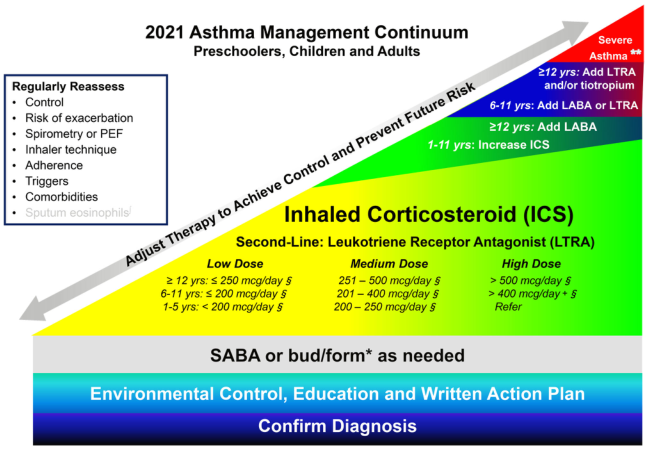
Summary : This figure presents the 2021 Asthma Management Continuum for preschoolers, children, and adults, outlining a stepwise approach to asthma therapy based on severity and age, with regular reassessment and escalation of treatment as needed. flowchart: # Main Structure : • The continuum is depicted as a sloped, color-coded triangle progressing from bottom left (mild) to top right (severe). • The base includes foundational steps, with increasing therapy intensity as you move upward. # Steps and Nodes : • Confirm Diagnosis (bottom, blue bar) • Environmental Control, Education and Written Action Plan (above, teal bar) • SABA or bud/form* as needed (grey bar) • Inhaled Corticosteroid (ICS) (large yellow-green area, central) – Second-Line: Leukotriene Receptor Antagonist (LTRA) – ICS Dosing: • Low Dose: – ≥12 yrs: ≤250 mcg/day § – 6-11 yrs: ≤200 mcg/day § – 1-5 yrs: <200 mcg/day § • Medium Dose: – ≥12 yrs: 251–500 mcg/day § – 6-11 yrs: 201–400 mcg/day § – 1-5 yrs: 200–250 mcg/day § • High Dose: – ≥12 yrs: >500 mcg/day § – 6-11 yrs: >400 mcg/day § – 1-5 yrs: Refer • Add-on therapies (upper right, color-coded by age group): – ≥12 yrs: Add LABA, then LTRA and/or tiotropium – 6-11 yrs: Add LABA or LTRA – 1-11 yrs: Increase ICS • Severe Asthma (top right, red): Add LTRA and/or tiotropium for ≥12 yrs # Regular Reassessment Box (left side) : • Control • Risk of exacerbation • Spirometry or PEF • Inhaler technique • Adherence • Triggers • Comorbidities • Sputum eosinophils # Connectors and Flow : • Large grey arrow labeled “Adjust Therapy to Achieve Control and Prevent Future Risk” runs diagonally upward, indicating escalation. • Steps are arranged from foundational (bottom) to advanced (top right). # Design Encodings : • Color gradient from blue (mild) to red (severe). • Age groups and therapy steps are color-coded. • Text boxes and arrows guide progression and reassessment. # Analysis : • The figure emphasizes a stepwise, age-specific approach to asthma management, starting with diagnosis and environmental control, then escalating pharmacologic therapy as needed. • Regular reassessment is highlighted as essential at all stages. • The structure supports individualized therapy adjustment based on control and risk, with clear escalation pathways for increasing severity.
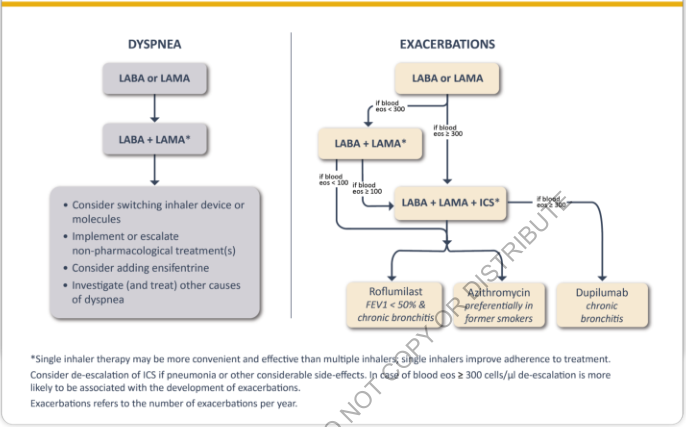
Summary : This figure presents two flowcharts outlining the pharmacological management of chronic obstructive pulmonary disease (COPD) based on the primary symptom: dyspnea or exacerbations. It details stepwise treatment escalation, decision points based on blood eosinophil counts, and additional therapeutic options. flowchart: # Dyspnea Management : Nodes : • LABA or LAMA (rounded rectangle) • LABA + LAMA* (rounded rectangle) • Consider switching inhaler device or molecules; Implement or escalate non-pharmacological treatment(s); Consider adding ensifentrine; Investigate (and treat) other causes of dyspnea (large rounded rectangle) Connectors : • Downward arrows from LABA or LAMA → LABA + LAMA* → management options box Layout : • Vertical, single branch, two main steps followed by a box with four bullet points # Exacerbations Management : Nodes : • LABA or LAMA (rounded rectangle) • LABA + LAMA* (rounded rectangle) • LABA + LAMA + ICS* (rounded rectangle) • Roflumilast (rounded rectangle, “FEV1 < 50% & chronic bronchitis”) • Azithromycin (rounded rectangle, “preferentially in former smokers”) • Dupilumab (rounded rectangle, “chronic bronchitis”) Connectors : • LABA or LAMA → LABA + LAMA* (if blood eos < 300) • LABA or LAMA → LABA + LAMA + ICS* (if blood eos ≥ 300) • LABA + LAMA* → LABA + LAMA + ICS* (if blood eos ≥ 100) • LABA + LAMA + ICS* → Roflumilast, Azithromycin, Dupilumab (branching arrows) • LABA + LAMA + ICS* → Dupilumab (if blood eos ≥ 300) Layout : • Vertical with multiple branches based on blood eosinophil count thresholds (<100, <300, ≥100, ≥300) • Final step branches into three parallel options # Additional Information : • Footnote: Single inhaler therapy may be more convenient and effective than multiple inhalers; single inhalers improve adherence to treatment. • Consider de-escalation of ICS if pneumonia or other considerable side-effects. In case of blood eos ≥ 300 cells/μl de-escalation is more likely to be associated with the development of exacerbations. • Exacerbations refers to the number of exacerbations per year. # Analysis : • The dyspnea pathway is linear, focusing on escalation and device/molecule switching, with consideration for non-pharmacological treatments and other causes. • The exacerbation pathway is more complex, with branching based on blood eosinophil counts, leading to different combinations of inhaled therapies and add-on treatments for specific patient subgroups (chronic bronchitis, former smokers, high eosinophil counts). • The figure emphasizes personalized treatment escalation and the importance of blood eosinophil count in guiding therapy for COPD exacerbations.
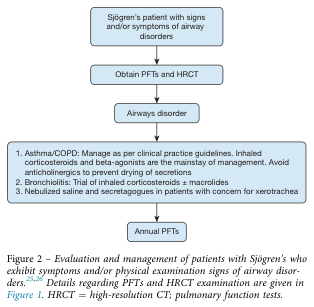
Summary : This flowchart outlines the evaluation and management process for patients with Sjögren’s syndrome who present with signs and/or symptoms of airway disorders, including recommended diagnostic steps and treatment options. flowchart: # Nodes : • “Sjögren’s patient with signs and/or symptoms of airway disorders” (rounded rectangle, top) • “Obtain PFTs and HRCT” (rounded rectangle) • “Airways disorder” (rounded rectangle) • Treatment options (rectangle with numbered list): 1. Asthma/COPD: Manage as per clinical practice guidelines. Inhaled corticosteroids and beta-agonists are the mainstay of management. Avoid anticholinergics to prevent drying of secretions. 2. Bronchiolitis: Trial of inhaled corticosteroids ± macrolides. 3. Nebulized saline and secretagogues in patients with concern for xerotrachea. • “Annual PFTs” (rounded rectangle, bottom) # Connectors : • Downward arrows connect each node sequentially from top to bottom. • No branching; all steps are linear. # Layout : • Vertical, single-column arrangement. • All nodes are aligned centrally, with the treatment options node larger to accommodate the list. # Analysis : • The flowchart presents a stepwise, linear approach for managing airway disorders in Sjögren’s patients: initial assessment, diagnostic testing, confirmation of disorder, tailored treatment based on specific airway condition, and ongoing annual monitoring. No decision branches or alternative pathways are depicted; the process is straightforward and protocol-driven.
Management of Bronchial Asthma
Per Harrison's Principles of Internal Medicine, 22nd Edition (2025) & GINA 2026 Guidelines
Goals of Therapy
- Achieve and maintain control of symptoms
- Prevent recurrent exacerbations (reduce their frequency and severity)
- Maintain near-normal lung function (FEV1, PEF)
- Maintain normal activity levels including exercise
- Avoid adverse effects of asthma medications
- Prevent asthma deaths
Assessment of Control (GINA Criteria)
- Daytime symptoms more than twice per week?
- Night waking due to asthma?
- Reliever needed more than twice per week?
- Activity limitation due to asthma?
| Score | Control Level |
|---|---|
| 0 "Yes" | Well controlled |
| 1-2 "Yes" | Partly controlled |
| 3-4 "Yes" | Uncontrolled |
Asthma Severity Classification (GINA)
| Severity | Step Required |
|---|---|
| Mild | Well controlled at Step 1 or 2 |
| Moderate | Well controlled at Step 3 |
| Severe | Requires Step 4-5, or uncontrolled despite it |
Step 1 - Reducing Triggers (Non-pharmacologic)
- Remove offending exposures: occupational antigens, pets, secondhand smoke, cannabis combustion products
- Pest control for those with IgE-mediated cockroach/rodent sensitivity
- Allergen immunotherapy: useful in mild-moderate allergic asthma (SCIT); sublingual evidence weaker
- Vaccinations: Pneumococcal (regardless of age), annual influenza, COVID-19, RSV vaccine
- Education: inhaler technique, self-management action plans, trigger avoidance
Stepwise Pharmacologic Management
The Major 2024-2026 Paradigm Shift: ICS-Formoterol as Reliever (AIR Strategy)
"A major change in the stepwise approach, advocated for more than two decades, has occurred. Evidence has accumulated that as-needed ICS can be used instead of regular ICS in milder asthma... Since formoterol is a LABA with a rapid onset, combination ICS/formoterol has been used as a single agent in multiple studies: as needed without background therapy in milder asthma... GINA, as part of a comprehensive strategy, recommends ICS/formoterol as the reliever in all steps of asthma severity, including intermittent asthma (step 1)."
- Track 1 (Traditional): Regular daily ICS as controller + SABA reliever
- Track 2 (AIR - Anti-Inflammatory Reliever): ICS-formoterol used as-needed only, without separate daily controller (Step 1-2); or ICS-formoterol daily + as-needed (MART, Step 3-5)
GINA Stepwise Treatment (Adults & Adolescents ≥12 yrs)
| Step | Preferred Controller | Reliever | Notes |
|---|---|---|---|
| Step 1 (Intermittent) | None (AIR track) or low-dose ICS | As-needed low-dose ICS-formoterol (preferred) or ICS-SABA | SABA alone no longer preferred per GINA 2024+ |
| Step 2 (Mild persistent) | Low-dose ICS daily | As-needed low-dose ICS-formoterol or SABA + ICS | LTRA alternative if ICS intolerable |
| Step 3 (Moderate persistent) | Low-dose ICS-LABA daily | As-needed low-dose ICS-formoterol (MART) | Medium ICS mono or ICS+LTRA as alternatives |
| Step 4 (Severe) | Medium/high-dose ICS-LABA | As-needed low-dose ICS-formoterol | Add LAMA (tiotropium) if uncontrolled; check technique, adherence |
| Step 5 (Very severe) | High-dose ICS-LABA + LAMA | As-needed ICS-formoterol | Add biologic; consider low-dose OCS |
Pharmacologic Agents in Detail
1. Beta-2 Agonists (Harrison's 22E)
- Salbutamol (albuterol), terbutaline, levalbuterol
- Rapid onset; peak effect 60-90 min
- G-protein coupled receptor → ↑cyclic AMP → smooth muscle relaxation
- Used for acute relief/rescue
- Regular scheduled SABA use associated with tachyphylaxis, increased airway reactivity - caution
- Patients needing >2 doses/week should step up therapy
- Salmeterol, formoterol, indacaterol
- Must NEVER be used as monotherapy in asthma (black box warning - increased mortality)
- Always combine with ICS
- Formoterol: rapid onset (~5 min) → suitable as reliever in MART strategy
- Improve lung function, reduce symptoms, reduce exacerbation frequency
2. Inhaled Corticosteroids (ICS) - Cornerstone
- Budesonide, fluticasone propionate, beclomethasone, mometasone, ciclesonide
- Suppress eosinophilic airway inflammation; reduce mucosal edema
- Most effective anti-inflammatory treatment available
- All patients with asthma should receive ICS-containing therapy (GINA 2026)
- Topical side effects: oral candidiasis, dysphonia (use spacer, rinse mouth)
- Systemic effects minimal at low-medium doses
- Low: ≤400 mcg/day (adults)
- Medium: 400-800 mcg/day
- High: >800 mcg/day
3. Leukotriene Receptor Antagonists (LTRAs)
- Montelukast, zafirlukast
- Alternative or add-on to ICS at Step 2
- Useful in aspirin-exacerbated respiratory disease, allergic rhinitis comorbidity, exercise-induced bronchospasm
- Important caveat (Harrison's 22E): "Recent warnings about suicidal ideation associated with montelukast may make this approach less appealing." - FDA black box warning added in 2020
4. Long-Acting Muscarinic Antagonists (LAMAs)
- Tiotropium, umeclidinium
- Step 4-5 add-on therapy
- GINA 2026 update: Triple therapy (ICS-LABA + LAMA) reduces severe exacerbations vs. ICS-LABA, but reductions are "far less than those achieved with biologic therapy" - useful when biologics are unavailable/contraindicated
- Tiotropium Respimat approved as add-on for adults ≥12 years
5. Theophylline
- Weak bronchodilator; narrow therapeutic window
- Mechanism: phosphodiesterase inhibition → ↑cyclic AMP; anti-inflammatory at low doses
- Serum level monitoring required (therapeutic: 10-20 mcg/mL; toxic >20 mcg/mL)
- Step 4-5 adjunct only; largely replaced by LABAs in modern practice
- Drug interactions (CYP1A2): fluoroquinolones, macrolides, cimetidine increase levels
6. Biologic Agents (Step 5 / Severe Asthma)
| Biologic | Target | Biomarker | Indication |
|---|---|---|---|
| Omalizumab | Anti-IgE | Elevated serum IgE, allergic sensitization | Allergic asthma ≥6 yrs |
| Mepolizumab | Anti-IL-5 | Blood eos ≥150-300/µL | Eosinophilic asthma ≥6 yrs |
| Benralizumab | Anti-IL-5Rα | Blood eos ≥300/µL | Eosinophilic asthma ≥12 yrs |
| Dupilumab | Anti-IL-4Rα (blocks IL-4 + IL-13) | Blood eos ≥150/µL or FeNO ≥25 ppb | Type 2 asthma ≥6 yrs; also COPD with eos + recurrent exacerbations |
| Tezepelumab | Anti-TSLP | Broad (even non-T2) | Severe asthma ≥12 yrs; shows benefit even without elevated biomarkers |
| Depemokimab | Anti-IL-5 (ultra-long-acting) | Blood eos ≥300/µL | NEW in GINA 2026 - eosinophilic asthma ≥12 yrs; also CRSwNP ≥18 yrs |
- Depemokimab (long-acting anti-IL-5, given every 6 months) added as new biologic option
- Generic anti-IgE (biosimilar omalizumab) added
- Updated biologic decision tree with clearer guidance
7. Oral Corticosteroids (OCS)
- Reserved for acute exacerbations and severe/Step 5 asthma
- GINA 2026 strongly emphasizes minimizing OCS use due to cumulative toxicity
- Optimize ICS-LABA, address modifiable risk factors, use biologics before resorting to maintenance OCS
- Short courses (5-7 days prednisolone 30-50 mg/day) for moderate-severe exacerbations
Management of Asthma Exacerbations
Acute Exacerbations - General (Harrison's 22E)
- Inhaled SABA up to every 1 hour (or ICS-formoterol as reliever - GINA 2026 new option for mild exacerbations in primary care/ED)
- Consider increasing ICS dose 4-5 fold
- If not improving after several hours → urgent care
- Assess PEFR or FEV1
- Nebulized beta-2 agonist every 20 minutes
- Add ipratropium bromide (anticholinergic) - synergistic bronchodilation
- Add systemic corticosteroids
| PEFR | Action |
|---|---|
| >60% predicted | Often responds to beta-2 agonists alone |
| <60% predicted | Add ipratropium + systemic steroids; consider admission |
| <30% predicted | ICU-level care, consider IV magnesium |
- Do NOT give supplemental O2 unless SpO2 <92%
- Target SpO2: 93-95% (adults, adolescents, children 6-11 yrs)
- Target SpO2: ≥92% (children ≤5 yrs with severe exacerbation)
Severe/Near-Fatal Acute Asthma
- Admit to ICU if PEFR <30% predicted, life-threatening features, or failure to respond
- High-dose inhaled + systemic bronchodilators
- IV methylprednisolone
- Controlled oxygen (titrate to target)
- Consider IV magnesium sulfate (2g over 20 min) - relaxes airway smooth muscle via calcium antagonism
- Heliox (helium-oxygen mixture) - reduces turbulent airflow in critical obstruction
- Non-invasive positive pressure ventilation (NIPPV) in selected patients
- Mechanical ventilation if respiratory failure imminent: use permissive hypercapnia, low tidal volumes (5-7 mL/kg), prolonged expiratory time, avoid auto-PEEP
GINA 2026 - Key New Updates (May 2026)
- ICS-SABA combination as Track 2 reliever at Step 1 (new alternative to ICS-formoterol)
- ICS-formoterol as alternate to SABA for mild exacerbations in primary care/ED
- Depemokimab added as new biologic (anti-IL-5, every 6-month dosing)
- Revised oxygen targets: O2 only if SpO2 <92%; target 93-95% for adults
- New flowcharts for primary care management of exacerbations (adults, children 6-11, children ≤5)
- Anaphylaxis protocol: If anaphylaxis + asthma features co-present → give epinephrine FIRST, then bronchodilators
- Triple therapy clarification: ICS-LABA + LAMA reduces exacerbations vs. ICS-LABA, but less so than biologics; use when biologics unavailable
- OCS minimization strongly emphasized
- Vaccine updates: Evidence updated for influenza, RSV, COVID-19 vaccines
- GLP-1 receptor agonists: New observational data on potential role in improving asthma outcomes
- New assessment tools: CAAT (Chronic Airways Assessment Test), Peds-AIRQ, PRAM added
Special Populations (Harrison's 22E)
Elderly Patients
- Mortality 5x higher than younger cohorts
- Adjust step therapy for β2-agonist intolerance (arrhythmias, tremulousness)
- Always consider COPD coexistence
- New-onset asthma in elderly: ~50% are/were smokers; ~25% occupational etiology
Asthma-COPD Overlap
- Smoking blunts ICS response
- Dupilumab effective in COPD with elevated eosinophils + recurrent exacerbations
- Earlier initiation of LAMAs may be beneficial
Severe Refractory Asthma (~5-10% of all asthma)
- Definition: Uncontrolled despite Step 5, OR requires Step 5 for control, after ruling out mimics, addressing comorbidities, and confirming adherence/technique
-
50% have persistent eosinophilic inflammation
- Biologic therapies (anti-IL-5, anti-IgE, anti-IL-4Rα, anti-TSLP) are the primary option
- Macrolides (azithromycin) useful in a subset (likely non-eosinophilic/neutrophilic)
- Bronchial thermoplasty: bronchoscopic option - reduces airway smooth muscle mass
Inhaler Device Selection
- Clinical condition and disease severity
- Patient's ability to use the device correctly
- Availability and cost
- Patient/prescriber preference
| Device | Pros | Cons |
|---|---|---|
| pMDI | Compact, portable, cheap, multidose | Needs hand-mouth coordination; oropharyngeal deposition |
| pMDI + spacer | Removes coordination need; less oropharyngeal deposition | Bulkier |
| DPI | Breath-actuated, no coordination needed | Needs adequate inspiratory flow; humidity sensitive |
| Nebulizer | Good for acute/severe, elderly, young children | Bulky, time-consuming, expensive |
Monitoring and Follow-up
- Reassess control at every visit (4-question GINA tool)
- Spirometry/PEFR monitoring
- Verify inhaler technique at every visit
- Review adherence
- Assess and manage comorbidities (allergic rhinitis, GERD, obesity, OSA, anxiety/depression)
- Consider stepping down therapy if well-controlled for ≥3 months (never step down during pregnancy or high-risk season)
- FeNO: useful to identify eosinophilic airway inflammation and predict steroid response
Summary Image - Stepwise Treatment Continuum
- Harrison's Principles of Internal Medicine, 22nd Edition (2025) - Chapter 298: Asthma
- GINA 2026 Strategy Report - Global Initiative for Asthma, Updated May 5, 2026
- Murray & Nadel's Textbook of Respiratory Medicine - Chapter 62
- Fishman's Pulmonary Diseases and Disorders - Chapter 45
- GINA 2026 Key Highlights Summary
Create a concise clinical summary document for easy reference
ls -la /tmp/workspace/ 2>/dev/null || mkdir -p /tmp/workspace && echo "workspace ready"
mkdir -p /tmp/workspace/asthma-summary && cat > /tmp/workspace/asthma-summary/create_doc.py << 'PYEOF' from docx import Document from docx.shared import Pt, Inches, RGBColor from docx.enum.text import WD_ALIGN_PARAGRAPH from docx.oxml.ns import qn from docx.oxml import OxmlElement import copy doc = Document() # ── Page margins ────────────────────────────────────────────────── section = doc.sections[0] section.page_width = Inches(8.5) section.page_height = Inches(11) section.top_margin = Inches(0.75) section.bottom_margin = Inches(0.75) section.left_margin = Inches(0.85) section.right_margin = Inches(0.85) # ── Base style ──────────────────────────────────────────────────── normal = doc.styles["Normal"] normal.font.name = "Calibri" normal.font.size = Pt(9.5) # ── Colour palette ──────────────────────────────────────────────── NAVY = RGBColor(0x1A, 0x35, 0x5E) # headings TEAL = RGBColor(0x00, 0x7A, 0x87) # sub-headings RED = RGBColor(0xC0, 0x39, 0x2B) # warnings / alerts GREEN = RGBColor(0x1E, 0x7A, 0x45) # positive / new GREY = RGBColor(0xF2, 0xF5, 0xF7) # table header fill WHITE = RGBColor(0xFF, 0xFF, 0xFF) BLACK = RGBColor(0x00, 0x00, 0x00) # ── Helper: set cell background ─────────────────────────────────── def set_cell_bg(cell, rgb: RGBColor): tc = cell._tc tcPr = tc.get_or_add_tcPr() shd = OxmlElement("w:shd") hex6 = f"{rgb[0]:02X}{rgb[1]:02X}{rgb[2]:02X}" shd.set(qn("w:val"), "clear") shd.set(qn("w:color"), "auto") shd.set(qn("w:fill"), hex6) tcPr.append(shd) def set_cell_borders(cell, border_color="999999", border_sz="4"): tc = cell._tc tcPr = tc.get_or_add_tcPr() tcBorders = OxmlElement("w:tcBorders") for side in ["top","left","bottom","right"]: b = OxmlElement(f"w:{side}") b.set(qn("w:val"), "single") b.set(qn("w:sz"), border_sz) b.set(qn("w:space"), "0") b.set(qn("w:color"), border_color) tcBorders.append(b) tcPr.append(tcBorders) def para_spacing(para, before=0, after=60): pPr = para._p.get_or_add_pPr() spacing = OxmlElement("w:spacing") spacing.set(qn("w:before"), str(before)) spacing.set(qn("w:after"), str(after)) pPr.append(spacing) # ── Helper: coloured heading ────────────────────────────────────── def add_heading(text, level=1, color=NAVY, size=13, bold=True, before=120, after=40): p = doc.add_paragraph() para_spacing(p, before=before, after=after) run = p.add_run(text) run.bold = True run.font.color.rgb = color run.font.size = Pt(size) run.font.name = "Calibri" return p def add_sub(text, color=TEAL, size=10, bold=True): p = doc.add_paragraph() para_spacing(p, before=60, after=20) run = p.add_run(text) run.bold = bold run.font.color.rgb = color run.font.size = Pt(size) run.font.name = "Calibri" return p def add_body(text, bold_prefix=None, color=BLACK, size=9.5, indent=False): p = doc.add_paragraph() para_spacing(p, before=0, after=30) if indent: pPr = p._p.get_or_add_pPr() ind = OxmlElement("w:ind") ind.set(qn("w:left"), "200") pPr.append(ind) if bold_prefix: r = p.add_run(bold_prefix + " ") r.bold = True r.font.size = Pt(size) r.font.name = "Calibri" r.font.color.rgb = color r2 = p.add_run(text) r2.font.size = Pt(size) r2.font.name = "Calibri" r2.font.color.rgb = color return p def add_bullet(text, bold_prefix=None, level=0): p = doc.add_paragraph(style="List Bullet") para_spacing(p, before=0, after=18) if bold_prefix: r = p.add_run(bold_prefix + " ") r.bold = True r.font.size = Pt(9.5) r.font.name = "Calibri" r2 = p.add_run(text) r2.font.size = Pt(9.5) r2.font.name = "Calibri" return p def add_alert(text, color=RED, size=9.5): p = doc.add_paragraph() para_spacing(p, before=40, after=40) pPr = p._p.get_or_add_pPr() # left border pBdr = OxmlElement("w:pBdr") left = OxmlElement("w:left") left.set(qn("w:val"), "thick") left.set(qn("w:sz"), "18") left.set(qn("w:space"), "8") left.set(qn("w:color"), f"{color[0]:02X}{color[1]:02X}{color[2]:02X}") pBdr.append(left) pPr.append(pBdr) r = p.add_run(text) r.bold = True r.font.color.rgb = color r.font.size = Pt(size) r.font.name = "Calibri" return p # ══════════════════════════════════════════════════════════════════ # TITLE BLOCK # ══════════════════════════════════════════════════════════════════ title_p = doc.add_paragraph() para_spacing(title_p, before=0, after=20) tr = title_p.add_run("BRONCHIAL ASTHMA — Clinical Management Summary") tr.bold = True tr.font.size = Pt(15) tr.font.color.rgb = WHITE tr.font.name = "Calibri" # set para shading (navy banner) pPr2 = title_p._p.get_or_add_pPr() shd2 = OxmlElement("w:shd") shd2.set(qn("w:val"), "clear") shd2.set(qn("w:color"), "auto") shd2.set(qn("w:fill"), "1A355E") pPr2.append(shd2) title_p.alignment = WD_ALIGN_PARAGRAPH.CENTER sub_p = doc.add_paragraph() para_spacing(sub_p, before=0, after=60) sr = sub_p.add_run("Based on Harrison's 22E (2025) · GINA 2026 · Murray & Nadel's · Fishman's") sr.italic = True sr.font.size = Pt(8.5) sr.font.color.rgb = RGBColor(0x55, 0x55, 0x55) sr.font.name = "Calibri" sub_p.alignment = WD_ALIGN_PARAGRAPH.CENTER # ══════════════════════════════════════════════════════════════════ # 1. ASSESSMENT OF CONTROL # ══════════════════════════════════════════════════════════════════ add_heading("1. ASSESSMENT OF SYMPTOM CONTROL (GINA 4-Question Tool)", level=1, size=11) tbl = doc.add_table(rows=1, cols=3) tbl.style = "Table Grid" hdr = tbl.rows[0].cells for i, txt in enumerate(["Question (past 4 weeks)", "Yes", "No"]): hdr[i].text = txt hdr[i].paragraphs[0].runs[0].bold = True hdr[i].paragraphs[0].runs[0].font.size = Pt(9) set_cell_bg(hdr[i], NAVY) hdr[i].paragraphs[0].runs[0].font.color.rgb = WHITE rows_data = [ "Daytime symptoms >2×/week?", "Night waking due to asthma?", "Reliever needed >2×/week?", "Any activity limitation?", ] for q in rows_data: row = tbl.add_row().cells row[0].text = q row[0].paragraphs[0].runs[0].font.size = Pt(9) set_cell_bg(row[1], RGBColor(0xF8,0xF8,0xF8)) set_cell_bg(row[2], RGBColor(0xF8,0xF8,0xF8)) # score legend score_row = tbl.add_row().cells score_row[0].merge(score_row[2]) score_row[0].text = "0 Yes = Well controlled | 1–2 Yes = Partly controlled | 3–4 Yes = Uncontrolled" sr2 = score_row[0].paragraphs[0].runs[0] sr2.bold = True sr2.font.size = Pt(9) set_cell_bg(score_row[0], RGBColor(0xE8,0xF4,0xFD)) doc.add_paragraph() # Risk factors box add_sub("Risk Factors for Poor Outcomes") risks = [ "Uncontrolled symptoms / ≥1 severe exacerbation in past year", "SABA overuse (>1 canister/month) — marker of poor control", "No ICS, poor adherence, or incorrect inhaler technique", "FEV1 <60% predicted or high bronchodilator reversibility", "Comorbidities: obesity, chronic rhinosinusitis, GERD, depression", "Smoking, occupational exposure, indoor allergens", "Blood eosinophilia / elevated FeNO", ] for r in risks: add_bullet(r) doc.add_paragraph() # ══════════════════════════════════════════════════════════════════ # 2. SEVERITY CLASSIFICATION # ══════════════════════════════════════════════════════════════════ add_heading("2. SEVERITY CLASSIFICATION (GINA)", level=1, size=11) sev_tbl = doc.add_table(rows=1, cols=2) sev_tbl.style = "Table Grid" for i, h in enumerate(["Severity", "Definition"]): sev_tbl.rows[0].cells[i].text = h sev_tbl.rows[0].cells[i].paragraphs[0].runs[0].bold = True sev_tbl.rows[0].cells[i].paragraphs[0].runs[0].font.size = Pt(9) set_cell_bg(sev_tbl.rows[0].cells[i], TEAL) sev_tbl.rows[0].cells[i].paragraphs[0].runs[0].font.color.rgb = WHITE for sev, defn in [ ("Mild", "Well controlled on Step 1 or Step 2"), ("Moderate", "Well controlled on Step 3"), ("Severe", "Requires Step 4–5 to maintain control, OR uncontrolled despite Step 4–5"), ]: row = sev_tbl.add_row().cells row[0].text = sev row[0].paragraphs[0].runs[0].font.size = Pt(9) row[0].paragraphs[0].runs[0].bold = True row[1].text = defn row[1].paragraphs[0].runs[0].font.size = Pt(9) doc.add_paragraph() # ══════════════════════════════════════════════════════════════════ # 3. STEPWISE TREATMENT # ══════════════════════════════════════════════════════════════════ add_heading("3. STEPWISE PHARMACOLOGIC MANAGEMENT (Adults & Adolescents ≥12 yrs)", level=1, size=11) add_alert("⚑ GINA 2026 PARADIGM SHIFT: SABA monotherapy is NO LONGER preferred at any step.\n" " All patients should receive ICS-containing therapy. ICS-formoterol is the preferred reliever at every step.") doc.add_paragraph() step_tbl = doc.add_table(rows=1, cols=5) step_tbl.style = "Table Grid" step_hdrs = ["Step", "Severity", "Controller (Daily)", "Reliever (As-needed)", "Notes"] for i, h in enumerate(step_hdrs): c = step_tbl.rows[0].cells[i] c.text = h c.paragraphs[0].runs[0].bold = True c.paragraphs[0].runs[0].font.size = Pt(8.5) set_cell_bg(c, NAVY) c.paragraphs[0].runs[0].font.color.rgb = WHITE steps = [ ("1", "Intermittent", "None (AIR track)\nOR Low-dose ICS daily", "As-needed low-dose ICS-formoterol ★\nOR ICS-SABA combo (new 2026)\n[SABA alone: no longer preferred]", "AIR = Anti-Inflammatory Reliever strategy"), ("2", "Mild\nPersistent", "Low-dose ICS daily", "As-needed low-dose ICS-formoterol ★\nOR SABA + concurrent ICS\nAlt: LTRA if ICS intolerable", "Caution: montelukast — FDA black-box warning (suicidal ideation)"), ("3", "Moderate\nPersistent", "Low-dose ICS-LABA\n(preferred)\nAlt: Medium ICS or ICS+LTRA", "As-needed low-dose ICS-formoterol\n(MART strategy ★★)", "MART: same inhaler for maintenance + relief\n(budesonide-formoterol)"), ("4", "Severe", "Medium/High-dose ICS-LABA\n+ consider add-on LAMA", "As-needed low-dose ICS-formoterol", "Check adherence & inhaler technique first\nRefer to specialist"), ("5", "Very Severe\n/ Refractory", "High-dose ICS-LABA + LAMA\n+ Biologic therapy\n(see biologic table)", "As-needed ICS-formoterol", "Minimize/avoid maintenance OCS\nBronchial thermoplasty option"), ] row_fills = [RGBColor(0xEA,0xF4,0xEA), RGBColor(0xFF,0xFF,0xE8), RGBColor(0xFD,0xF0,0xD8), RGBColor(0xFD,0xE8,0xE8), RGBColor(0xF5,0xE8,0xF5)] for idx, (step, sev, ctrl, rel, note) in enumerate(steps): row = step_tbl.add_row().cells for ci, txt in enumerate([step, sev, ctrl, rel, note]): row[ci].text = txt for run in row[ci].paragraphs[0].runs: run.font.size = Pt(8.5) set_cell_bg(row[ci], row_fills[idx]) row[0].paragraphs[0].runs[0].bold = True row[0].paragraphs[0].runs[0].font.size = Pt(10) p_note = doc.add_paragraph() para_spacing(p_note, before=20, after=20) rn = p_note.add_run("★ ICS-formoterol (e.g., budesonide/formoterol) preferred reliever across all steps per GINA 2026 " "★★ MART = Maintenance And Reliever Therapy") rn.italic = True rn.font.size = Pt(8) rn.font.color.rgb = RGBColor(0x44,0x44,0x44) doc.add_paragraph() # ══════════════════════════════════════════════════════════════════ # 4. DRUG CLASSES # ══════════════════════════════════════════════════════════════════ add_heading("4. KEY DRUG CLASSES", level=1, size=11) drug_tbl = doc.add_table(rows=1, cols=4) drug_tbl.style = "Table Grid" for i, h in enumerate(["Drug Class", "Examples", "Mechanism / Role", "Key Cautions"]): c = drug_tbl.rows[0].cells[i] c.text = h c.paragraphs[0].runs[0].bold = True c.paragraphs[0].runs[0].font.size = Pt(9) set_cell_bg(c, TEAL) c.paragraphs[0].runs[0].font.color.rgb = WHITE drug_rows = [ ("SABA", "Salbutamol, Terbutaline", "β2 activation → ↑cAMP → smooth muscle relaxation\nRelief/rescue; PRN use", "Overuse (>1 can/month) = poor control marker\nTachyphylaxis with scheduled use"), ("LABA", "Formoterol, Salmeterol, Indacaterol", "Long-acting β2 agonist; combine with ICS\nFormoterol: rapid onset → suitable for MART", "NEVER monotherapy in asthma\n(↑mortality — black box warning)"), ("ICS", "Budesonide, Fluticasone, Beclomethasone, Mometasone", "Suppress eosinophilic inflammation\nCornerstoneof all asthma therapy", "Oral candidiasis, dysphonia\n→ use spacer, rinse mouth after"), ("ICS-LABA\nCombination", "Budesonide/formoterol\nFluticasone/salmeterol\nFluticasone/vilanterol", "Dual controller; MART possible with\nbudesonide/formoterol", "Preferred combination at Steps 3–5"), ("LAMA", "Tiotropium (Respimat)\nUmeclidinium", "Long-acting muscarinic antagonist\nAdd-on at Steps 4–5", "Triple Rx (ICS-LABA+LAMA) < biologics\nfor reducing severe exacerbations"), ("LTRA", "Montelukast, Zafirlukast", "Leukotriene receptor antagonist\nAlt/add-on; useful in AERD, allergic rhinitis", "⚠ Montelukast: FDA black box — suicidal ideation/behaviour"), ("Theophylline", "Aminophylline (IV)\nTheophylline (oral)", "PDE inhibition → ↑cAMP; anti-inflammatory\nNarrow therapeutic window", "Serum level: 10–20 mcg/mL\nDrug interactions: fluoroquinolones, macrolides"), ("OCS", "Prednisolone\nMethylprednisolone (IV)", "Acute: short courses 5–7 days, 30–50 mg/day\nChronic: only if all else fails", "Minimize long-term use\nCumulative toxicity: T2DM, osteoporosis, cataracts"), ] alt_fill = [RGBColor(0xFF,0xFF,0xFF), RGBColor(0xF7,0xF9,0xFC)] for idx, row_data in enumerate(drug_rows): row = drug_tbl.add_row().cells for ci, txt in enumerate(row_data): row[ci].text = txt for run in row[ci].paragraphs[0].runs: run.font.size = Pt(8.5) set_cell_bg(row[ci], alt_fill[idx % 2]) doc.add_paragraph() # ══════════════════════════════════════════════════════════════════ # 5. BIOLOGICS # ══════════════════════════════════════════════════════════════════ add_heading("5. BIOLOGIC AGENTS (Step 5 — Severe / Type 2 Asthma)", level=1, size=11) bio_tbl = doc.add_table(rows=1, cols=5) bio_tbl.style = "Table Grid" for i, h in enumerate(["Biologic", "Target", "Biomarker Threshold", "Age", "Notes"]): c = bio_tbl.rows[0].cells[i] c.text = h c.paragraphs[0].runs[0].bold = True c.paragraphs[0].runs[0].font.size = Pt(9) set_cell_bg(c, NAVY) c.paragraphs[0].runs[0].font.color.rgb = WHITE bio_rows = [ ("Omalizumab\n(biosimilar available)", "Anti-IgE", "Elevated serum IgE\n+ allergic sensitization", "≥6 yrs", "Allergic/atopic asthma\nMonthly or bimonthly SC"), ("Mepolizumab", "Anti-IL-5", "Blood eos ≥150–300/μL", "≥6 yrs", "Eosinophilic asthma\nMonthly SC"), ("Benralizumab", "Anti-IL-5Rα", "Blood eos ≥300/μL", "≥12 yrs", "Eosinophilic; Q8 weekly SC\nafter 3 monthly loading doses"), ("Dupilumab", "Anti-IL-4Rα\n(blocks IL-4 + IL-13)", "Blood eos ≥150/μL\nOR FeNO ≥25 ppb", "≥6 yrs", "Type 2 asthma; also approved\nfor COPD with eos + exacerbations"), ("Tezepelumab", "Anti-TSLP\n(upstream cytokine)", "Broad; works even without\nelevated T2 biomarkers", "≥12 yrs", "Severe asthma including\nnon-Type 2 phenotype"), ("Depemokimab ★NEW", "Anti-IL-5\n(ultra-long-acting)", "Blood eos ≥300/μL", "≥12 yrs\n(CRSwNP ≥18)", "NEW — GINA 2026\nDosing every 6 months SC"), ] for idx, row_data in enumerate(bio_rows): row = bio_tbl.add_row().cells for ci, txt in enumerate(row_data): row[ci].text = txt for run in row[ci].paragraphs[0].runs: run.font.size = Pt(8.5) set_cell_bg(row[ci], alt_fill[idx % 2]) doc.add_paragraph() # ══════════════════════════════════════════════════════════════════ # 6. ACUTE EXACERBATION MANAGEMENT # ══════════════════════════════════════════════════════════════════ add_heading("6. ACUTE EXACERBATION MANAGEMENT", level=1, size=11) add_sub("Initial Assessment — PEFR/FEV1 Classification") pefr_tbl = doc.add_table(rows=1, cols=4) pefr_tbl.style = "Table Grid" for i, h in enumerate(["Severity", "PEFR", "Features", "Immediate Action"]): c = pefr_tbl.rows[0].cells[i] c.text = h c.paragraphs[0].runs[0].bold = True c.paragraphs[0].runs[0].font.size = Pt(9) set_cell_bg(c, TEAL) c.paragraphs[0].runs[0].font.color.rgb = WHITE pefr_rows = [ ("Mild–Moderate", ">60% predicted", "Wheeze, SOB; speaks in sentences\nSpO2 ≥92%", "Inhaled SABA q20 min ×3 (or ICS-formoterol)\nMonitor, OCS if no response in 1–2h"), ("Severe", "40–60% predicted", "Speaks in words; accessory muscle use\nSpO2 <92%", "SABA + ipratropium q20 min ×3\nSystemic OCS\nControlled O2 (target SpO2 93–95%)"), ("Life-Threatening", "<40% predicted", "Silent chest, cyanosis, altered consciousness\nPEFR <30% = ICU", "IV methylprednisolone\nIV/nebulized bronchodilators\nIV MgSO4 2g over 20 min\nConsider intubation"), ] exac_fills = [RGBColor(0xEA,0xF7,0xEA), RGBColor(0xFF,0xF3,0xCC), RGBColor(0xFD,0xE8,0xE8)] for idx, row_data in enumerate(pefr_rows): row = pefr_tbl.add_row().cells for ci, txt in enumerate(row_data): row[ci].text = txt for run in row[ci].paragraphs[0].runs: run.font.size = Pt(8.5) set_cell_bg(row[ci], exac_fills[idx]) doc.add_paragraph() add_alert("⚑ O2 THERAPY (GINA 2026): Supplemental O2 ONLY if SpO2 <92%\n" " Target: 93–95% (adults, adolescents, children 6–11 yrs) | ≥92% (children ≤5 yrs)\n" " ⚑ ANAPHYLAXIS + ASTHMA: Give EPINEPHRINE first, then bronchodilators") doc.add_paragraph() add_sub("ICU / Ventilated Patient") icu_bullets = [ "Permissive hypercapnia acceptable (avoid barotrauma)", "Low tidal volumes 5–7 mL/kg ideal body weight", "Prolonged expiratory time; minimise auto-PEEP", "Heliox (He:O2 70:30) — reduces turbulent airflow in critical obstruction", "IV ketamine: bronchodilatory anaesthetic induction agent", "Avoid propofol-only without ICS if reactive airways", ] for b in icu_bullets: add_bullet(b) doc.add_paragraph() add_sub("Discharge Criteria") dc = [ "PEFR ≥60% predicted (ideally ≥70–80%)", "Symptoms controlled; no nocturnal symptoms", "Inhaler technique verified", "Written asthma action plan provided", "Follow-up arranged within 1–2 weeks", "Prednisolone course completed or continued as prescribed", ] for d in dc: add_bullet(d) doc.add_paragraph() # ══════════════════════════════════════════════════════════════════ # 7. GINA 2026 KEY UPDATES # ══════════════════════════════════════════════════════════════════ add_heading("7. GINA 2026 — KEY NEW UPDATES (May 5, 2026)", level=1, size=11, color=GREEN, before=80) updates = [ ("ICS-SABA combo at Step 1:", "Added as Track 2 (AIR) alternative to ICS-formoterol at Step 1"), ("ICS-formoterol in mild exacerbations:", "Now an alternate to inhaled SABA in primary care / ED (adults, adolescents, children 6–11)"), ("Depemokimab:", "New biologic (anti-IL-5, every-6-month dosing) added for severe eosinophilic asthma ≥12 yrs"), ("Biosimilar omalizumab:", "Generic anti-IgE added as biologic option"), ("O2 thresholds revised:", "O2 only if SpO2 <92%; target 93–95% adults; ≥92% for children ≤5 yrs"), ("Anaphylaxis protocol:", "If anaphylaxis + asthma co-present → epinephrine FIRST, then bronchodilators"), ("Triple therapy clarification:", "ICS-LABA + LAMA reduces exacerbations vs ICS-LABA, but far less than biologics"), ("OCS minimization:", "Strongly emphasized — optimize ICS-LABA, modifiable factors, and biologics before maintenance OCS"), ("New assessment tools:", "CAAT, Peds-AIRQ, PRAM added to guideline toolkit"), ("Vaccines:", "Evidence updated for influenza, RSV, and COVID-19 vaccines in asthma"), ("GLP-1 receptor agonists:", "Observational data added on potential role in improving asthma outcomes (future direction)"), ("New flowcharts:", "4 new flowcharts for primary care / ED management of exacerbations by age group"), ] for bold_t, body_t in updates: add_bullet(body_t, bold_prefix=bold_t) doc.add_paragraph() # ══════════════════════════════════════════════════════════════════ # 8. SPECIAL POPULATIONS # ══════════════════════════════════════════════════════════════════ add_heading("8. SPECIAL POPULATIONS", level=1, size=11) sp_tbl = doc.add_table(rows=1, cols=2) sp_tbl.style = "Table Grid" for i, h in enumerate(["Population", "Key Considerations"]): c = sp_tbl.rows[0].cells[i] c.text = h c.paragraphs[0].runs[0].bold = True c.paragraphs[0].runs[0].font.size = Pt(9) set_cell_bg(c, TEAL) c.paragraphs[0].runs[0].font.color.rgb = WHITE sp_rows = [ ("Elderly (>65 yrs)", "5× higher mortality than younger patients\nAdjust β2-agonist dose for arrhythmia/tremulousness\nAlways consider COPD coexistence\nNew-onset: ~50% are/were smokers; ~25% occupational aetiology"), ("Asthma-COPD Overlap", "Smoking blunts ICS response\nDupilumab approved in COPD with eos + recurrent exacerbations\nEarlier initiation of LAMAs beneficial"), ("Severe Refractory\n(~5–10% of asthma)", "Uncontrolled on Step 5 after confirming adherence, technique, and treating comorbidities\n>50% have persistent eosinophilic inflammation\nMacrolides useful in neutrophilic/non-eosinophilic subset\nBronchial thermoplasty: bronchoscopic option — reduces airway smooth muscle mass"), ("Pregnancy", "Uncontrolled asthma more dangerous than ICS therapy\nContinue ICS; avoid stepping down\nSalbutamol safe as reliever; budesonide preferred ICS"), ("Exercise-Induced", "Pre-exercise SABA or ICS-formoterol 15 min before\nRegular ICS reduces EIB\nLTRA useful adjunct"), ("Aspirin/NSAID-Exacerbated\n(AERD)", "Avoid NSAIDs, aspirin\nLTRA particularly useful\nAspirin desensitisation under specialist supervision"), ] for idx, row_data in enumerate(sp_rows): row = sp_tbl.add_row().cells for ci, txt in enumerate(row_data): row[ci].text = txt for run in row[ci].paragraphs[0].runs: run.font.size = Pt(8.5) set_cell_bg(row[ci], alt_fill[idx % 2]) doc.add_paragraph() # ══════════════════════════════════════════════════════════════════ # 9. NON-PHARMACOLOGIC / MONITORING # ══════════════════════════════════════════════════════════════════ add_heading("9. NON-PHARMACOLOGIC MEASURES & MONITORING", level=1, size=11) left_items = [ ("Trigger avoidance:", "Remove pets, occupational antigens, second-hand smoke, cannabis"), ("Allergen immunotherapy:", "Mild–moderate allergic asthma; SCIT under controlled conditions"), ("Vaccinations:", "Annual influenza; pneumococcal; COVID-19; RSV"), ("Inhaler education:", "Technique check at every visit — poor technique in up to 50% of 'refractory' cases"), ("Written action plan:", "Green/yellow/red zones based on PEFR or symptoms"), ("FeNO monitoring:", "≥25 ppb = eosinophilic inflammation; predicts ICS response"), ("Weight loss / OSA:", "Obesity worsens control; screen and treat OSA"), ("Rhinosinusitis / GERD:", "Manage upper airway disease and reflux as asthma comorbidities"), ] for bold_t, body_t in left_items: add_bullet(body_t, bold_prefix=bold_t) doc.add_paragraph() # ══════════════════════════════════════════════════════════════════ # FOOTER # ══════════════════════════════════════════════════════════════════ footer_p = doc.add_paragraph() para_spacing(footer_p, before=60, after=0) pPr3 = footer_p._p.get_or_add_pPr() shd3 = OxmlElement("w:shd") shd3.set(qn("w:val"), "clear") shd3.set(qn("w:color"), "auto") shd3.set(qn("w:fill"), "1A355E") pPr3.append(shd3) footer_r = footer_p.add_run( "Sources: Harrison's Principles of Internal Medicine 22E (2025, McGraw-Hill) · " "GINA 2026 Strategy Report (May 5 2026, ginasthma.org) · " "Murray & Nadel's Textbook of Respiratory Medicine · " "Fishman's Pulmonary Diseases & Disorders | Prepared: August 2026" ) footer_r.font.size = Pt(7.5) footer_r.font.color.rgb = WHITE footer_r.font.name = "Calibri" footer_p.alignment = WD_ALIGN_PARAGRAPH.CENTER # ── Save ────────────────────────────────────────────────────────── out = "/tmp/workspace/asthma-summary/Asthma_Clinical_Summary.docx" doc.save(out) print(f"SAVED: {out}") PYEOF python3 /tmp/workspace/asthma-summary/create_doc.py
python3 -c " from docx import Document doc = Document('/tmp/workspace/asthma-summary/Asthma_Clinical_Summary.docx') headings = [p.text for p in doc.paragraphs if p.text.strip() and len(p.text) > 5][:30] print('Paragraphs preview:') for h in headings: print(' -', h[:90]) import os size = os.path.getsize('/tmp/workspace/asthma-summary/Asthma_Clinical_Summary.docx') print(f'File size: {size:,} bytes') "
Asthma Clinical Summary
Word Document · DOCX
| Section | Contents |
|---|---|
| 1. Symptom Control Assessment | GINA 4-question tool table + risk factors for poor outcomes |
| 2. Severity Classification | Mild / Moderate / Severe defined by treatment step |
| 3. Stepwise Treatment | Step 1-5 table with colour-coded rows — controller, reliever, and notes per step; GINA 2026 paradigm shift callout box |
| 4. Drug Classes | SABA, LABA, ICS, ICS-LABA, LAMA, LTRA, Theophylline, OCS — mechanism, examples, key cautions |
| 5. Biologics | All 6 agents (incl. Depemokimab - new 2026) — target, biomarker threshold, age, notes |
| 6. Acute Exacerbation | PEFR severity table, revised O2 targets, ICU/ventilation tips, discharge criteria |
| 7. GINA 2026 Updates | 12 key changes highlighted with bold prefixes |
| 8. Special Populations | Elderly, asthma-COPD overlap, refractory, pregnancy, exercise-induced, AERD |
| 9. Non-pharmacologic & Monitoring | Trigger avoidance, vaccination, FeNO, written action plans, comorbidities |
Provide a simplified flowchart for the above information for clinical usee
mkdir -p /tmp/workspace/asthma-summary && python3 -c "import matplotlib; print(matplotlib.__version__)"
~/asthma-summary/flowchart.py
import matplotlib
matplotlib.use("Agg")
import matplotlib.pyplot as plt
import matplotlib.patches as mpatches
from matplotlib.patches import FancyBboxPatch, FancyArrowPatch

# ── Canvas ────────────────────────────────────────────────────────
fig = plt.figure(figsize=(22, 30), facecolor="#F8FAFC")
ax  = fig.add_axes([0, 0, 1, 1])
ax.set_xlim(0, 22)
ax.set_ylim(0, 30)
ax.axis("off")

# ── Palette ───────────────────────────────────────────────────────
NAVY    = "#1A355E"
TEAL    = "#007A87"
GREEN   = "#1E7A45"
AMBER   = "#E67E22"
RED     = "#C0392B"
PURPLE  = "#6C3483"
LGREY   = "#EAF0F6"
MGREY   = "#D5E8F0"
LYELLOW = "#FEF9E7"
LGREEN  = "#E9F7EF"
LORANGE = "#FDF2E9"
LRED    = "#FDEDEC"
LPURPLE = "#F4ECF7"
WHITE   = "#FFFFFF"
DARK    = "#1C1C1C"

# ── Helper functions ──────────────────────────────────────────────
def box(ax, x, y, w, h, text, bg=LGREY, border=NAVY, fontsize=8.5,
        bold=False, text_color=DARK, radius=0.25, alpha=1.0, linew=1.5,
        va="center", ha="center", wrap=False):
    rect = FancyBboxPatch((x - w/2, y - h/2), w, h,
                          boxstyle=f"round,pad=0.05,rounding_size={radius}",
                          facecolor=bg, edgecolor=border,
                          linewidth=linew, zorder=3, alpha=alpha)
    ax.add_patch(rect)
    weight = "bold" if bold else "normal"
    ax.text(x, y, text, ha=ha, va=va, fontsize=fontsize,
            color=text_color, fontweight=weight, zorder=4,
            wrap=wrap, multialignment="center",
            linespacing=1.35)

def header_box(ax, x, y, w, h, text, bg=NAVY, fontsize=10, text_color=WHITE):
    rect = FancyBboxPatch((x - w/2, y - h/2), w, h,
                          boxstyle="round,pad=0.05,rounding_size=0.3",
                          facecolor=bg, edgecolor=bg,
                          linewidth=2, zorder=3)
    ax.add_patch(rect)
    ax.text(x, y, text, ha="center", va="center", fontsize=fontsize,
            color=text_color, fontweight="bold", zorder=4,
            multialignment="center", linespacing=1.3)

def arrow(ax, x1, y1, x2, y2, color=NAVY, lw=1.8, style="->"):
    ax.annotate("", xy=(x2, y2), xytext=(x1, y1),
                arrowprops=dict(arrowstyle=style, color=color,
                                lw=lw, connectionstyle="arc3,rad=0.0"),
                zorder=2)

def label_arrow(ax, x1, y1, x2, y2, label, color=AMBER, fontsize=7.5, lw=1.8):
    ax.annotate("", xy=(x2, y2), xytext=(x1, y1),
                arrowprops=dict(arrowstyle="->", color=color, lw=lw),
                zorder=2)
    mx, my = (x1+x2)/2, (y1+y2)/2
    ax.text(mx+0.08, my, label, fontsize=fontsize, color=color,
            fontweight="bold", zorder=5)

def diamond(ax, x, y, w, h, text, bg=LYELLOW, border=AMBER, fontsize=8):
    dx, dy = w/2, h/2
    pts = [(x, y+dy), (x+dx, y), (x, y-dy), (x-dx, y)]
    from matplotlib.patches import Polygon
    poly = Polygon(pts, closed=True, facecolor=bg, edgecolor=border,
                   linewidth=2, zorder=3)
    ax.add_patch(poly)
    ax.text(x, y, text, ha="center", va="center", fontsize=fontsize,
            fontweight="bold", color=DARK, zorder=4, multialignment="center",
            linespacing=1.3)

def divider(ax, y, color="#CCCCCC"):
    ax.plot([0.3, 21.7], [y, y], color=color, lw=0.8, ls="--", zorder=1)

# ══════════════════════════════════════════════════════════════════
#   TITLE
# ══════════════════════════════════════════════════════════════════
header_box(ax, 11, 29.3, 21.4, 0.9,
           "BRONCHIAL ASTHMA — Clinical Management Flowchart\n"
           "Harrison's 22E (2025)  ·  GINA 2026  ·  Murray & Nadel's",
           bg=NAVY, fontsize=10.5)

# ══════════════════════════════════════════════════════════════════
#   SECTION A  —  DIAGNOSIS & CONTROL ASSESSMENT
# ══════════════════════════════════════════════════════════════════
header_box(ax, 11, 28.5, 21.4, 0.5,
           "STEP 1 — DIAGNOSIS  &  CONTROL ASSESSMENT", bg=TEAL, fontsize=9.5)

# --- GINA 4-question tool
box(ax, 5.5, 27.3, 10.0, 1.4,
    "GINA SYMPTOM CONTROL  (past 4 weeks)\n"
    "①  Daytime symptoms >2×/week?\n"
    "②  Any night waking due to asthma?\n"
    "③  Reliever needed >2×/week?\n"
    "④  Any activity limitation?",
    bg=LGREY, border=TEAL, fontsize=8, bold=False)

# --- Scoring
box(ax, 5.5, 25.85, 9.8, 0.9,
    "0 Yes = Well controlled    |    1–2 Yes = Partly controlled    |    3–4 Yes = Uncontrolled",
    bg=MGREY, border=TEAL, fontsize=8.5, bold=True)

arrow(ax, 5.5, 26.6, 5.5, 26.3)

# --- Severity classification (right column)
box(ax, 16.8, 27.0, 8.2, 1.8,
    "SEVERITY  (GINA)\n\n"
    " Mild  →  Controlled at Step 1–2\n"
    " Moderate  →  Controlled at Step 3\n"
    " Severe  →  Requires Step 4–5",
    bg=LGREEN, border=GREEN, fontsize=8.5, bold=False)

# connector between two panels
ax.plot([10.5, 12.5], [27.3, 27.3], color=TEAL, lw=1.2, ls="--", zorder=2)
ax.plot([12.5, 12.5], [27.3, 27.05], color=TEAL, lw=1.2, ls="--", zorder=2)
arrow(ax, 12.5, 27.05, 12.7, 27.05)

divider(ax, 25.35)

# ══════════════════════════════════════════════════════════════════
#   SECTION B  —  NON-PHARMACOLOGIC  +  CHECK BEFORE STEPPING UP
# ══════════════════════════════════════════════════════════════════
header_box(ax, 11, 25.1, 21.4, 0.45,
           "STEP 2 — NON-PHARMACOLOGIC MEASURES  (ALL PATIENTS)", bg=GREEN, fontsize=9)

box(ax, 7.0, 24.15, 13.0, 1.3,
    "• Remove triggers: allergens, smoke, occupational antigens, pets\n"
    "• Vaccinate: annual influenza · pneumococcal · COVID-19 · RSV\n"
    "• Allergen immunotherapy (mild–moderate allergic asthma, controlled)\n"
    "• Treat comorbidities: rhinosinusitis · GERD · obesity · OSA · anxiety",
    bg=LGREEN, border=GREEN, fontsize=8.2)

box(ax, 18.5, 24.15, 7.0, 1.3,
    "CHECK FIRST before stepping up:\n"
    "✓  Inhaler technique correct?\n"
    "✓  Adherence adequate?\n"
    "✓  Comorbidities treated?",
    bg=LYELLOW, border=AMBER, fontsize=8.2)

arrow(ax, 11, 25.1, 11, 24.8)

divider(ax, 23.5)

# ══════════════════════════════════════════════════════════════════
#   SECTION C  —  STEPWISE PHARMACOTHERAPY
# ══════════════════════════════════════════════════════════════════
header_box(ax, 11, 23.25, 21.4, 0.45,
           "STEP 3 — STEPWISE PHARMACOTHERAPY  (Adults & Adolescents ≥12 yrs)", bg=NAVY, fontsize=9.5)

arrow(ax, 11, 23.5, 11, 23.25)

# GINA 2026 alert banner
box(ax, 11, 22.85, 21.0, 0.6,
    "⚑  GINA 2026 SHIFT:  SABA alone NO LONGER preferred at any step."
    "  All patients need ICS-containing therapy."
    "  ICS-formoterol = preferred reliever at ALL steps.",
    bg="#FDEDEC", border=RED, fontsize=8.5, bold=True, text_color=RED)

# --- Step labels (vertical cascade, left column)
step_data = [
    # (y_center, step_label, bg, border, controller, reliever, note_color, note)
    (21.85, "STEP 1\nIntermittent",  "#E8F8F5", TEAL,
     "No daily controller\n(AIR track)\nOR  Low-dose ICS daily",
     "★ As-needed ICS-formoterol\n   (preferred)\nOR  ICS-SABA combo (new 2026)\n   [not SABA alone]",
     TEAL, ""),
    (20.35, "STEP 2\nMild\nPersistent", "#EAF4FB", "#2980B9",
     "Low-dose ICS daily\n(Alt: LTRA if ICS intolerable)",
     "★ As-needed ICS-formoterol\nOR  SABA + concurrent ICS\n⚠  Montelukast: FDA black-box\n    (suicidal ideation)",
     "#2980B9", ""),
    (18.70, "STEP 3\nModerate\nPersistent", "#FEF9E7", AMBER,
     "Low-dose ICS-LABA\n(preferred)\nAlt: Medium ICS  or  ICS+LTRA",
     "★★ MART strategy\n    (ICS-formoterol for\n     maintenance + relief)",
     AMBER, ""),
    (17.10, "STEP 4\nSevere", "#FDF2E9", "#E67E22",
     "Medium/High ICS-LABA\n+ Add LAMA (tiotropium)\nif uncontrolled",
     "As-needed ICS-formoterol\n→ Refer to specialist\n→ Check adherence + technique",
     "#E67E22", ""),
    (15.50, "STEP 5\nVery Severe /\nRefractory", "#FDEDEC", RED,
     "High-dose ICS-LABA + LAMA\n+ BIOLOGIC THERAPY\n(see biologic table below)",
     "As-needed ICS-formoterol\nMinimize / avoid OCS\n[Bronchial thermoplasty: option]",
     RED, ""),
]

for (yc, step_lbl, bg_c, brd, ctrl, rel, nc, note) in step_data:
    # Step badge
    box(ax, 1.6, yc, 2.5, 1.1, step_lbl,
        bg=brd, border=brd, bold=True, fontsize=9, text_color=WHITE)
    # Controller
    box(ax, 7.2, yc, 8.8, 1.1, "CONTROLLER (Daily)\n" + ctrl,
        bg=bg_c, border=brd, fontsize=7.8)
    # Reliever
    box(ax, 16.5, yc, 8.8, 1.1, "RELIEVER (As-needed)\n" + rel,
        bg=bg_c, border=brd, fontsize=7.8)
    # down arrows between steps
    if yc > 15.5:
        arrow(ax, 1.6, yc - 0.55, 1.6, yc - 1.05, color=brd, lw=2.0)

# "step up" label on left
for yc in [20.35, 18.70, 17.10, 15.50]:
    ax.text(0.35, yc + 0.55, "▲ Step\nUp", fontsize=7, color="#888888",
            ha="center", va="center", rotation=0)

# Step-down annotation
ax.text(0.35, 21.35, "▼ Step\nDown\nif controlled\n3+ months",
        fontsize=6.5, color=GREEN, ha="center", va="center")

divider(ax, 14.85)

# ══════════════════════════════════════════════════════════════════
#   SECTION D  —  BIOLOGICS
# ══════════════════════════════════════════════════════════════════
header_box(ax, 11, 14.6, 21.4, 0.45,
           "STEP 3b — BIOLOGIC AGENTS  (Step 5 — Severe / Type 2 Asthma)", bg=PURPLE, fontsize=9.5)

bio_data = [
    ("Omalizumab\n(+ biosimilar)\n★ Anti-IgE",         "Elevated IgE\n+ allergic sensitisation", "Allergic\nasthma\n≥6 yrs",  "#F4ECF7", PURPLE),
    ("Mepolizumab\n★ Anti-IL-5",                       "Blood eos\n≥150–300/μL",                 "Eosinophilic\nasthma\n≥6 yrs", "#EBF5FB", "#2980B9"),
    ("Benralizumab\n★ Anti-IL-5Rα",                    "Blood eos\n≥300/μL",                     "Eosinophilic\nasthma\n≥12 yrs","#EBF5FB","#1A5276"),
    ("Dupilumab\n★ Anti-IL-4Rα\n(IL-4 + IL-13)",      "Blood eos ≥150/μL\nOR FeNO ≥25 ppb",     "Type 2\nasthma\n≥6 yrs",       "#E9F7EF", GREEN),
    ("Tezepelumab\n★ Anti-TSLP",                       "Broad — works even\nwithout T2 markers",  "Severe asthma\nincl. non-T2\n≥12 yrs","#FEF9E7",AMBER),
    ("Depemokimab\n★ Anti-IL-5 (NEW)\nEvery 6 months", "Blood eos\n≥300/μL",                     "Eosinophilic\nasthma\n≥12 yrs","#FDEDEC", RED),
]

bx_w  = 3.2
bx_gap = 3.53
bx_start = 1.85
bx_y  = 13.55

for i, (name, marker, age, bg_b, brd_b) in enumerate(bio_data):
    bx = bx_start + i * bx_gap
    box(ax, bx, bx_y, bx_w, 1.8,
        name + "\n─────────\n" + marker + "\n─────────\n" + age,
        bg=bg_b, border=brd_b, fontsize=7.5)

ax.text(11, 12.6, "★ NEW — GINA 2026: Depemokimab added  |  Biosimilar omalizumab added  |  "
        "GLP-1 agonists: potential future role (observational data)",
        ha="center", va="center", fontsize=7.5, color=PURPLE,
        fontstyle="italic")

divider(ax, 12.25)

# ══════════════════════════════════════════════════════════════════
#   SECTION E  —  ACUTE EXACERBATION
# ══════════════════════════════════════════════════════════════════
header_box(ax, 11, 12.05, 21.4, 0.45,
           "STEP 4 — ACUTE EXACERBATION MANAGEMENT", bg=RED, fontsize=9.5)

# ---- 3 severity columns ----
sev_cols = [
    (4.0,  "MILD – MODERATE\nPEFR >60%",
     "• SpO₂ ≥92%; speaks sentences\n"
     "• SABA q20 min ×3\n"
     "  (or ICS-formoterol — new 2026)\n"
     "• If no improvement in 1–2h:\n"
     "  → Add ipratropium\n"
     "  → Oral prednisolone 30–50 mg\n"
     "• Observe; discharge if PEFR ≥60%",
     LGREEN, GREEN),
    (11.0, "SEVERE\nPEFR 40–60%",
     "• SpO₂ <92%; speaks in words\n"
     "• Nebulised SABA + ipratropium\n"
     "  q20 min ×3\n"
     "• Systemic OCS (IV or oral)\n"
     "• Controlled O₂ → target 93–95%\n"
     "  (give O₂ ONLY if SpO₂ <92%)\n"
     "• Admit if no rapid improvement",
     LORANGE, AMBER),
    (18.0, "LIFE-THREATENING\nPEFR <40% / Silent chest",
     "• ICU admission\n"
     "• IV methylprednisolone\n"
     "• Continuous nebulised SABA\n"
     "• IV MgSO₄ 2 g over 20 min\n"
     "• Heliox (70:30) if available\n"
     "• NIPPV (selected patients)\n"
     "• Intubate if imminent resp. failure\n"
     "  (permissive hypercapnia strategy)",
     LRED, RED),
]

for (bx, title, body, bg_e, brd_e) in sev_cols:
    box(ax, bx, 10.4, 6.8, 3.0,
        title + "\n──────────\n" + body,
        bg=bg_e, border=brd_e, fontsize=7.8)

# Alert: O2 + anaphylaxis
box(ax, 11, 8.65, 20.8, 0.8,
    "⚑  O₂ THERAPY (GINA 2026): Give supplemental O₂ ONLY if SpO₂ <92%  —  Target 93–95% (adults)  /  ≥92% (children ≤5 yrs)\n"
    "⚑  ANAPHYLAXIS + ASTHMA:  Give EPINEPHRINE FIRST  →  then bronchodilators",
    bg="#FDEDEC", border=RED, fontsize=8.5, bold=True, text_color=RED)

divider(ax, 8.1)

# ══════════════════════════════════════════════════════════════════
#   SECTION F  —  DISCHARGE + FOLLOW-UP
# ══════════════════════════════════════════════════════════════════
header_box(ax, 11, 7.9, 21.4, 0.45,
           "STEP 5 — DISCHARGE CRITERIA & FOLLOW-UP", bg=GREEN, fontsize=9.5)

discharge_items = [
    "PEFR ≥60% (ideally ≥70–80%)", "Symptoms controlled; no nocturnal symptoms",
    "Inhaler technique verified", "Written asthma action plan given",
    "Follow-up within 1–2 weeks",  "Step-up therapy reviewed; OCS course completed"
]
cols_per_row = 3
box_w = 6.6
x_starts = [2.2, 9.0, 15.8]

for i, item in enumerate(discharge_items):
    row_i = i // cols_per_row
    col_i = i  % cols_per_row
    bx = x_starts[col_i]
    by = 7.2 - row_i * 0.65
    box(ax, bx, by, box_w, 0.5, "✓  " + item,
        bg=LGREEN, border=GREEN, fontsize=8.2, ha="center")

divider(ax, 5.85)

# ══════════════════════════════════════════════════════════════════
#   SECTION G  —  MONITORING LOOP
# ══════════════════════════════════════════════════════════════════
header_box(ax, 11, 5.65, 21.4, 0.45,
           "ONGOING MONITORING  (Every Visit)", bg=TEAL, fontsize=9.5)

monitor_items = [
    ("Symptom\nControl", "GINA 4Q tool\nevery visit", LGREY, TEAL),
    ("Spirometry /\nPEFR", "FEV1; reassess\nevery 3–12 months", "#EBF5FB", "#2980B9"),
    ("Inhaler\nTechnique", "Check & correct\nat every visit\n(50% have errors)", LYELLOW, AMBER),
    ("Adherence", "Address barriers;\nsimplify regimen", LGREEN, GREEN),
    ("FeNO", "≥25 ppb = eosinophilic\nInflammation; predicts\nICS response", LPURPLE, PURPLE),
    ("Step\nReview", "Step DOWN if\nwell controlled\n≥3 months", "#E8F8F5", TEAL),
]

mon_x  = [2.0, 5.7, 9.4, 13.1, 16.8, 20.5]
for i, (title, body, bg_m, brd_m) in enumerate(monitor_items):
    box(ax, mon_x[i], 4.8, 3.2, 1.45,
        title + "\n─────\n" + body,
        bg=bg_m, border=brd_m, fontsize=7.7)

# curved "reassess" arrow
ax.annotate("", xy=(0.7, 23.4), xytext=(0.7, 4.5),
            arrowprops=dict(arrowstyle="->", color="#AAAAAA", lw=1.5,
                            connectionstyle="arc3,rad=-0.3"),
            zorder=1)
ax.text(0.1, 14.0, "Reassess\n& adjust\ntherapy",
        fontsize=7.5, color="#888888", ha="center", rotation=90)

divider(ax, 3.65)

# ══════════════════════════════════════════════════════════════════
#   LEGEND
# ══════════════════════════════════════════════════════════════════
legend_items = [
    (NAVY,   "Main pathway"),
    (GREEN,  "Non-pharmacologic / discharge"),
    (AMBER,  "Moderate severity"),
    (RED,    "Severe / warning"),
    (PURPLE, "Biologic therapy"),
    (TEAL,   "Assessment / monitoring"),
]
lx = 1.5
ax.text(lx, 3.4, "LEGEND:", fontsize=8, fontweight="bold", color=DARK)
for i, (col, lbl) in enumerate(legend_items):
    cx = lx + i * 3.4
    rect = FancyBboxPatch((cx, 2.85), 0.35, 0.3,
                          boxstyle="round,pad=0.02",
                          facecolor=col, edgecolor=col, zorder=3)
    ax.add_patch(rect)
    ax.text(cx + 0.5, 3.0, lbl, fontsize=7.5, color=DARK, va="center")

# ── Footer ─────────────────────────────────────────────────────────
footer_rect = FancyBboxPatch((0.15, 0.1), 21.7, 0.55,
                             boxstyle="round,pad=0.02",
                             facecolor=NAVY, edgecolor=NAVY, zorder=3)
ax.add_patch(footer_rect)
ax.text(11, 0.38,
        "Sources: Harrison's Principles of Internal Medicine 22E (2025)  ·  GINA 2026 Strategy Report (May 2026)  ·  "
        "Murray & Nadel's Textbook of Respiratory Medicine  ·  Fishman's Pulmonary Diseases & Disorders     |     Prepared: August 2026",
        ha="center", va="center", fontsize=7.5, color=WHITE, zorder=4)

# ── Key footnotes ─────────────────────────────────────────────────
ax.text(11, 2.35,
        "★ ICS-formoterol (budesonide/formoterol) = preferred reliever at ALL steps (GINA 2026)   "
        "★★ MART = Maintenance And Reliever Therapy (same inhaler for maintenance + rescue)   "
        "AIR = Anti-Inflammatory Reliever strategy",
        ha="center", va="center", fontsize=7.5, color=DARK, fontstyle="italic",
        multialignment="center")

plt.tight_layout(pad=0)
out = "/tmp/workspace/asthma-summary/Asthma_Flowchart.png"
plt.savefig(out, dpi=180, bbox_inches="tight", facecolor="#F8FAFC")
print(f"SAVED: {out}")
import os; print(f"Size: {os.path.getsize(out):,} bytes")
cd /tmp/workspace/asthma-summary && python3 flowchart.py 2>&1
python3 -c " from PIL import Image img = Image.open('/tmp/workspace/asthma-summary/Asthma_Flowchart.png') print(f'Size: {img.size} Mode: {img.mode}') "
Asthma Flowchart
Image · PNG
| Panel | Contents |
|---|---|
| Step 1 — Diagnosis & Assessment | GINA 4-question control tool with scoring + Severity classification (Mild/Moderate/Severe) |
| Step 2 — Non-Pharmacologic | Trigger removal, vaccinations, immunotherapy, comorbidities; "Check before stepping up" checklist |
| Step 3 — Stepwise Therapy | Colour-coded rows for Steps 1–5 with controller and reliever columns; GINA 2026 paradigm shift alert banner; step-up/step-down arrows |
| Step 3b — Biologics | All 6 agents in individual cards (Omalizumab, Mepolizumab, Benralizumab, Dupilumab, Tezepelumab, Depemokimab) with target, biomarker threshold, and age |
| Step 4 — Acute Exacerbation | Three-column severity table (Mild-Moderate / Severe / Life-Threatening) with PEFR thresholds, actions, and revised GINA 2026 O2 targets; anaphylaxis protocol alert |
| Step 5 — Discharge | Six discharge criteria tick-boxes |
| Ongoing Monitoring | Six monitoring domains (symptoms, spirometry, inhaler technique, adherence, FeNO, step review) |
Make an interactive PowerPoint presentation with the stepwise management slides
~/asthma-summary/build_pptx.py
"""
Bronchial Asthma — Interactive Stepwise Management Presentation
python-pptx  |  16:9 widescreen  |  interactive hyperlink navigation
Slides:
  0  Title / Navigation Hub
  1  Overview: Goals + Assessment
  2  Step 1 — Intermittent
  3  Step 2 — Mild Persistent
  4  Step 3 — Moderate Persistent (MART)
  5  Step 4 — Severe
  6  Step 5 — Very Severe / Biologic
  7  Acute Exacerbation Algorithm
  8  Biologic Selection Guide
  9  Monitoring & Step-Down
"""

from pptx import Presentation
from pptx.util import Inches, Pt, Emu
from pptx.dml.color import RGBColor
from pptx.enum.text import PP_ALIGN, MSO_ANCHOR
from pptx.oxml.ns import qn, nsmap
from pptx.oxml import parse_xml
from pptx.util import Inches, Pt
from lxml import etree
from io import BytesIO
import copy, textwrap

# ── Slide dimensions 16:9 ────────────────────────────────────────
W = Inches(13.333)
H = Inches(7.5)

prs = Presentation()
prs.slide_width  = W
prs.slide_height = H
BLANK = prs.slide_layouts[6]

# ── Colour palette ────────────────────────────────────────────────
NAVY     = RGBColor(0x1A, 0x35, 0x5E)
TEAL     = RGBColor(0x00, 0x7A, 0x87)
GREEN    = RGBColor(0x1E, 0x7A, 0x45)
AMBER    = RGBColor(0xE6, 0x7E, 0x22)
RED      = RGBColor(0xC0, 0x39, 0x2B)
PURPLE   = RGBColor(0x6C, 0x34, 0x83)
BLUE     = RGBColor(0x29, 0x80, 0xB9)
LGREY    = RGBColor(0xF0, 0xF4, 0xF8)
MGREY    = RGBColor(0xD5, 0xE8, 0xF0)
WHITE    = RGBColor(0xFF, 0xFF, 0xFF)
DARK     = RGBColor(0x1C, 0x1C, 0x1C)
LGREEN   = RGBColor(0xE9, 0xF7, 0xEF)
LYELLOW  = RGBColor(0xFE, 0xF9, 0xE7)
LORANGE  = RGBColor(0xFD, 0xF2, 0xE9)
LRED     = RGBColor(0xFD, 0xED, 0xEC)
LPURPLE  = RGBColor(0xF4, 0xEC, 0xF7)
LBLUE    = RGBColor(0xEB, 0xF5, 0xFB)

# step accent colours
STEP_COLORS = {
    1: (TEAL,   RGBColor(0xE0,0xF4,0xF6), "STEP 1"),
    2: (BLUE,   LBLUE,                     "STEP 2"),
    3: (AMBER,  LYELLOW,                   "STEP 3"),
    4: (RGBColor(0xE6,0x7E,0x22), LORANGE, "STEP 4"),
    5: (RED,    LRED,                      "STEP 5"),
}

# ── Helper: add slide ─────────────────────────────────────────────
def new_slide():
    return prs.slides.add_slide(BLANK)

# ── Helper: solid background ──────────────────────────────────────
def set_bg(slide, color: RGBColor):
    bg = slide.background
    fill = bg.fill
    fill.solid()
    fill.fore_color.rgb = color

# ── Helper: rectangle ────────────────────────────────────────────
def add_rect(slide, x, y, w, h, fill_color, line_color=None, line_w=Pt(0)):
    from pptx.util import Emu
    shape = slide.shapes.add_shape(
        1,  # MSO_SHAPE_TYPE.RECTANGLE
        x, y, w, h
    )
    shape.fill.solid()
    shape.fill.fore_color.rgb = fill_color
    if line_color:
        shape.line.color.rgb = line_color
        shape.line.width = line_w
    else:
        shape.line.fill.background()
    return shape

# ── Helper: rounded rect ─────────────────────────────────────────
def add_rrect(slide, x, y, w, h, fill_color, line_color=None, line_w=Pt(1.5), radius_pct=5):
    """Add a rounded rectangle via XML tweak."""
    shape = slide.shapes.add_shape(5, x, y, w, h)  # 5 = ROUNDED_RECTANGLE
    shape.fill.solid()
    shape.fill.fore_color.rgb = fill_color
    if line_color:
        shape.line.color.rgb = line_color
        shape.line.width = line_w
    else:
        shape.line.fill.background()
    # set corner rounding
    sp = shape._element
    spPr = sp.find(qn('p:spPr'))
    prstGeom = spPr.find(qn('a:prstGeom'))
    if prstGeom is not None:
        avLst = prstGeom.find(qn('a:avLst'))
        if avLst is None:
            avLst = etree.SubElement(prstGeom, qn('a:avLst'))
        gd = etree.SubElement(avLst, qn('a:gd'))
        gd.set('name', 'adj')
        gd.set('fmla', f'val {radius_pct * 1000}')
    return shape

# ── Helper: textbox ───────────────────────────────────────────────
def add_tb(slide, x, y, w, h, text, size=Pt(11), color=DARK,
           bold=False, align=PP_ALIGN.LEFT, wrap=True,
           italic=False, anchor=MSO_ANCHOR.TOP):
    tb = slide.shapes.add_textbox(x, y, w, h)
    tf = tb.text_frame
    tf.word_wrap = wrap
    tf.auto_size = None
    tf.vertical_anchor = anchor
    tf.margin_left  = Inches(0.05)
    tf.margin_right = Inches(0.05)
    tf.margin_top   = Inches(0.03)
    tf.margin_bottom= Inches(0.03)
    p = tf.paragraphs[0]
    p.alignment = align
    r = p.add_run()
    r.text = text
    r.font.size  = size
    r.font.color.rgb = color
    r.font.bold  = bold
    r.font.italic = italic
    r.font.name  = "Calibri"
    return tb, tf

def add_tb_lines(slide, x, y, w, h, lines, default_size=Pt(10),
                 default_color=DARK, anchor=MSO_ANCHOR.TOP, align=PP_ALIGN.LEFT):
    """lines = list of (text, size, color, bold, italic) tuples"""
    tb = slide.shapes.add_textbox(x, y, w, h)
    tf = tb.text_frame
    tf.word_wrap = True
    tf.auto_size = None
    tf.vertical_anchor = anchor
    tf.margin_left   = Inches(0.06)
    tf.margin_right  = Inches(0.06)
    tf.margin_top    = Inches(0.04)
    tf.margin_bottom = Inches(0.04)
    first = True
    for line in lines:
        text  = line[0]
        size  = line[1] if len(line) > 1 else default_size
        col   = line[2] if len(line) > 2 else default_color
        bold  = line[3] if len(line) > 3 else False
        ital  = line[4] if len(line) > 4 else False
        if first:
            para = tf.paragraphs[0]
            first = False
        else:
            para = tf.add_paragraph()
        para.alignment = align
        para.space_after  = Pt(2)
        para.space_before = Pt(1)
        run = para.add_run()
        run.text = text
        run.font.size   = size
        run.font.color.rgb = col
        run.font.bold   = bold
        run.font.italic = ital
        run.font.name   = "Calibri"
    return tb, tf

# ── Helper: hyperlink on shape ────────────────────────────────────
def add_hyperlink(shape, slide_index, prs):
    """Add a slide-jump hyperlink to a shape (click action)."""
    target_slide = prs.slides[slide_index]
    rId = shape.part.relate_to(
        target_slide.part,
        'http://schemas.openxmlformats.org/officeDocument/2006/relationships/slide'
    )
    sp = shape._element
    spPr_tag = sp.find(qn('p:spPr'))
    # Build <p:sp><p:nvSpPr><p:cNvPr> click action via hlinkClick
    nvSpPr = sp.find(qn('p:nvSpPr'))
    nvPr   = nvSpPr.find(qn('p:nvPr'))
    if nvPr is None:
        nvPr = etree.SubElement(nvSpPr, qn('p:nvPr'))
    hlinkMouseClick = etree.SubElement(nvPr, qn('p:hlinkMouseClick'))
    hlinkMouseClick.set(qn('r:id'), rId)

# ── Helper: nav button ─────────────────────────────────────────────
def nav_btn(slide, x, y, label, target_idx, bg=NAVY, fg=WHITE, size=Pt(8.5)):
    w, h = Inches(1.35), Inches(0.32)
    shape = add_rrect(slide, x, y, w, h, bg, line_color=None, radius_pct=8)
    tb = slide.shapes.add_textbox(x, y, w, h)
    tf = tb.text_frame
    tf.vertical_anchor = MSO_ANCHOR.MIDDLE
    tf.margin_left = tf.margin_right = tf.margin_top = tf.margin_bottom = 0
    p = tf.paragraphs[0]
    p.alignment = PP_ALIGN.CENTER
    r = p.add_run()
    r.text = label
    r.font.size = size
    r.font.color.rgb = fg
    r.font.bold = True
    r.font.name = "Calibri"
    add_hyperlink(shape, target_idx, prs)
    return shape

# ── Helper: header bar ────────────────────────────────────────────
def header_bar(slide, title, subtitle="", bg=NAVY):
    # full-width bar at top
    add_rect(slide, 0, 0, W, Inches(1.05), bg)
    add_tb(slide, Inches(0.3), Inches(0.05), Inches(10), Inches(0.55),
           title, size=Pt(22), color=WHITE, bold=True, align=PP_ALIGN.LEFT)
    if subtitle:
        add_tb(slide, Inches(0.3), Inches(0.6), Inches(10), Inches(0.38),
               subtitle, size=Pt(10), color=RGBColor(0xB8,0xCC,0xE4),
               align=PP_ALIGN.LEFT, italic=True)

def source_bar(slide):
    add_rect(slide, 0, Inches(7.2), W, Inches(0.3), NAVY)
    add_tb(slide, Inches(0.2), Inches(7.21), Inches(13), Inches(0.25),
           "Sources: Harrison's 22E (2025)  ·  GINA 2026  ·  Murray & Nadel's  ·  Fishman's Pulmonary",
           size=Pt(7), color=RGBColor(0xAA,0xBB,0xCC), align=PP_ALIGN.LEFT)

# ── Helper: step badge ────────────────────────────────────────────
def step_badge(slide, x, y, step_num):
    ac, _, lbl = STEP_COLORS[step_num]
    w, h = Inches(1.1), Inches(1.0)
    shape = add_rrect(slide, x, y, w, h, ac, radius_pct=10)
    add_tb(slide, x, y, w, h,
           f"STEP\n{step_num}", size=Pt(14), color=WHITE, bold=True,
           align=PP_ALIGN.CENTER, anchor=MSO_ANCHOR.MIDDLE)

# ── Helper: info card ────────────────────────────────────────────
def info_card(slide, x, y, w, h, title, body_lines, title_bg=TEAL, body_bg=LGREY, accent=None):
    # title strip
    th = Inches(0.38)
    add_rrect(slide, x, y, w, th, title_bg, radius_pct=5)
    add_tb(slide, x + Inches(0.06), y, w - Inches(0.1), th,
           title, size=Pt(9.5), color=WHITE, bold=True,
           align=PP_ALIGN.LEFT, anchor=MSO_ANCHOR.MIDDLE)
    # body
    bh = h - th
    add_rrect(slide, x, y + th, w, bh, body_bg, line_color=title_bg, line_w=Pt(1), radius_pct=3)
    line_objs = [(ln, Pt(8.5), DARK, False, False) for ln in body_lines]
    add_tb_lines(slide, x + Inches(0.08), y + th + Inches(0.04),
                 w - Inches(0.12), bh - Inches(0.06), line_objs)

# ══════════════════════════════════════════════════════════════════
#  SLIDE INDEX CONSTANTS (0-based)
# ══════════════════════════════════════════════════════════════════
S_TITLE  = 0
S_ASSESS = 1
S_STEP1  = 2
S_STEP2  = 3
S_STEP3  = 4
S_STEP4  = 5
S_STEP5  = 6
S_EXAC   = 7
S_BIO    = 8
S_MON    = 9
TOTAL    = 10   # slides 0-9

# Pre-create all slides so hyperlinks resolve correctly
slides = [new_slide() for _ in range(TOTAL)]

# ── NAV BAR helper (reusable bottom strip) ────────────────────────
NAV_LABELS = [
    ("🏠 Home",    S_TITLE),
    ("Assess",     S_ASSESS),
    ("Step 1",     S_STEP1),
    ("Step 2",     S_STEP2),
    ("Step 3",     S_STEP3),
    ("Step 4",     S_STEP4),
    ("Step 5",     S_STEP5),
    ("Exacerb.",   S_EXAC),
    ("Biologics",  S_BIO),
    ("Monitor",    S_MON),
]

def add_nav_bar(slide, current_idx):
    # strip background
    add_rect(slide, 0, Inches(6.88), W, Inches(0.32), RGBColor(0x10,0x20,0x40))
    gap = W / TOTAL
    for i, (lbl, tgt) in enumerate(NAV_LABELS):
        x = i * gap + Inches(0.04)
        bg = RGBColor(0x00,0x5F,0x73) if tgt == current_idx else RGBColor(0x10,0x20,0x40)
        nav_btn(slide, x, Inches(6.9), lbl, tgt, bg=bg, size=Pt(7.5))

# ══════════════════════════════════════════════════════════════════
#  SLIDE 0 — TITLE / NAVIGATION HUB
# ══════════════════════════════════════════════════════════════════
sl = slides[S_TITLE]
set_bg(sl, NAVY)

# decorative gradient strip
add_rect(sl, 0, Inches(1.8), W, Inches(0.06), TEAL)
add_rect(sl, 0, Inches(5.9), W, Inches(0.06), TEAL)

# Title text
add_tb(sl, Inches(0.5), Inches(0.25), Inches(12.3), Inches(0.8),
       "BRONCHIAL ASTHMA", size=Pt(38), color=WHITE, bold=True,
       align=PP_ALIGN.CENTER)
add_tb(sl, Inches(0.5), Inches(1.0), Inches(12.3), Inches(0.65),
       "Interactive Stepwise Management Guide", size=Pt(18),
       color=RGBColor(0x7F,0xC4,0xD0), bold=False, align=PP_ALIGN.CENTER)
add_tb(sl, Inches(0.5), Inches(1.5), Inches(12.3), Inches(0.3),
       "Based on  Harrison's 22E (2025)  ·  GINA 2026  ·  Murray & Nadel's  ·  Fishman's",
       size=Pt(9), color=RGBColor(0x88,0xAA,0xBB), align=PP_ALIGN.CENTER, italic=True)

# GINA 2026 alert banner
add_rrect(sl, Inches(1.2), Inches(1.95), Inches(10.9), Inches(0.52),
          RGBColor(0x3D,0x11,0x11), line_color=RED, line_w=Pt(2), radius_pct=5)
add_tb(sl, Inches(1.3), Inches(1.98), Inches(10.7), Inches(0.45),
       "⚑  GINA 2026:  SABA alone NO LONGER preferred at any step  —  "
       "All patients need ICS-containing therapy  —  ICS-formoterol = preferred reliever",
       size=Pt(9.5), color=RGBColor(0xFF,0x88,0x88), bold=True, align=PP_ALIGN.CENTER)

# Navigation tiles (2 rows × 4-5 cols)
hub_items = [
    ("📋  Assessment\n& Control",      S_ASSESS, TEAL,   RGBColor(0xE0,0xF4,0xF6)),
    ("1️⃣  Step 1\nIntermittent",       S_STEP1,  TEAL,   RGBColor(0xE0,0xF4,0xF6)),
    ("2️⃣  Step 2\nMild Persistent",    S_STEP2,  BLUE,   LBLUE),
    ("3️⃣  Step 3\nModerate / MART",    S_STEP3,  AMBER,  LYELLOW),
    ("4️⃣  Step 4\nSevere",             S_STEP4,  RGBColor(0xE6,0x7E,0x22), LORANGE),
    ("5️⃣  Step 5\nVery Severe",        S_STEP5,  RED,    LRED),
    ("🚨  Acute\nExacerbation",         S_EXAC,   RED,    LRED),
    ("💉  Biologic\nSelection",         S_BIO,    PURPLE, LPURPLE),
    ("📈  Monitoring\n& Step-Down",     S_MON,    GREEN,  LGREEN),
]

tile_w = Inches(2.5)
tile_h = Inches(1.0)
cols = 5
gap_x = (W - Inches(0.4) - tile_w * cols) / (cols - 1) + tile_w
row1_y = Inches(2.6)
row2_y = Inches(3.75)

for i, (lbl, tgt, ac, lc) in enumerate(hub_items):
    col_i = i % cols
    row_i = i // cols
    tx = Inches(0.2) + col_i * gap_x
    ty = row1_y if row_i == 0 else row2_y
    shape = add_rrect(sl, tx, ty, tile_w, tile_h, lc, line_color=ac, line_w=Pt(2), radius_pct=8)
    add_tb(sl, tx, ty, tile_w, tile_h, lbl,
           size=Pt(11), color=DARK, bold=True, align=PP_ALIGN.CENTER,
           anchor=MSO_ANCHOR.MIDDLE)
    add_hyperlink(shape, tgt, prs)

# Key goal box
add_rrect(sl, Inches(0.3), Inches(4.95), Inches(12.7), Inches(0.72),
          RGBColor(0x10,0x28,0x4A), line_color=TEAL, line_w=Pt(1.5), radius_pct=5)
add_tb_lines(sl, Inches(0.4), Inches(5.0), Inches(12.5), Inches(0.6), [
    ("GOALS OF THERAPY: ", Pt(9), RGBColor(0x7F,0xC4,0xD0), True, False),
    ("Control symptoms  ·  Prevent exacerbations  ·  Maintain normal lung function  ·  "
     "Normal activity  ·  Minimise medication side-effects  ·  Prevent asthma deaths",
     Pt(8.5), RGBColor(0xCC,0xDD,0xEE), False, False),
])

source_bar(sl)
add_nav_bar(sl, S_TITLE)

# ══════════════════════════════════════════════════════════════════
#  SLIDE 1 — ASSESSMENT & CONTROL
# ══════════════════════════════════════════════════════════════════
sl = slides[S_ASSESS]
set_bg(sl, LGREY)
header_bar(sl, "ASSESSMENT OF ASTHMA CONTROL", "GINA 4-Question Tool + Risk Factor Evaluation", TEAL)

# GINA 4Q table
tbl_shape = sl.shapes.add_table(6, 3, Inches(0.3), Inches(1.15), Inches(6.5), Inches(2.3))
t = tbl_shape.table
t.columns[0].width = Inches(4.0)
t.columns[1].width = Inches(1.25)
t.columns[2].width = Inches(1.25)
hdrs = ["GINA 4-Question Tool  (Past 4 weeks)", "Yes", "No"]
for ci, h in enumerate(hdrs):
    c = t.cell(0, ci)
    c.fill.solid(); c.fill.fore_color.rgb = TEAL
    c.text = h
    r = c.text_frame.paragraphs[0].runs[0]
    r.font.bold = True; r.font.size = Pt(9.5); r.font.color.rgb = WHITE
    r.font.name = "Calibri"

q_rows = [
    "① Daytime asthma symptoms >2×/week?",
    "② Any night waking due to asthma?",
    "③ Reliever medication needed >2×/week?",
    "④ Any activity limitation due to asthma?",
]
for ri, q in enumerate(q_rows, 1):
    row_bg = RGBColor(0xF5,0xFC,0xFC) if ri % 2 == 0 else WHITE
    for ci in range(3):
        c = t.cell(ri, ci)
        c.fill.solid(); c.fill.fore_color.rgb = row_bg
        txt = q if ci == 0 else ("☐" if ci == 1 else "☐")
        c.text = txt
        r = c.text_frame.paragraphs[0].runs[0]
        r.font.size = Pt(9); r.font.name = "Calibri"
        if ci == 0: r.font.color.rgb = DARK
        else: r.font.size = Pt(14); r.font.color.rgb = TEAL

# Merge score row
sc = t.cell(5, 0)
sc.merge(t.cell(5, 2))
sc.fill.solid(); sc.fill.fore_color.rgb = RGBColor(0xD4,0xEF,0xF4)
sc.text = "Score:  0 Yes = Well controlled   |   1–2 Yes = Partly controlled   |   3–4 Yes = Uncontrolled"
r = sc.text_frame.paragraphs[0].runs[0]
r.font.bold = True; r.font.size = Pt(9); r.font.color.rgb = TEAL; r.font.name = "Calibri"

# Severity classification card (right)
info_card(sl, Inches(7.0), Inches(1.15), Inches(6.0), Inches(2.3),
          "SEVERITY CLASSIFICATION  (GINA)",
          ["  Mild      →  Well controlled at Step 1–2",
           "  Moderate  →  Well controlled at Step 3",
           "  Severe    →  Requires Step 4–5 for control",
           "              OR uncontrolled despite Step 4–5"],
          NAVY, LGREY)

# Risk factors card
info_card(sl, Inches(0.3), Inches(3.55), Inches(6.5), Inches(2.75),
          "RISK FACTORS FOR POOR OUTCOMES",
          ["• SABA overuse (>1 canister/month) — marker of poor control",
           "• No ICS / poor adherence / incorrect inhaler technique",
           "• FEV₁ <60% predicted; high bronchodilator reversibility",
           "• Comorbidities: obesity, rhinosinusitis, GERD, depression, OSA",
           "• Smoking, occupational exposures, indoor allergens",
           "• Blood eosinophilia / elevated FeNO",
           "• History of ≥1 severe exacerbation in past year"],
          RED, LRED)

# Check-before-step-up card
info_card(sl, Inches(7.0), Inches(3.55), Inches(6.0), Inches(2.75),
          "✓  CHECK BEFORE STEPPING UP",
          ["✓  Inhaler technique correct? (errors in ~50%)",
           "✓  Adherence adequate?",
           "✓  Triggers identified & removed?",
           "✓  Comorbidities treated?",
           "✓  Correct diagnosis (not vocal cord, COPD)?"],
          GREEN, LGREEN)

source_bar(sl)
add_nav_bar(sl, S_ASSESS)

# ══════════════════════════════════════════════════════════════════
#  SLIDES 2–6 — STEPWISE TREATMENT (one slide per step)
# ══════════════════════════════════════════════════════════════════

STEP_DATA = {
    1: {
        "slide_idx": S_STEP1,
        "title": "STEP 1 — INTERMITTENT ASTHMA",
        "subtitle": "Symptoms ≤2×/month  |  No night waking  |  Normal lung function",
        "track1_ctrl": ["No daily controller required\n(Anti-Inflammatory Reliever — AIR — track)"],
        "track1_rel":  ["★ As-needed low-dose ICS-formoterol\n   (budesonide/formoterol)  ← PREFERRED",
                        "   OR  ICS-SABA combination inhaler  (new GINA 2026)",
                        "   ⚠  SABA monotherapy ALONE no longer recommended"],
        "track2_ctrl": ["Low-dose ICS daily (daily controller track)"],
        "track2_rel":  ["As-needed SABA  (salbutamol)\n(acceptable if ICS-formoterol unavailable)"],
        "notes":       ["AIR = Anti-Inflammatory Reliever strategy",
                        "ICS-SABA added at Step 1 as GINA 2026 new option",
                        "SABA alone → no anti-inflammatory protection",
                        "LTRA (montelukast): alternative — ⚠ FDA black-box (suicidal ideation)"],
        "ac": TEAL,
        "lc": RGBColor(0xE0,0xF4,0xF6),
    },
    2: {
        "slide_idx": S_STEP2,
        "title": "STEP 2 — MILD PERSISTENT ASTHMA",
        "subtitle": "Symptoms >2×/month but <daily  |  Risk of exacerbations present",
        "track1_ctrl": ["Low-dose ICS daily\n(e.g., budesonide 200–400 mcg/day)"],
        "track1_rel":  ["★ As-needed low-dose ICS-formoterol  ← PREFERRED",
                        "   OR  As-needed SABA + concurrent ICS"],
        "track2_ctrl": ["LTRA (montelukast) — alternative to ICS\n⚠ FDA black-box warning: neuropsychiatric events"],
        "track2_rel":  ["As-needed SABA"],
        "notes":       ["Low-dose ICS: budesonide ≤400 mcg/day (adults)",
                        "Fluticasone propionate ≤250 mcg/day equivalent",
                        "ICS-formoterol as reliever reduces exacerbations vs SABA alone",
                        "Address modifiable risk factors at every visit"],
        "ac": BLUE,
        "lc": LBLUE,
    },
    3: {
        "slide_idx": S_STEP3,
        "title": "STEP 3 — MODERATE PERSISTENT ASTHMA  (MART Strategy)",
        "subtitle": "Daily symptoms  |  FEV₁ 60–80% predicted  |  Step up from Step 2",
        "track1_ctrl": ["Low-dose ICS-LABA daily  ← PREFERRED\n"
                        "e.g., budesonide/formoterol 160/4.5 mcg  1–2 puffs BD"],
        "track1_rel":  ["★★ MART Strategy (same inhaler for maintenance + rescue)\n"
                        "   ICS-formoterol as-needed  IN ADDITION to daily ICS-formoterol",
                        "   → Reduces exacerbations vs fixed-dose + SABA",
                        "   ★ MART = Maintenance And Reliever Therapy"],
        "track2_ctrl": ["Medium-dose ICS daily (alternative)\nOR  Low-dose ICS + LTRA"],
        "track2_rel":  ["As-needed SABA (if not on MART)"],
        "notes":       ["Medium ICS dose: budesonide 400–800 mcg/day (adults)",
                        "MART evidence strongest with budesonide/formoterol",
                        "Formoterol's rapid onset makes it suitable as reliever",
                        "FeNO ≥25 ppb supports eosinophilic inflammation → ICS responsive"],
        "ac": AMBER,
        "lc": LYELLOW,
    },
    4: {
        "slide_idx": S_STEP4,
        "title": "STEP 4 — SEVERE ASTHMA",
        "subtitle": "Uncontrolled on Step 3  |  Confirm adherence, technique, comorbidities first",
        "track1_ctrl": ["Medium/High-dose ICS-LABA daily  ← PREFERRED\n"
                        "e.g., budesonide/formoterol 320/9 mcg or fluticasone/salmeterol 250/50 mcg"],
        "track1_rel":  ["As-needed ICS-formoterol  (MART if on budesonide/formoterol)",
                        "OR  As-needed SABA"],
        "track2_ctrl": ["Add-on LAMA (tiotropium Respimat)\n"
                        "if uncontrolled on ICS-LABA alone\n"
                        "→ Triple therapy (ICS-LABA-LAMA)"],
        "track2_rel":  ["Add-on LTRA or theophylline if needed\n"
                        "(step 4 adjunct; limited role)"],
        "notes":       ["High ICS dose: budesonide >800 mcg/day (adults)",
                        "Triple therapy reduces exacerbations vs ICS-LABA",
                        "  BUT less effective than biologics",
                        "Refer to respiratory specialist",
                        "Consider FeNO, blood eosinophils, IgE for biologic eligibility"],
        "ac": RGBColor(0xE6,0x7E,0x22),
        "lc": LORANGE,
    },
    5: {
        "slide_idx": S_STEP5,
        "title": "STEP 5 — VERY SEVERE / REFRACTORY ASTHMA",
        "subtitle": "Uncontrolled on Step 4-5  |  5–10% of all asthma patients  |  ~50% have eosinophilic inflammation",
        "track1_ctrl": ["High-dose ICS-LABA + LAMA (triple therapy)\n"
                        "+ BIOLOGIC THERAPY  ← mainstay of Step 5"],
        "track1_rel":  ["As-needed ICS-formoterol",
                        "MINIMIZE oral corticosteroids — only if all else fails",
                        "Cumulative OCS toxicity: T2DM, osteoporosis, cataracts, adrenal suppression"],
        "track2_ctrl": ["Macrolide (azithromycin) — neutrophilic/non-eosinophilic subset\n"
                        "Low-dose maintenance OCS — last resort only"],
        "track2_rel":  ["Bronchial thermoplasty\n"
                        "(bronchoscopic; reduces airway smooth muscle mass)\n"
                        "Selected patients at specialist centres"],
        "notes":       ["Definition: uncontrolled despite Step 4–5 after addressing adherence,",
                        "  inhaler technique, comorbidities, and triggers",
                        "Biologics: see Biologic Selection slide",
                        "IV magnesium / OCS for severe exacerbations",
                        "Dupilumab also approved in COPD + eos + exacerbations"],
        "ac": RED,
        "lc": LRED,
    },
}

for step_num, data in STEP_DATA.items():
    sl = slides[data["slide_idx"]]
    ac = data["ac"]
    lc = data["lc"]
    set_bg(sl, LGREY)
    header_bar(sl, data["title"], data["subtitle"], ac)

    # Step badge
    step_badge(sl, Inches(12.15), Inches(0.05), step_num)

    # --- Track layout -----------------------------------------------
    # Track 1 (Preferred)
    add_rrect(sl, Inches(0.25), Inches(1.15), Inches(6.25), Inches(0.32),
              ac, radius_pct=5)
    add_tb(sl, Inches(0.3), Inches(1.15), Inches(6.1), Inches(0.32),
           "TRACK 1  —  PREFERRED  (GINA 2026)",
           size=Pt(9), color=WHITE, bold=True)

    info_card(sl, Inches(0.25), Inches(1.48), Inches(3.0), Inches(2.1),
              "CONTROLLER (Daily)",
              data["track1_ctrl"], ac, lc)
    info_card(sl, Inches(3.5), Inches(1.48), Inches(3.0), Inches(2.1),
              "RELIEVER (As-needed)",
              data["track1_rel"], ac, lc)

    # --- Track 2 (Alternative) ---------------------------------------
    add_rrect(sl, Inches(0.25), Inches(3.7), Inches(6.25), Inches(0.32),
              RGBColor(0x55,0x55,0x55), radius_pct=5)
    add_tb(sl, Inches(0.3), Inches(3.7), Inches(6.1), Inches(0.32),
           "TRACK 2  —  ALTERNATIVE",
           size=Pt(9), color=WHITE, bold=True)

    info_card(sl, Inches(0.25), Inches(4.03), Inches(3.0), Inches(2.0),
              "ALTERNATIVE CONTROLLER",
              data["track2_ctrl"], RGBColor(0x55,0x55,0x55), WHITE)
    info_card(sl, Inches(3.5), Inches(4.03), Inches(3.0), Inches(2.0),
              "ALTERNATIVE RELIEVER",
              data["track2_rel"], RGBColor(0x55,0x55,0x55), WHITE)

    # --- Key notes panel (right side) --------------------------------
    info_card(sl, Inches(6.85), Inches(1.15), Inches(6.2), Inches(5.45),
              "📌  KEY NOTES",
              data["notes"], NAVY, LGREY)

    # --- Navigation buttons ------------------------------------------
    # Prev / Next step arrows
    if step_num > 1:
        prev_idx = data["slide_idx"] - 1
        nav_btn(sl, Inches(0.25), Inches(6.55), "◀ Step " + str(step_num-1), prev_idx,
                bg=RGBColor(0x33,0x55,0x77), fg=WHITE, size=Pt(8))
    if step_num < 5:
        next_idx = data["slide_idx"] + 1
        nav_btn(sl, Inches(1.75), Inches(6.55), "Step " + str(step_num+1) + " ▶", next_idx,
                bg=ac, fg=WHITE, size=Pt(8))

    # Quick-jump buttons
    nav_btn(sl, Inches(4.5),  Inches(6.55), "🚨 Exacerbation", S_EXAC,  bg=RED,    fg=WHITE, size=Pt(8))
    nav_btn(sl, Inches(6.0),  Inches(6.55), "💉 Biologics",    S_BIO,   bg=PURPLE, fg=WHITE, size=Pt(8))
    nav_btn(sl, Inches(7.5),  Inches(6.55), "📈 Monitor",      S_MON,   bg=GREEN,  fg=WHITE, size=Pt(8))
    nav_btn(sl, Inches(9.0),  Inches(6.55), "📋 Assess",       S_ASSESS,bg=TEAL,   fg=WHITE, size=Pt(8))
    nav_btn(sl, Inches(10.5), Inches(6.55), "🏠 Home",         S_TITLE, bg=NAVY,   fg=WHITE, size=Pt(8))

    source_bar(sl)
    add_nav_bar(sl, data["slide_idx"])

# ══════════════════════════════════════════════════════════════════
#  SLIDE 7 — ACUTE EXACERBATION ALGORITHM
# ══════════════════════════════════════════════════════════════════
sl = slides[S_EXAC]
set_bg(sl, LGREY)
header_bar(sl, "ACUTE EXACERBATION MANAGEMENT", "PEFR-based severity assessment  |  GINA 2026 updated O₂ targets", RED)

# O2 alert
add_rrect(sl, Inches(0.25), Inches(1.12), Inches(12.85), Inches(0.5),
          RGBColor(0x3D,0x11,0x11), line_color=RED, line_w=Pt(2), radius_pct=5)
add_tb(sl, Inches(0.3), Inches(1.14), Inches(12.7), Inches(0.44),
       "⚑  O₂ ONLY if SpO₂ <92%  —  Target 93–95% (adults)  /  ≥92% (children ≤5 yrs)     "
       "⚑  ANAPHYLAXIS + ASTHMA:  Give EPINEPHRINE first, THEN bronchodilators",
       size=Pt(9.5), color=RGBColor(0xFF,0x88,0x88), bold=True, align=PP_ALIGN.CENTER)

# Three severity columns
SEV_COLS = [
    ("MILD – MODERATE\nPEFR >60%", GREEN, LGREEN,
     ["SpO₂ ≥92%  |  Speaks in sentences",
      "",
      "① SABA 4–8 puffs (or 2.5 mg neb)",
      "   q20 min × 3  (or ICS-formoterol)",
      "② Assess PEFR after 1 h",
      "③ If improving: continue SABA PRN",
      "④ If not improving:",
      "    → Add ipratropium 4 puffs",
      "    → Oral prednisolone 30–50 mg",
      "",
      "DISCHARGE if PEFR ≥60%:",
      "✓ Written action plan",
      "✓ Follow-up in 1–2 weeks",
      "✓ Step-up therapy reviewed"]),
    ("SEVERE\nPEFR 40–60%", AMBER, LORANGE,
     ["SpO₂ <92%  |  Speaks in words",
      "Accessory muscle use",
      "",
      "① Nebulised SABA + ipratropium",
      "   q20 min × 3",
      "② IV or oral OCS (early)",
      "③ Controlled O₂ → target 93–95%",
      "④ PEFR reassessment in 1 h",
      "⑤ If no rapid improvement → ADMIT",
      "",
      "IN HOSPITAL:",
      "• Continuous neb. bronchodilators",
      "• IV methylprednisolone",
      "• Monitor SpO₂, PEFR, blood gases"]),
    ("LIFE-THREATENING\nPEFR <40%  /  Silent chest", RED, LRED,
     ["Signs: Silent chest, cyanosis,",
      "  altered consciousness, bradycardia",
      "",
      "→ ICU ADMISSION",
      "",
      "① IV methylprednisolone 125 mg",
      "② Continuous nebulised SABA",
      "③ IV MgSO₄  2g over 20 min",
      "④ Heliox 70:30  (if available)",
      "⑤ NIPPV (selected patients)",
      "",
      "If respiratory failure imminent:",
      "• Intubate & ventilate",
      "• Permissive hypercapnia",
      "• Low VT 5–7 mL/kg, long exp. time",
      "• Avoid auto-PEEP"]),
]

col_w = Inches(4.15)
for i, (title, ac_e, lc_e, lines) in enumerate(SEV_COLS):
    cx = Inches(0.25) + i * Inches(4.36)
    add_rrect(sl, cx, Inches(1.7), col_w, Inches(0.4), ac_e, radius_pct=5)
    add_tb(sl, cx + Inches(0.05), Inches(1.7), col_w - Inches(0.1), Inches(0.4),
           title, size=Pt(9.5), color=WHITE, bold=True,
           align=PP_ALIGN.CENTER, anchor=MSO_ANCHOR.MIDDLE)
    add_rrect(sl, cx, Inches(2.11), col_w, Inches(4.55), lc_e,
              line_color=ac_e, line_w=Pt(1.5), radius_pct=3)
    line_objs = [(ln, Pt(8.5), DARK, False, False) for ln in lines]
    add_tb_lines(sl, cx + Inches(0.08), Inches(2.15),
                 col_w - Inches(0.12), Inches(4.48), line_objs)

nav_btn(sl, Inches(0.25), Inches(6.6), "🏠 Home",   S_TITLE, bg=NAVY, size=Pt(8))
nav_btn(sl, Inches(1.75), Inches(6.6), "💉 Biologics", S_BIO, bg=PURPLE, size=Pt(8))
nav_btn(sl, Inches(3.25), Inches(6.6), "📈 Monitor", S_MON, bg=GREEN, size=Pt(8))

source_bar(sl)
add_nav_bar(sl, S_EXAC)

# ══════════════════════════════════════════════════════════════════
#  SLIDE 8 — BIOLOGIC SELECTION
# ══════════════════════════════════════════════════════════════════
sl = slides[S_BIO]
set_bg(sl, LGREY)
header_bar(sl, "BIOLOGIC THERAPY SELECTION GUIDE", "Step 5 — Severe / Refractory Asthma  |  GINA 2026", PURPLE)

bio_tbl = sl.shapes.add_table(8, 5,
                               Inches(0.25), Inches(1.15),
                               Inches(12.85), Inches(5.0))
t = bio_tbl.table
t.columns[0].width = Inches(2.2)
t.columns[1].width = Inches(2.0)
t.columns[2].width = Inches(3.2)
t.columns[3].width = Inches(1.5)
t.columns[4].width = Inches(3.95)

hdrs = ["Biologic  (Target)", "Mechanism", "Biomarker / Indication", "Age", "Notes"]
for ci, h in enumerate(hdrs):
    c = t.cell(0, ci)
    c.fill.solid(); c.fill.fore_color.rgb = PURPLE
    c.text = h
    r = c.text_frame.paragraphs[0].runs[0]
    r.font.bold = True; r.font.size = Pt(9.5); r.font.color.rgb = WHITE; r.font.name = "Calibri"

bio_rows = [
    ("Omalizumab\n(Anti-IgE)\n+ biosimilar available",
     "Binds free IgE →\n↓ mast cell / basophil\nactivation",
     "Elevated serum IgE\n+ allergen sensitisation\n(allergic asthma)",
     "≥6 yrs",
     "SC monthly or bimonthly\nFor allergic/atopic phenotype",
     RGBColor(0xF4,0xEC,0xF7)),
    ("Mepolizumab\n(Anti-IL-5)",
     "Blocks IL-5 →\n↓ eosinophil maturation\n& survival",
     "Blood eos ≥150–300/μL\n(≥300 for best response)\nEosinophilic asthma",
     "≥6 yrs",
     "SC monthly\nAlso: EGPA, HES",
     LBLUE),
    ("Benralizumab\n(Anti-IL-5Rα)",
     "Binds IL-5Rα →\nDirect eosinophil\ndepletion (ADCC)",
     "Blood eos ≥300/μL\nEosinophilic asthma",
     "≥12 yrs",
     "SC Q4w × 3, then Q8w\nFaster eosinophil depletion\nvs mepolizumab",
     LGREEN),
    ("Dupilumab\n(Anti-IL-4Rα)\n[IL-4 + IL-13 blockade]",
     "Blocks shared IL-4Rα\n→ ↓ type-2 airway\ninflammation",
     "Blood eos ≥150/μL\nOR FeNO ≥25 ppb\nType 2 (T2-high) asthma",
     "≥6 yrs",
     "SC biweekly or monthly\nAlso approved: COPD+eos,\natopic dermatitis, CRSwNP",
     LYELLOW),
    ("Tezepelumab\n(Anti-TSLP)",
     "Blocks TSLP (upstream\nalarmins) → broad\nT2 + non-T2 effects",
     "BROADEST INDICATION\nWorks even without\nelevated T2 biomarkers",
     "≥12 yrs",
     "SC monthly\nOnly biologic for non-T2\nor mixed-endotype asthma",
     LORANGE),
    ("Depemokimab\n(Anti-IL-5)\n★ NEW — GINA 2026",
     "Ultra-long-acting anti-IL-5\n↓ eosinophil\nmaturation & survival",
     "Blood eos ≥300/μL\nSevere eosinophilic asthma\nAlso: CRSwNP (≥18 yrs)",
     "≥12 yrs\n(CRSwNP\n≥18 yrs)",
     "SC every 6 MONTHS\n(half-yearly dosing)\nNew addition in GINA 2026",
     LRED),
]

alt_fills = [RGBColor(0xF4,0xEC,0xF7), LBLUE, LGREEN, LYELLOW, LORANGE, LRED]
for ri, (name, mech, marker, age, notes, bg_r) in enumerate(bio_rows, 1):
    for ci, txt in enumerate([name, mech, marker, age, notes]):
        c = t.cell(ri, ci)
        c.fill.solid(); c.fill.fore_color.rgb = bg_r
        c.text = txt
        r = c.text_frame.paragraphs[0].runs[0]
        r.font.size = Pt(8.5); r.font.name = "Calibri"
        if ci == 0: r.font.bold = True; r.font.color.rgb = PURPLE
        else: r.font.color.rgb = DARK

# last row — selection hint
for ci in range(5):
    t.cell(7, ci).fill.solid()
    t.cell(7, ci).fill.fore_color.rgb = RGBColor(0x1A,0x35,0x5E)
t.cell(7, 0).merge(t.cell(7, 4))
t.cell(7, 0).text = ("SELECTION HINT:  Allergic → Omalizumab  |  Blood eos high → Mepolizumab / Benralizumab / Depemokimab  |  "
                     "T2-high (eos OR FeNO) → Dupilumab  |  Non-T2 or mixed → Tezepelumab")
r = t.cell(7, 0).text_frame.paragraphs[0].runs[0]
r.font.bold = True; r.font.size = Pt(8.5); r.font.color.rgb = WHITE; r.font.name = "Calibri"

nav_btn(sl, Inches(0.25),  Inches(6.57), "◀ Step 5",    S_STEP5, bg=RED,    size=Pt(8))
nav_btn(sl, Inches(1.75),  Inches(6.57), "🚨 Exacerb.", S_EXAC,  bg=RED,    size=Pt(8))
nav_btn(sl, Inches(3.25),  Inches(6.57), "📈 Monitor",  S_MON,   bg=GREEN,  size=Pt(8))
nav_btn(sl, Inches(11.6),  Inches(6.57), "🏠 Home",     S_TITLE, bg=NAVY,   size=Pt(8))

source_bar(sl)
add_nav_bar(sl, S_BIO)

# ══════════════════════════════════════════════════════════════════
#  SLIDE 9 — MONITORING & STEP-DOWN
# ══════════════════════════════════════════════════════════════════
sl = slides[S_MON]
set_bg(sl, LGREY)
header_bar(sl, "ONGOING MONITORING & STEP-DOWN", "Every visit checklist  |  When & how to step down", GREEN)

# 6 monitoring cards in 2 rows × 3 cols
mon_cards = [
    ("📋  Symptom Control", GREEN, LGREEN,
     ["GINA 4-question tool every visit",
      "Well controlled ≥3 months → consider step-down",
      "Partly controlled → check technique, adherence",
      "Uncontrolled → step up after addressing barriers"]),
    ("🌬  Spirometry / PEFR", BLUE, LBLUE,
     ["FEV₁ at diagnosis, then annually",
      "Reassess after 3–6 months of new therapy",
      "PEFR diaries for self-monitoring (severe asthma)",
      "FEV₁ <60% predicted = high-risk marker"]),
    ("💨  Inhaler Technique", TEAL, RGBColor(0xE0,0xF4,0xF6),
     ["Check technique at every single visit",
      "Poor technique found in up to 50% of 'refractory'",
      "pMDI: slow deep breath, 5 s hold; shake suspensions",
      "DPI: fast forceful breath; spacer with pMDI for children/elderly"]),
    ("✅  Adherence", AMBER, LYELLOW,
     ["Identify and address barriers",
      "Simplify regimen (MART reduces inhaler count)",
      "Assess prescription refill rates",
      "Poor adherence → cause of apparent refractory asthma"]),
    ("🔬  Biomarker Review", PURPLE, LPURPLE,
     ["FeNO ≥25 ppb → eosinophilic inflammation",
      "  → predicts ICS response",
      "Blood eosinophils ≥300/μL → biologic eligibility",
      "IgE level → omalizumab eligibility"]),
    ("⬇  Step-Down Protocol", GREEN, LGREEN,
     ["Step down only if well controlled ≥3 months",
      "Do NOT step down during: pregnancy, allergy season,",
      "  active infection, recent exacerbation",
      "Reduce ICS dose by 25–50% per step",
      "Discontinue LABA before reducing ICS (if possible)"]),
]

card_w = Inches(4.1)
card_h = Inches(2.4)
gap_x  = Inches(0.23)
start_x = Inches(0.25)
row1_y  = Inches(1.2)
row2_y  = Inches(3.8)

for i, (title, ac_m, lc_m, lines) in enumerate(mon_cards):
    col_i = i % 3
    row_i = i // 3
    cx = start_x + col_i * (card_w + gap_x)
    cy = row1_y if row_i == 0 else row2_y
    info_card(sl, cx, cy, card_w, card_h, title, lines, ac_m, lc_m)

nav_btn(sl, Inches(0.25),  Inches(6.6), "🏠 Home",   S_TITLE, bg=NAVY,   size=Pt(8))
nav_btn(sl, Inches(1.75),  Inches(6.6), "📋 Assess", S_ASSESS,bg=TEAL,   size=Pt(8))
nav_btn(sl, Inches(3.25),  Inches(6.6), "💉 Biologics", S_BIO, bg=PURPLE, size=Pt(8))
nav_btn(sl, Inches(4.75),  Inches(6.6), "🚨 Exacerb.", S_EXAC, bg=RED,   size=Pt(8))

source_bar(sl)
add_nav_bar(sl, S_MON)

# ══════════════════════════════════════════════════════════════════
#  SAVE
# ══════════════════════════════════════════════════════════════════
out = "/tmp/workspace/asthma-summary/Asthma_Stepwise_Management.pptx"
buf = BytesIO()
prs.save(buf)
with open(out, "wb") as f:
    f.write(buf.getvalue())

import os
print(f"SAVED: {out}")
print(f"Size:  {os.path.getsize(out):,} bytes")
print(f"Slides: {len(prs.slides)}")
cd /tmp/workspace/asthma-summary && python3 build_pptx.py 2>&1
python3 -c " from pptx import Presentation prs = Presentation('/tmp/workspace/asthma-summary/Asthma_Stepwise_Management.pptx') print(f'Slides: {len(prs.slides)}') for i, slide in enumerate(prs.slides): texts = [] for shape in slide.shapes: if shape.has_text_frame: t = shape.text_frame.text.strip()[:60] if t: texts.append(t) print(f' Slide {i}: {texts[0] if texts else \"(empty)\"}') "
Asthma Stepwise Management
Presentation · PPTX
What's inside — 10 slides, fully hyperlinked
| Slide | Title | Colour |
|---|---|---|
| 0 | Title / Navigation Hub | Navy — 9 clickable tiles jump to each section |
| 1 | Assessment & Control | Teal — GINA 4Q table + severity + risk factors |
| 2 | Step 1 — Intermittent | Teal — AIR strategy, ICS-formoterol preferred, new ICS-SABA option |
| 3 | Step 2 — Mild Persistent | Blue — Low-dose ICS, montelukast caveat |
| 4 | Step 3 — Moderate (MART) | Amber — MART explained, budesonide/formoterol |
| 5 | Step 4 — Severe | Orange — Medium/high ICS-LABA, add-on LAMA |
| 6 | Step 5 — Very Severe | Red — High-dose triple + biologics, minimize OCS |
| 7 | Acute Exacerbation | Red — 3-column severity algorithm, revised O₂ targets, ICU protocol |
| 8 | Biologic Selection Guide | Purple — All 6 agents (incl. Depemokimab new 2026), selection hint row |
| 9 | Monitoring & Step-Down | Green — 6 monitoring domain cards, step-down rules |
Interactive features
- Navigation hub on Slide 0: 9 clickable tiles jump directly to any section
- Bottom nav bar on every slide: click any of the 10 buttons to jump anywhere
- ◀ / ▶ Step buttons on each step slide for sequential browsing
- Quick-jump buttons on each slide: Home, Exacerbation, Biologics, Monitor, Assess
- Works in PowerPoint Slide Show mode (F5) — all hyperlinks are internal slide jumps