
Mdr and xdr tb
"MDR-TB" OR "XDR-TB" AND treatment
MDR-TB XDR-TB drug treatment regimen WHO groups
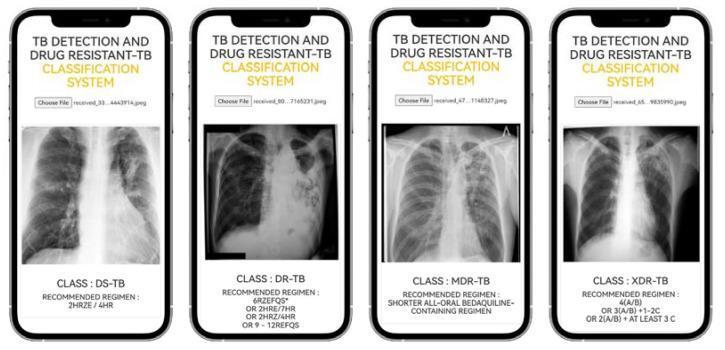
This infographic showcases the user interface of the TB-DRC-DSS, a web-based decision support system for tuberculosis (TB) detection and drug resistance classification, displayed across four mobile device frames. Each screen follows a consistent layout: a header titled 'TB DETECTION AND DRUG RESISTANT-TB CLASSIFICATION SYSTEM', an image upload button, a central posterior-anterior (PA) chest X-ray (CXR), and a diagnostic results section at the bottom. The visual demonstrates four distinct clinical categories: Drug-Susceptible TB (DS-TB), Drug-Resistant TB (DR-TB), Multidrug-Resistant TB (MDR-TB), and Extensively Drug-Resistant TB (XDR-TB). Each X-ray displays varying pulmonary pathologies, including consolidations, cavitary lesions, and diffuse opacities. Below each radiographic image, the system provides a specific 'CLASS' label and a 'RECOMMENDED REGIMEN' according to established treatment protocols (e.g., 2HRZE/4HR for DS-TB or Bedaquiline-containing regimens for MDR-TB). The tool is designed for pulmonologists and TB specialists to integrate diagnostic imaging with pharmaceutical decision-making at the point of care.
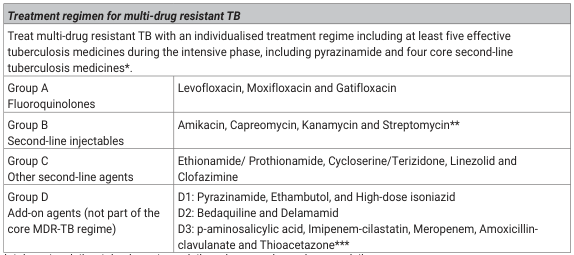
Treatment regimen for multi-drug resistant TB <table><thead><tr><th colspan="2">Treatment regimen for multi-drug resistant TB</th></tr><tr><td colspan="2">Treat multi-drug resistant TB with an individualised treatment regime including at least five effective tuberculosis medicines during the intensive phase, including pyrazinamide and four core second-line tuberculosis medicines*.</td></tr></thead><tbody><tr><td>Group A<br>Fluoroquinolones</td><td>Levofloxacin, Moxifloxacin and Gatifloxacin</td></tr><tr><td>Group B<br>Second-line injectables</td><td>Amikacin, Capreomycin, Kanamycin and Streptomycin**</td></tr><tr><td>Group C<br>Other second-line agents</td><td>Ethionamide/ Prothionamide, Cycloserine/Terizidone, Linezolid and Clofazimine</td></tr><tr><td>Group D<br>Add-on agents (not part of the core MDR-TB regime)</td><td>D1: Pyrazinamide, Ethambutol, and High-dose isoniazid<br>D2: Bedaquiline and Delamanid<br>D3: p-aminosalicylic acid, Imipenem-cilastatin, Meropenem, Amoxicillin-clavulanate and Thioacetazone***</td></tr></tbody></table>
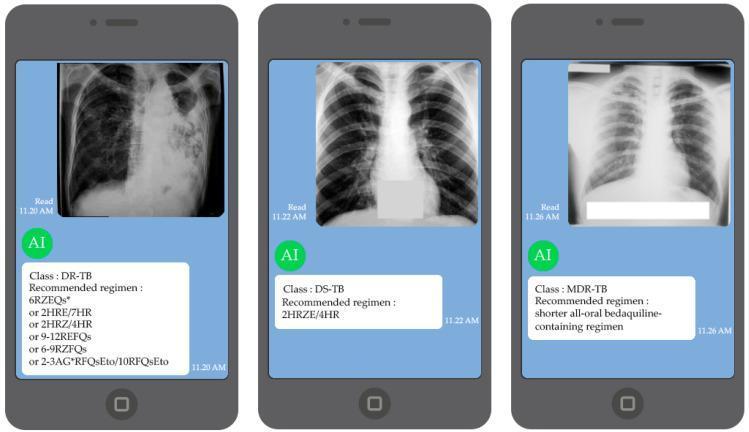
This infographic depicts a mobile-based diagnostic support system for tuberculosis (TB) management, presenting three separate smartphone interface frames. Each frame features a posterior-anterior (PA) chest X-ray (CXR) with AI-generated classifications and treatment regimens. The first image shows significant opacification and consolidation in the upper lung fields, classified as Drug-Resistant TB (DR-TB), with complex multidrug regimens listed. The second image displays relatively clear lung fields with normal vascular markings, classified as Drug-Susceptible TB (DS-TB), suggesting early-stage disease or a normal baseline, paired with a standard '2HRZE/4HR' regimen. The third image illustrates mild interstitial markings and apical opacities, classified as Multi-Drug Resistant TB (MDR-TB), recommending a shorter all-oral bedaquiline-containing regimen. This visual demonstrates the clinical application of deep learning algorithms in identifying TB drug-response phenotypes (DS, DR, MDR) and providing automated therapeutic guidance based on WHO protocols for infectious disease specialists and healthcare providers.
MDR-TB and XDR-TB: A Comprehensive Overview
Definitions
| Term | Definition |
|---|---|
| MDR-TB | M. tuberculosis resistant to at least isoniazid (INH) AND rifampicin (RIF) - the two most potent first-line drugs |
| Pre-XDR-TB | MDR-TB + additional resistance to either a fluoroquinolone OR a second-line injectable (amikacin, kanamycin, capreomycin) - but not both |
| XDR-TB | MDR-TB + resistance to a fluoroquinolone AND at least one second-line injectable agent (amikacin, kanamycin, capreomycin, or streptomycin) |
Updated 2021 WHO Definition: XDR-TB now also includes MDR-TB with resistance to fluoroquinolones AND bedaquiline/linezolid, reflecting their central role in modern regimens.
-
Approximately 20% of M. tuberculosis isolates globally meet the MDR-TB definition
-
Conversion rates approach 50% in exposed individuals - MDR-TB strains are highly infectious
-
XDR-TB carries significantly poorer outcomes and higher mortality, found in New York, California, Italy, Iran, India, and former Soviet states
-
Tintinalli's Emergency Medicine, p. 1004-1006
-
Goldman-Cecil Medicine, p. 3167-3168
Pathogenesis of Resistance
- Inadequate drug regimens (monotherapy or suboptimal combinations)
- Poor adherence / incomplete courses
- Subtherapeutic drug levels
Risk Factors for Suspecting Drug-Resistant TB
-
Prior TB treatment (especially incomplete or non-standard)
-
Not receiving directly observed therapy (DOT)
-
Close contact with known MDR-TB patient
-
Origin from high-burden regions (former Soviet states, South Africa, India, China)
-
Known INH resistance in community >4%
-
Lack of culture conversion after 3-4 months of standard therapy
-
Progressing radiographic findings despite therapy
-
Murray & Nadel's Respiratory Medicine, p. 2535-2556
Diagnosis
- GeneXpert MTB/RIF - detects M. tuberculosis AND RIF resistance simultaneously; results in ~2 hours
- CDC Molecular Detection of Drug Resistance Service - detects mutations for INH, RIF, and second-line drugs
- Culture-based drug susceptibility testing (DST) - gold standard
- Whenever RIF resistance is identified, full second-line DST should be requested
- Fluoroquinolone susceptibility must be evaluated whenever INH resistance is found
Treatment of MDR-TB
WHO Drug Grouping for MDR/RR-TB
| Group | Drugs | Principle |
|---|---|---|
| A (all three required) | Levofloxacin OR moxifloxacin, Bedaquiline, Linezolid | Include all 3 unless contraindicated |
| B (add both if possible) | Clofazimine, Cycloserine or terizidone | Add both unless contraindicated |
| C (fill regimen to ≥4-5 drugs) | Ethambutol, Delamanid, Pyrazinamide, Meropenem + amoxicillin-clavulanate, Amikacin, Ethionamide/prothionamide | Use when Group A/B agents cannot be used |
- Goodman & Gilman's Pharmacological Basis of Therapeutics, Table 65-6
Standard Long Regimen (MDR-TB)
- 4-5 active drugs during an intensive phase, then 4 active drugs in continuation phase
- Total treatment: 18-20 months (after culture conversion)
- Under expert guidance with monthly sputum cultures to monitor response
WHO Short-Course Regimen (9-12 months)
-
Eligibility: fluoroquinolone-susceptible, no prior second-line drug exposure
-
Drugs: Bedaquiline + fluoroquinolone + clofazimine + pyrazinamide + ethambutol + high-dose INH + ethionamide
-
Excludes: pregnancy, disseminated TB, treatment intolerance
-
Goldman-Cecil Medicine, p. 3166-3167
Treatment of XDR-TB: BPaL Regimen
| Drug | Dose | Duration |
|---|---|---|
| Bedaquiline (B) | 400 mg daily x 2 weeks, then 200 mg 3x/week | 26 weeks |
| Pretomanid (Pa) | 200 mg daily | 26 weeks |
| Linezolid (L) | 1200 mg daily (reduce to 600 mg for toxicity, 300 mg for myelosuppression/neuropathy/optic neuropathy) | 26 weeks |
- Outcome: BPaL achieved 90% favorable outcomes in XDR-TB or complicated MDR-TB (Nix-TB trial)
- Total duration: ~6 months - dramatically shorter than historical 18-24 month regimens
- FDA-approved: Pretomanid for XDR-TB in combination with bedaquiline and linezolid
- Murray & Nadel's, p. 3433-3437; Goldman-Cecil, p. 3168; Katzung, p. 3215-3221
Mechanisms of Key Drugs
| Drug | Mechanism |
|---|---|
| Levofloxacin / Moxifloxacin | Inhibit bacterial DNA gyrase (topoisomerase II/IV) - bactericidal, concentration-dependent killing |
| Bedaquiline | Inhibits mycobacterial ATP synthase - active against both replicating AND dormant bacilli |
| Linezolid | Inhibits bacterial protein synthesis (binds 23S rRNA of 50S subunit) |
| Pretomanid | Bicyclic nitroimidazole - generates reactive nitrogen intermediates (active against anaerobic bacilli); also inhibits mycolic acid synthesis |
| Delamanid | Dihydro-nitroimidazooxazole - inhibits mycolic acid synthesis; licensed by EMA for MDR-TB |
| Clofazimine | Binds mycobacterial DNA, generates reactive oxygen species |
| Cycloserine | Inhibits D-alanine racemase/ligase - blocks cell wall peptidoglycan synthesis |
Key Treatment Principles
- Never add a single new drug to a failing regimen - this selects resistance to that drug; always change multiple drugs simultaneously
- Only use drugs with documented/likely susceptibility - never add drugs with known resistance
- Expert consultation is mandatory for all drug-resistant TB cases
- Monitor monthly sputum cultures - if cultures remain positive at 3 months, repeat susceptibility testing
- Surgery: partial resection can be considered for localized pulmonary MDR-TB refractory to medical therapy in selected patients
- Success rates for MDR-TB with conventional regimens rarely exceed 60%; BPaL has improved outcomes for XDR-TB dramatically
Special Situations
MDR-TB in HIV
- Use rifabutin (RFB) instead of rifampicin to reduce CYP3A4 interactions with antiretrovirals
- Dolutegravir 50 mg twice daily is compatible with rifampicin
- Watch for IRIS (immune reconstitution inflammatory syndrome) - treat severe cases with prednisone 1.25 mg/kg/day for 2-4 weeks, then taper
MDR-TB in Pregnancy
- Avoid aminoglycosides (ototoxicity to fetus)
- Bedaquiline and linezolid: limited data; risk-benefit discussion required
- BPaL regimen: pregnancy is an exclusion criterion for short-course regimens
Children
- Lower sputum yield; diagnosis harder
- Risk of miliary TB, TB meningitis, and disseminated disease is higher
MDR-TB Drug Regimen Chart
Recent Evidence (2025-2026)
- A 2025 systematic review and meta-analysis (PMID 40172415) confirmed the efficacy and safety of bedaquiline + linezolid regimens for MDR-TB
- A 2026 systematic review (PMID 40986702) found isoniazid preventive treatment (IPT) is NOT effective for contacts of MDR-TB patients - reflecting the known limitation that MDR strains are INH-resistant
- A 2025 meta-analysis (PMID 39693627) in NEJM Evidence supported levofloxacin for preventive treatment in MDR-TB contacts
Summary: MDR vs XDR Quick Reference
| Feature | MDR-TB | XDR-TB |
|---|---|---|
| Resistance | INH + RIF | MDR + fluoroquinolone + injectable |
| Treatment duration | 9-20 months | 6 months with BPaL |
| Core drugs | FQ + Bedaquiline + Linezolid | Bedaquiline + Pretomanid + Linezolid |
| Outcomes | Success ~60-70% with modern regimens | ~90% with BPaL (Nix-TB) |
| Mortality | Moderate | Historically high; improved with BPaL |