
What is fit's and it occur
A fit (also called a seizure) is a sudden, uncontrolled burst of electrical activity in the brain that temporarily disrupts normal brain function. It can cause changes in behavior, movements, feelings, and levels of consciousness.
Searching sources...
Reading File
Searching the Web
seizure fits types causes symptoms overview 2025
Finding Sources
Searching Images
seizure types brain classification diagram epilepsy
Reading File
Reading File
Loading Image
Here is a thorough, textbook-based explanation of fits (seizures):
Fits (Seizures) - What They Are and How They Occur
Definition
A fit, medically called a seizure, is a sudden, transient episode caused by abnormal, excessive, and synchronous electrical discharge of neurons in the brain. This disrupts normal brain function and can cause changes in consciousness, behavior, movement, sensation, or feelings.
The term "convulsion" refers specifically to involuntary, repetitive muscle contractions - but not all seizures cause convulsions. A seizure is the broader, preferred term.
- Adams and Victor's Principles of Neurology, 12th Edition: "A seizure represents the uncontrolled, abnormal electrical activity of the brain that may cause changes in the level of consciousness, behavior, memory, or feelings."
How a Fit/Seizure Occurs (Mechanism)
The brain normally has a delicate balance between excitation (firing of neurons) and inhibition (suppression of firing). A seizure occurs when this balance is disrupted:
- Excessive neuronal excitation - too many neurons fire at once
- Reduced inhibition - the brain's natural "brakes" (mainly the neurotransmitter GABA) fail
- Synchronous spread - the abnormal electrical discharge spreads to nearby or distant brain areas
The result is a sudden "electrical storm" in the brain. Depending on where it starts and how far it spreads, different symptoms appear.
Phases of a Seizure
| Phase | What Happens |
|---|---|
| Prodrome | Hours to days before: mood changes, irritability, depression, headache, disturbed sleep |
| Aura | Seconds before: unusual smell, taste, fear, visual changes, a rising feeling in the stomach - this is actually the very beginning of the seizure (a focal onset) |
| Ictal phase | The seizure itself: convulsions, loss of consciousness, staring, muscle jerking |
| Postictal phase | After: confusion, drowsiness, headache, muscle soreness, weakness (may last minutes to hours) |
Types of Seizures (ILAE Classification)
Seizures are classified based on where in the brain they start:
1. Focal (Partial) Seizures
Start in one specific area of the brain.
- Focal Aware (Simple Partial) - person remains conscious; may have jerking of one limb, abnormal sensations, déjà vu, or a rising feeling in the stomach
- Focal Impaired Awareness (Complex Partial) - consciousness is impaired; person may stare blankly, make repetitive movements (lip smacking, picking at clothes), and not remember the episode
- Focal to Bilateral Tonic-Clonic - starts focal, then spreads to involve both sides of the brain
2. Generalized Seizures
Involve both halves of the brain from the start.
| Type | Description |
|---|---|
| Tonic-Clonic (Grand Mal) | Sudden stiffening (tonic) followed by rhythmic jerking (clonic); loss of consciousness; may bite tongue, be incontinent |
| Absence (Petit Mal) | Brief staring spell, 5-30 seconds; person appears to "check out"; common in children |
| Myoclonic | Sudden, brief muscle jerks, often on waking |
| Tonic | Sudden muscle stiffening without jerking |
| Clonic | Rhythmic jerking movements only |
| Atonic (Drop attack) | Sudden loss of muscle tone; person drops to ground |
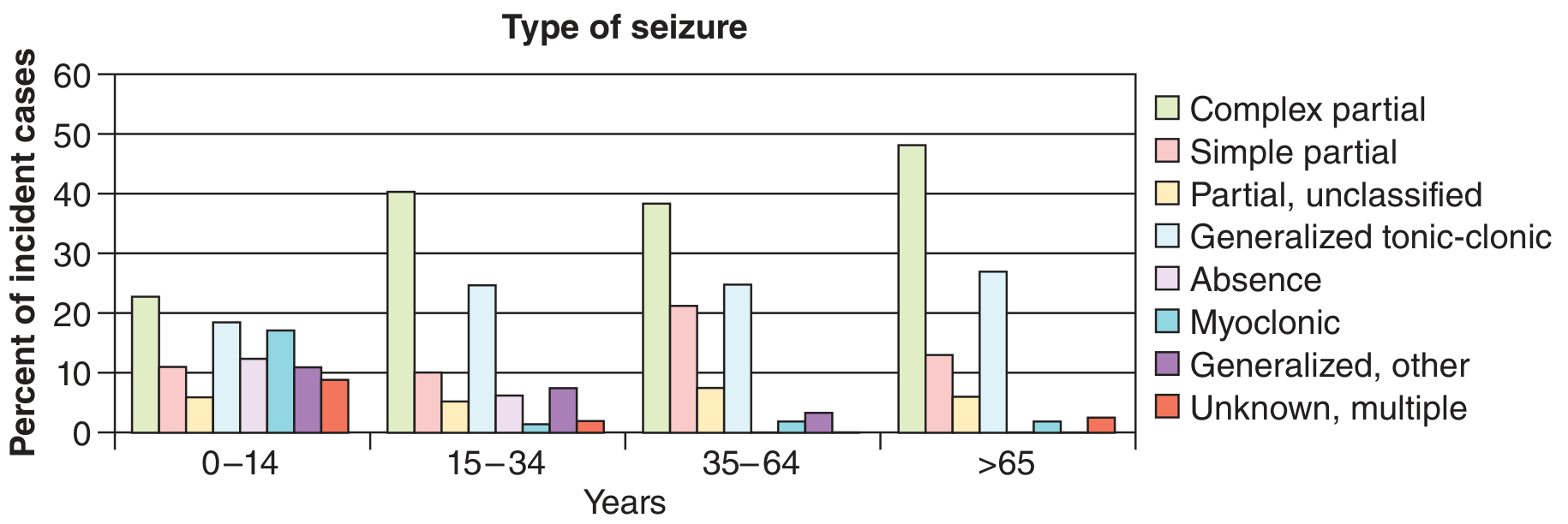
Age Distribution of Seizure Types
The chart below (from Adams and Victor's Neurology) shows how seizure types vary with age - absence and myoclonic seizures are more common in children, while complex partial (focal impaired awareness) seizures dominate in adults and the elderly:
Causes of Seizures
Seizures are divided into provoked (triggered by a temporary cause) and unprovoked (epilepsy).
Provoked (Non-Epileptic) Causes
- High fever - febrile seizures (very common in young children ages 6 months to 5 years)
- Low blood sugar (hypoglycemia)
- Low sodium, calcium, or magnesium
- Alcohol withdrawal or drug overdose
- Head injury or brain trauma
- Meningitis or encephalitis (brain infections)
- Stroke or lack of oxygen to the brain
- Eclampsia (in pregnancy)
- High blood pressure crisis
Unprovoked (Epilepsy) Causes
- Genetic/idiopathic - inherited tendency, no structural cause
- Structural - brain scar from old injury, stroke, tumor, cortical dysplasia, hippocampal sclerosis
- Metabolic - enzyme defects, mitochondrial disease
- Immune - autoimmune encephalitis (antibodies attacking the brain)
Epidemiology
- About 10% of people will have at least one seizure in their lifetime
- True epilepsy (recurrent, unprovoked seizures) affects roughly 1% of the population
- Approximately 2 million people in the US have epilepsy
- Incidence peaks in early childhood (especially the first year of life) and again after age 60
- Over two-thirds of all epileptic seizures begin in childhood
Status Epilepticus
A seizure lasting more than 5 minutes, or two or more seizures without full recovery between them, is called status epilepticus - a medical emergency requiring immediate treatment.
Key Points Summary
| Feature | Detail |
|---|---|
| Core mechanism | Abnormal synchronous electrical discharge in the brain |
| Main classification | Focal (one brain area) vs. Generalized (both hemispheres) |
| Most common adult type | Complex partial (focal impaired awareness) |
| Most common childhood type | Febrile seizures, absence seizures |
| Emergency form | Status epilepticus (seizure >5 min) |
If you or someone you know experiences a seizure, seek medical evaluation - especially after a first-ever seizure, to identify the cause and determine if treatment is needed.
This is a shared conversation. Sign in to Orris to start your own chat.