
How to examine document ctev case in orthopedic
Reading File
Now let me search the medical library for CTEV (Clubfoot) examination content.
Finding Sources
Finding Sources
Finding Sources
Finding Sources
Excellent results. Now let me read the most relevant sections - S Das Clinical Surgery (clinical examination focus) and Bailey & Love, plus Campbell's Operative Orthopaedics.
Reading File
Reading File
Reading File
Reading File
Reading File
Reading File
Finding Sources
Reading File
Finding Sources
Now let me fetch the clinical images and also read the Campbell's section on clubfoot clinical features:
Reading File
Loading Image
I now have comprehensive information from multiple authoritative orthopedic textbooks. Let me compile the full answer.
Examination of a CTEV (Congenital Talipes Equinovarus / Clubfoot) Case in Orthopedics
CTEV is a complex three-dimensional foot deformity combining four elements, remembered by the mnemonic CAVE: Cavus (high arch), Adduction of forefoot, Varus of hindfoot, Equinus of ankle. Here is a systematic approach to examining a CTEV case.
1. Definition and Deformity Components
CTEV consists of:
- Equinus - plantarflexion of the ankle (heel pointing down)
- Varus - inversion of the hindfoot (heel tilts inward)
- Adductus - forefoot adducted toward the midline
- Cavus - high medial arch (pronation of first ray)
The talonavicular joint is subluxed with the navicular displaced medially relative to the talar head.
2. History
- Age at presentation and whether treated previously
- Antenatal diagnosis (ultrasound)
- Family history (multifactorial inheritance)
- Birth history - associated conditions (spina bifida, arthrogryposis, amniotic band syndrome)
- Laterality (unilateral vs bilateral - 50% are bilateral)
- Sex (males twice as commonly affected)
- Any prior casting or surgery
3. General Observation (Before Touching)
Look at the child from a distance:
- Overall posture and gait (if walking age)
- Does the child walk on the outer border of the foot?
- Asymmetry of limbs
Look at the foot:
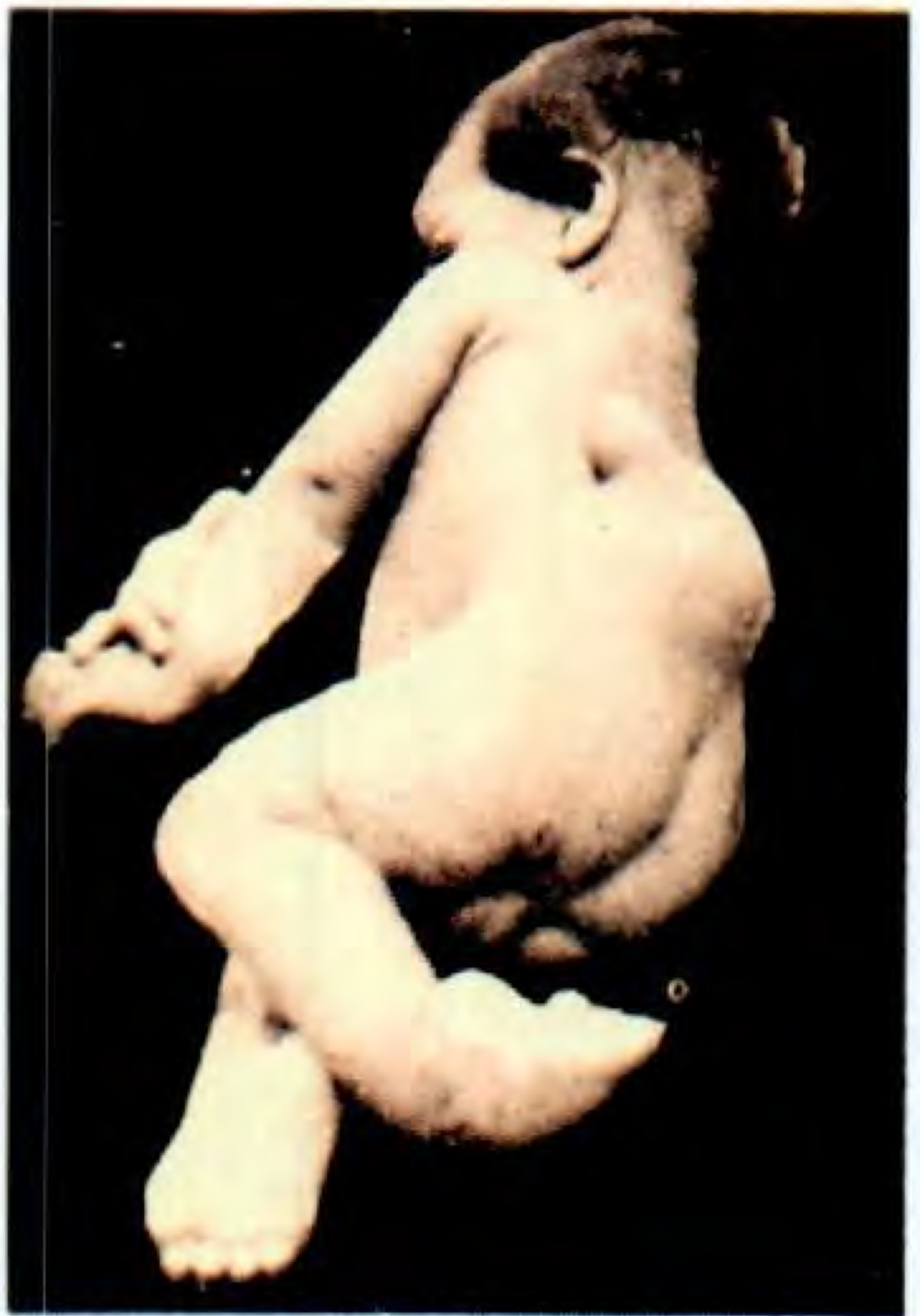
- The foot is plantarflexed, inverted, and adducted
- The sole faces medially/posteriorly (plantarflexion + inversion)
- There is a deep medial crease (from forefoot adduction) and a single deep posterior crease (from equinus)
- The lateral border of the foot is convex ("rocker-bottom" appearance in some)
- Small foot and calf - smaller foot size and calf hypoplasia compared to the opposite side
- The heel appears "empty" because the calcaneus is pulled up by the shortened tendo-Achilles
Distinguish from postural clubfoot:
- Postural clubfoot is flexible and corrects fully to neutral - by definition must normalize by 3 months
- True structural CTEV has fixed deformity that cannot be passively corrected to neutral
4. Inspection - Detailed
| Feature | Findings in CTEV |
|---|---|
| Foot posture | Plantarflexion + inversion + adduction |
| Medial crease | Deep medial skin crease (from adduction) |
| Posterior crease | Deep posterior crease (from equinus) |
| Heel | Empty, small, pulled upward |
| Calf | Hypoplastic, smaller than normal side |
| Skin | May have skin breakdown/calluses at lateral border if walking (neglected/older case) |
| Tibial shortening | May be apparent with growth |
5. Palpation
- Talar head - Palpate the head of talus on the dorsolateral aspect of the foot; it will be prominent laterally as the navicular is displaced medially off it
- Calcaneus - Small, in varus (inverted) and equinus position; the heel pad feels "empty" or underfilled
- Tendo-Achilles (TA) - Tight, prominent, shortened
- Tibialis posterior tendon - Tight on palpation
- Navicular - Displaced medially; may not be ossified in infants
- Skin creases - Feel the depth of medial and posterior creases
- Calf bulk - Measure calf circumference bilaterally and compare
6. Assessment of Flexibility / Passive Movements
This is the most critical part - determines postural vs structural CTEV and guides treatment.
Method:
- Fix the lower leg with one hand to stabilize the tibia
- Hold the heel with the other hand (not the forefoot)
- Attempt to passively correct each component:
| Movement | How to Test | Finding in CTEV |
|---|---|---|
| Dorsiflexion (equinus) | Hold leg, dorsiflex foot at ankle | Limited - cannot reach neutral (0°) |
| Eversion (varus) | Hold heel, evert the calcaneus | Limited - resistance felt medially |
| Abduction (adductus) | Hold heel with lower leg, abduct forefoot at midtarsal joint | Limited |
| Cavus | Assess plantar arch height | Fixed high arch |
- In postural clubfoot: all movements are correctable to normal
- In true CTEV: movements cannot be fully corrected passively
Simmons test / Heel bisector line:
- Normally the heel bisector line passes through the 2nd web space
- In CTEV it passes laterally (through 4th or 5th toe)
7. Severity Scoring Systems
Pirani Score (most widely used for Ponseti treatment)
Six clinical signs, each scored 0 (normal), 0.5 (moderate), or 1 (severe) - total 0-6:
Hindfoot score (3 signs):
- Posterior crease - depth and number
- Empty heel - degree of calcaneal elevation
- Rigid equinus - ability to dorsiflex
Midfoot score (3 signs):
4. Medial crease - depth
5. Talar head coverage - lateral prominence
6. Curvature of lateral border - convexity
Higher score = more severe, requires more casts
Dimeglio Classification (I-IV)
Based on reducibility of deformity in 4 planes - predicts casting difficulty. Both Pirani and Dimeglio must be assessed at maximal correction position (not at rest).
8. Neurological Examination
This is mandatory in every CTEV case:
- Muscle power - assess tibialis anterior, peroneals, gastrosoleus, toe extensors/flexors
- Sensation - check dermatomal distribution (L4/L5/S1)
- Reflexes - ankle jerk (S1), knee jerk (L3/L4)
- Weakness of evertor muscles (peroneals) is common even in idiopathic CTEV
Why important: CTEV may be secondary to:
- Spina bifida (myelomeningocele) - examine the spine for sacral dimple, hairy patch, midline defect
- Arthrogryposis - multiple joint contractures
- Poliomyelitis - asymmetric muscle weakness
9. Examination of Knee, Hip, and Spine
Always examine proximally:
- Spine - inspect for spinal dysraphism (hairy tuft, dimple, gibbus)
- Hip - DDH may co-exist; test Barlow/Ortolani in neonates
- Knee - assess for genu valgum, tibial torsion
- Leg length - tibial shortening may develop with growth
10. Radiological Assessment
Standard X-rays have limited value in infants due to unossified cartilage, but are used in older children and post-treatment:
| View | Finding in CTEV |
|---|---|
| AP (weight-bearing) | Talocalcaneal (Kite) angle < 20° (normal 20-40°); talus-1st metatarsal angle is negative (normal 0-20°); parallelism of calcaneus and talus |
| Lateral (Turco / dorsiflexion stress) | Talocalcaneal angle < 35° on dorsiflexion lateral view |
Key radiological sign: Parallelism of talus and calcaneus (normally they diverge). In CTEV both bones are parallel and pointing in the same direction.
11. Summary of Clinical Signs at a Glance
| Sign | Description |
|---|---|
| CAVE deformity | Cavus, Adductus, Varus, Equinus |
| Deep medial crease | From forefoot adduction |
| Deep posterior crease | From hindfoot equinus |
| Empty heel | Calcaneus pulled up |
| Calf hypoplasia | Smaller calf on affected side |
| Prominent talar head | Lateral prominence, navicular displaced medially |
| Rigid, non-correctable | Cannot passively reach neutral |
| Pirani score | 0-6 scale for severity |
Sources
- Bailey and Love's Short Practice of Surgery, 28th Edition, p. 647
- S Das - A Manual on Clinical Surgery, 13th Edition, p. 325
- Miller's Review of Orthopaedics, 9th Edition
- Campbell's Operative Orthopaedics, 15th Ed 2026
This is a shared conversation. Sign in to Orris to start your own chat.