
Normal tension glaucoma
I'll start by reading the medical library skill, then search for comprehensive information on normal tension glaucoma.
Reading File
Now let me run parallel searches across the medical library and PubMed simultaneously.
Finding Sources
Finding Sources
Searching PubMed
"normal tension glaucoma" pathophysiology management
Excellent - found a dedicated section in Kanski's. Let me read both the Kanski block and the Wills Eye Manual section in parallel.
Reading File
Reading File
The Kanski block was truncated. Let me read the rest of it (treatment, prognosis) and also check the Robbins pathology entry.
Reading File
Reading File
I now have rich content from Kanski's, Wills Eye Manual, and Robbins. Let me also fetch the key optic disc image and read the earlier Kanski section on differential diagnosis / investigations.
Reading File
Loading Image
I now have comprehensive information from multiple authoritative sources. Let me compile the full answer.
Normal Tension Glaucoma (NTG)
Definition
Normal tension glaucoma (NTG) - also called low-tension glaucoma or normal-pressure glaucoma - is a form of primary open-angle glaucoma (POAG) in which characteristic optic nerve damage and visual field loss occur despite intraocular pressure (IOP) consistently at or below 21 mmHg. It is defined by:
- IOP consistently ≤ 21 mmHg on diurnal testing
- Open anterior chamber angle on gonioscopy
- Characteristic glaucomatous optic nerve cupping
- Visual field defects consistent with nerve appearance
- No features of secondary glaucoma or a non-glaucomatous cause
Depending on ethnic background, 30-65% of all open-angle glaucoma patients may have IOP within the normal range at initial assessment. NTG is especially prevalent in Japanese patients.
- Kanski's Clinical Ophthalmology, 10th ed., p. 386
Pathogenesis
The mechanisms underlying NTG are multifactorial and not fully resolved. While IOP still plays a role, IOP-independent mechanisms are relatively more important than in POAG:
| Mechanism | Details |
|---|---|
| Vascular dysregulation | Vasospasm, nocturnal hypotension, loss of autoregulation; associated with migraine and Raynaud phenomenon |
| Reduced ocular perfusion pressure | Relatively lower than in POAG |
| Lamina cribrosa | Larger translaminar pressure gradient; structural vulnerability may predispose to damage at normal IOP |
| Low CCT | Thin corneas cause IOP underestimation; corneas are thinner in NTG than POAG |
| Accelerated apoptosis | Retinal ganglion cell loss via non-mechanical pathways |
| Autoimmune factors | Higher autoantibody levels in some NTG groups |
| Nocturnal IOP spikes | A small proportion have marked nocturnal IOP elevation detectable only in the supine position |
From Robbins: "...visual field and optic nerve changes typical of glaucoma develop with normal intraocular pressure...there is a spectrum of neuronal susceptibility to the effects of elevated intraocular pressure."
- Robbins Pathologic Basis of Disease, p. 1223
Risk Factors
- Age - tends to be older than POAG patients (may reflect delayed diagnosis)
- Sex - higher prevalence in females in some studies
- Race - significantly more common in Japanese individuals
- Family history - OPTN gene (optineurin) mutations identified in some NTG cases
- Low CCT - thinner corneas than POAG
- Vascular conditions - migraine, Raynaud phenomenon, diabetes, carotid insufficiency, hypercoagulability
- Systemic hypotension - nocturnal BP dips >20% are particularly important; beta-blockers taken at bedtime may worsen this
- Obstructive sleep apnoea - impairs ocular perfusion
- Myopia - associated with glaucoma and progression
- Thyroid disease - may be more common
- Low serum retinol
- Autoantibodies
Clinical Features
Optic Nerve Head (distinctive features vs POAG):
- Optic nerve head tends to be larger on average
- Acquired optic disc pits and focal nerve fibre layer defects are more common
- Splinter haemorrhages on the disc margin are more frequent - they are associated with a greater likelihood of progression and are often missed without disc photography
- Peripapillary atrophic changes may be more prevalent
- Pallor disproportionate to cupping should raise suspicion of an alternative (non-glaucomatous) diagnosis
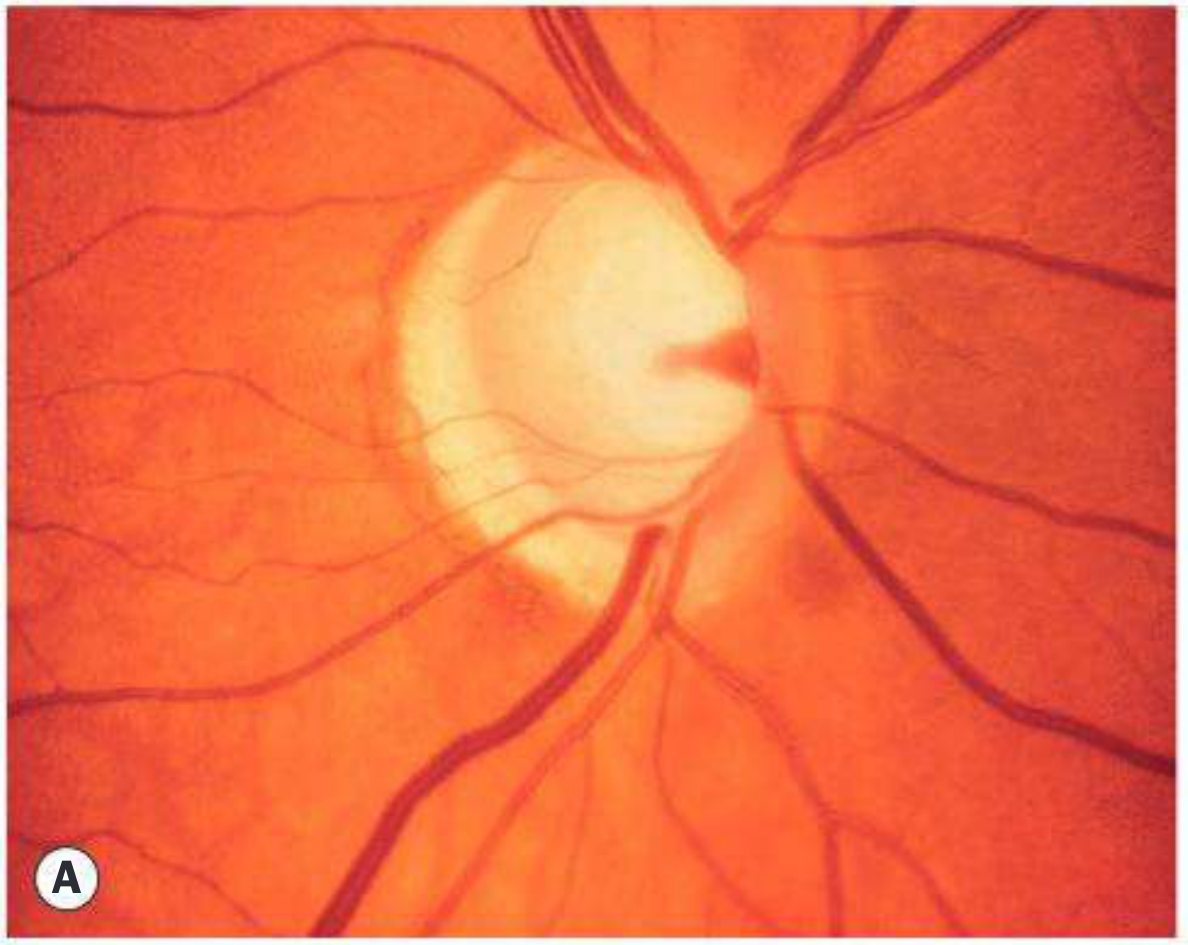
Visual Field Defects:
-
Denser, more localised, and closer to fixation than in POAG
-
A dense nasal paracentral defect is typical
-
Same pattern types as POAG (arcuate, etc.) but with above features
-
Wills Eye Manual, p. 561
Differential Diagnosis
Before accepting an NTG diagnosis, the following must be excluded:
- Angle closure - rule out by dark-room gonioscopy
- Low CCT causing spuriously low IOP readings (post-refractive surgery, corneal ectasia)
- POAG with wide diurnal IOP fluctuation - diurnal phasing required; nocturnal spikes require home monitoring or in-patient assessment
- Previous masking by systemic beta-blockers started after glaucomatous damage
- Spontaneously resolved glaucoma (pigmentary, traumatic, steroid-induced)
- Shock-related optic neuropathy - from acute blood loss, MI, bypass surgery; visual loss should not progress
- Neurological compressive lesions - optic nerve/chiasmal compression (neuroimaging mandatory if visual fields suggest non-glaucomatous pattern, if colour vision is disturbed, or in young patients)
- AION (arteritic or non-arteritic) - may mimic NTG exactly; check ESR/CRP if GCA suspected
- Other optic neuropathies - inflammatory, infiltrative, drug-induced (e.g., ethambutol), Leber hereditary optic neuropathy, dominant optic atrophy
Workup
History:
- Vasospasm (migraine, Raynaud), hypotensive episodes (surgery, haemorrhage), prior steroid use, ocular trauma/uveitis, GCA symptoms, cardiovascular risk factors
Investigations:
- Repeat IOP - diurnal curve (phasing); consider supine IOP
- Gonioscopy - rule out angle closure, angle recession, PAS
- Visual fields (perimetry at 6-monthly intervals initially)
- OCT - RNFL thinning (thinner in NTG)
- Colour plates (Ishihara/HRR) - rule out optic neuropathy
- Blood pressure monitoring - 24-hour ambulatory BP; look for nocturnal dipping
- Carotid Dopplers - assess ocular blood flow
- CT or MRI - to exclude compressive lesions, especially if visual acuity reduced, colour vision affected, or fields suggest non-glaucomatous pattern
- FBC, ESR, CRP (if GCA or inflammatory cause suspected)
- Lipid profile, glucose, thrombophilia screen if vascular risk suspected
Treatment
The Collaborative Normal Tension Glaucoma Study (CNTGS)
The landmark CNTGS established that IOP lowering by at least 30% reduced the 5-year risk of visual field progression from 35% to 12% in untreated patients. However, approximately 50% of untreated patients do not deteriorate at 5-7 years, so treatment should be targeted at those at highest risk.
Indications to treat:
- Demonstrated progression on serial perimetry
- Advanced glaucomatous damage, especially if central vision is threatened
- Long life expectancy
- Disc haemorrhages (marker of higher progression risk)
Medical Treatment
| Agent | Notes |
|---|---|
| Prostaglandin analogues (latanoprost, bimatoprost) | First-line IOP-lowering agents |
| Brimonidine | IOP lowering + potential neuroprotective effect; preferred over beta-blockers in NTG |
| Beta-blockers | Use with caution - systemic absorption can worsen nocturnal BP dip; if used, betaxolol is preferred (cardioselective) |
| Selective laser trabeculoplasty (SLT) | Reasonable initial option |
Surgical Treatment
- Consider if progression occurs despite IOP in the low teens
- Trabeculectomy with antimetabolite (MMC or 5-FU) is usually required to achieve sufficiently low target pressure
Non-IOP-Directed Measures
- Systemic vascular control - optimise management of diabetes, hypertension, hyperlipidaemia
- Nocturnal BP dips - reduce antihypertensive dose (especially bedtime dosing); consider increased salt intake (in consultation with cardiologist)
- Calcium-channel blockers (e.g., nimodipine) - for vasospasm; advocated by some authorities
- Head-up sleeping position (30°) - mean IOP is ~20% lower than flat position; beneficial in at least one-third of patients
- Regular exercise - encouraged
- Avoid head-stand yoga - transiently raises IOP
- Ginkgo biloba (40 mg TID) - may confer some benefit in selected cases
- Neuroprotection - no agent of proven benefit yet; memantine showed no benefit in clinical trials
Prognosis & Progression
- Approximately 50% of untreated patients remain stable at 5-7 years
- Progression is more likely with: disc haemorrhages, female sex, lower IOP at baseline (paradoxically), migraine, myopia, and nocturnal hypotension
- The EMGT confirms low blood pressure as an independent risk factor for progression
- Splinter haemorrhages are the strongest clinical marker of ongoing progression
Recent Evidence (PubMed, 2025)
- A 2025 Cochrane systematic review (PMID 41370133) on prognostic factors in open-angle glaucoma progression confirms that low perfusion pressure, disc haemorrhages, and thin RNFL are the strongest predictors of progression.
- A 2025 meta-analysis (PMID 40340860) found that microinvasive glaucoma surgery (MIGS), alone or combined with phacoemulsification, is effective at achieving IOP reduction in NTG patients.
Sources:
- Kanski's Clinical Ophthalmology: A Systematic Approach, 10th ed., pp. 385-388
- Wills Eye Manual, Office and Emergency Room Diagnosis, pp. 561-562
- Robbins & Cotran Pathologic Basis of Disease, p. 1223
This is a shared conversation. Sign in to Orris to start your own chat.