
What is deep transverse
The term "deep transverse" can refer to several anatomical structures. Let me check the medical library for the most relevant ones.
Searching sources...
Reading File
"Deep transverse" most commonly refers to anatomical structures with that phrase in their name - the most well-known being the deep transverse perineal muscle and the deep transverse metacarpal ligament. Let me search the library for the full details.
Finding Sources
Good - I can see the main structures. Let me read the relevant sections for full details.
Reading File
Reading File
Reading File
I have comprehensive information. Let me also fetch the diagram image for the metacarpal ligaments.
Loading Image
"Deep transverse" refers to several distinct anatomical structures across the body. Here is a breakdown of the main ones:
1. Deep Transverse Metacarpal Ligaments (Hand)
These are three thick bands of connective tissue that connect the palmar (volar) ligaments of the metacarpophalangeal (MCP) joints of the four fingers to each other - linking the heads of metacarpals 2-5.
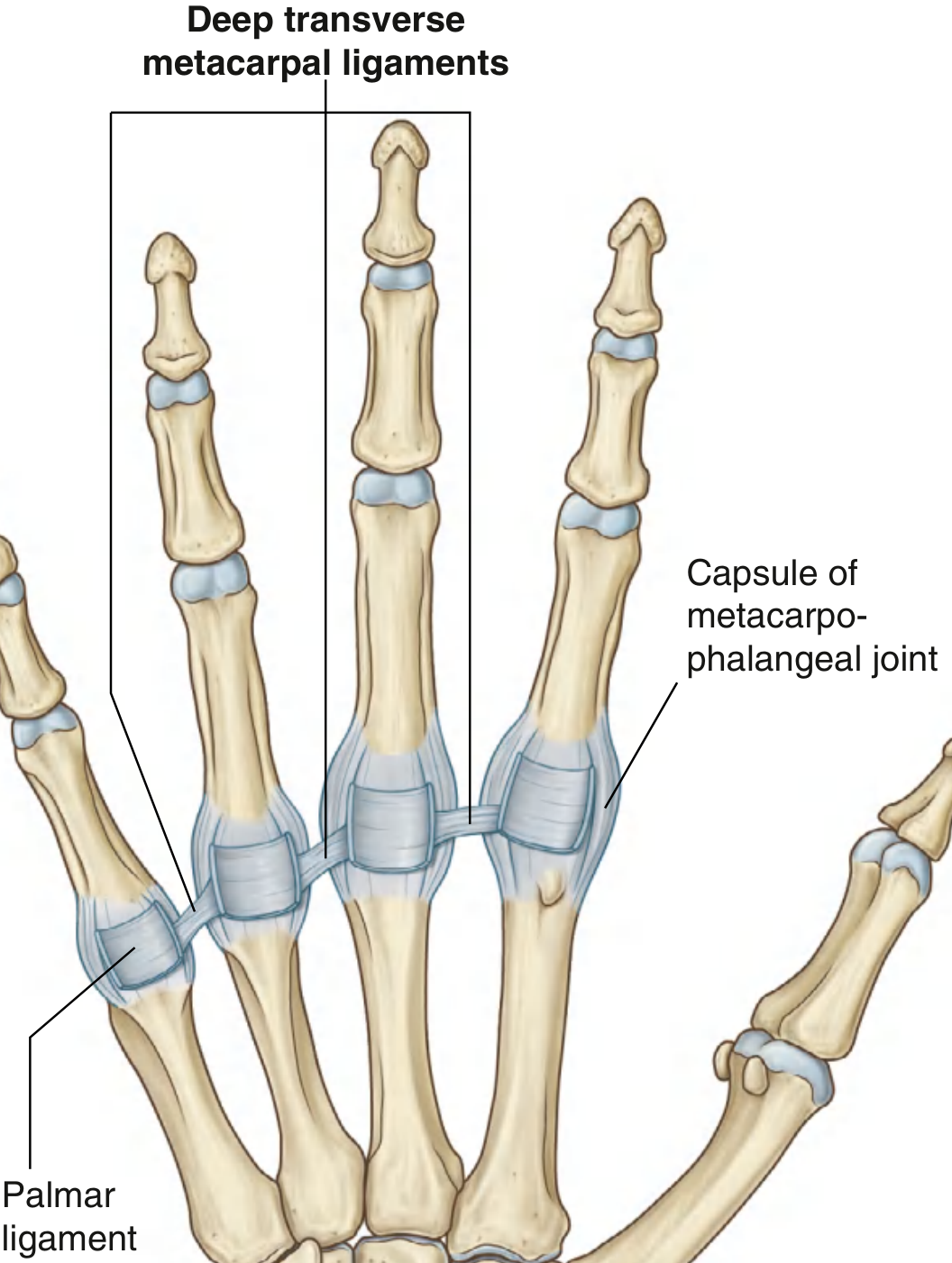
Key features:
- They restrict independent movement of the metacarpal heads relative to each other
- They help form a unified skeletal framework for the palm
- Notably, there is no deep transverse metacarpal ligament between the thumb (metacarpal I) and the index finger - this absence, combined with the saddle joint at the carpometacarpal joint of the thumb, is what gives the thumb its greatly increased mobility compared to the fingers
- Gray's Anatomy for Students, p. 917
2. Deep Transverse Metatarsal Ligaments (Foot)
These are four ligaments in the foot that link the heads of metatarsals 1-5 together.
Key features:
- They enable the metatarsals to act as a single unified structure
- They blend with the plantar ligaments of the adjacent metatarsophalangeal joints
- Unlike in the hand, the great toe's metatarsal is connected to the second metatarsal by one of these ligaments - this is why the great toe has very restricted independent function (compared to the thumb)
- They help maintain the transverse arch of the foot near the metatarsal heads
- Gray's Anatomy for Students
3. Deep Transverse Perineal Muscle (Pelvis/Perineum)
This is a muscle located in the deep perineal pouch (urogenital triangle).
Location: Between the two layers of the urogenital diaphragm, deep to the superficial transverse perineal muscle.
In males:
- A distinct, identifiable muscle
- Located in the deep perineal space alongside the external urethral sphincter and bulbourethral glands
In females:
- Its existence is contested in anatomy - it becomes heavily permeated by connective tissue with aging and especially after vaginal deliveries
- In older/multiparous women, the deep perineal space is largely occupied by connective tissue rather than a discrete muscle
- THIEME Atlas of Anatomy: General Anatomy and Musculoskeletal System
Summary Table
| Structure | Location | Function |
|---|---|---|
| Deep transverse metacarpal ligaments | Palm of hand (MCP joints of fingers) | Links metacarpal heads; stabilizes the palm; restricts independent metacarpal movement |
| Deep transverse metatarsal ligaments | Sole of foot (MTP joints) | Links metatarsal heads; supports transverse arch; limits great toe independence |
| Deep transverse perineal muscle | Deep perineal pouch | Supports pelvic floor; contributes to urinary continence |
Could you let me know which context you are asking about (hand, foot, or pelvis)? I can go into more detail on any of these.
This is a shared conversation. Sign in to Orris to start your own chat.