
Types of epidemics from park
Reading File
Searching sources...
Finding Sources
Finding Sources
Park's Textbook is in the library. Let me read the epidemic section directly.
Reading File
Reading File
Now let me also look for the section specifically on "types of epidemics" (common source, propagated, etc.) which Park covers under epidemic investigation.
Finding Sources
Finding Sources
Found the dedicated section. Let me read it fully.
Reading File
Reading File
Now let me fetch the epidemic curve image and check for C. Slow epidemics content.
Finding Sources
Loading Image
Reading File
I now have all the content needed. Here is the complete, detailed answer directly from Park's Textbook:
Types of Epidemics - Park's Textbook of Preventive and Social Medicine
Park distinguishes three major types of epidemics:
A. Common-Source Epidemics
In these epidemics, cases arise from exposure to a single contaminated source. There are two sub-types:
(a) Single Exposure / "Point-Source" Epidemics
- Exposure to the disease agent is brief and essentially simultaneous
- All resultant cases develop within one incubation period of the disease
- Classic example: food poisoning outbreak
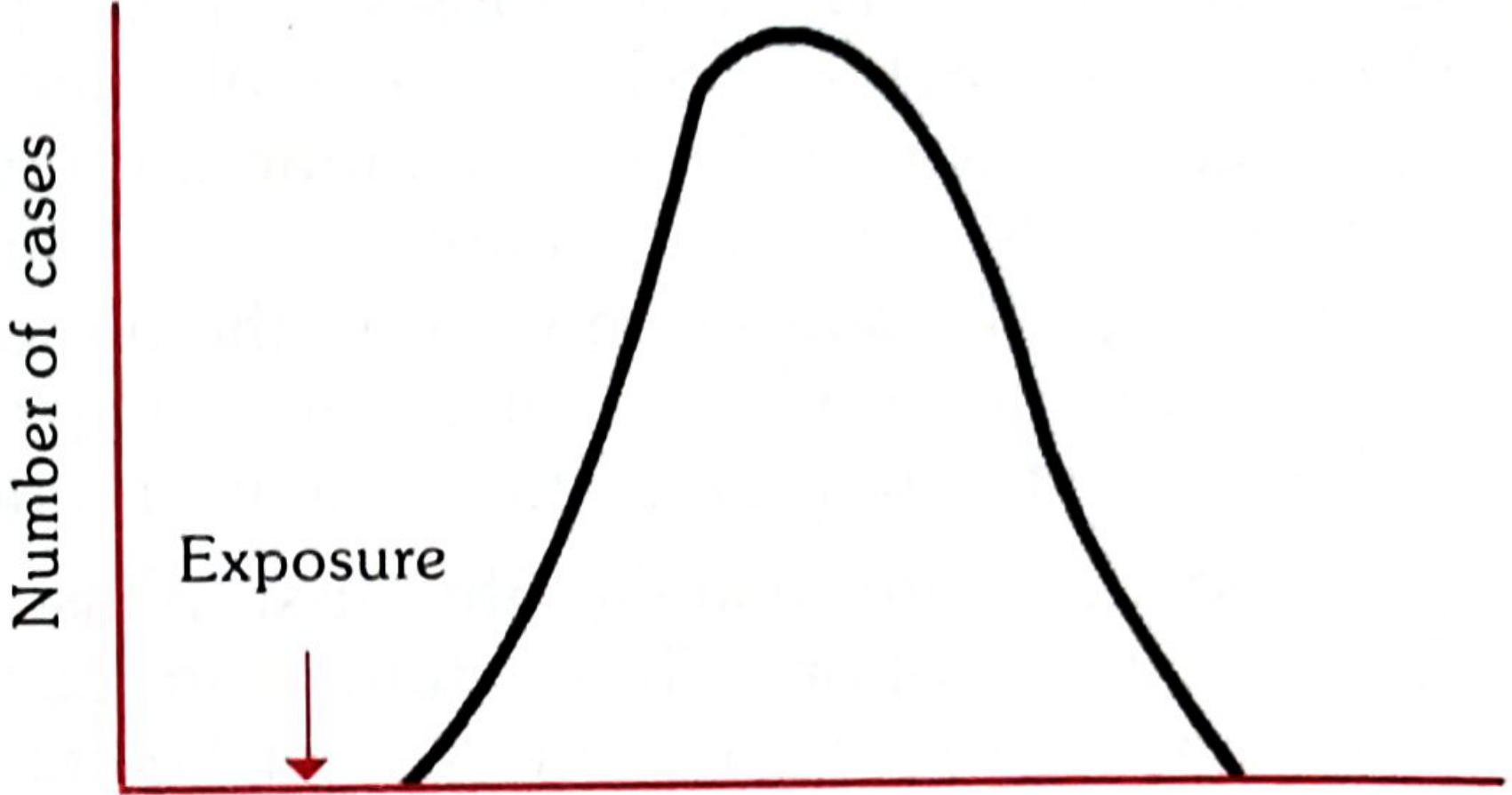
Features of the epidemic curve:
- Rises and falls rapidly, with no secondary waves
- Epidemic is explosive - cases cluster within a narrow time interval
- The "median incubation period" (time for 50% of cases to appear after exposure) can be calculated from the curve
Below is the classic point-source epidemic curve (Fig. 4 from Park):
Note: Common-source epidemics can result not only from infectious agents but also from environmental contamination by industrial chemicals (e.g., Bhopal gas tragedy, Minamata disease from mercury-contaminated fish).
(b) Common-Source, Continuous or Repeated Exposure Epidemics
- The exposure from the same source is prolonged, repeated, or intermittent
- No explosive rise; the epidemic is more extended or irregular
- Examples:
- A contaminated water well supplying a community over weeks
- A nationally distributed contaminated food or vaccine batch
- The Legionnaire's disease outbreak in Philadelphia, 1976 (continued beyond one incubation period, no secondary person-to-person cases)
A variation: an epidemic may begin as common-source and then continue as propagated - e.g., water-borne cholera reaches a sharp peak but tails off gradually.
B. Propagated Epidemics
- Most often of infectious origin, resulting from person-to-person (or vector/animal) transmission
- The epidemic shows a gradual rise and tails off over a much longer period
- Transmission continues until susceptibles are depleted or no longer exposed
- Speed of spread depends on: herd immunity, opportunities for contact, and secondary attack rate
- More likely where large numbers of susceptibles are aggregated, or where there is a regular supply of new susceptibles (newborns, immigrants) - lowering herd immunity
- Examples: hepatitis A, polio
Sub-types of propagated epidemics:
| Sub-type | Mechanism |
|---|---|
| (a) Person-to-person | Direct human transmission |
| (b) Arthropod vector | Via mosquito, tick, etc. |
| (c) Animal reservoir | From an animal source |
C. Slow (Modern) Epidemics
- These are epidemics of non-communicable, chronic diseases such as cancer, cardiovascular diseases, obesity, etc.
- Their existence is not easily recognized unless a comparison is made with previous experience (unlike the obvious onset of cholera or food poisoning outbreaks)
- They evolve slowly over years or decades
Related Terminology (from Park)
| Term | Meaning |
|---|---|
| Endemic | Constant presence of a disease in a given geographic area at usual/expected frequency |
| Hyperendemic | Constantly present at high incidence, affecting all age groups equally |
| Holoendemic | High infection beginning early in life (e.g., malaria) |
| Pandemic | Epidemic crossing international boundaries affecting a large number; e.g., influenza pandemics, cholera |
| Sporadic | Irregular, infrequent, geographically scattered cases; e.g., tetanus, herpes zoster |
| Exotic | Diseases imported into a country where they do not otherwise occur |
| Epizootic | Epidemic in an animal population; e.g., anthrax, rabies, brucellosis |
| Epornithic | Epidemic in a bird population |
| Enzootic | Endemic in animals |
Source: Park's Textbook of Preventive and Social Medicine, Chapter on Epidemiology - Types of Epidemics (pp. 76-77)
This is a shared conversation. Sign in to Orris to start your own chat.